
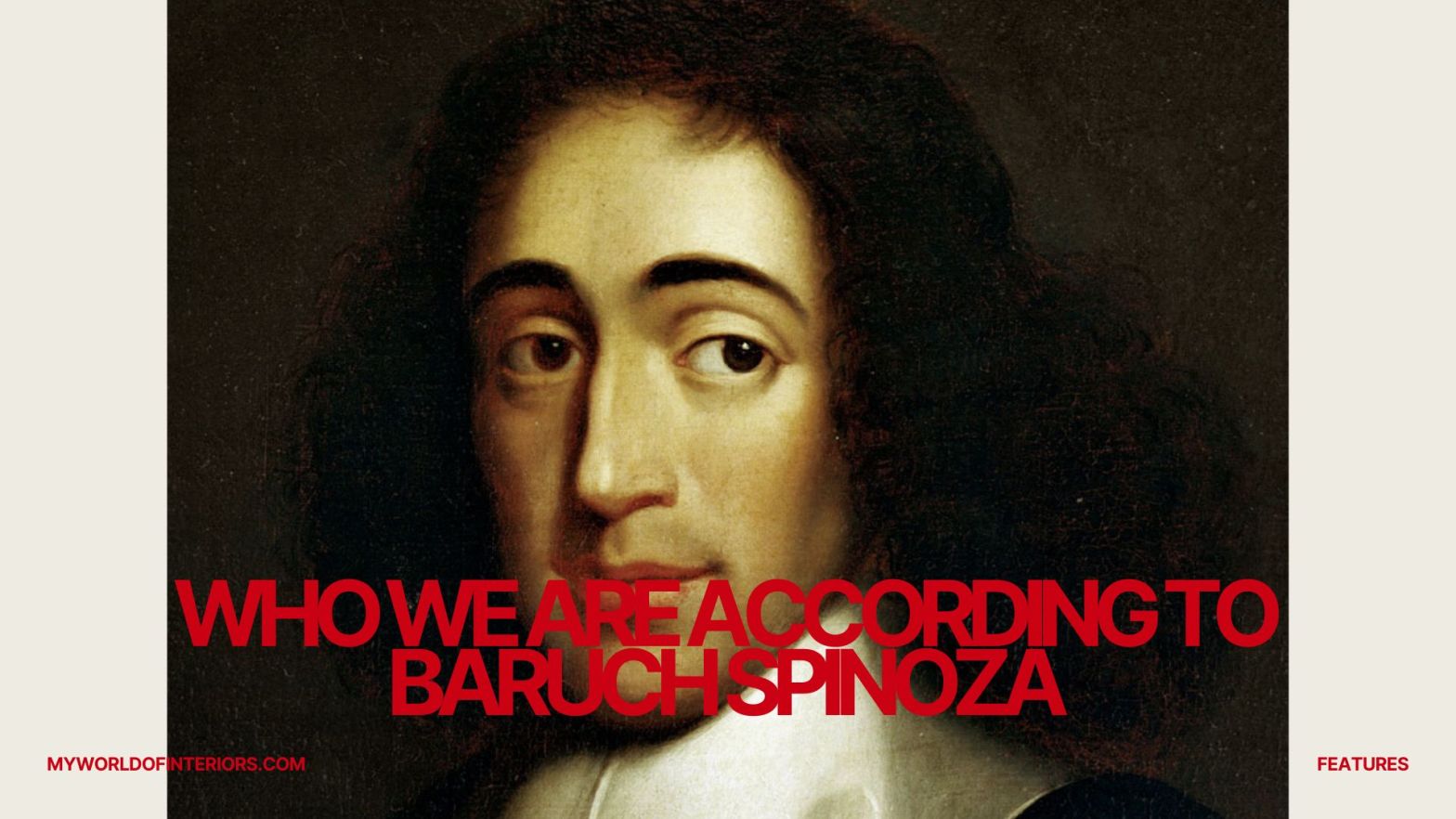
He was excommunicated at twenty-three by the Jewish community that raised him, in terms so severe that no record of the reason survives. He spent the rest of his life grinding lenses and thinking, alone, in a sequence of Dutch boarding houses. What he produced was the most complete and most radical philosophical system in the Western tradition — and a vision of what we are that makes everything the previous philosophers said about the self look like a conversation conducted in a very small room.
By Bergotte
There is a way of reading the three philosophers who precede Spinoza in this series — Kierkegaard, Beauvoir, Nietzsche — that reveals a shared assumption so fundamental that none of them quite names it. All three are asking what the self must do: choose genuinely, resist the structures that constrain the choosing, create the values that make the choosing meaningful. All three begin from the individual — the single, specific, irreducible human being standing before the question of what her life is for — and treat that individual as the primary unit of philosophical inquiry, the thing that must be understood before anything else can be understood.
Spinoza does not begin there. Spinoza begins with everything.
He begins, in the Ethics — the masterwork he spent most of his adult life writing and never published in his lifetime, knowing the publication would be the end of whatever remained of his social existence — with God. Not the personal God of the Jewish tradition in which he was raised, not the Christian God of the surrounding Dutch society, not a God who creates the world and intervenes in it and hears prayer and rewards the righteous. A God who is the world — who is, in the precise technical sense that Spinoza means and that requires patience to understand, identical with Nature, identical with everything that exists, the one infinite substance of which everything we encounter is a finite modification.
“God, or Nature” — Deus sive Natura — is the equation at the centre of the Ethics, and it is an equation that changes everything. If God is not a being above and outside the world, looking down on it and judging it, but is the world itself — the infinite, self-causing, eternal totality of everything that is — then the self is not the creature of a personal God who cares about it individually, who has a plan for it, who will eventually redeem its suffering with meaning. The self is a wave in the ocean. The ocean is God. The wave is real, has its specific shape and its specific motion and its specific duration, but the wave is not separate from the ocean, and the ocean is what is real in a sense that the wave, considered in isolation, simply is not.
This is the most vertiginous thought in the history of Western philosophy. It is also, properly understood, the most liberating.
The Excommunication and the Life
Baruch Spinoza was born in Amsterdam in 1632, into the Sephardic Jewish community that had fled the Inquisition in Portugal and Spain and reconstituted itself, with considerable success, in the relative tolerance of the Dutch Republic. His family were merchants; he was educated in the Jewish tradition, in Hebrew, in the Bible and the Talmud and the medieval Jewish philosophy that formed the intellectual backbone of the community. He was, by all accounts, a brilliant student — the kind of student whose teachers see in him the future of whatever tradition they represent.
In July 1656, the community issued against him the most severe form of excommunication available in Jewish law — the cherem — in terms of denunciation so extreme that they have few parallels in the history of the practice. The document speaks of “abominable heresies” and “monstrous deeds” without specifying what either consisted of. Spinoza was twenty-three. He was expelled from the community, forbidden contact with its members, and effectively erased from the social world that had formed him. He never returned, never reconciled, never recanted. He changed his name from Baruch to Benedict — the Latin equivalent, meaning blessed — and spent the remaining twenty-one years of his life outside the community, working as a lens grinder, corresponding with the leading scientists and philosophers of Europe, writing in Latin for an audience that would not exist until after his death.
He was offered a professorship at the University of Heidelberg and declined it, on the grounds that academic employment would constrain his freedom of thought. He lived simply, in rented rooms, earning enough from the lens grinding to cover his modest expenses and declining the patronage that was offered to him by people who recognised the magnitude of what he was doing. He died in 1677, at forty-four, of a lung disease — possibly tuberculosis, possibly aggravated by the glass dust from the grinding — leaving the Ethics unpublished and his other manuscripts to be published by his friends.
The lens grinding is not incidental. Spinoza spent his professional life making the instruments through which other people saw more clearly — grinding the glass to the precise curvature that would correct the distortions of ordinary vision and bring the world into focus. The Ethics is the same activity conducted at the level of the mind: the sustained, patient, technically demanding effort to correct the distortions of ordinary human perception and bring reality into focus. The instrument is different. The vocation is the same.
One Substance, Infinite Attributes
The Ethics is written in the manner of a geometrical proof — definitions, axioms, propositions, demonstrations, corollaries, notes — as though the truths it contains could be derived with the necessity of mathematical theorems from premises that no honest mind could deny. This formal apparatus has misled some readers into thinking the Ethics is cold, mechanical, inhuman. It is not. It is one of the most passionate philosophical documents ever written — passionate with the specific passion of someone who has seen something that changes everything and who is trying, with every formal tool available, to make the reader see it too.
The first thing it establishes — the thing on which everything else depends — is the claim that there is only one substance. Substance, in the technical philosophical vocabulary Spinoza inherits and transforms, is the thing that exists in itself and is conceived through itself — the thing whose existence does not depend on anything outside it, that requires nothing other than itself to be understood. The philosophical tradition before Spinoza had allowed for many substances: Descartes had two, mind and matter, and the relationship between them had produced the mind-body problem that philosophy has been failing to solve ever since. Spinoza argues, with a rigour that is genuinely compelling even when it is not quite conclusive, that there can be only one substance, because if there were two, each would require the other to explain why it was the kind of thing it was, and neither would be genuinely self-subsistent. One substance. Infinite, eternal, self-caused, self-sustaining. This is what Spinoza means by God, and this is what he means by Nature, and they are the same thing.
This one substance has infinite attributes — infinite ways of being what it is — of which human beings, in their finite cognitive situation, can perceive only two: thought and extension. Extension is what we call the physical world — matter, space, the bodies that occupy it. Thought is what we call the mental world — consciousness, ideas, the mind that perceives and thinks. These are not two separate substances, as Descartes had claimed. They are two attributes of the one substance — two ways of describing the same infinite reality, as different as the map and the territory but referring to the same thing.
Every particular thing — every human being, every stone, every idea, every emotion — is a mode of this one substance, a specific and finite modification of the infinite. The self is not a separate substance mysteriously connected to a body. It is a mode — a wave in the ocean, a particular configuration of the one substance’s infinite expression. It is real. It has its specific character, its specific duration, its specific place in the infinite network of causes and effects that constitutes the whole. But it is not, in the deepest sense, separate. Its separateness is a function of its finitude — of the fact that it is this particular modification rather than the infinite whole — and the perception of separateness, while practically useful, is, in Spinoza’s account, a kind of cognitive limitation rather than a final metaphysical truth.
Conatus: The Striving That Is You
Every finite mode — every particular thing, including every human being — strives to persist in its own being. This striving Spinoza calls conatus, and it is the most important concept in the Ethics for the question of who we are, because it is the concept that connects the vast metaphysical architecture of the one substance to the specific, lived experience of being a particular self in a particular world.
Conatus is not a desire, exactly — not a conscious choice to continue existing. It is the fundamental tendency of every existing thing to maintain and express its own nature, to resist dissolution, to continue being what it is for as long as its circumstances permit. It is, in Nietzsche’s vocabulary — and the connection is not coincidental; Nietzsche read Spinoza and was electrified by him — something like the will to power understood as the drive toward self-expression rather than domination. It is in every living thing, and it is what every living thing, in its own way and at its own scale, is fundamentally doing when it does anything at all.
In human beings, conatus is complicated by the fact that we are complex modes — modes that are composed of many parts, that exist in constant interaction with other modes, that have both bodies and minds, and whose striving therefore takes both physical and mental forms simultaneously. The human conatus is desire — the fundamental drive of the whole person, body and mind together, toward whatever she perceives as good, as conducive to her continued existence and her continued expression of her own nature. Everything we do, Spinoza argues, is an expression of this desire — every emotion, every choice, every relationship, every project is a specific form of the conatus, the striving expressing itself in the particular circumstances of the particular life.
This has a consequence that is, initially, startling: there is no freedom of will in the conventional sense. The human being does not stand above her desires and choose among them from a position of neutral detachment. She is her desires — her conatus is what she is, and her choices are the expression of the conatus in interaction with the world around her, determined by causes that extend backward through the infinite network of prior causes that is the one substance expressing itself. She cannot choose to want something other than what she wants, any more than a stone can choose to fall upward.
This sounds like the most thorough determinism imaginable — the complete elimination of freedom, the reduction of the human being to a node in a causal network. It is, in a sense, exactly that. And yet Spinoza’s account of human freedom — which follows from this determinism rather than contradicting it — is one of the most interesting and most psychologically rich in the philosophical tradition.
Freedom as Understanding
The freedom that Spinoza offers is not the freedom of the will — not the ability to choose otherwise than one does, to stand outside the causal network and make uncaused choices. That freedom, he thinks, is an illusion — a product of the fact that we know what we want without knowing the causes of our wanting, and mistake the ignorance of the cause for the absence of the cause. The stone does not know why it falls; if it did, it might think it was falling freely. The human being does not know all the causes of her desires; she therefore thinks she chooses them. She does not.
The freedom Spinoza offers in place of this illusion is the freedom of adequate understanding — the freedom of the person who knows what she is, knows the causes that have made her what she is, and can therefore act from the fullest expression of her own nature rather than being driven by forces she does not understand and therefore cannot engage with consciously. This is not a small thing. Most human beings, most of the time, are driven by what Spinoza calls inadequate ideas — partial, confused, affect-laden perceptions of themselves and the world that produce passive emotions — fear, hope, jealousy, hatred, the various forms of bondage to external things — rather than the active emotions that express the conatus in its fullest and most self-determined form.
The distinction between active and passive emotions is the key to Spinoza’s ethics and to his account of human freedom. A passive emotion is one in which we are acted upon by external things — in which the cause of the emotion is outside us and we are, in the precise sense, passive recipients of its effect. Fear is a passive emotion: something external threatens us and the fear is the response, produced by the external cause rather than by our own nature. Hope is a passive emotion: something external might benefit us and the hope is the response, dependent for its existence on the uncertain outcome of something we do not control. Hatred, jealousy, envy, wounded pride — all passive emotions, all products of the inadequate perception of our relationship to external things, all forms of bondage to what lies outside the self.
An active emotion is one that flows from the adequate understanding of our own nature — from the expression of the conatus in its fullest form. Joy — not pleasure in the narrow sensory sense, but the specific emotion of the increase of one’s power of acting, of the expansion of one’s capacity to be and to do — is the paradigmatic active emotion. Love, properly understood — not the possessive, anxious, dependency-producing emotion that ordinarily goes by that name, but the genuine affirmation of another’s existence and flourishing — is an active emotion. Intellectual understanding itself — the activity of the mind engaging adequately with the causes of things — is the most active emotion of all, because it is the activity in which the human conatus most fully expresses what it essentially is.
Sub Specie Aeternitatis: The View From Eternity
The phrase sub specie aeternitatis — under the aspect of eternity — is Spinoza’s description of the highest form of understanding available to a finite mind: the form in which things are seen not in their particularity and their temporal specificity but in their necessary connection to the whole, in the way that they appear when the limitations of the partial perspective are overcome as fully as a finite being can overcome them.
Most of the time, most human beings perceive things sub specie durationis — under the aspect of duration, in time, in the partial and temporary way of the being who is located in a specific time and a specific place and sees the world from that specific vantage point. This is not wrong — it is the appropriate perception for most practical purposes, the perception that allows us to navigate the daily world of causes and effects. But it is limited, in ways that produce the passive emotions and the confusion about freedom and the suffering that comes from the identification of the self with its temporal particularity rather than with its participation in the whole.
To see things sub specie aeternitatis is to see them as they are in the one substance — in their necessary, eternal, causally determined place in the infinite network of being. It is to see the self not as the isolated, temporal, mortal particular that the ordinary perspective presents, but as the finite expression of the infinite — as the wave that is genuinely the ocean, real in its specific shape and its specific motion but not separate from the medium in which it exists and which it expresses.
This is the knowledge that Spinoza calls the third kind — the highest form of understanding — and it is both a cognitive achievement and an emotional one. To genuinely understand that one is a finite mode of the infinite substance, that one’s existence is necessary in the sense that it follows from the nature of the whole, that the causes that have made one what one is are part of the same eternal network of causes that makes everything what it is — this understanding is, in Spinoza’s account, the source of the deepest and most stable form of joy available to a human being. Not the volatile, contingent joy of the person who has gotten what she wanted and fears losing it, but the deep, self-sustaining joy of the person who understands what she is and affirms it — who sees, in the necessity of her own existence, something that connects her to the necessity of everything.
He calls this intellectual love of God — amor intellectualis Dei — the mind’s love of the infinite of which it is a part, experienced through the act of understanding the infinite. It is not the love of a personal God who loves us back. It is the love that is identical with understanding — the joy of the mind fully engaged with the reality it is part of, fully expressing its own nature in the activity that is most essentially its own.
The Problem of the Other
Spinoza’s metaphysics creates what might seem like a difficulty for ethics: if everything is determined, if the human being is a mode of the one substance acting according to its own nature with the necessity of a mathematical theorem, what is the ground of obligation to others? What reason is there to care about the suffering of another mode if everything that happens, including that suffering, follows necessarily from the nature of the whole?
The answer Spinoza gives is not the answer one might expect from a rigorous determinist. It is, in certain respects, the most social and the most generous ethical position in the history of philosophy.
Human beings, he argues, are most fully themselves — most fully expressive of their own conatus, most fully active rather than passive, most fully free — when they are in genuine community with others. The isolated individual, pursuing her own advantage in competition with others, is not the most powerful human mode. She is, in Spinoza’s account, among the least powerful — because the power available to a community of people who understand each other and cooperate with each other is immeasurably greater than the power available to any individual alone, and because the emotions that social cooperation generates — the genuine love and genuine friendship that come from the recognition of shared nature — are among the most active and most strengthening emotions available to human beings.
This is not altruism in the conventional sense — it is not the sacrifice of self-interest for the interest of others. It is the recognition that the fullest expression of self-interest, properly understood, requires the flourishing of others — that the person who helps others flourish is thereby helping herself flourish, because human beings are the kind of modes whose nature is most fully expressed in community and cooperation rather than isolation and competition. The most useful thing to another human being, Spinoza writes, is another human being who lives by the guidance of reason.
The political implications follow: the state that allows its citizens the fullest possible exercise of reason and the fullest possible freedom of thought and expression is the state that most fully serves the genuine interest of all its citizens. Spinoza was one of the earliest and most rigorous advocates of freedom of thought and speech in the Western tradition — not because he thought all opinions were equally valid, but because he thought the suppression of thought produced exactly the kind of passive, affect-driven, inadequately understanding human beings who were most likely to be moved by the false appeals of tyrants and demagogues, and least likely to achieve the genuine understanding that was the condition of human freedom and human flourishing.
What the Wave Knows
Return to the ocean. The wave knows — in the partial, temporal, durational way that finite modes know things — that it is a wave, that it has a specific shape and a specific motion and a specific duration. It experiences, from within the specific perspective of being this wave rather than any other, the specific texture of its own existence: the way the water moves through it, the way the wind shapes it, the way it rises and falls and eventually breaks and disappears back into the ocean from which it was never, in any final sense, separate.
What the wave does not ordinarily know — what requires the specific cognitive effort that Spinoza spent his life describing and advocating — is that it is the ocean. Not metaphorically. Not as a comforting thought about the continuity of nature or the immortality of matter. Literally: the wave is a modification of the substance that is the ocean, and the ocean is a modification of the one substance that is everything, and the everything is God, or Nature, and it is eternal, and the wave’s participation in it is the wave’s participation in eternity.
This knowledge — which Spinoza believes is available to any human mind that applies itself with sufficient rigour and sufficient patience to the understanding of its own nature and the nature of the whole — does not make the wave less of a wave. It does not dissolve the specific particularity of the individual life, the specific joys and specific sufferings of the specific person. It recontextualises them — places them within a frame so large that the passive emotions, the fears and the hopes and the angers that depend on the outcome of specific contingent events, begin to lose some of their hold. Not because the events cease to matter, but because the understanding of their place in the whole changes the relationship to them.
This is what Spinoza means by blessedness — beatitudo — the state of the mind that has achieved the highest degree of understanding available to it and has found in that understanding a joy that is not contingent on external circumstances, that cannot be taken away by the fluctuations of fortune, that is the mind’s own possession because it is identical with the mind’s fullest expression of its own nature. It is not happiness in the ordinary sense — not the satisfaction of desire, not the accumulation of pleasant experiences. It is the specific joy of understanding: of the mind that has seen, as clearly as a finite mind can see, what it is and what everything is, and has found in the seeing not terror but love.
Why He Matters Now, and Why He Was Always Going to Matter
The three philosophers who precede Spinoza in this series are, in their different ways, philosophers of the crisis of the self — of the self threatened by the crowd, by structural power, by the collapse of inherited values. They are responding to conditions of fragmentation, of the loss of the frameworks that used to hold things together, of the terrifying freedom that results from the absence of foundations.
Spinoza does not respond to fragmentation. He denies that fragmentation is the ultimate truth. He says: look more carefully. The fragmentation is a product of the partial perspective — of seeing the wave without seeing the ocean, of seeing the particular without seeing the whole, of seeing the self in its isolation without seeing its necessary connection to everything that is. The partial perspective is real and it is practically necessary and it should not be simply abandoned. But it is not the final truth about what exists or what you are.
In a moment of profound disconnection — the disconnection of social atomisation, of the algorithmic dissolution of community into competitive individualism, of the environmental crisis that results from treating the natural world as an external resource rather than the substance of which we are a modification — Spinoza’s insistence that the separation is not final, that the self and the world are not genuinely other to each other, that the most adequate understanding of what we are is an understanding of our participation in the whole rather than our separation from it: this insistence has a quality of urgency that it did not have when it was first expressed.
He was not proposing a comfortable mysticism. He was not telling people to feel connected to the universe and thereby achieve peace. He was making a rigorous philosophical claim — that the substance of which we are modes is one, that our apparent separateness is a function of our finitude rather than an ultimate metaphysical fact, that the adequate understanding of this claim is the condition of the highest human freedom and the highest human joy. The rigour matters. The claim is not warm. It is true, or it is as close to true as a finite mind working in the seventeenth century with the tools available to it could get. And the implications of its being true are, for the question of who we are, more radical than any of the implications of the three philosophers who preceded it in this series.
We are not the isolated self that must choose. We are not the situated self that must resist. We are not the self that must create its own values in a valueless world. We are, if Spinoza is right, the specific, finite, temporary, real expression of the infinite substance that is everything — the wave that is the ocean, knowing and not knowing this, striving and not striving, free and not free, mortal and, in the only sense that matters, eternal.
The lens grinder in the Dutch boarding house, grinding glass to help other people see, knew this. He wrote it down in a form so rigorous and so demanding that it took two centuries for the world to be ready for it. We are still, in most respects, not ready. But the readiness is the work. The understanding is the freedom. And the freedom, when it comes, is not the freedom of the isolated will but the freedom of the wave that has recognised the ocean — the boundless, self-causing, eternal ocean that it has been, all along, all along.
The standard English translation of the Ethics is Edwin Curley’s, in The Collected Works of Spinoza (Princeton University Press), which is the most philosophically rigorous. For accessibility, Michael Silverthorne and Matthew Kisner’s translation (Cambridge Texts in the History of Philosophy) is excellent. Steven Nadler’s biography Spinoza: A Life is published by Cambridge University Press and is the definitive account. Nadler’s Spinoza’s Ethics: An Introduction, also Cambridge, is the most useful guide to the main work. For the broader context, Stuart Hampshire’s Spinoza is published by Penguin and remains one of the finest short introductions in the philosophical literature.
Discover more from My World of Interiors
Subscribe to get the latest posts sent to your email.

