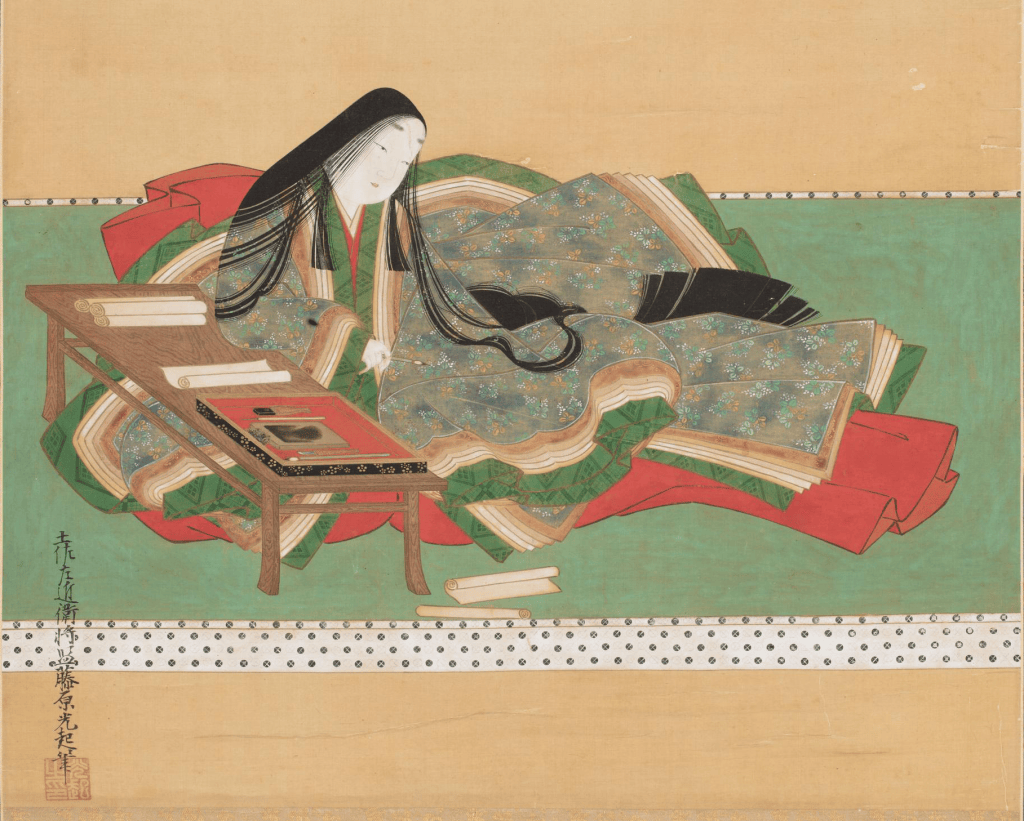
Sometime around the year 1000, a woman sitting in the imperial court of Heian Japan wrote the world’s first psychological novel. She did not know she was doing this. The category did not exist. She was writing about the emotional life of people she knew, about the way desire moved through a highly ritualised society and left damage in its wake, about the texture of grief and longing and the particular cruelty of beauty that passes. She wrote with a precision about interior states that European literature would not match for another seven centuries. Her name was Murasaki Shikibu — a courtesy name, her real name lost to history — and her book, The Tale of Genji, is among the handful of works in world literature that genuinely changed what literature understood itself to be capable of. To read it is to discover that the most fundamental questions about human existence — how we love, how we lose, how we carry the past inside the present, how beauty and suffering are finally inseparable — were being asked and answered, with extraordinary sophistication, in a world so distant from our own that its customs and its cosmology are almost entirely foreign. The distance makes the recognition more startling. We are, across a thousand years and the width of the world, the same.
The Court at the Edge of the World
The Heian period — roughly 794 to 1185 CE — was the golden age of classical Japanese culture, a civilisation centred on the imperial court at Kyoto that had developed, over several centuries of relative peace and deliberate aesthetic cultivation, a culture of extraordinary refinement. Poetry was the currency of social life: people communicated through verse, judged each other by the quality of their seasonal references, conducted entire love affairs in the exchange of poems left at dawn on a lover’s pillow. The appreciation of beauty — of the correct gradation of colour in a robe, of the precise emotional register of a piece of music heard across a garden wall at twilight, of the specific quality of moonlight on snow — was not a luxury or a distraction but the central practice of civilised existence, the activity through which the most important truths about the world were apprehended and expressed.
Into this world Murasaki Shikibu was born, probably in the early 970s, the daughter of a provincial governor who belonged to a lesser branch of the powerful Fujiwara clan. Her father was a scholar of Chinese literature and he educated her alongside her brother, teaching her the Chinese classics that were then the prestige literary tradition — and apparently regretting, with the conventional ambivalence of his time and place, that she was a girl. She married, had a daughter, was widowed after two years, and entered the service of the Empress Shoshi at the imperial court around the year 1005, where she served as a lady-in-waiting and where she wrote, or continued to write, The Tale of Genji. She also kept a diary, the Murasaki Shikibu Diary, which gives a partial and carefully managed account of court life and of her own position within it — a position she describes with a characteristic mixture of acute observation and deliberate self-effacement.
She disappears from the historical record around 1014. The date of her death is unknown. What she left behind is a book of approximately a thousand pages, written in classical Japanese of such beauty and complexity that it has required continuous scholarly annotation for a thousand years and is still being translated, debated, and reinterpreted. The standard modern translation, by Royall Tyler, runs to over a thousand pages of text and hundreds of pages of notes. The work has never been out of circulation in Japan. It has been illustrated, dramatised, adapted, and absorbed into the culture so completely that its characters — Genji, Murasaki, the Lady of the Evening Face, the Third Princess — are as familiar to educated Japanese as Hamlet and Ophelia are to educated Europeans. And unlike Hamlet and Ophelia, they were imagined by a woman.
The Shining Prince
Hikaru Genji — the Shining Prince, the son of an ancient emperor and a beloved concubine who died when he was three — is the central figure of the first two-thirds of the novel, and he is one of the most complex and most honestly rendered protagonists in world literature. He is beautiful beyond description, gifted in every art, capable of a quality of attention to other people — to their feelings, their aesthetics, their specific and individual beauty — that functions, in the world of the novel, as both his greatest gift and his most consistent instrument of harm.
He is also, by any modern standard, deeply problematic. He abducts a ten-year-old girl — the child who will become the Lady Murasaki, the great love of his life — and raises her according to his ideal of feminine perfection, shaping her into exactly the woman he wants her to be. He has affairs with women he has no intention of committing to, including his father’s consort Fujitsubo, whose resemblance to his dead mother is the novel’s first and most disturbing statement about the nature of Genji’s desire. He is careless with the feelings of women who love him in ways that cause them genuine and lasting damage. And yet he is presented, throughout, with a sympathy and a psychological complexity that prevents simple condemnation — not because Murasaki Shikibu approves of what he does, but because she understands that the sources of his behaviour are themselves expressions of a wound so deep and so early that its full shape is never entirely clear even to him.
The loss of the mother — this is the wound. Genji was three when she died, and the novel is, in one of its registers, the most extended and most psychologically sophisticated account of maternal loss in literature: a man who spends his life searching the faces of women for the face he cannot remember, finding approximations and responding to them with a completeness of feeling that is simultaneously genuine and transferable, love that is real but not finally specific, desire that mistakes its object for its source. He loves the women he loves. He also, always, loves something behind them that they cannot be, and the gap between the two is where the novel’s grief lives.
Mono No Aware
The concept that organises the emotional world of The Tale of Genji — and, in a broader sense, the emotional world of Japanese aesthetics — is mono no aware: literally, the pathos of things, the bittersweet recognition that everything beautiful is passing and that the passing is inseparable from the beauty. It is not pessimism. It is not resignation. It is something more nuanced and more demanding: the willingness to be fully present to beauty in the knowledge of its transience, to let the transience deepen rather than diminish the experience, to understand that the cherry blossom is most beautiful precisely because it falls.
This is a completely different relationship to impermanence from anything in the Western tradition. The Western tradition, broadly, responds to impermanence with resistance — with the attempt to hold, to preserve, to create monuments that will outlast the moment, to find in love or faith or art some stay against the current that is always moving everything away. So long lives this, and this gives life to thee. Whitman reaching for the eternal in the democratic catalogue. Dante constructing the architecture of eternity. Even Chekhov’s resigned acceptance of passing has a tinge of mourning that implies the wish for something else.
Murasaki Shikibu does not wish for something else. The impermanence is not the problem. It is the condition of the beauty, and the correct response to it is not resistance but a quality of attention so complete and so honest that nothing is lost in the experiencing even as everything is lost in the passing. The scenes of greatest beauty in The Tale of Genji — moonlight on water, music heard through screens, the colour of a robe against snow, the scent of incense fading from a sleeve — are rendered with a precision that is itself a form of grief, the attention so acute because the thing attended to is already going.
This is, I would argue, a more demanding vision of the human condition than the Western alternatives, because it requires the abandonment of the consolations that most of us, in the West, have organised our emotional lives around. It requires the willingness to love what will not last without asking it to last, to find in the impermanence itself the fullness that we usually seek in permanence. It is extraordinarily difficult. It is also, the novel insists with its thousand pages of evidence, the most honest available response to the way things actually are.
The Women
The women of The Tale of Genji are among the most fully realised in world literature, and their fullness is inseparable from their constraint. The Heian court was a world of almost total female confinement: women of rank communicated through screens and curtains, were seen only in shadow or glimpsed through moving blinds, were known by the men who pursued them primarily through their poetry, their calligraphy, the scent of their robes, the quality of their musical performance. They had no public existence and almost no private autonomy. Their lives were organised entirely around the requirements and the caprices of the men who held power over them.
And yet within this confinement Murasaki Shikibu found, and rendered with extraordinary precision, the full range of female interior life — desire, grief, jealousy, dignity, resignation, wit, bitterness, generosity, the specific loneliness of the woman who is valued for her accomplishments and not for herself. The Lady of the Evening Face, who loves Genji with a completeness that frightens her and dies — mysteriously, possibly at the hands of a jealous spirit — before the love can become a life. Aoi, Genji’s first wife, formal and cold and damaged by a marriage to a man who does not love her, dying in childbirth while possessed by the spirit of his mistress. The Lady Murasaki, raised by Genji to be his ideal, loving him with everything she has, denied the status of principal wife, watching him marry another woman in her middle age, dying of the accumulated weight of a life spent being someone else’s perfect object.
The Lady Murasaki’s death is the emotional centre of the novel’s second movement, and it is handled with a restraint and a gravity that make it more devastating than any more explicit treatment could achieve. She has been ill for months. She has made her peace, or something that resembles peace. She dies while Genji is briefly absent from her room, and the absence is one of the most terrible details in the book: he has gone to wash his hands in preparation for a Buddhist rite, and when he returns she is gone. He spent his whole life reaching and the reaching missed the moment. This is not a moral judgment on Genji. It is an accurate description of how loss works: not at the appointed time, not when we are ready and present and properly prepared, but in the moment we stepped away.
The World of Ukifune
The third and final movement of the novel — the Uji chapters, set after Genji’s death, following the fates of several young women connected to his legacy — is the most psychologically radical and the most modern. The central figure, Ukifune, is a young woman of illegitimate birth caught between two men who both love her with a genuine and mutually exclusive intensity, and her response — to attempt suicide by drowning herself in the Uji river, to survive and take Buddhist vows and refuse to return to the world — is the most direct statement the novel makes about female agency and its limits.
Ukifune’s retreat from the world is not presented as defeat. It is presented as the one available form of autonomy: the refusal to be the object of other people’s desires, the choice of a life that is hers in the only way a life can be hers in the world the novel describes — by removing it from the field of competition entirely. She takes the vows, she refuses to see the man who loves her, she insists on the integrity of her new life against every pressure to return to the old one, and the novel ends with her closing the door.
It is an ending without resolution, without consolation, without the marriages and reconciliations that conventional narrative requires. The door closes. The novel stops. The world of The Tale of Genji — the world of beauty and desire and impermanence and grief — continues on the other side of the door, without her, as it will continue without all of them.
Poetry and Prose
The Tale of Genji contains approximately eight hundred poems, woven into the prose narrative at moments of emotional intensity — the poem is what a character says when prose is insufficient, the condensed expression of feeling at the point where ordinary language gives out. The poems are mostly in the tanka form: thirty-one syllables, five lines, the seasonal reference that places the feeling in the natural world and the natural world in the feeling simultaneously. They are untranslatable in the sense that their full effect requires the original Japanese, but they are not incomprehensible: even in translation the quality of mind they represent — the precision, the restraint, the willingness to let a single image carry the full weight of an emotion — is apparent.
This integration of poetry and prose is one of the things that makes The Tale of Genji unlike any Western novel, and it is also one of the things that makes it, in retrospect, more honest about the relationship between the two modes than the Western tradition has generally been. Poetry and prose are not different things in Murasaki Shikibu’s world — they are different registers of the same continuous attempt to find language for experience, and the movement between them is the movement between ordinary feeling and feeling at its most acute, between the surface of life and its depth. The novel moves between the two as naturally as breathing, and the movement itself is a statement about the human condition: that we live on both levels simultaneously, that the depth is always present beneath the surface, that the poem is always waiting inside the sentence.
What Murasaki Shikibu Gives
What The Tale of Genji gives the human condition argument is something that required a woman, in a court at the edge of the known world, a thousand years ago, to give: the understanding that the interior life — the life of feeling, of aesthetic response, of the specific quality of attention brought to the passing world — is not secondary to the life of action and achievement but is the life itself, the place where what matters actually happens.
This is not a small claim. The entire Western tradition of the novel, from Cervantes to Dostoevsky to James, is in some sense working toward this understanding and never quite arriving at it with the completeness and the ease that Murasaki Shikibu achieves in the eleventh century. The interiority of her characters — the precision with which she renders what it feels like to be inside a particular consciousness at a particular moment of beauty or grief or longing — is not a technique she is developing or a territory she is exploring. It is simply the natural medium of the work, the only way she knows to write about people, because it is the only way she knows to understand them.
She understood, a thousand years before anyone had the language to say it, that the human condition is not most truthfully expressed in what we do but in what we feel while we are doing it — in the quality of the attention, the texture of the experience, the specific and irreplaceable weight of each passing moment. The cherry blossom falls. The screen is lowered. The poem is folded and left on the pillow. The incense fades from the sleeve. And in the attending to these things, in the full and honest and undeluded attending, something is understood about what it means to be alive that no monument and no philosophy has quite managed to say better.
Her name is lost. Her book is not.
Sources and Further Reading
Murasaki Shikibu. The Tale of Genji. Translated by Royall Tyler. Viking, 2001.
Murasaki Shikibu. The Tale of Genji. Translated by Edward Seidensticker. Knopf, 1976.
Murasaki Shikibu. The Diary of Lady Murasaki. Translated by Richard Bowring. Penguin Classics, 1996.
Bowring, Richard. Murasaki Shikibu: The Tale of Genji. Cambridge University Press, 1988.
Field, Norma. The Splendor of Longing in the Tale of Genji. Princeton University Press, 1987.
Shirane, Haruo. The Bridge of Dreams: A Poetics of the Tale of Genji. Stanford University Press, 1987.
Morris, Ivan. The World of the Shining Prince: Court Life in Ancient Japan. Knopf, 1964.
Keene, Donald. Seeds in the Heart: Japanese Literature from Earliest Times to the Late Sixteenth Century. Henry Holt, 1993.
Waley, Arthur. The Tale of Genji. Translated by Arthur Waley. George Allen and Unwin, 1925.
Bargen, Doris G. A Woman’s Weapon: Spirit Possession in The Tale of Genji. University of Hawaii Press, 1997.
Nickerson, Peter. “The Meaning of Matrilocality: Kinship, Property, and Politics in Mid-Heian.” Monumenta Nipponica 48, no. 4, 1993.
Seidensticker, Edward. This Country, Japan. Kodansha International, 1979.

