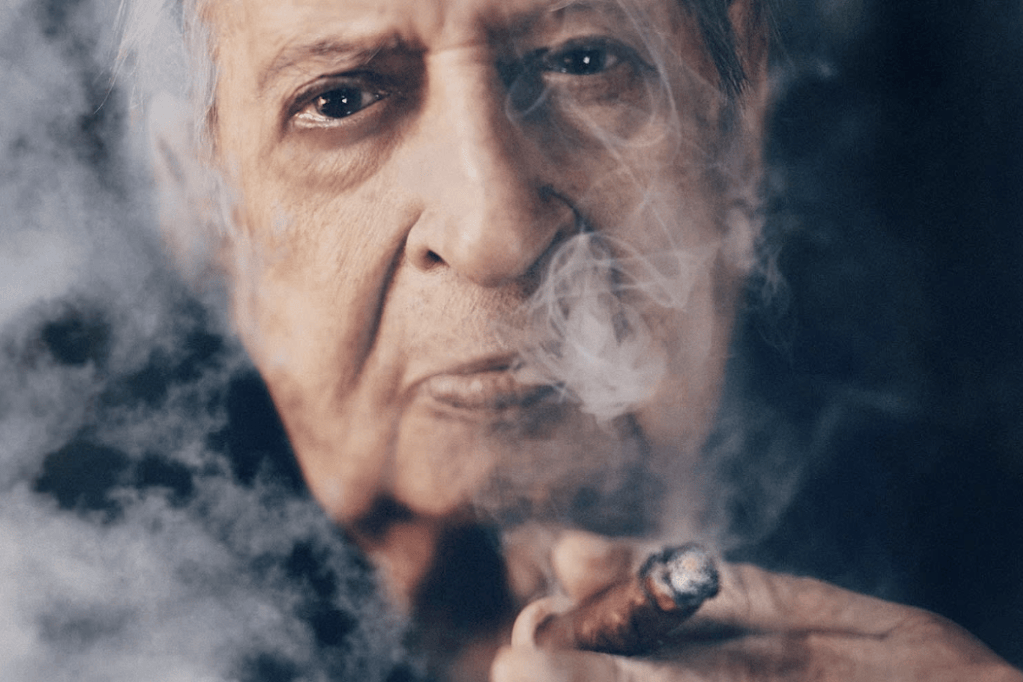
The Italian filmmaker, who died on 4 November aged 93, became internationally notorious for his erotic cinema. Yet his career began among the experimental filmmakers of the 1960s, when questions of artistic freedom, political authority and the possibilities of the moving image occupied his work. His legacy is considerably more complicated than his reputation suggests.
On 1 September 2026, the Venice International Film Festival paid tribute to Tinto Brass with a newly restored version of his 1967 thriller Col cuore in gola (Deadly Sweet). Shot in London, with Jean-Louis Trintignant and Ewa Aulin in the leading roles, the film was an experiment in Pop Art, comic-strip imagery and cinematic montage. Its restoration, undertaken by the Centro Sperimentale di Cinematografia with support from Netflix, offered audiences an opportunity to reconsider a filmmaker whose early achievements had become overshadowed by his later notoriety.
Brass was unable to attend the screening. His wife, Caterina Varzi, read a message in which he reflected on the aesthetic experimentation and artistic freedom that had guided his work. He also received the Pietro Bianchi Award from the Italian National Union of Film Journalists. It was a fitting recognition of a director whose relationship with the established institutions of cinema had often been contentious.
Two months later, on 4 November, Brass died in Rome at the age of 93. His death was announced by Varzi and his children, Bonifacio and Beatrice. He leaves behind a filmography that ranges from anarchic political satire to historical extravagance and erotic comedy, as well as an unresolved argument about the relationship between artistic freedom and the representation of women.
An education in images
Giovanni Brass was born in Milan on 26 March 1933 and grew up in Venice. His grandfather, Italico Brass, was a painter and collector who specialised in Venetian subjects and assembled an important collection of seventeenth- and eighteenth-century painting. He was particularly interested in Alessandro Magnasco, whose work he helped bring to wider attention. Brass thus grew up in a family with a close relationship to the visual arts.
He studied law, graduating in 1957, but soon moved to Paris, where he worked at the Cinémathèque française under Henri Langlois. The institution was a formative centre for the emerging French New Wave, and Brass absorbed its understanding of cinema as a medium with a history, a language and possibilities still being discovered. He subsequently worked with filmmakers including Joris Ivens and Roberto Rossellini.
The influence of this education became evident in his first feature, Chi lavora è perduto (Who Works Is Lost, 1963). Its protagonist, Bonifacio, a young man approaching thirty, wanders through Venice while considering the prospect of employment. His thoughts move between recollections, fantasies and encounters that expose his discomfort with the institutions governing Italian society.
The title itself amounts to a political provocation: work is a form of defeat. During Italy’s postwar economic expansion, when employment and industrial productivity were widely celebrated as signs of national progress, Brass presented a protagonist who regarded entry into the workforce as a surrender of personal freedom.
The film’s restless structure owed something to the French New Wave, but its anarchism was distinctly Brass’s own. His hostility extended to the Church, bourgeois respectability and the assumptions of a society increasingly organised around production and consumption. The film attracted attention at the 1963 Venice Film Festival and encountered censorship difficulties, beginning a long history of confrontation with the authorities.
His interest in political filmmaking continued with Ça ira – Il fiume della rivolta, an experimental documentary assembled from archival footage of wars and revolutions. Here, montage became the principal means of argument. By selecting, juxtaposing and accelerating historical images, Brass examined the violence of political power and the failure of revolutionary aspirations.
An especially revealing commission followed in 1964.
For the XIII Milan Triennale, the writer and semiotician Umberto Eco and the architect Vittorio Gregotti invited Brass to produce two short films examining contemporary experiences of work and leisure. Tempo lavorativo and Tempo libero were assembled from rapidly edited archival images of machinery, factories, sporting activities, entertainment and everyday urban life.
The films were projected within a mirrored architectural installation designed by Gregotti, Lodovico Meneghetti and Giotto Stoppino. Images multiplied across the reflective surfaces, incorporating the spectators themselves into an environment of visual repetition and disorientation.
The installation addressed a question central to the economic culture of the 1960s: how free was leisure in a society that increasingly organised human life around work, consumption and commercial entertainment?
The imagery was deliberately relentless. Factory machinery, traffic and industrial labour gave way to acrobats, dancers and holiday entertainment, but the rhythm of the editing barely changed. The apparent distinction between working time and leisure began to dissolve. Even the spectators became part of the installation, their movements reflected and multiplied alongside the projected images.
This episode is particularly revealing when considered alongside Brass’s later preoccupation with voyeurism. Long before he became associated with the erotic gaze, he was investigating the act of looking and the power of images to direct the spectator’s experience.
Pop Art, rebellion and the cinema of the 1960s
Brass continued to move between genres with considerable freedom. He made the science-fiction satire Il disco volante (1964), featuring Alberto Sordi in several roles, and the western Yankee (1966). Neither genre imposed a fixed style on him.
With Col cuore in gola, he found an especially productive intersection between popular entertainment and visual experimentation.
The film follows a French actor, played by Trintignant, who becomes involved with a young woman suspected of murder. Its London setting provided Brass with the imagery of contemporary youth culture, fashion and advertising, while the thriller narrative offered opportunities for abrupt shifts in perspective and visual register.
The involvement of the Italian illustrator Guido Crepax was particularly significant. Crepax created a series of colour illustrations for the action sequences, which Brass used as storyboards. The collaboration allowed the graphic conventions of comics to influence the film’s cinematic construction.
Brass referred at the time to the collages of Robert Rauschenberg and Roy Lichtenstein when describing the artificial world inhabited by some of his characters. These references were appropriate to a film in which popular imagery and fictional reality continually intersect.
The film also exposed an interest that would become increasingly prominent in his later work: the instability of desire. Its male protagonist constructs an image of a woman that proves inadequate to the person herself. Looking produces fascination, but it does not necessarily produce understanding.
Subsequent films such as L’urlo (1968), Nerosubianco (1969) and Dropout continued his experiments with sexuality, political rebellion and unconventional narrative structures.
In La vacanza (1971), starring Vanessa Redgrave and Franco Nero, Brass returned to the persecution of people who fail to conform to established social expectations. Redgrave plays Immacolata, a young woman temporarily released from a psychiatric institution who becomes involved with a poacher and encounters a society whose institutions prove considerably more brutal than the people they condemn as deviant.
Its mixture of grotesque comedy, sexuality and social criticism belongs firmly to the political cinema of the period. The film’s treatment of psychiatric confinement, class hierarchy and institutional violence also reveals how consistently Brass associated personal freedom with resistance to social authority.
By the early 1970s, he had developed a recognisable artistic temperament: impatient with conventional morality, fascinated by excess and increasingly convinced that sexual behaviour could expose the mechanisms of political and social power.
The direction his career subsequently took would bring him unprecedented public attention, while gradually narrowing the way in which his work was understood.
Sex, spectacle and political power
Salon Kitty (1976) marked a decisive change.
Set in Nazi Germany and starring Helmut Berger and Ingrid Thulin, the film concerns a Berlin brothel appropriated by the Nazi security apparatus for surveillance and political blackmail. Sexual encounters become opportunities for gathering information, and the private behaviour of military and political figures becomes an instrument of control.
The premise allowed Brass to return to his longstanding suspicion of institutions and authority. The brothel, ostensibly a place of pleasure, functions as an extension of the authoritarian state. Its elaborate interiors and theatrical rituals reinforce the film’s presentation of political power as performance.
Yet Salon Kitty also demonstrated a contradiction that would persist throughout his career. Its criticism of fascist decadence depended heavily upon spectacular images of precisely the decadence it purported to expose. The film’s elaborate sexual tableaux could be understood as political satire, commercial exploitation, or an unstable combination of the two.
That tension became more pronounced with Caligula, the lavish historical production financed by Bob Guccione, publisher of Penthouse.
Starring Malcolm McDowell, Helen Mirren, Peter O’Toole and John Gielgud, and developed from a screenplay by Gore Vidal, the film attempted to combine the scale of a major historical epic with explicit sexual material.
The production became notorious for disagreements over its interpretation of the Roman emperor and, ultimately, over control of the finished film.
Brass was removed from the editing process, and Guccione subsequently arranged for additional explicit scenes to be filmed and incorporated without the director’s approval. Brass repudiated the resulting version.
The controversy was substantial, although the film’s enduring notoriety sometimes obscures its unusual production history. What audiences encountered was the product of incompatible artistic and commercial ambitions, compounded by editorial interventions.
A further complication arrived in 2023, when Caligula – The Ultimate Cut premiered at Cannes. Assembled from previously unused footage, it offered an alternative version of the material, but Brass had not participated in the reconstruction.
For a filmmaker who regarded editing as fundamental to artistic authorship, the loss of control over Caligula was particularly consequential. The freedom to construct his own images, which he had defended since the 1960s, had become entangled with the commercial machinery of sexual spectacle.
The erotic gaze
With La chiave (The Key, 1983), Brass established the direction that would dominate the remainder of his career.
Adapted from the novel by the Japanese writer Jun’ichirō Tanizaki, the film relocates the story to Venice in 1940, under Fascist rule. Stefania Sandrelli and Frank Finlay play Teresa and Nino, a married couple whose sexual relationship is revitalised through the discovery and deliberate exchange of private diaries.
The premise is intellectually more interesting than the film’s popular reputation might suggest. The diaries create an elaborate arrangement of observation and disclosure. Husband and wife construct fantasies for one another, while never entirely knowing how much of what they read represents an authentic confession.
Privacy becomes a form of performance. Jealousy is cultivated, and intimate knowledge is made dependent upon acts of deliberate exposure.
Brass had reportedly conceived the adaptation as early as the 1960s, long before it reached the screen. Tanizaki’s exploration of erotic psychology gave him material exceptionally well suited to his preoccupations. The difference between what is seen, what is imagined and what is actually known had occupied his work for years.
The relocation to Fascist Venice introduced an additional historical dimension, placing intimate rebellion within a society governed by authoritarian values and restrictive conventions.
Yet the film also raises questions about the nature of the liberation Brass sought to depict.
He frequently argued that eroticism offered a means of understanding women and their desires. In La chiave, Teresa acquires increasing freedom to explore her sexuality and challenge the arrangements of her marriage. Sandrelli gives the character a presence that complicates her husband’s attempts to direct their erotic lives.
At the same time, the narrative is initially organised around his fantasies and strategies of observation. The distinction between a woman’s sexual freedom and her availability to the spectator is never entirely resolved.
Sandrelli was thirty-seven when the film appeared. Academic research by Gabriele Rigola into its reception has examined the remarkable degree to which contemporary discussion treated her sexuality through the language of ageing, revealing assumptions about female performers that extended well beyond Brass’s own filmmaking.
The film’s significance therefore includes the questions it raises about the culture in which it was produced and received.
The limits of liberation
During the following two decades, Brass increasingly specialised in erotic comedy and drama. Films including Miranda (1985), Paprika (1991), Così fan tutte (1992) and Monella (1998) consolidated his international reputation.
His cinema became recognisable through its playful theatricality, elaborate interiors, recurring emphasis on the female body and fascination with voyeurism.
There was humour in this work, often broadly physical, and an evident pleasure in staging situations that challenged conventional sexual modesty. Brass’s enthusiasm for the sensual possibilities of cinema was rarely in doubt.
The limitations became equally conspicuous.
His persistent focus on particular aspects of the female body, especially the buttocks, could reduce otherwise independent characters to a narrow collection of visual preferences. The erotic freedom he celebrated was repeatedly expressed through a highly controlling directorial gaze.
It is possible to recognise the artistic skill involved in these films while questioning the account of female liberation that Brass offered in their defence. A woman appearing sexually uninhibited on screen does not, by itself, establish that her perspective governs the representation.
The later works also became increasingly repetitive. The formal restlessness that once took Brass from political documentary to experimental installation, western and Pop Art thriller gave way to a comparatively consistent erotic vocabulary.
His interest in the body, censorship and the act of looking had been present from the beginning. What changed was the balance between experimentation and repetition, as well as the kinds of questions his films seemed prepared to ask.
His career also depended upon significant artistic collaborations. His first wife, Carla Cipriani, who died in 2006, worked with him across several decades, contributing to scripts and production design. She was responsible for the art direction of La vacanza and remained closely involved in his later films. Brass openly acknowledged the importance of her contribution, although the public mythology surrounding his work tended to concentrate attention upon the director himself and his actresses.
The restoration of Col cuore in gola in September 2026 was particularly significant because it offered a way of examining Brass’s cinema beyond the categories through which his reputation had been established.
The film was returned to the screen in a new 4K restoration, nearly sixty years after its original presentation at Venice. The festival’s decision acknowledged the contribution he had made to the visual experimentation of Italian cinema during the 1960s.
Brass had experienced serious health difficulties in his later years, following a stroke in 2010. He lived near Rome with Caterina Varzi, whom he married in 2017 and who also helped preserve his professional archive.
In his message to the Venice festival, he maintained that aesthetic investigation and the pursuit of freedom had remained central to his work, whether the subject was political or erotic.
It was a coherent account of his intentions, although the films themselves tell a more complicated story.
His early cinema repeatedly challenged the spectator’s position. Images collided, perspectives shifted, and established categories of social behaviour were treated with suspicion. Even the mirrored installation at the 1964 Triennale made its audience part of the visual mechanism it was invited to question.
In much of the later work, the position of the spectator became considerably more secure. The camera offered pleasures that were immediately recognisable, and the same forms of looking returned with increasing regularity.
Brass belonged to a generation that sought to challenge the restrictions governing cinema, sexuality and public morality. His career illustrates both the possibilities of that rebellion and the contradictions that emerged when sexual liberation became an established commercial genre.
In Col cuore in gola, the man who mistakes his fantasy for knowledge is the one exposed by the film. It is an uncomfortable precedent for much of the cinema Brass made afterward.
Cover image: Courtesy of Netflix.

