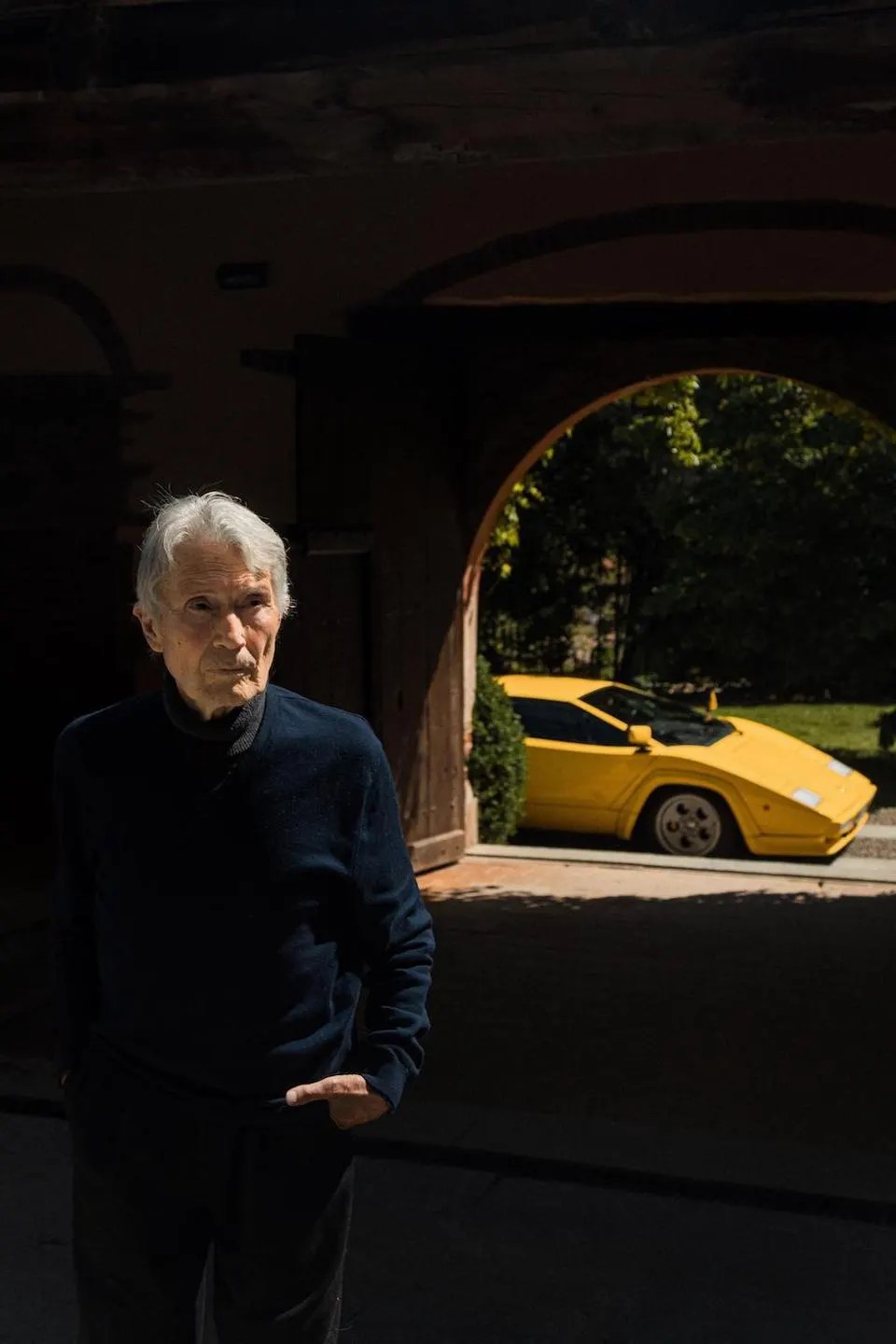
Marcello Gandini was twenty-seven years old when he designed the Miura. He was twenty-nine when he designed the Countach. In the space of two cars, in the space of two years, he invented the visual language of the supercar and made every other car on the road look like it belonged to a previous civilisation. He has been working in a small studio in Turin ever since, largely alone, largely indifferent to the fame that follows him everywhere he does not go.
There is a moment, familiar to anyone who has spent time around the serious automotive enthusiasts who constitute one of the more passionate subcultures of the designed-object world, in which a person sees the Lamborghini Countach for the first time — not in a photograph, not on a screen, but in the physical world, parked on a street or standing in a museum or emerging from a garage into the light — and stops. The stopping is involuntary. It is the response of the eye to something that the eye does not quite know how to process, that does not fit the categories of automotive form that have been accumulated through years of looking at cars. The Countach is not a normal car made dramatic. It is a different kind of object from a normal car — a wedge of surface and angle and glass so extreme in its proportions and so coherent in its formal logic that the word car barely applies to it. It looks like something that was designed to travel at speeds the road cannot accommodate, to exist in a time slightly ahead of the time in which it was actually made.
It was designed by Marcello Gandini in 1971, when he was twenty-nine years old and working as chief designer at Bertone, the Turin coachbuilding and design house that had been one of the great incubators of Italian automotive design since the early twentieth century. Gandini had been at Bertone since 1965, when Nuccio Bertone hired him at the age of twenty-three to replace Giorgetto Giugiaro, who had left to establish his own design studio. The replacement of Giugiaro, one of the most gifted automotive designers of the century, with a twenty-three-year-old who had essentially no formal design training and no previous automotive experience is the kind of hiring decision that looks, in retrospect, like either extraordinary courage or extraordinary luck, and was probably both. Within two years of joining Bertone, Gandini had designed the Lamborghini Miura. Within four, the Countach. The century’s two most formally radical production cars, by the same hand, before he was thirty.
Turin, 1938
Marcello Gandini was born in Turin in 1938, the son of an orchestra conductor — a detail that seems, like Bertoni’s father the theatre props maker, either coincidental or entirely inevitable. The conductor’s child grows up understanding that a complex work can be organised by a single controlling intelligence, that the relationship between the individual contribution and the total effect is the central creative problem, that timing and proportion and the management of tension and release are not merely musical concepts but structural ones applicable to any form that exists in time or space. Whether Gandini absorbed these lessons consciously or simply lived inside them is impossible to know. What is clear is that his automotive designs have, more than those of any other designer of his generation, the character of musical compositions: internally organised according to a rigorous formal logic, in which every element is in precise relationship to every other, and in which the experience of the whole is something different from and greater than the sum of its parts.
He did not study design in any institutional sense. He was largely self-taught, which in the context of the Italian automotive design culture of the 1950s and 1960s was not necessarily a disadvantage — the coachbuilding tradition of the Turin region, with its emphasis on craft and visual intelligence over formal theory, produced designers who learned by looking and by making rather than by attending lectures, and the understanding of form and surface that this education produced was in some ways more direct and more physical than the understanding that came from the art school. Gandini drew obsessively, as autodidacts in visual fields tend to do, and the drawing gave him a command of three-dimensional form at two dimensions — the ability to see a car in the round from a single line on paper — that was, by all accounts of people who worked with him, extraordinary.
He joined Bertone in 1965 and was almost immediately given responsibility for the project that would define his career: the body of the Lamborghini P400, the car that Ferruccio Lamborghini was developing as a direct challenge to Ferrari, a car whose engineering specification — a mid-mounted V12 engine, a tubular chassis designed by Gian Paolo Dallara, a brief to be the fastest and most exciting road car in the world — was already so radical that the body design had to match it or be overwhelmed by it.
The Miura and the Horizontal Revolution
The Lamborghini Miura, unveiled at the 1966 Geneva Motor Show as a finished car after the bare chassis had been shown the previous year, was the first automotive body Gandini had designed for production, and it remains, fifty years later, one of the most formally resolved car bodies ever made. This is not a minority position among automotive enthusiasts. It is close to a consensus, held by people whose opinions on other cars diverge in every direction, that the Miura is the most beautiful production car of the twentieth century — or, if you hold the DS in that position, the most beautiful Italian car, which is still a very strong claim in a field whose competition includes the Ferrari 250 GTO and the Alfa Romeo 8C and everything Pininfarina produced in the 1960s.
The Miura’s beauty is not the beauty of elaboration. It is the beauty of resolution — of a form in which every surface and every line is exactly where the design logic requires it to be, in which nothing is arbitrary and nothing is excessive and the whole reads, from any angle and in any quality of light, as a single continuous statement rather than as a collection of individually styled elements. The long, low hood, extending forward from the passenger compartment in a surface of almost uninterrupted smoothness. The greenhouse — the glassed area of the cabin — sitting low and compact at the car’s midpoint, its horizontal emphasis reinforced by the thin chrome trim at its base. The rear haunches, swelling outward over the rear wheels in forms that suggest musculature without reproducing it. The louvred engine cover, the only element of the body that admits texture and shadow into the otherwise unbroken surface, sitting at the car’s tail like a visual full stop.
The colour that the Miura is most frequently shown in — a deep orange-yellow, the colour of the sun in late afternoon — is not incidental to the design. Gandini understood, as Bertoni had understood with the DS, that a car body is an object experienced in light, that its form reveals itself differently in different qualities of illumination, and that the choice of colour was a choice about which qualities of the form to emphasise and which to allow to recede. The warm metallic colours that the Miura is most often associated with — the oranges and golds and deep yellows — catch the Italian sun in ways that emphasise the smoothness of the surfaces and the precision of the transitions between them, that make the car look, in the right light, as though it had been poured rather than pressed. This is not an accident. It is knowledge.
The Countach and the Wedge
If the Miura represented the apotheosis of the rounded, organic form in supercar design — the endpoint of a tradition that ran from the prewar streamlined bodies through the postwar Italian coachbuilders — the Countach, unveiled at the 1971 Geneva Motor Show, was the beginning of something entirely new: the wedge aesthetic, the angular, faceted, aggressively geometric form language that would dominate performance car design through the 1970s and 1980s and whose influence is still visible in the supercars of the present day.
The Countach LP500 — the prototype, before the production modifications that slightly softened its edges and added the wings and scoops that visual logic required but formal purity did not — is one of the most extreme automotive forms ever presented to the public. It is almost entirely flat surfaces meeting at sharp angles: the wedge of the nose driving forward and downward toward the road, the cabin rising abruptly from the car’s midpoint in a form of near-vertical glass, the tail cut off cleanly in a near-vertical plane that makes the car look, from behind, as though it has been truncated. There are no curves in the conventional sense — no organic roundness, no flowing surfaces, none of the visual vocabulary that the Miura had employed. The Countach is all geometry, all angle, all the aggressive forward thrust of a form that seems to be moving even when it is standing still.
The name Countach is Piedmontese dialect for something between an exclamation of astonishment and an expression of visceral admiration — the word a man from Turin would say on encountering something so extraordinary that the standard vocabulary of response was inadequate. Nuccio Bertone is said to have used the word when he first saw Gandini’s drawings for the car. It was adopted as the model name. The naming of a car after the inarticulate response it produces in the person who first sees it is a form of design criticism that leaves the conventional vocabulary behind.
The Countach entered production in 1974, modified from the LP500 prototype by the engineering requirements of a road car — the addition of the prominent air intakes on the flanks, the rear wing that became increasingly elaborate through the car’s production life, the practical accommodations that the pure concept required. These modifications were the work of multiple hands, and Gandini has been consistent, over the years, in expressing his regret about some of them — the production car was not quite the car he had drawn, which is the condition of almost every designed object but which is felt more acutely when the original drawing was as pure as the LP500 prototype. The production Countach was nonetheless extraordinary: a car that made every contemporary on the road look, by comparison, like a vehicle designed for a different and lesser reality.
The Stratos and the Rally Machine
Between the Miura and the Countach, and alongside the development of the Countach, Gandini produced a third car of the first rank that is less well known than either but whose formal intelligence is, in some respects, even more concentrated: the Lancia Stratos, the rally car that dominated the World Rally Championship in the mid-1970s and that is, in its production form, one of the most functionally pure objects in the history of the automobile.
The Stratos was designed around a single purpose — winning rally races — and every element of its form was determined by that purpose with a rigour that left no room for the decorative or the conventional. The wheelbase was extremely short, making the car manoeuvrable on the tight, winding stages of the European rallies it was designed for. The engine was mounted transversely behind the driver, concentrating the mass at the car’s centre and giving the vehicle a responsiveness to the driver’s inputs that cars with more conventional weight distributions could not achieve. The body was shaped by these functional requirements and by Gandini’s formal intelligence simultaneously, and the result is a car that looks like nothing else in the automotive world before or since: a low, wide, almost circular form, the driver sitting in a glass bubble at the car’s nose, the entire rear of the car given over to the mechanical package in a form that makes no apology for its priorities.
The Stratos won the World Rally Championship in 1974, 1975, and 1976. It did so in a car that looked as though it had been drawn at a single sitting by someone who had decided that the conventional compromises of road car design were not available and that the form would be determined entirely by what winning required. This is not quite accurate — the Stratos was a road car as well as a rally car, produced in sufficient numbers to homologate it for competition — but the road car feels, in the way that the best purpose-built objects feel, as though the purpose were so completely served by the form that the distinction between the purpose-built and the designed becomes irrelevant. The Stratos was designed. It happened also to be perfect for its purpose. In the hands of a lesser designer, these would have been two separate achievements. In Gandini’s hands, they were one.
Bertone and the Atelier System
To understand Gandini’s career it is necessary to understand Bertone — the organisation within which most of his greatest work was produced and whose particular character shaped the conditions of that production in ways that a freelance or independent practice could not have replicated. Bertone was a coachbuilder in the original sense: a company that built bespoke bodies on chassis supplied by manufacturers, in the tradition of the Italian carrozzerie that had been producing custom automotive bodies since the early years of the automobile. By the time Gandini joined in 1965, the coachbuilding tradition had evolved into something closer to a design studio — a company that worked with manufacturers to develop production body designs and concept cars, that maintained the craft intelligence of the coachbuilding tradition while operating at the scale of the modern automotive industry.
The Bertone atelier under Nuccio Bertone was, in the 1960s and 1970s, one of the most creatively productive environments in the history of automotive design. Nuccio had an eye for talent — his recruitment of Giugiaro and then Gandini demonstrated a capacity to identify formal intelligence that the established automotive companies, with their larger design staffs and more conservative briefs, rarely matched — and he gave his designers, within the constraints of the commercial brief, an unusual degree of creative freedom. The concept cars that Bertone produced through these decades — the Carabo, the Espada, the Bravo, the Navajo, the Sibilo — were not merely proposals for future production but formal research projects, explorations of what automotive form could become if the constraints of production were temporarily suspended, that pushed the boundaries of what the eye could accommodate and what the hand could make.
Gandini thrived in this environment because it matched his temperament: the intense concentration of formal problems, the rapid production of ideas, the willingness to follow a formal logic wherever it led without stopping to ask whether the destination was commercially viable. He was not, by any account, a designer who thought about markets or demographics or the consumer research that drives the mainstream automotive industry. He thought about form — about the relationship between surfaces and the spaces between them, about the way that light moved across a body and what that movement revealed about the quality of the design — and he trusted that the right form would find its audience.
He left Bertone in 1980, after fifteen years and a body of work that had no parallel in the industry, and established his own studio in Turin. The work that followed — the Lamborghini Diablo, the Bugatti EB110, the Cizeta-Moroder V16T, a series of projects for manufacturers across Europe and Japan — continued to demonstrate the formal intelligence of the Bertone years without quite recapturing the concentrated intensity of the period in which the Miura, the Countach, and the Stratos had been produced in rapid succession. This may be the inevitable consequence of working independently rather than within the creative pressure of the atelier, or it may simply reflect the fact that the formal language Gandini had invented in the late 1960s and early 1970s had, by the 1980s, become so thoroughly absorbed into the automotive mainstream that the radicalism of the original gesture was no longer available to him. You cannot invent the wedge twice.
The Diablo and the Long Shadow
The Lamborghini Diablo, unveiled in 1990, is the most significant of the post-Bertone Gandini designs and the car whose history most clearly illustrates the tension between the designer’s formal vision and the commercial and practical pressures that production imposes. Gandini designed the Diablo as the successor to the Countach — a car that would advance the formal language of the earlier car without merely repeating it, that would use the twenty years of technical development since the Countach’s introduction to produce something as formally radical in 1990 as the Countach had been in 1971.
The car he designed was sharper and more extreme than the production Diablo that was eventually released. Chrysler, which had acquired Lamborghini in 1987, intervened in the design process in the final stages of development and softened a series of elements that Gandini had conceived as hard-edged — the nose, the greenhouse, the treatment of the rear — in the direction of the more rounded, more aerodynamically managed forms that the American market preferred. Gandini’s response was characteristic: he designed a separate car, the Cizeta-Moroder V16T, using the original Diablo design that Chrysler had declined, and brought it to production through a small independent manufacturer. The Cizeta-Moroder is, by most formal assessments, the purer design. It is also, by most practical assessments, one of the least commercially successful supercars ever produced, which illustrates, with painful clarity, the relationship between formal purity and commercial viability that runs as a structural tension through every designer’s career.
The production Diablo was nonetheless a remarkable car — faster than the Countach, more technologically sophisticated, and in its best versions visually powerful in ways that the Chrysler modifications had compromised without destroying. It sold well, by supercar standards, and it maintained Lamborghini’s position as the manufacturer of the most formally extreme cars in the world through the 1990s. That it was not quite what Gandini had intended is a fact that the automotive record preserves but that the cars on the road do not announce. They look, to anyone who encounters them, like cars designed by someone who knew exactly what they were doing.
The Studio in Turin
Gandini works today from a studio in Turin — small, private, organised around the drawing board and the model-making equipment that have been the primary tools of his practice throughout his career. He has never maintained a large staff. He has never sought the institutional profile of the major design houses. He has given interviews rarely and self-promotional statements essentially never, conducting his practice with the same indifference to the machinery of reputation that Kawakubo conducts hers, though the two figures are otherwise so dissimilar that the comparison illuminates only the single shared quality of radical self-sufficiency.
He continues to design. The projects are fewer than in the Bertone years and less visible internationally, but they are made with the same concentrated formal intelligence that produced the Miura — with the understanding, arrived at over six decades of practice and apparently unshaken by any of the commercial and institutional pressures that have led other designers toward accommodation, that the form is either right or it is not, and that the difference between right and not-right is the only difference that ultimately matters. This is a demanding standard. It has produced, in the years since the Countach, work of uneven quality — the inevitable consequence of applying an absolute standard to the contingent and compromised conditions of industrial production. It has also produced, in the best moments, the same quality of formal resolution that the great early cars had: the sense that the designer had found, rather than invented, the form that the brief required, that the car could not have been otherwise.
He is, at the time of writing, in his mid-eighties. The Turin studio is still open. The drawing board is still in use. The history of the cars he made when he was twenty-seven and twenty-nine continues to follow him with the particular persistence of greatness achieved early — the knowledge, shared by everyone who cares about the designed world, that the Miura and the Countach were not lucky accidents but the product of an intelligence so formed and so certain of itself that it could, in the space of two years and two cars, change the visual language of an entire industry and define the terms in which performance automobiles have been understood ever since.
The wedge sits at the kerb. The afternoon light falls across its flanks at exactly the angle that makes the surfaces most themselves. The person passing on the foot pavement stops, without knowing quite why, and looks. This is what Gandini drew. This is what he has always been drawing, in every line of every car, in the small studio in Turin where the future keeps arriving on paper, one more time, before anyone else has seen it.
Cover image: Marcello Gandini with Countach LP 400 S Giallo Fly courtesy of Lamborghini
