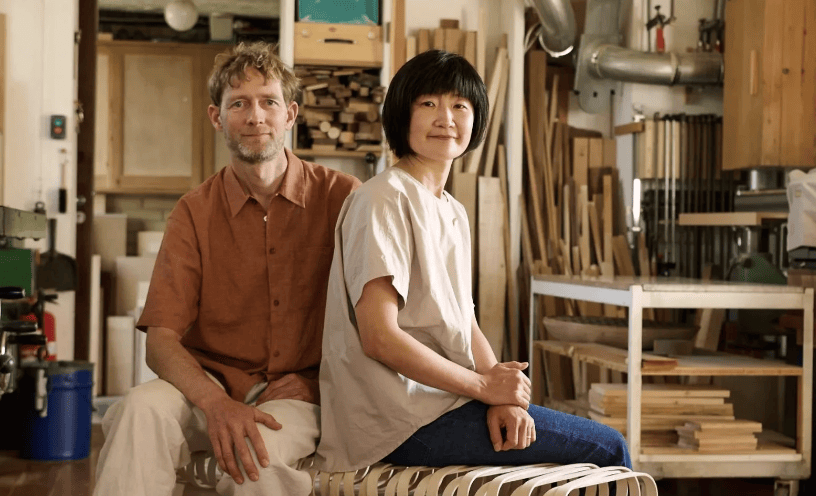
At a small exhibition space on Copenhagen’s Østerbro, Japanese designer Akiko Kuwahata and Danish cabinetmaker Ken Winther bring together two remarkable traditions of woodworking. Their new exhibition celebrates material intelligence, craftsmanship and the quiet beauty of ordinary things.
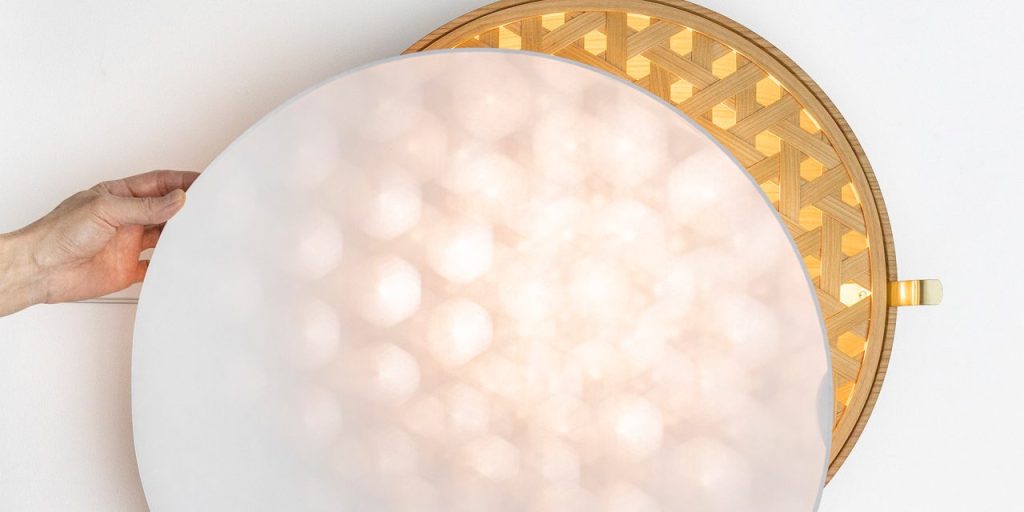
A simple wooden breadbasket and a wall-sized sculpture of light might appear to have little in common. For Japanese–Danish design duo Akiko Ken Made, both are expressions of the same pursuit: understanding wood so thoroughly that its possibilities extend far beyond conventional furniture making.
Their new exhibition, Nærmest Håndgribelig (Almost Tangible), opened on 22 October at TILÆRKS, an intimate exhibition space devoted to architecture, design and craftsmanship in Copenhagen’s Østerbro neighbourhood.
It brings together furniture, lighting, small domestic objects, tools and experiments, offering an insight into a practice that has developed over more than fifteen years of collaboration.
Two Traditions, One Workshop
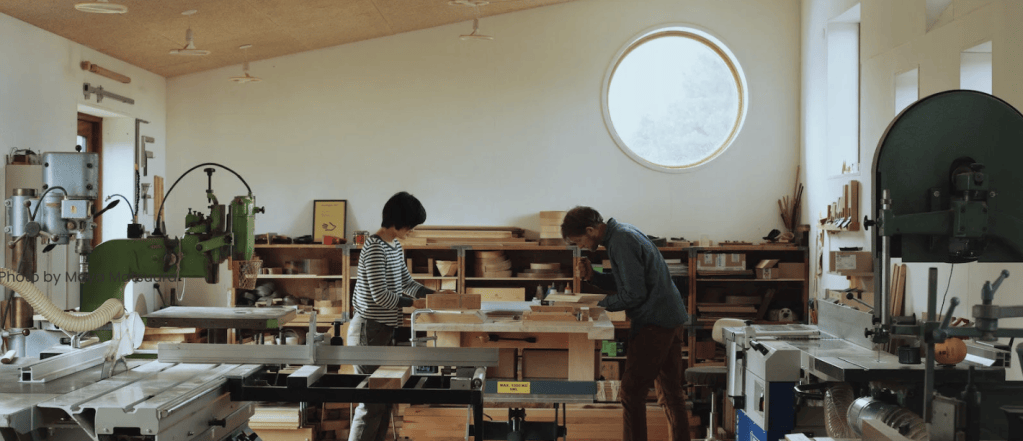
Akiko Kuwahata and Ken Winther are partners in both life and work, operating from a combined home and workshop in Kokkedal, north of Copenhagen.
Kuwahata studied Living Space Design at Nihon University before spending four years working at the Japanese cabinetmaking workshop Hinoki Kogei. She subsequently studied furniture and interior design at Aarhus School of Architecture.
Winther belongs to a Danish family of furniture makers and trained at PP Møbler, the celebrated workshop closely associated with Hans J. Wegner. He remained with the company for more than twenty years, also spending time in Japan studying traditional woodworking techniques.
The pair established their independent practice in 2010, combining the architectural clarity of Danish furniture making with the remarkable precision and material sensitivity of Japanese carpentry.
Their work is distinguished by a particular understanding of wood as a living material. Grain, scent, flexibility, colour and surface texture influence every design decision.
The resulting objects can appear deceptively simple, although their construction often involves techniques of extraordinary complexity.
Consider Stitch (2009), a sculptural bowl constructed from slender pieces of maple joined with waxed string. Or Facet (2018), whose carefully articulated surfaces demonstrate how changing angles can produce subtle variations of light and colour within a single material.
In these works, construction becomes part of the aesthetic experience.
The Intelligence of the Hand
The current exhibition explores the relationship between tools, material and artistic expression.
Among the techniques employed are surfaces shaped with a yarigana, a traditional Japanese blade used to create fine, faceted cuts in wood.
Other works investigate brushing techniques that compress the softer fibres of timber, producing unusually tactile and resilient surfaces.
In an interview published by HÅNDVÆRK, Winther explained how one particular carving tool had remained in the workshop for ten years before the couple found the appropriate project in which to use it.
The exhibition includes a low table made from Danish alder and another constructed from Swedish pine, whose surface has been treated with a succession of increasingly soft brushes, ending with horsehair.
Such details illuminate the considerable patience underlying the work.
Akiko Ken Made’s artistic reputation has developed internationally through exhibitions at Galerie Maria Wettergren in Paris, Design Miami/Basel and the 21st Century Museum of Contemporary Art in Kanazawa, Japan.
Their achievements have also received considerable recognition at home. In 2026, they were awarded both the Finn Juhl Prize and Håndfuglen, the latter recognising their outstanding presentation at Copenhagen’s Frue Plads craft market.
A Small Exhibition Worth Seeking Out
The exhibition’s setting is particularly appropriate.
Opened in 2023 inside a former laundry, TILÆRKS was conceived as a meeting place for architecture, art and craftsmanship, with an emphasis on materials, experimentation and direct encounters with objects.
For Nærmest Håndgribelig, the space has been arranged to evoke something of Kuwahata and Winther’s working environment, where finished furniture exists alongside prototypes, collected natural objects and traditional tools.
The presentation encourages visitors to look beyond the finished form and consider the accumulated knowledge involved in its making.
At a time when much contemporary design is consumed primarily through photographs, the exhibition offers a welcome reminder that some objects demand a more physical encounter.
A beautifully made wooden bowl can reveal its qualities through its weight, its finish and the way it rests in the hand. The knowledge embedded in its construction is not necessarily visible at first glance.
For Kuwahata and Winther, the art of design begins with understanding those qualities, and with knowing when to allow the material itself to determine the result.
All images courtesy of Akiko Ken Made in Copenhagen’s website
Visit the exhibition
Nærmest Håndgribelig — Akiko Ken Made
22 October – 1 December 2026
TILÆRKS
Livjægergade 28, corner of Willemoesgade
2100 Copenhagen Ø, Denmark
Opening hours:
Wednesday 17:00–20:00
Thursday and Friday 15:00–18:00
Saturday 12:00–16:00
Artist talk: Friday 30 October, 17:00–18:30.

