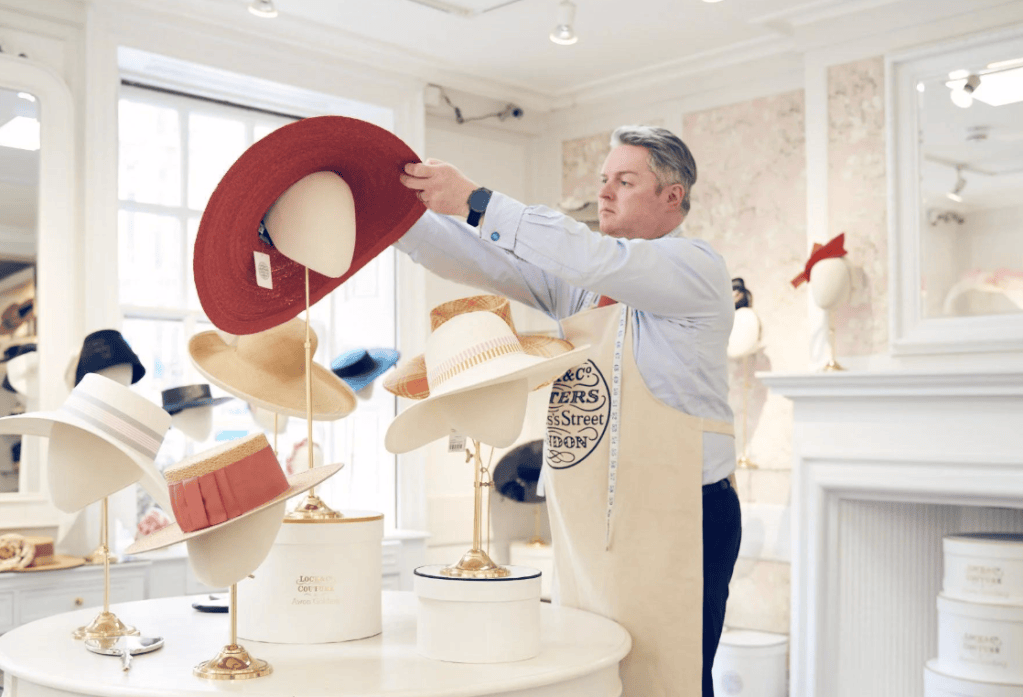
In an era when luxury brands change creative directors almost as frequently as their collections, one London hatmaker has been quietly getting on with business since 1676. Lock & Co., the world’s oldest hat shop, celebrates its 350th anniversary in 2026 with limited-edition collections, contemporary millinery and an extraordinary archive of British social history. Its continued success suggests that genuine craftsmanship may be the most enduring form of luxury.
At 6 St James’s Street, a short walk from the royal palace of the same name, Lock & Co. has been fitting hats to some of Britain’s most recognisable heads for three and a half centuries. Its clients have included Admiral Lord Nelson, Beau Brummell and Winston Churchill, whose distinctive Homburg and Cambridge hats became essential elements of his public image.
The business originated in 1676 when Robert Davis established a hat shop in St James’s Street. James and Mary Lock moved into the present premises in 1765, and successive generations developed a reputation for workmanship, discretion and the ability to accommodate increasingly specific demands.
One of its most important contributions to fashion arrived in 1849. Edward Coke, a relative of the Earl of Leicester, wanted a practical hat for his gamekeepers, whose traditional top hats were easily damaged by low branches. Lock commissioned Thomas Bowler & Son to produce a hard, rounded design that would provide greater protection. The resulting Coke hat, later popularly known as the bowler, became one of the defining accessories of Victorian and Edwardian dress.
The story illustrates something easily forgotten about traditional British clothing: many apparently formal garments originated in practical requirements. Their elegance developed through the refinement of functional design.
Lock’s continuing expertise lies in the relationship between shape, proportion and fit. For formal hard hats, its hatters still use a conformateur, the nineteenth-century measuring instrument that records the precise shape of a customer’s head. The resulting measurements allow a rigid hat to fit more accurately than conventional sizing permits.
The company’s bespoke and made-to-measure services extend to customised couture hats, tweed caps made in clients’ selected fabrics and personalised details. Its repair and maintenance services also encourage the preservation of existing hats rather than their automatic replacement.
Yet Lock has survived because it has never treated tradition as an excuse to stop designing.
In 2020, milliner Awon Golding became its Head Millinery Designer, introducing an adventurous contemporary approach to the company’s couture collections. Her elaborate sculptural pieces, dramatic silhouettes and unconventional materials draw upon the theatrical possibilities of millinery while maintaining traditional construction techniques.
For the 350th anniversary, the company has introduced a succession of limited-edition hats and accessories, including reinterpretations of classic boaters, flat caps and trilbies. Golding’s extraordinary Lion Tamer designs demonstrate how historical shapes can become thoroughly contemporary objects.
There is a larger design lesson in Lock’s remarkable longevity. A hat depends upon a deceptively sophisticated relationship between material, proportion and individual anatomy. Its success cannot be judged entirely on a drawing or a screen.
It must be made, fitted and worn.
After 350 years, Lock & Co. remains a particularly persuasive example of what happens when technical knowledge is preserved without allowing it to become an obstacle to new ideas.
Explore: Lock & Co.’s 350th anniversary · Bespoke hats · Awon Golding’s couture millinery
Visit: 6 St James’s Street, London SW1A 1EF.

