
Culture · Art
The Animal Remembers
Harumi Klossowska de Rola at Villa Kérylos
In a house built from a modern dream of ancient Greece, the Swiss artist’s bronze creatures ask what happens when humanity returns the animal world to the realm of the sacred.
By Bergotte
Harumi Klossowska de Rola, Chinook (Salmon), 2024, bronze, 28 × 80 × 12 cm, installed at Villa Kérylos. Photograph © Adrien Dirand.
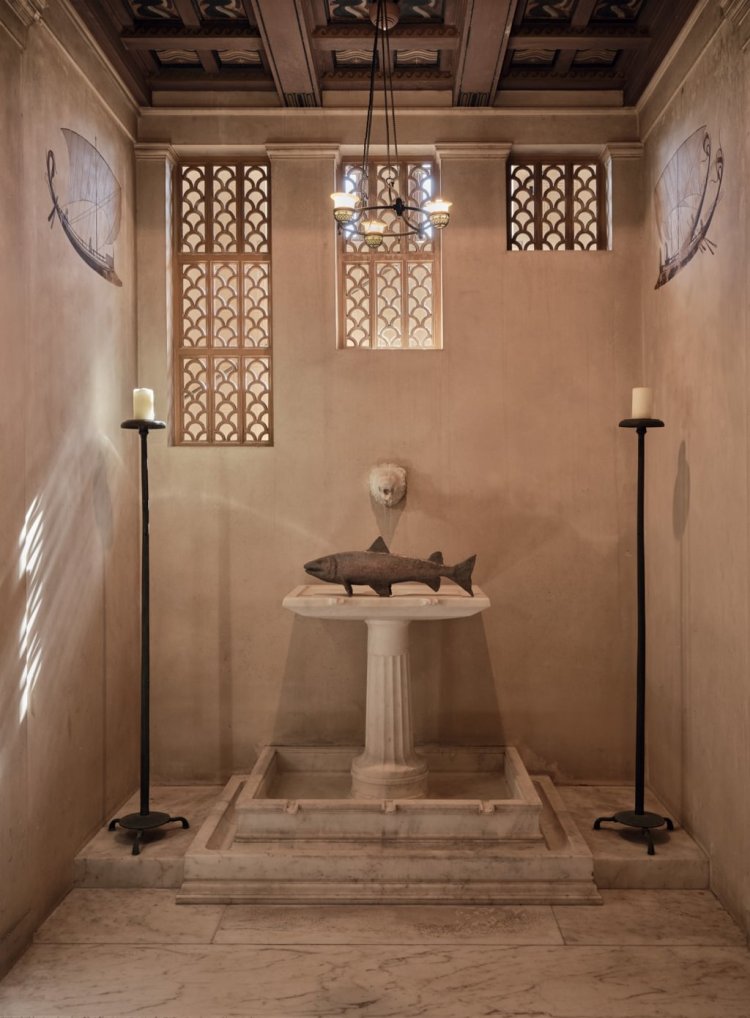
In the marble-lined intimacy of Villa Kérylos, a bronze salmon has been set upon a pale pedestal, flanked by two tall candles. The arrangement is so ceremonial that the sculpture appears less displayed than received. Behind it, a lion’s head emerges from the wall; above, patterned coffers and painted ornament preserve the dream of an ancient interior. The work is Chinook (Salmon), made in 2024 by Harumi Klossowska de Rola. It looks at once like a specimen, a relic, a votive gift and a living animal holding itself perfectly still.
That instability is central to Klossowska de Rola’s art. Her animals occupy the border between object and being, material and spirit, the archaeological and the alive. In the exhibition now installed at Villa Kérylos in Beaulieu-sur-Mer, creatures fashioned from bronze, alabaster and precious woods enter rooms already inhabited by myth. The setting does more than flatter them. It reveals the intellectual structure beneath their beauty.
Any account of Harumi Klossowska de Rola eventually arrives at her parentage. Born in Geneva in 1973, she is the daughter of Balthus and the Japanese painter Setsuko Ideta. It is an extraordinary inheritance, but a lineage can also become an elegant method of not seeing an artist. Her work is not an appendix to her father’s, nor simply the decorative flowering of an unusually cultivated childhood. It has its own argument: that matter carries time, that craft is a form of thought, and that the modern division between human culture and the natural world has impoverished both.
Her artistic inheritance is spatial before it is genealogical. She spent her early childhood at the Villa Medici in Rome, where Balthus was director of the French Academy. In a conversation with Olivier Gabet, Klossowska de Rola recalled collecting sticks, stones, leaves and fragments of old mosaic glass in its gardens: objects chosen because a shape or colour made them seem charged. The family later moved to the Grand Chalet at Rossinière in the Swiss Alps, exchanging Roman architecture for forests, snow, mountains and wild animals. Between these worlds ran another education: the Japanese calligraphy lessons given by her mother, the philosophy of animism, and a visual culture in which the boundaries between painter, sculptor, ceramicist, lacquerer and artisan are less rigid than Western institutions have often allowed.
She first became known as a jewellery designer, working for houses including Boucheron and Chopard before her practice expanded into furniture, objects and large-scale sculpture. She described that enlargement to Frederic with appealing dryness: “My jewelry became sculpture—and very hard to wear.” Yet to say that she came to sculpture through jewellery is not to describe an apprenticeship in something smaller. It identifies one of the central intelligences of her work.
A jewel is sculpture in intimate relation to the body. It demands an understanding of weight, balance, touch, fastening, surface and the concentrated force of materials. Klossowska de Rola carried that knowledge outward. The creature once curved around a wrist now occupies a room; the talisman becomes an animal presence. Scale changes, but the intensity of the object does not.
Her trajectory also exposes the poverty of the old hierarchies: fine art over applied art, sculpture over jewellery, concept over hand. Klossowska de Rola begins with drawings and models in wax or plasticine, but the finished bronzes emerge through collaboration with mould-makers, waxworkers, metal chasers and specialists in patina. She hand-finishes the works after casting. The intellectual idea and practical workmanship are not opposing stages; each depends upon the other. Her sculptures are therefore not simply images of living systems. They are themselves the products of one: a network of knowledge moving through many hands.
The resulting bestiary is not a catalogue of naturalistic likenesses. Klossowska de Rola pares an animal down until a line, posture or interval of empty space carries its presence. Bodies may be elongated or opened by voids; eyes are frequently left hollow. Bronze gives the creatures density, but their omissions keep them from becoming inert. They appear to contain silence.
Across the wider body of work, names such as Athene Noctua, Sobek, Wepwawet, Ame-no-kaku and Chinook move among Greek, Egyptian and Japanese mythology and the taxonomies of the natural world. Yet these are not symbols arranged for us to decode according to a stable key. The artist has resisted such fixed readings, describing her attachment to animals as personal and often non-verbal. Her animism is more demanding than allegory. An animal does not merely stand in for a human virtue, fear or desire; it occupies its own centre of experience.
That distinction gives the work its contemporary force. The dominant story of Western modernity placed the human being outside nature and then above it: animals became resources, specimens, property, entertainment or scenery. The ecological crisis has exposed the violence and absurdity of that separation. Klossowska de Rola does not turn her sculptures into protest posters, and their stillness should not be mistaken for political neutrality. Their social meaning is quieter and more fundamental. They rearrange the hierarchy of the room. The animal is no longer background to civilisation but a presence before which civilisation must account for itself.
There is, admittedly, a productive contradiction in rendering the untamed world through bronze, gold leaf, alabaster, oak and rosewood—materials that enter galleries and collections as objects of considerable luxury. But the contradiction belongs to the culture around the work as much as to the work itself. Modern society most often approaches nature through objects it can own, images it can circulate and myths it can domesticate. Klossowska de Rola does not entirely escape that economy; no artist can. What she does is preserve something within the object that resists possession. Her creatures remain aloof, severe and unreadable. They do not flatter us.
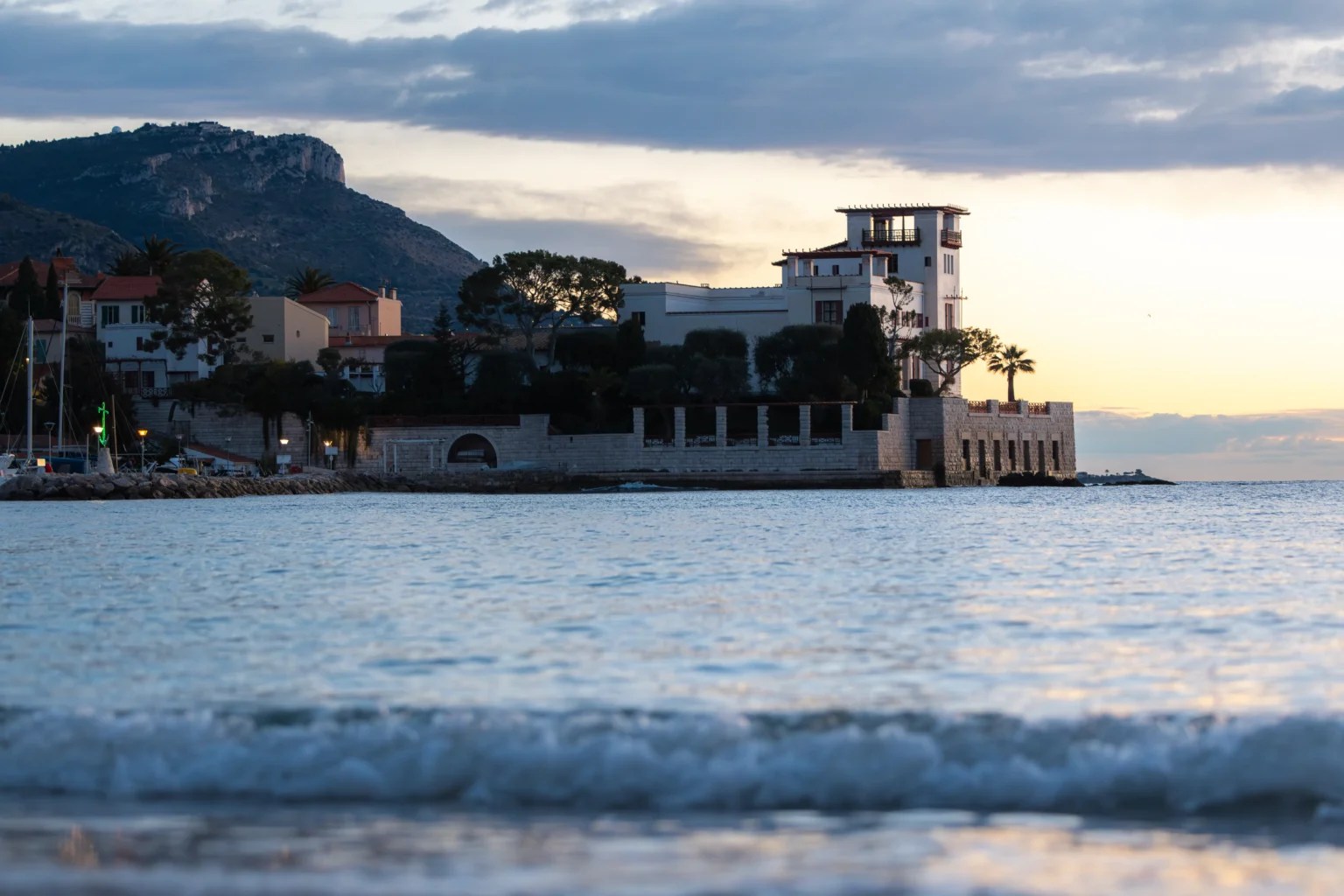
Villa Kérylos is an unusually exact place in which to encounter them. The house was conceived in 1902 by the archaeologist and patron Théodore Reinach with the architect Emmanuel Pontremoli. Inspired by the Hellenistic houses excavated on Delos, it combined ancient forms with the techniques and comforts of the early twentieth century. As the Villa itself emphasises, Kérylos was never intended as a literal copy. It is a modern reinterpretation of Greek life: scholarship transformed into architecture, archaeology made inhabitable.
The exhibition is therefore a meeting between two invented antiquities. Reinach and Pontremoli translated fragments of the classical world into a modern home; Klossowska de Rola translates animals into objects that feel excavated from cultures that may never have existed. Both understand that fidelity is not the same as imitation. The past becomes meaningful through selection, material, imagination and use.
Chinook makes the point beautifully. A Pacific salmon is an improbable resident of a house devoted to the ancient Mediterranean, and that geographical dislocation prevents the sculpture from dissolving into neo-Hellenic décor. The fish retains its specificity. Its life cycle is governed by departure and return, by the arduous journey back towards the waters of its birth. Set inside a villa that represents modern Europe’s own attempted return to an imagined cultural source, it gathers an additional resonance. The bronze arrests the animal’s movement, yet the metal will continue to darken and patinate. Apparent permanence records change.
What emerges at Villa Kérylos is not nostalgia for a lost age in which animals, gods and humans supposedly lived in easy harmony. Ancient myth was never gentle, and nature is not a moral idyll. Klossowska de Rola’s creatures can feel dangerous precisely because they are not sentimentalised. The exhibition proposes something more useful: a correction to humanism. The human does not become less valuable when placed back among other forms of life. It becomes less arrogant, and perhaps more fully alive.
The bronze salmon does not explain itself. It lies in a room made from a twentieth-century dream of a second-century world, its surface already holding the passage of time. Around it, the Villa remembers Greece; the animal remembers the river. Culture, in this encounter, is not an escape from nature. It may be one of the ways we learn to see ourselves inside it again.
Harumi Klossowska de Rola
Villa Kérylos, Impasse Gustave Eiffel, 06310 Beaulieu-sur-Mer
12 June–20 September 2026 · Daily, 10am–6pm
Tickets: €15, sold on site. The Villa also offers an alternating thematic “Harumi” tour at 4pm; check the current programme before visiting.
Sources and further reading: Villa Kérylos exhibition information; the history of Villa Kérylos; Harumi Klossowska de Rola in conversation with Olivier Gabet; Frederic magazine’s studio profile; Acquavella Galleries, Sacred Woods.
Discover more from My World of Interiors
Subscribe to get the latest posts sent to your email.

