
Encounters · No. 4
The Count of Nowhere
Balthus was one of the greatest painters of the twentieth century and the author of images that remain genuinely, irreducibly disturbing. Both of these things are true. The difficulty is that they cannot be separated.
By Bergotte
Toward the end of his life, Balthus lived in a vast wooden chalet in the Swiss village of Rossinière, in the canton of Vaud, surrounded by mountains and by a silence so complete it seemed intentional. He had designed his own coat of arms. He wore linen shirts and received visitors in rooms hung with his own paintings. He referred to himself, when pressed, as a Polish count, a claim to which his actual biography gave only the most ambiguous support. He was photographed in attitudes of patrician repose. He gave interviews in which he declined to explain his work, suggested that any sexual content in his paintings was a product of the viewer’s imagination, and described himself as essentially medieval in sensibility, a craftsman in the tradition of Piero della Francesca, indifferent to the twentieth century and its concerns. He was, by all accounts, magnificent company. He was also, by any honest reading of the evidence, engaged in a performance of himself so sustained and so polished that it had become indistinguishable from the person performing it.
Balthasar Klossowski de Rola — Balthus — was born in Paris in 1908, the second son of Erich Klossowski, a painter and art historian of Polish-German extraction, and Elisabeth Dorothea Spiro, a painter known as Baladine, who was the daughter of a cantor from Breslau. The aristocratic lineage was, at best, a matter of selective genealogical emphasis. What was genuine, and extraordinary, was the cultural world into which he was born. His parents moved in the circles of the Parisian and then the Swiss avant-garde. When his parents separated and his mother formed a close relationship with Rainer Maria Rilke, the poet became a second father to the boy — attentive, literary, conducting a years-long correspondence with him. It was Rilke who wrote the preface to Balthus’s first published work, a sequence of forty ink drawings made at the age of eleven depicting the adventures of a lost cat. The book was called Mitsou. The cat in it belonged to Balthus and had run away. The drawings are accomplished, tender, and shot through with a quality of mournful intensity that would become his signature.
He had designed his own coat of arms. He wore linen shirts. He described himself as essentially medieval in sensibility — indifferent to the twentieth century and its concerns. He was engaged in a performance of himself so sustained it had become indistinguishable from the person performing it.
The Technique
Balthus learned to paint, he always said, by copying Poussin in the Louvre, and later by studying Piero della Francesca in Arezzo, making meticulous drawings of the frescoes in the church of San Francesco during a visit to Italy in his early twenties. Whether or not this account is entirely accurate, its emphasis is correct: Balthus’s work is oriented backwards, toward the fifteenth and seventeenth centuries, toward a tradition of pictorial construction built on geometry and stillness and the precise management of light. His surfaces have the quality of old masters — dense, slow, built up in layers over months and years, the paint applied with a deliberateness that seems almost contemplative in an era of gestural abstraction and pop appropriation.
He was, by the assessment of artists as different as Giacometti, Picasso, and Francis Bacon, one of the finest painters alive. Giacometti, who knew everyone and admired almost no one, said that Balthus was the greatest living painter working in the figurative tradition. This was not a peripheral view. It was shared across a generation of artists who found in his work a stubbornness they respected: the stubbornness of someone who had decided what painting could do at its best and had spent a lifetime trying to do it, regardless of fashion, regardless of the market, regardless of what anyone else thought interesting.
The paintings are, on purely technical grounds, extraordinary. The quality of light in The Mountain, completed in 1937 — a large canvas depicting several figures in a high Alpine landscape — has the cold, clarifying brightness of altitude, the kind of light that makes objects look more solidly themselves than they do at lower elevations. The street scenes of Paris and provincial France have an architectural gravity, a weight of shadow and stone, that recalls Courbet without reproducing him. The interiors — the cat asleep, the window, the girl reading — are lit from sources you cannot quite locate, the shadows falling at angles that feel slightly wrong in a way you only notice after looking for a while.
The Paintings
And then there are the other paintings. The ones for which Balthus is most widely known, most widely reproduced, and most seriously contested. The paintings of girls.
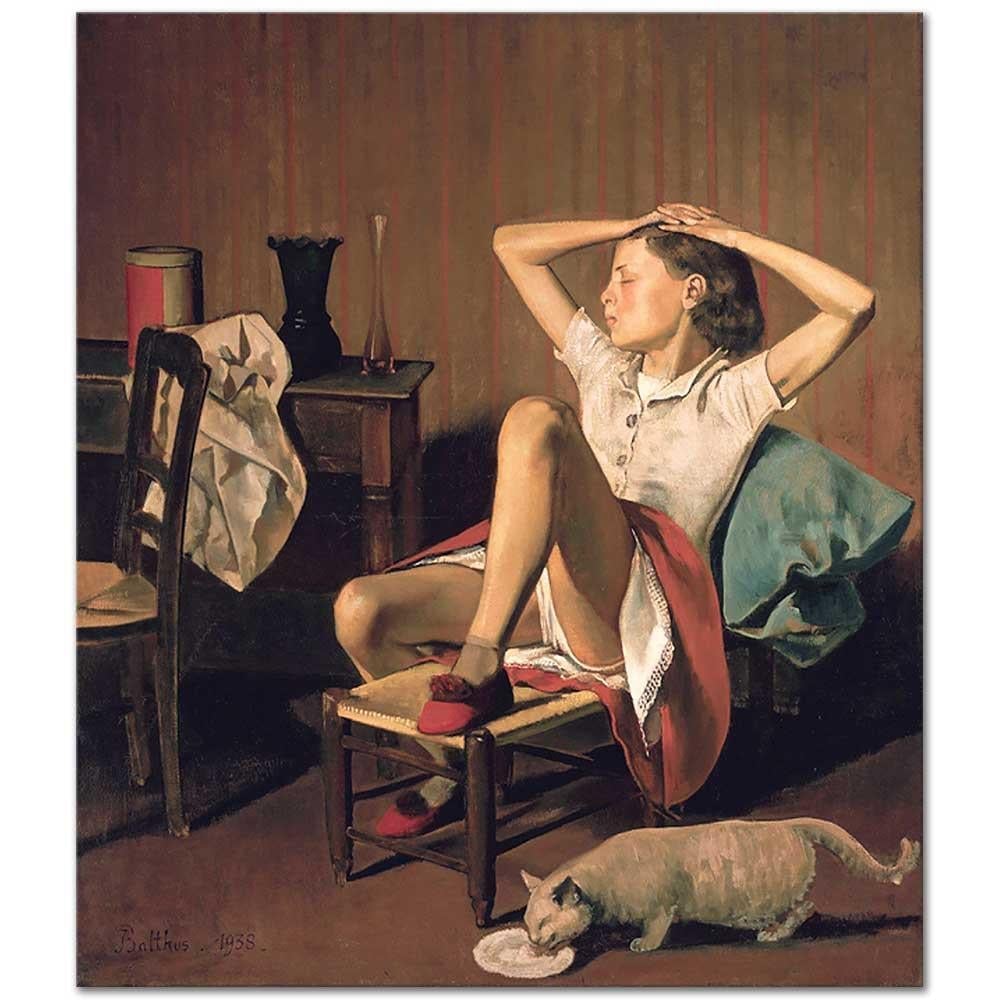
From the early 1930s onward, Balthus returned repeatedly to the figure of the pubescent girl — typically alone in an interior, typically arranged in a pose that is at minimum erotically charged and in some cases explicitly, unmistakably sexual. In Thérèse Dreaming, painted in 1938, a girl of perhaps twelve sits with one knee raised, her skirt falling open. Her eyes are closed. Her expression is remote, interiorised, somewhere else entirely. A cat laps milk from a saucer in the foreground. The composition is superb — the geometry precise, the light extraordinary, the paint surface dense and slow. And the image, looked at without evasion, depicts a child in a state of sexual exposure, observed by a painter who has arranged her with great care.
In 2017, a petition addressed to the Metropolitan Museum of Art in New York asked the institution to remove Thérèse Dreaming from display, or at minimum to add contextual signage acknowledging its troubling content. The Met declined to remove it and declined to add signage, citing principles of artistic and curatorial integrity. The petition had attracted tens of thousands of signatures. The counter-argument — that removing the painting would be a form of censorship, that art must be permitted to disturb, that the history of Western painting is full of images of young women arranged for the male gaze and that singling out Balthus is arbitrary — was made with some force. Both sides were, in their different ways, responding to the same thing: the paintings are genuinely disturbing, and the disturbance does not resolve.
The paintings are, on purely technical grounds, extraordinary. And they are, on any honest moral reckoning, images of children in states of sexual exposure, made by a man who arranged them with evident deliberateness. Both of these things are true.
Balthus’s own position, maintained with remarkable consistency across decades of interviews, was that the sexual content was not there — that the paintings were studies in innocence, in the particular quality of unselfconsciousness that children have before they learn to manage their appearance for other people, and that anyone who found them sexual was projecting. This argument is not made in good faith. The poses are not accidental. The compositions are not naive. A painter of Balthus’s technical mastery and visual intelligence knows what he is arranging when he arranges it, and the claim that the eroticism is entirely in the viewer’s eye insults both the viewer and the paintings themselves.
What the argument does reveal, perhaps unintentionally, is the central contradiction of Balthus’s aesthetic project: he wanted to paint states of being that exist before the onset of self-consciousness, before the body becomes a social instrument, before the girl becomes a woman who knows she is being looked at — and he painted these states with the full consciousness of a middle-aged man looking very deliberately indeed. The innocence he claimed to be preserving was compromised by the act of its preservation. You cannot paint unselfconsciousness without someone being aware of it. The camera is always in the room.
The Self
To understand what Balthus was doing — not to excuse it, but to understand it — requires taking seriously the world he had constructed around himself. The aristocratic pose, the coat of arms, the medieval self-identification, the Swiss chalet, the Japanese wife Setsuko Ideta whom he married in 1967 when he was fifty-eight and she was twenty-three — all of this was part of a sustained project of placing himself outside time, outside the social and moral conventions of the contemporary world, in a realm where different rules applied. He modelled himself not on twentieth-century artists but on Renaissance craftsmen, on figures for whom the relationship between the painter and his subject was understood differently, governed by different assumptions about bodies and beauty and the uses of representation.
This is, in its way, a coherent position. It is also, in its way, an evasion. The Renaissance craftsman comparison works aesthetically — the surfaces, the geometry, the light. It does not work morally. Balthus was not living in the fifteenth century. His models were living girls in twentieth-century Paris and Rome. The claim to temporal exemption — I operate by older rules — is available only to someone who has decided that his own aesthetic framework supersedes the ethical frameworks of the world his subjects actually inhabit.
The claim to temporal exemption — I operate by older rules — is available only to someone who has decided that his own aesthetic framework supersedes the ethical frameworks of the world his subjects actually inhabit.
He died in 2001 at the Grand Chalet, aged ninety-two, working until near the end. The late paintings — large figures of girls in landscapes, rendered with a softness and a kind of autumnal distance — are among his most technically refined. They are also, in their way, the most unsettling, because the distance in them reads less like serenity than like the composure of someone who has made his peace with something the rest of us have not.
The question his work poses — and refuses to answer — is one the twentieth century never satisfactorily resolved: what do we do with beauty that implicates us in something we would rather not be implicated in? The paintings are magnificent. The paintings are also, in ways that matter, wrong. Standing in front of them, you feel both things with equal force, and the feeling does not simplify with time. This may be, in some bleak sense, precisely what great art is supposed to do. It does not make the looking comfortable. It does not make it clean. It makes it necessary, and then it leaves you alone with what you have seen.
Works referenced: Mitsou (1921, preface by Rainer Maria Rilke); The Street (1933); The Mountain (1937); Thérèse Dreaming (1938); The Room (1952–54); The Turkish Room (1963–66). See also Sabine Rewald, Balthus (Metropolitan Museum of Art, 1984). This essay is part of an ongoing series, Encounters, on artists whose practice cannot be easily categorised.
Discover more from My World of Interiors
Subscribe to get the latest posts sent to your email.

