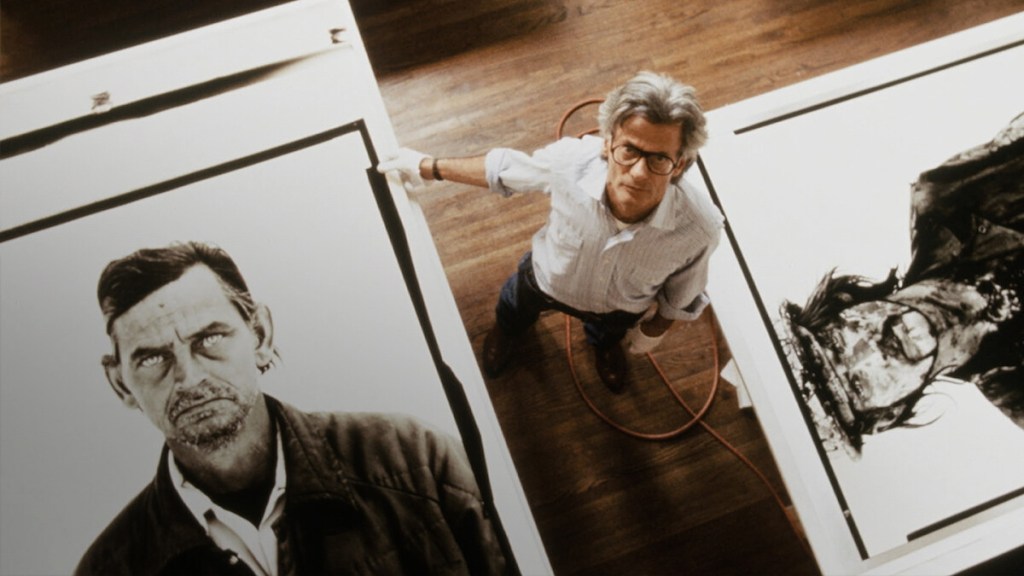
Ron Howard’s new Netflix documentary revisits one of the twentieth century’s most influential photographers, whose images transformed fashion, celebrity and portraiture. With unprecedented access to his archives, the film explores a man whose fascination with beauty was matched by an equally powerful curiosity about human vulnerability.
In 1955, Richard Avedon photographed the model Dovima standing between two elephants at the Cirque d’Hiver in Paris. Dressed in an elegant black Christian Dior evening gown, her arms extended towards the enormous animals, she appeared to command the entire composition through the effortless movement of her body.
Dovima with Elephants became one of the defining fashion photographs of the twentieth century. Its theatrical combination of elegance, movement and improbable scale demonstrated how dramatically Avedon had transformed a medium previously dominated by comparatively static representations of clothes.
Yet the photograph also contains a less comfortable detail. The elephants are chained, their enormous bodies restrained within the carefully constructed fantasy. The contrast between beauty and constraint provides an intriguing introduction to a photographer whose work repeatedly examined the uneasy relationship between appearance, power and reality.
A new documentary, Avedon (2026), directed by Ron Howard, explores those contradictions through previously unseen photographs, archival footage and interviews with people who knew and worked alongside him.
Premiering at the Cannes Film Festival in May, the 104-minute film arrives on Netflix on 11 November 2026.
The Man Who Reinvented Fashion
Born in New York in 1923, Richard Avedon entered fashion photography during the 1940s, working under the influential art director Alexey Brodovitch at Harper’s Bazaar.
His approach challenged the prevailing conventions of the fashion photograph. Models were encouraged to move, laugh, run and occupy the world around them. Fashion became a form of performance, its images infused with energy, spontaneity and an unmistakable sense of contemporary life.
Avedon’s collaborations with figures including Dovima, Suzy Parker, Veruschka and Twiggy helped establish a new visual vocabulary for the fashion industry.
Later, his work for Vogue, The New Yorker and major international campaigns would extend that influence across advertising, editorial photography and the emerging culture of celebrity.
But Avedon’s fascination with the human face was never limited to beauty.
His portraits of Marilyn Monroe, Audrey Hepburn, Truman Capote, Andy Warhol and countless other cultural figures frequently exposed qualities that their carefully maintained public identities seemed designed to conceal.
Against a plain white background, stripped of the reassuring details of a familiar environment, his subjects became extraordinarily present.
The resulting images could appear intimate, confrontational or deeply uncomfortable. Avedon’s portraits did not offer transparent access to another person’s inner life; they recorded the complex encounter between photographer, subject and camera.
The distinction was central to his understanding of photography as an interpretative art.
The Other America
Avedon’s work extended far beyond the glamorous world that established his reputation.
In 1964, he collaborated with his former school friend, the writer James Baldwin, on Nothing Personal, an extraordinary photographic and literary examination of American identity.
Published during the civil rights era, the book juxtaposed portraits of political leaders, cultural figures and ordinary Americans with Baldwin’s searching analysis of race, freedom and national contradiction.
Avedon’s photographs of civil rights activists, anti-war protesters and victims of the Vietnam War demonstrated an increasingly explicit political engagement.
Perhaps his most ambitious undertaking was In the American West, developed between 1979 and 1985 through a commission from the Amon Carter Museum of American Art in Texas.
Travelling across the western United States, Avedon photographed miners, oil workers, drifters, slaughterhouse employees and other individuals rarely afforded the attention traditionally reserved for cultural celebrities.
The subjects were photographed against his familiar white background, removing almost every indication of their surroundings.
The results remain arresting, although the project also raises questions about representation and authority. Avedon exercised enormous control over the final images, and the transformation of working-class Americans into monumental photographic subjects was both artistically radical and ethically complicated.
The relationship between the celebrated fashion photographer and the people whose lives he documented remains one of the most fascinating tensions within his career.
Behind the Photograph
Howard’s documentary draws upon the archives of the Richard Avedon Foundation, including previously unseen photographs and extensive recordings of the photographer discussing his work.
Contributors include Isabella Rossellini, Lauren Hutton, Twiggy, Calvin Klein, Tina Brown, art dealer Larry Gagosian and Avedon’s son, John.
Their recollections offer an opportunity to examine the personality behind the extraordinary images: a demanding perfectionist whose professional accomplishments were accompanied by complicated personal relationships and an almost relentless commitment to work.
In an interview at Cannes, Howard described Avedon’s continuous reinvention as one of the essential themes of the film.
The documentary also considers the tension between commercial success and artistic ambition, a distinction that Avedon repeatedly challenged throughout his career.
Early reviews have welcomed the film’s extensive archival material and engaging account of his photographic innovations, although some critics have questioned whether its largely admiring approach fully confronts the more difficult aspects of his personal and professional life.
That tension is worth acknowledging. Avedon was a photographer of extraordinary technical and psychological sophistication, but his photographs were always shaped by his own interests, judgments and power over the people who stood before his camera.
His achievement was to make that encounter central to the image itself.
In an age dominated by carefully controlled public identities, endlessly circulating portraits and increasingly artificial representations of human appearance, Avedon’s work feels unexpectedly contemporary.
He understood that a photograph could transform the cultural significance of its subject, whether a celebrated actress or an anonymous labourer. He also recognised that the camera’s apparent ability to reveal the truth was inseparable from its power to construct an image.
Howard’s documentary offers an opportunity to revisit that extraordinary body of work and reconsider the photographer whose influence continues to shape how we present, scrutinise and remember one another.
Watch the documentary
Avedon (2026)
Director: Ron Howard
Running time: 104 minutes
Premiered: Cannes Film Festival, 17 May 2026
Netflix release: 11 November 2026

