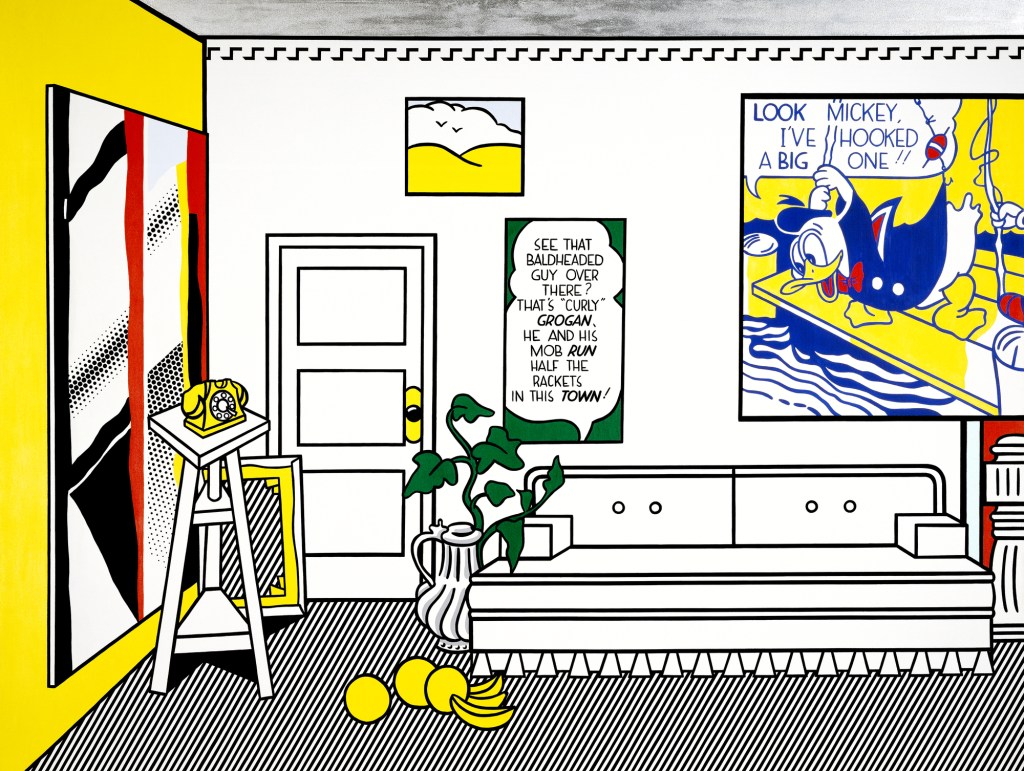
At the Whitney Museum of American Art, Roy Lichtenstein: Like New brings the artist’s remarkable studio paintings into conversation with Matisse, his own earlier work and the imaginary interiors he continued to explore in later life.
In Artist’s Studio “Look Mickey” (1973), Roy Lichtenstein furnished an imaginary room with an inventory of his own art. A sofa, telephone and potted plant establish the familiar surroundings of a domestic interior. Above the furniture hangs a reproduction of Look Mickey (1961), the painting of Donald Duck and Mickey Mouse that helped launch his Pop Art career. Another wall carries a comic-book speech balloon, while fragments of paintings and decorative motifs occupy the remaining space.
Lichtenstein has arranged his work as though it belonged to a private collection, transforming paintings into household possessions within another painting.
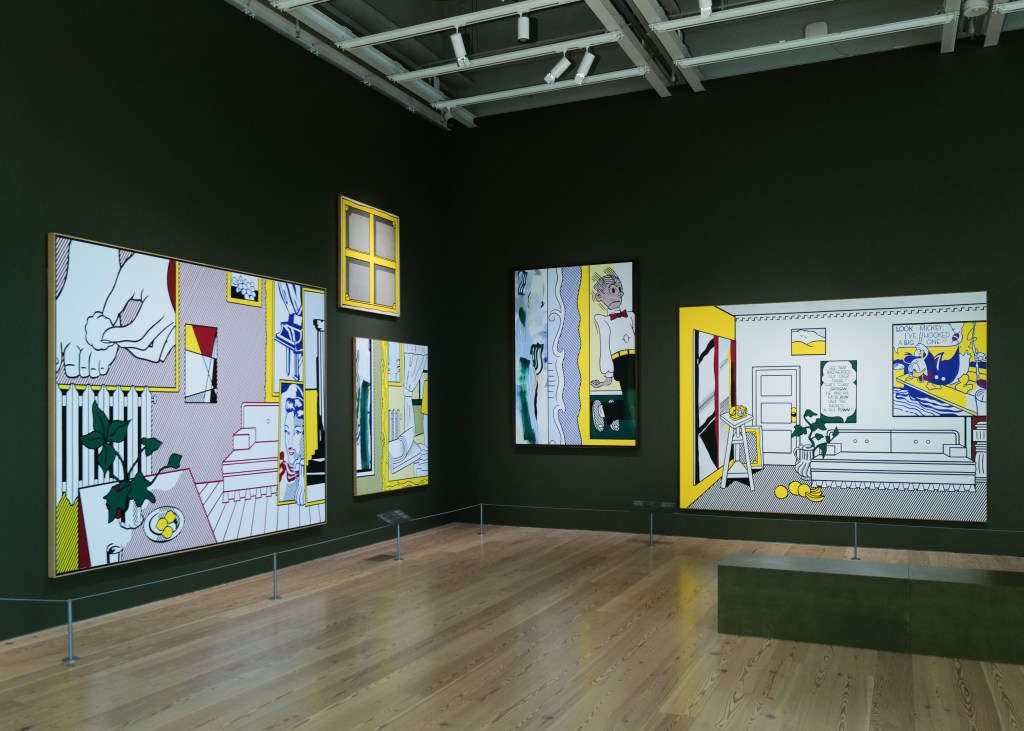
At the Whitney Museum of American Art in New York, the relationship has been given a new dimension. In Roy Lichtenstein: Like New, organised by curator Meg Onli and artist Alex Da Corte, the original Look Mickey is displayed alongside other works that appear in the fictional studio. Da Corte has even created a painting from the comic-book speech balloon that previously existed only inside Lichtenstein’s composition.
The installation belongs to a retrospective of more than 130 works spanning six decades, but its examination of the Artist’s Studio paintings is particularly revealing. These large canvases from 1973–74 offer an opportunity to consider Lichtenstein through the history of the painted interior, a tradition that reaches well beyond the comic-book imagery for which he became famous.
From Matisse to the Imaginary Atelier
A principal reference for Lichtenstein’s studio paintings was Henri Matisse, particularly The Red Studio and The Pink Studio, both painted in 1911.
Matisse’s The Red Studio depicts his workspace in Issy-les-Moulineaux, its furniture, paintings, sculptures and decorative objects organised within a striking red interior. Although the objects correspond to things that existed in the studio, the room itself is extensively transformed. Matisse covered almost the entire composition in Venetian red, allowing the paintings and sculptures to retain their individual colours while furnishings and architectural details were reduced to lines and spaces within the painted surface.
The room becomes a setting for Matisse’s own artistic production, presenting an informal retrospective in which the artist’s paintings and sculptures exist within another of his paintings.
Lichtenstein recognised the possibilities of this arrangement. By the early 1970s, he had spent more than a decade developing an immediately identifiable pictorial language. His paintings of comics, advertisements, household objects and modernist art had given him a considerable repertoire of images. Matisse’s studio compositions suggested a way of bringing those images together.
But where Matisse transformed an identifiable physical workspace, Lichtenstein invented his interiors. They were assembled from reproductions, earlier paintings, preparatory drawings, architectural details and familiar objects, all translated into the graphic language of Pop Art.
These are not records of the rooms in which Lichtenstein worked. They are constructed spaces in which different moments of his artistic career can coexist.
The art historian Bernice Rose examined their development in The Drawings of Roy Lichtenstein, published by the Museum of Modern Art in 1987. Her research demonstrated how carefully Lichtenstein prepared these apparently effortless compositions. For Artist’s Studio “Look Mickey”, he projected a small preparatory drawing to produce a larger study, photographed that drawing and projected it onto the canvas.
Further adjustments were made through successive corrections, sometimes using pieces of paper pasted over earlier drawings. What appears to be a casually furnished room is therefore the product of calculated decisions about scale, balance, line and the relationships between objects.
The furniture, decorative features and architecture establish a spatial framework, but the artworks occupy a different visual order. They compete for attention, overlap with architectural boundaries and sometimes appear only as fragments. Lichtenstein made the room serve the composition rather than allowing conventional perspective to determine how the paintings should be displayed.
Pictures Within Pictures
The Whitney’s presentation makes this process unusually accessible.
Artist’s Studio “Look Mickey” combines images produced at different moments of Lichtenstein’s career. The original Look Mickey, painted in 1961, had not yet been publicly exhibited when he incorporated it into the 1973 studio composition. According to the Whitney’s accompanying exhibition label, the work finally received its first public showing in 1982.
Artwork © Estate of Roy Lichtenstein. Photograph by Jason Lowrie/BFA.com
The studio painting also includes motifs that Lichtenstein had not yet developed into independent works. Landscape (1974), displayed nearby in the Whitney exhibition, emerged as a separate painting after appearing in the imaginary room.
Da Corte’s Comic Painting (2026) extends this unusual chronology. A comic-book speech balloon included in the studio painting had never existed as a corresponding independent work. Da Corte has now made one, creating an object that belongs simultaneously to Lichtenstein’s fictional arrangement and to the present exhibition.
The Whitney’s gallery consequently functions as something more complex than a conventional retrospective display. It brings together the original paintings, their subsequent reinterpretations and, in one case, a work created in response to an image that had never previously existed outside another painting.
In Artist’s Studio “Foot Medication” (1974), Lichtenstein developed the arrangement further. The composition includes a sofa, plant, decorative table and framed images, but the paintings refuse to remain discreet objects on the walls. A fragmented image of a foot-treatment illustration occupies part of the composition, while a woman’s face and geometric abstractions interrupt the surrounding architecture.
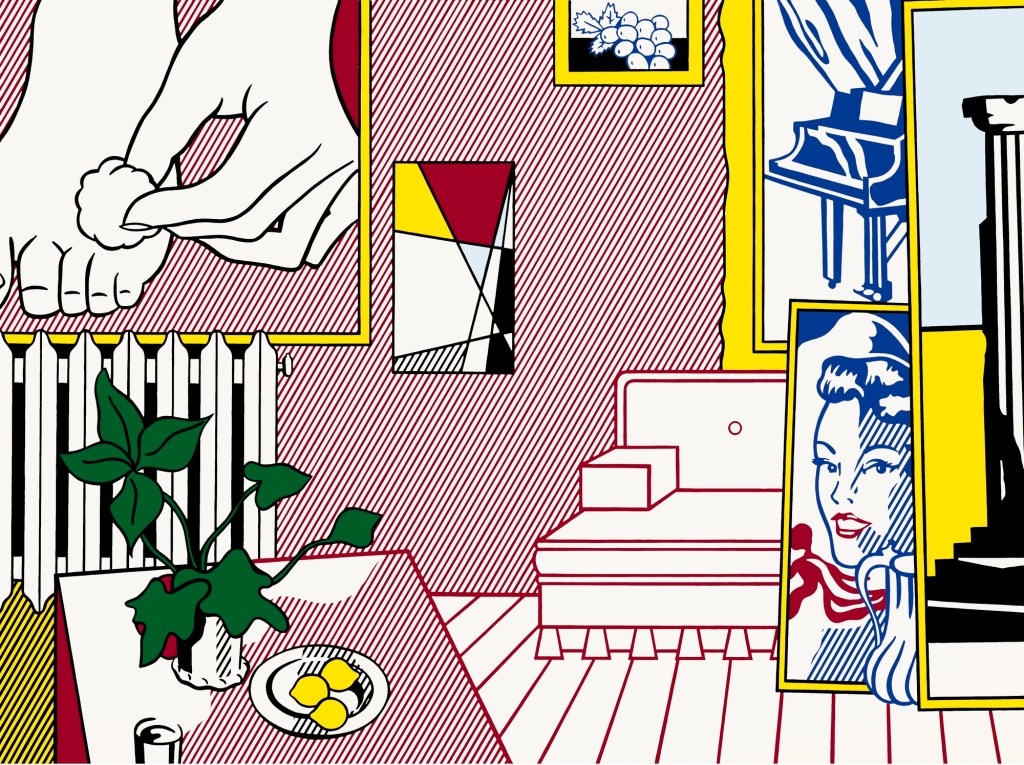
The patterned walls and sharply angled floor help organise these competing elements. Individual pictures become components of a larger design, their original subjects subordinated to the spatial relationships between colour, line and form.
The apparent interior design is inseparable from the process of painting. Lichtenstein is arranging one image inside another, testing how fragments retain or surrender their identities when placed in a new setting.
The relationship with Matisse becomes more explicit in Artist’s Studio “The Dance” (1974), now in the collection of the Museum of Modern Art.
Across the rear of the studio, Lichtenstein reinterprets the dancers from Matisse’s celebrated Dance. In the foreground are lemons, vessels, flowers, paintbrushes and pieces of driftwood. Musical notes appear at an opening on the right. The dancers, stripped of Matisse’s original colouring, become part of a larger arrangement of black outlines, patterned surfaces and carefully distributed objects.
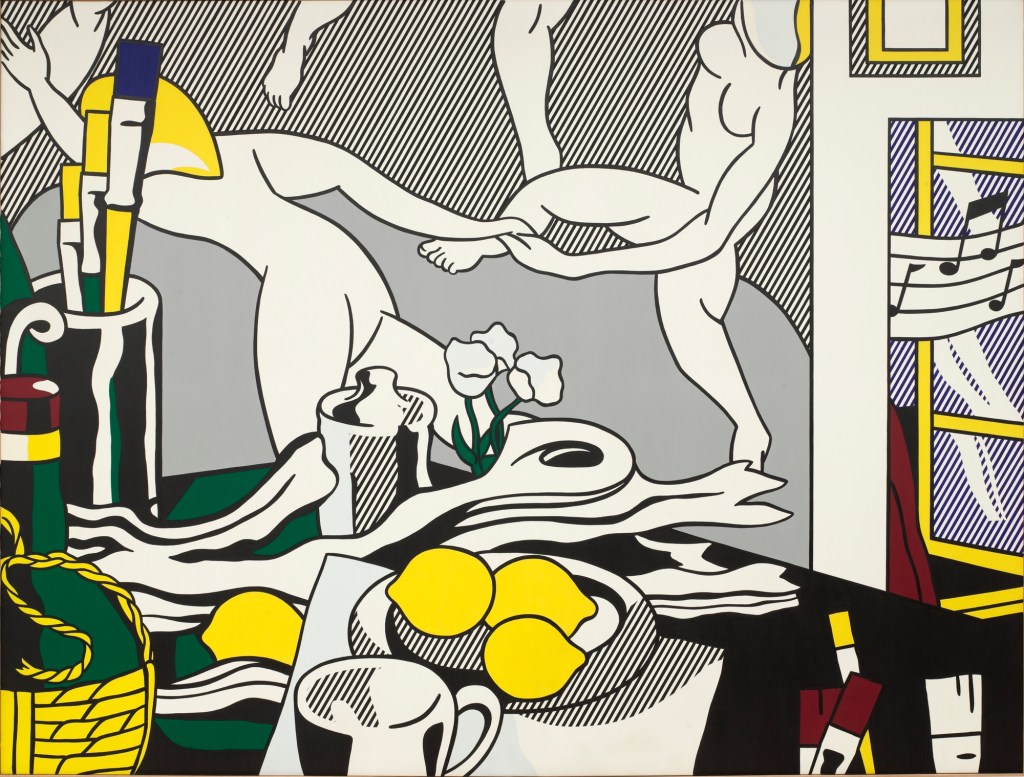
Matisse’s figures retain their recognisable movement, but their placement changes their function. What was conceived as a monumental composition of bodies in motion becomes part of the visual furnishing of another painting.
The Whitney reinforces this art-historical relationship by including Matisse’s Study after Dance (I), dating from around 1909, in the same section. The drawing offers a direct point of comparison between the movement of Matisse’s figures and Lichtenstein’s transformation of them into his own pictorial vocabulary.
From the Artist’s Studio to the Modern Home
The studio paintings were an important beginning rather than an isolated episode.
In the late 1980s and early 1990s, Lichtenstein returned to the subject of interiors, developing large compositions based partly on furniture advertising and illustrated representations of modern homes. During a stay in Rome in 1989, a billboard advertising furniture stimulated his interest in the subject.
These later rooms have a different character from the studios of the 1970s. Furniture, paintings, sculptures and architectural details are arranged within interiors that resemble idealised advertisements or carefully staged magazine photographs. The rooms are immaculate, sometimes almost clinically so, and human presence is generally absent.
The paintings often include references to Lichtenstein’s own work and to other modern artists. Sculpture, furniture and pictures become components of a visual language in which the distinction between domestic decoration and fine art is deliberately unsettled.
When the Museum of Contemporary Art Chicago organised Roy Lichtenstein: Interiors in 1999, it traced these compositions from sketches and collages to monumental paintings. The exhibition demonstrated how the interiors of Lichtenstein’s final years brought together subjects and formal ideas developed throughout his career.
There is also something faintly disquieting about their perfection. The rooms contain the signs of cultivated taste without the irregularities of occupation. Leo Castelli, Lichtenstein’s longtime dealer, described the environments as too clean to be habitable, an observation discussed in Christie’s account of the later interior paintings.
That observation offers a useful distinction between the artist’s studio paintings and his later domestic interiors. In the former, the room serves as a gathering place for artistic ideas. In the latter, it increasingly resembles an image of a lifestyle, composed from the visual conventions through which modern interiors are marketed and consumed.
The Whitney includes Interior with Perfect Painting (Study) (1992) among the works in its Artist’s Studio section, allowing this later development to be considered alongside the earlier studio compositions.
An earlier stage in this development can be seen in Two Paintings: Radiator and Folded Sheets (1983). A radiator and folded fabric occupy a sharply defined pictorial space alongside an expressive painted passage. The domestic interior has become another opportunity for Lichtenstein to bring different conventions of representation into a single composition.
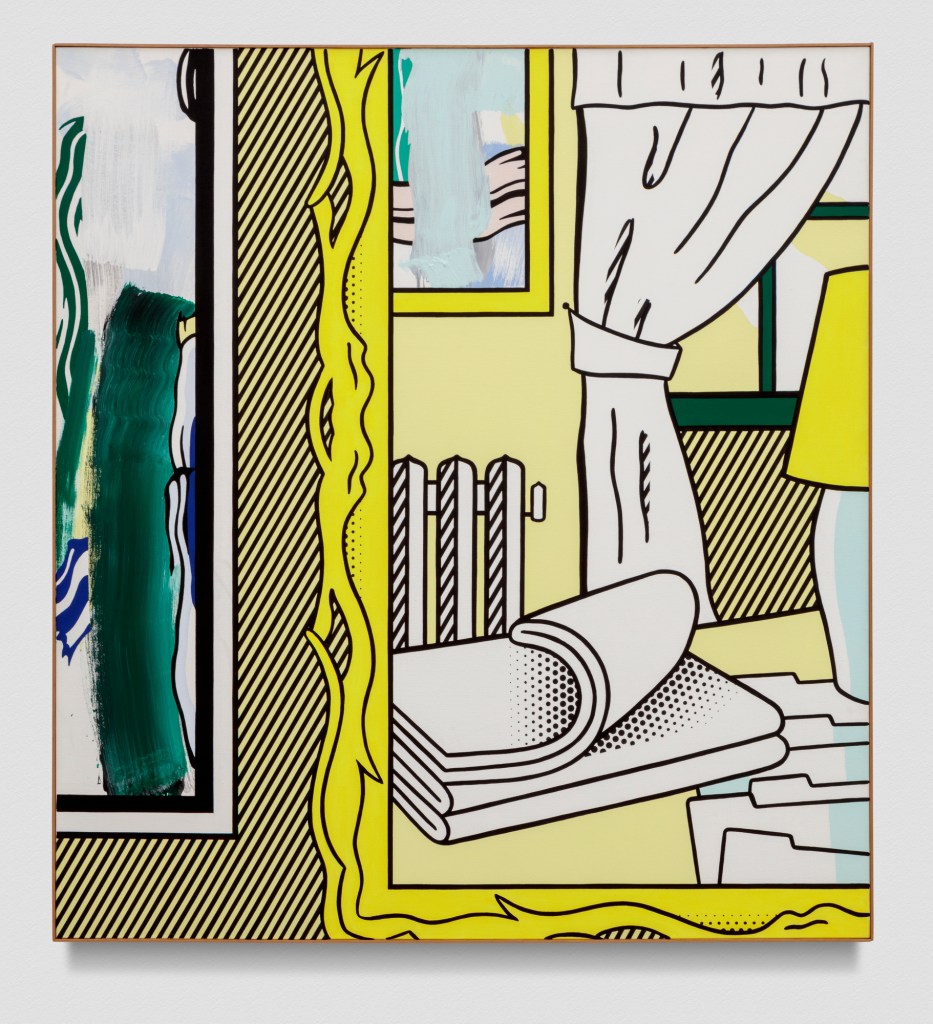
Yet the attraction of these paintings also presents a difficulty. Lichtenstein’s ability to translate almost anything into his characteristic visual language can make the distinctions between artworks, decorative objects and reproductions seem remarkably slight. The paintings gain their coherence through this process, but they can also become enclosed within an endlessly repeating vocabulary of the artist’s own inventions.
The Whitney’s decision to exhibit the original works alongside their appearances in the studio paintings helps restore some of those distinctions. It allows the viewer to examine what was changed, what was retained and what emerged only through the new composition.
The most compelling feature of this installation is its treatment of the painted room as an active part of Lichtenstein’s artistic process. His studios were neither reliable records of working life nor simple celebrations of the art he had already made. They allowed him to reconsider existing pictures, test new compositions and occasionally anticipate works that would emerge years later.
At the Whitney, those relationships can be examined in physical space. Lichtenstein’s imagined studio has been opened up, and the pictures that once occupied its walls have acquired a life outside the room.
Roy Lichtenstein: Like New
Whitney Museum of American Art, New York
11 October 2026 – 10 May 2027
For a broader examination of the retrospective, read our accompanying feature, Roy Lichtenstein: Like New at the Whitney.
Cover image: Roy Lichtenstein, Artist’s Studio “Look Mickey” (Study), 1973. Colored pencil, graphite pencil, acrylic and collage on paper, 17 × 22 1/2 in. (43.2 × 57.2 cm). Whitney Museum of American Art, New York; gift of the Roy Lichtenstein Foundation 2019.47. © Estate of Roy Lichtenstein/DACS 2026
