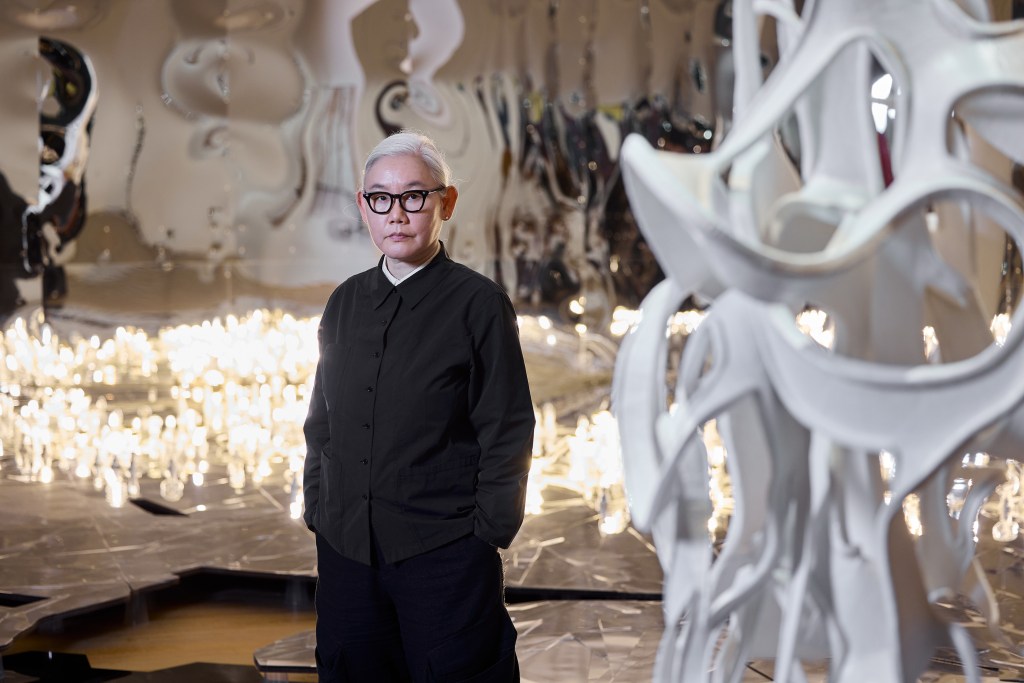
From futuristic cyborgs to the remnants of twentieth-century utopian architecture, a major exhibition at M HKA in Antwerp examines the South Korean artist’s fascination with technological progress, political power and the human desire for perfection.
A silver airship measuring ten metres in length occupies the Pointed Hall of Antwerp’s Museum of Contemporary Art. Its reflective surface and elegant proportions recall a period when aviation promised to transform humanity’s relationship with distance. Yet the historical reference behind Lee Bul’s Willing To Be Vulnerable – Metalized Balloon (2019) is the Hindenburg, whose destruction in 1937 became one of the defining images of technological catastrophe in the twentieth century.
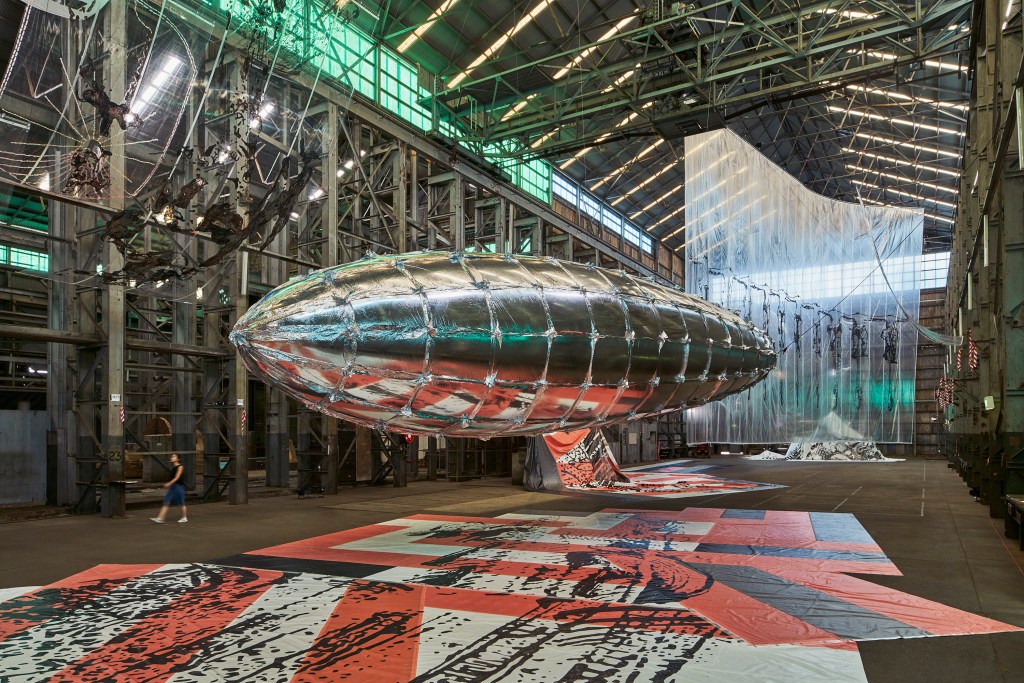
The airship is among the central works in Lee Bul: From 1998 to Now, a major survey at M HKA running until 7 March 2027. Organised in collaboration with the Leeum Museum of Art in Seoul and M+ in Hong Kong, the exhibition occupies two floors of the Antwerp museum, bringing together sculpture, architectural installations, drawings and preparatory models. Antwerp is the exhibition’s only European destination before it travels to the National Gallery of Canada in Ottawa.
Throughout her career, Lee Bul has examined the ambitions that shape the environments we inhabit and the bodies we occupy. Architecture holds a particular significance within her work because buildings give physical form to ideological aspirations. A society’s understanding of progress can be read in its construction projects, its infrastructure and the spaces it reserves for its citizens.
Growing up within modernity
Born in South Korea in 1964, Lee grew up during a period of authoritarian government and accelerated industrialisation. Her parents were political dissidents, and the family moved frequently under government surveillance. The economic and architectural transformation of South Korea, experienced from the precarious position of a politically marginalised family, would become central to her understanding of modernity.
In a 2018 interview with curator Stephanie Rosenthal, published in connection with her exhibition at London’s Hayward Gallery, Lee recalled the industrial landscapes and military settlements of her childhood alongside a very different domestic memory.
Unable to secure conventional employment because of her political circumstances, her mother earned money through knitting and beadwork. As a frequently ill child, Lee spent considerable time surrounded by brightly coloured beads and textiles, observing the women who produced these objects.
The experience offers an important insight into her later use of decorative materials. Crystal, beads and lustrous surfaces might ordinarily suggest luxury, yet their significance for Lee also lies in the repetitive physical labour required to produce them.
This personal history complicates the apparently futuristic appearance of her sculptures. The visual language of technological advancement is frequently achieved through painstaking manual fabrication, using techniques and materials associated with much older forms of making.
The imperfect perfection of the cyborg
Lee studied sculpture at Hongik University in Seoul, subsequently establishing her reputation through experimental performances in the late 1980s and early 1990s that addressed the female body and its position within Korean society.
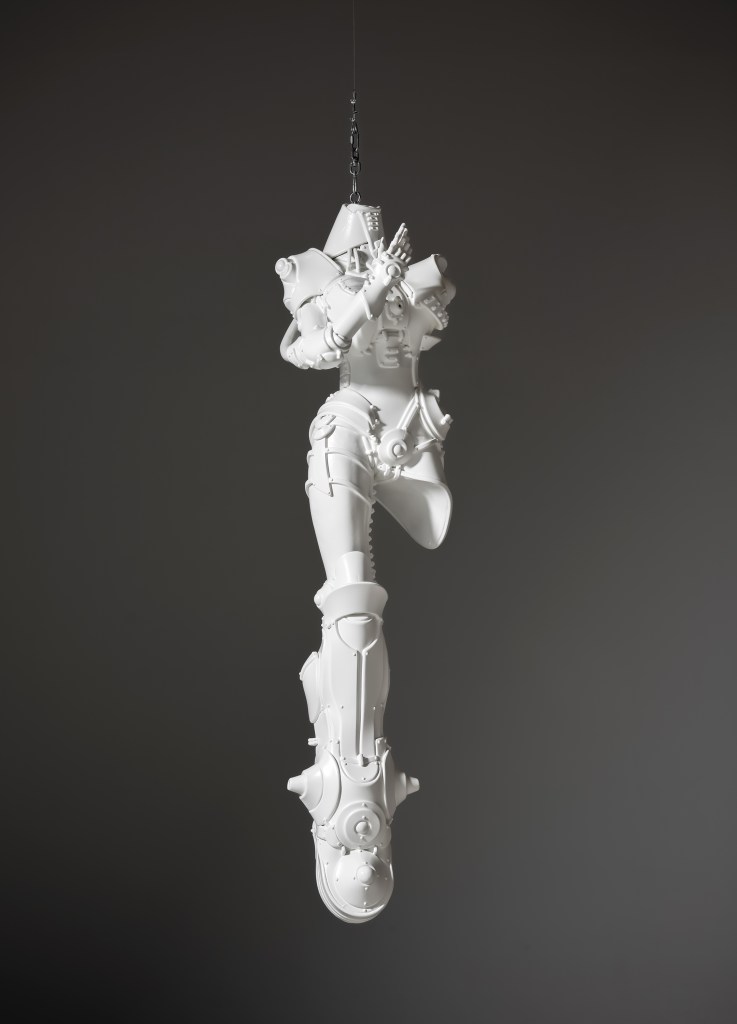
Her Cyborg series, initiated in the late 1990s, extended these concerns into the realm of technological transformation.
The white, suspended figures evoke the fragmented bodies of classical sculpture. Their anatomical forms, interrupted by mechanical components and artificial extensions, also belong to the visual world of science fiction.
The apparent incompleteness of these figures is significant. In surviving examples of ancient sculpture, missing limbs are generally understood as the consequence of damage sustained over centuries. In Lee’s cyborgs, fragmentation is part of their original conception. The technologically enhanced body remains an unresolved construction.
The series also exposes a persistent contradiction in representations of the female body: technological sophistication does not necessarily free it from inherited expectations of physical beauty. The cyborg may possess extraordinary capabilities while remaining subject to familiar aesthetic ideals.
In a 2026 conversation with Doryun Chong at M+, Lee explained that the relationship between technology and power had been central to these works from their inception, although early interpretations frequently concentrated on their connections with popular culture and science fiction.
Building the ideal world
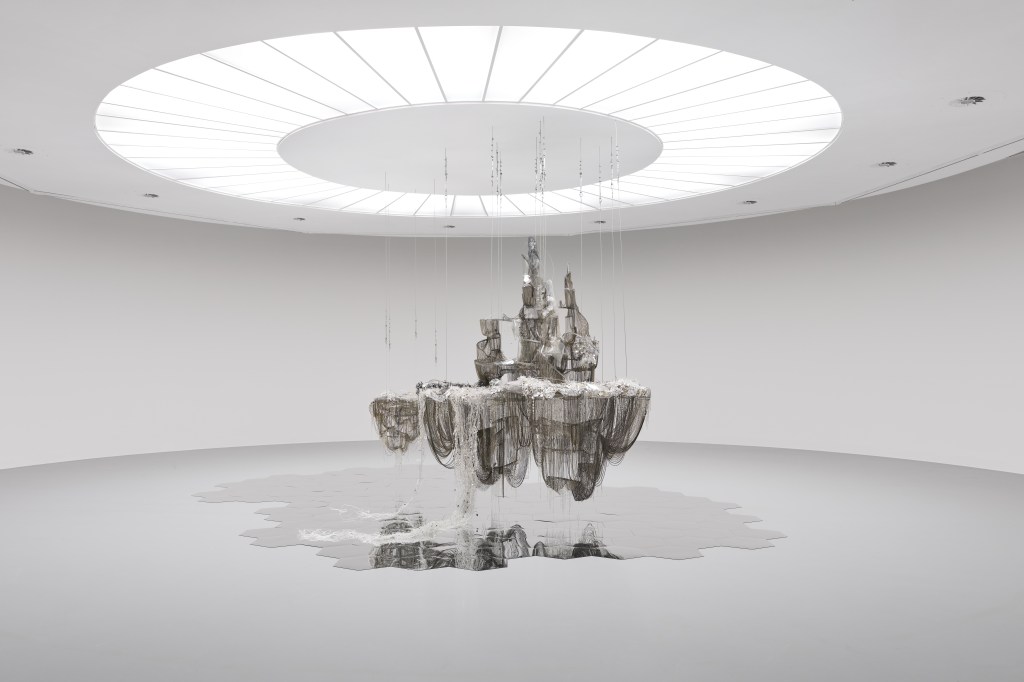
From 2005 onwards, Lee’s ongoing Mon grand récit series expanded her investigation of modernity into elaborate architectural landscapes.
An early installation, Mon grand récit: Weep into stones… (2005), incorporates references to the architectural imagination of Hugh Ferriss and the unrealised projects of the Russian avant-garde artist Vladimir Tatlin, alongside a sectional model of Hagia Sophia. These references, discussed in Andy St. Louis’s 2025 profile of Lee for Frieze, bring together architectural expressions of different historical and political ambitions.
Lee rearranges the fragments of these visions into speculative environments of her own. Their resemblance to architectural models is particularly revealing: ordinarily, a model precedes a building and represents a future that might eventually become inhabitable. Her constructions often appear suspended in this preliminary state, somewhere between conception and realisation.
In Aubade (2007), aluminium, electrical wiring, lights and glass beads form a structure suggestive of urban infrastructure. Its exposed framework gives the work the character of an unfinished construction, while its decorative elements complicate the distinction between ornament and engineering. The materials recall both the industrial landscape of Lee’s childhood and the domestic labour she witnessed there.
A later work, Aubade V (2019), brings these architectural investigations into direct contact with the political geography of the Korean peninsula. The tower-like sculpture incorporates material salvaged from dismantled guard posts in the Demilitarised Zone separating North and South Korea. An electronic display carries information concerning the inclination of the Earth’s axis.
There is a considerable difference in scale between the planetary phenomenon described on the display and the territorial divisions embodied in the sculpture’s physical components. A material once employed to enforce a political boundary becomes part of an object that situates that boundary within a much larger geographical and temporal perspective.
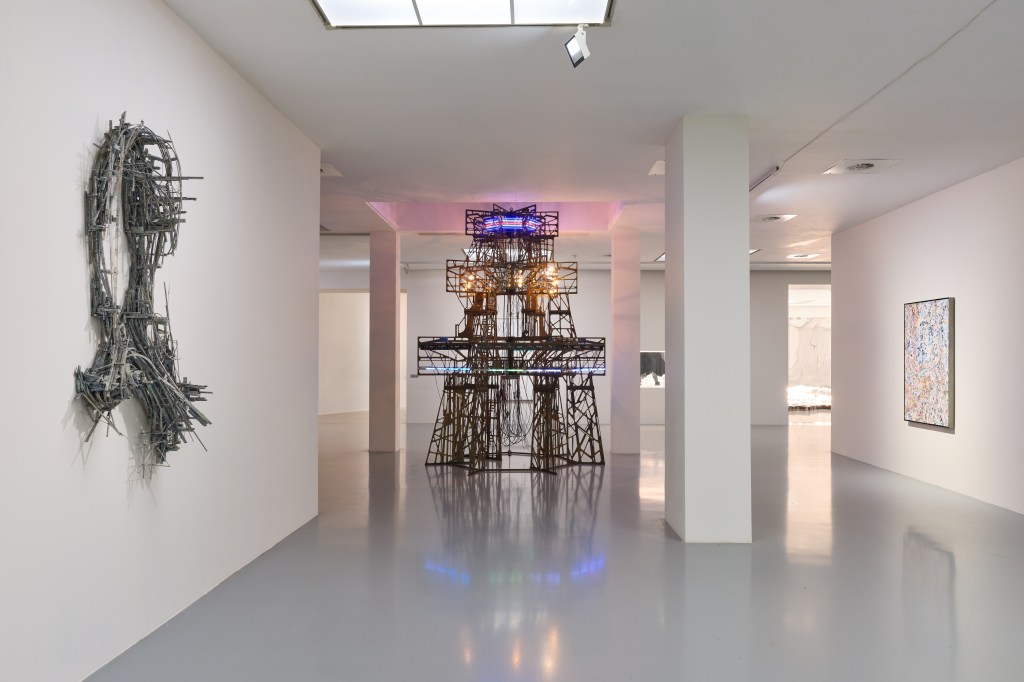
Installation view ‘Lee Bul: From 1998 to Now’, M HKA, 2026. Photo: We Document Art.
The future, made by hand
One of the most valuable aspects of the Antwerp exhibition is its inclusion of drawings, sketches and maquettes alongside the completed installations. They make visible the process through which Lee develops her imaginary structures, adjusting their proportions and experimenting with materials before undertaking their construction.
The earlier presentation at M+ in Hong Kong similarly emphasised the importance of her studio practice, documenting the intricate material composition of works whose finished surfaces can appear almost industrially manufactured.
There is a generosity in making these intermediate stages visible. They allow the audience to consider the decisions behind the spectacle and to recognise how much physical work goes into constructing an imagined future.
Lee’s sculptures repeatedly return to the distance between an idea and its material consequences. The architectural model, the cyborg and the airship each embody a particular ambition for human advancement, but their forms preserve the vulnerabilities that such ambitions frequently overlook.
Seen in the context of her upbringing, the attention she gives to materials and manual labour acquires an additional significance. The future, however technologically sophisticated its appearance, remains something made by human beings within particular social and political conditions. It is this human involvement, with all its imperfections and limitations, that makes Lee Bul’s imagined worlds so compelling.
Lee Bul: From 1998 to Now
13 November 2026 – 7 March 2027
M HKA — Museum of Contemporary Art Antwerp
Leuvenstraat 32, Antwerp, Belgium
Exhibition information and tickets
Cover image: Portrait of Lee Bul. © Lee Bul. Photo: Dan Leung. Courtesyof M+, Hong Kong
