
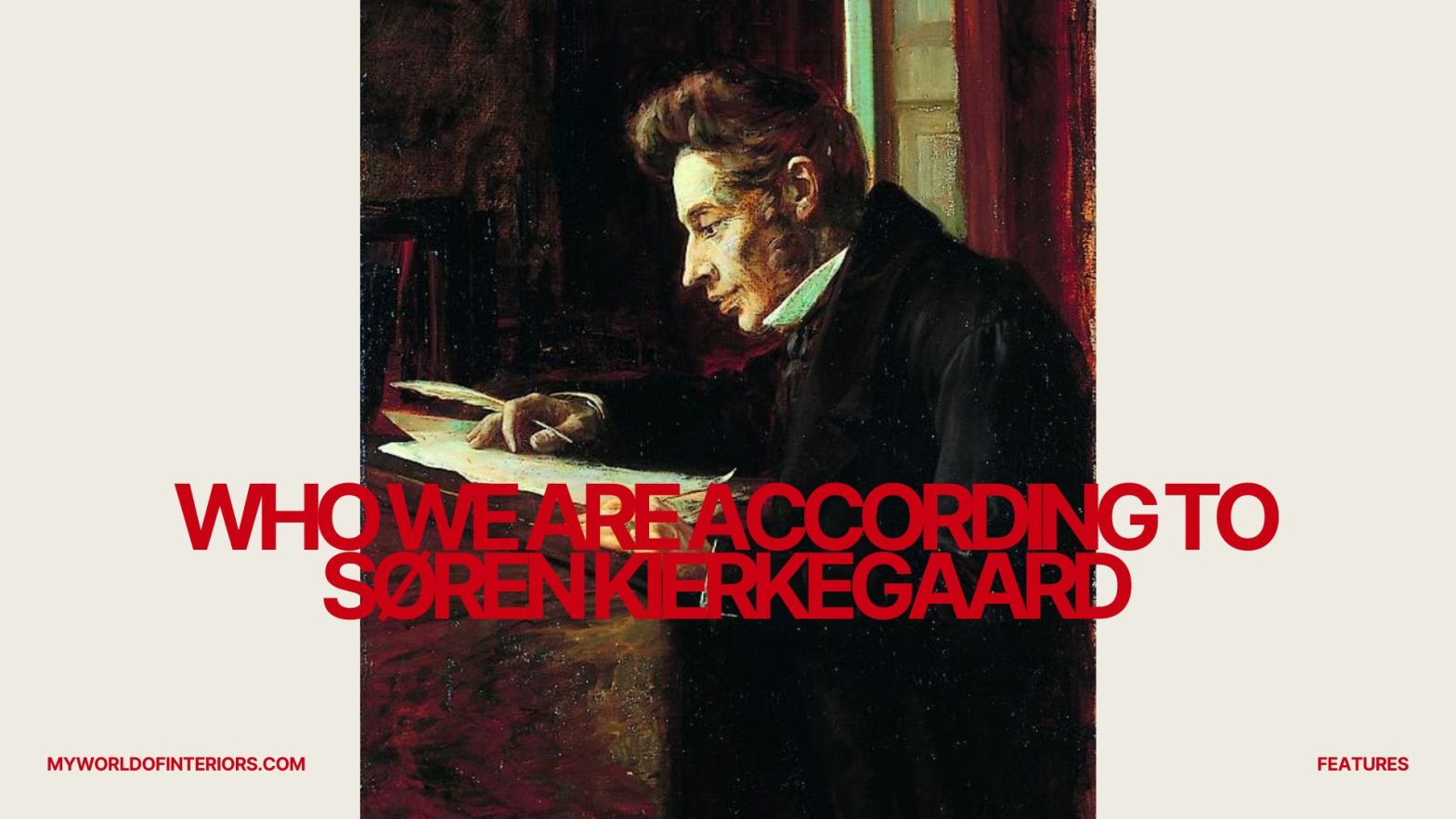
He wrote under false names, spoke in riddles, and refused to give answers. He died at forty-two having produced, in a little over a decade, the most searching account of what it means to be a human being that Western philosophy has ever attempted. Kierkegaard did not want to make things easy for you. He wanted to make things real.
By Bergotte
There is a passage near the beginning of The Sickness Unto Death, published in 1849 under the pseudonym Anti-Climacus, that announces its subject with the compressed ferocity of someone who has run out of patience with the alternatives:
“A human being is spirit. But what is spirit? Spirit is the self. But what is the self? The self is a relation that relates itself to itself, or it is that in the relation that the relation relates itself to itself; the self is not the relation but the relation’s relating itself to itself.”
This sentence has been called obscure by people who want philosophy to be cleaner than the things it is trying to describe. It is not obscure. It is precise — precisely adequate to something that is genuinely complicated, genuinely resistant to the simpler formulations that philosophy, in its more optimistic moods, has reached for. What Kierkegaard is saying is this: you are not a thing. You are not a substance, a soul-particle, a set of properties that could in principle be listed and filed. You are a process — the process of relating to yourself, of being aware of yourself, of taking a stance on what you are and what you will be. You are the activity of becoming, and the activity never stops, and you cannot opt out of it, and the failure to understand this is the source of most of the misery that passes, in ordinary life, for simply the way things are.
Søren Aabye Kierkegaard was born in Copenhagen in 1813, the youngest of seven children of a wool merchant named Michael Pedersen Kierkegaard, who was a man of melancholic temperament, intense religiosity, and sufficient commercial success that his youngest son would never need to work for money, which was, given the work the youngest son had to do, providential. The father had, as a young man on a Jutland heath, shaken his fist at God and cursed him for the misery of his life. He later came to believe that this act of blasphemy had brought a curse down on his family — a belief confirmed, as he aged, by the deaths of five of his seven children before they reached adulthood. Søren, one of the two who survived, grew up in the shadow of this theology: in the knowledge that his father believed the family was damned, that suffering was the condition of their existence, that God’s presence in a life was not necessarily a comfortable thing.
He was brilliant, difficult, physically odd — he had a spinal curvature that gave him an irregular gait and that he was mocked for, which contributed to the outsider sensibility that saturates all his writing. He studied theology at the University of Copenhagen, fell in love, became engaged to a woman named Regine Olsen and then, in circumstances that he never fully explained and that generated enormous speculation both during his lifetime and after, broke the engagement. He never married. He lived alone, wrote prodigiously under a series of pseudonyms that were themselves philosophical positions rather than mere disguises, engaged in a public feud with the established Church of Denmark that consumed the last months of his life, and died of a spinal illness in November 1855, having refused — with the same ornery consistency that characterised everything he did — to receive communion from a pastor rather than a layman.
He was not, in his own lifetime, famous beyond Copenhagen. He is now understood as the founder of existentialism, the thinker who turned philosophy from its preoccupation with systems and certainties toward the irreducible, unsystematisable experience of the individual life. He was the first modern philosopher to ask, with genuine seriousness and genuine difficulty, what it is to be a self — not what the self is made of, in the way of the metaphysician, nor what the self knows, in the way of the epistemologist, but what it is to be one, in the way that only someone who has been genuinely troubled by the question can ask it.
The Crowd Is Untruth
Begin here, because everything else depends on it: Kierkegaard’s conviction that the individual — the single, specific, irreplaceable human being with her particular history and her particular fears and her particular relationship to the question of what her life is for — is the only unit of moral and existential reality that matters.
This sounds obvious. It is not obvious, or rather it has never been obvious in practice, because the history of human social organisation is in large part the history of the devices by which the individual is dissolved into the collective — absorbed into the crowd, the nation, the class, the church, the market, the social media feed — and the dissolution is made to feel not like a loss but like a relief. The crowd offers something that the individual, standing alone with the full weight of her own existence, cannot offer: the comfort of not having to decide, of not having to be responsible, of being carried by the movement of the many rather than having to generate, from her own uncertain resources, the forward motion of a life.
Kierkegaard despised the crowd. “The crowd is untruth,” he wrote, in a formulation so compressed that it requires unpacking. He did not mean that crowds are always factually wrong, though they often are. He meant that the mode of being that the crowd represents — the dissolution of individual responsibility into collective anonymity, the replacement of genuine decision by the mere following of the general tendency — is a fundamental abdication of what it means to be human. The person who does what is done, who thinks what is thought, who values what is valued, simply because this is what the crowd does and thinks and values, has not actually become a person in the sense that Kierkegaard thought mattered. She has become a function — a node in a network, a point through which the crowd’s energy passes, without the resistance or the friction that genuine selfhood produces.
This is a position with obvious political implications that Kierkegaard did not pursue systematically, because he was not a political thinker. But the implications are there. The totalitarianisms of the twentieth century — which Kierkegaard did not live to see but which his analysis, in some sense, predicted — required precisely the dissolution of individual moral responsibility into the collective that he was diagnosing. Hannah Arendt’s concept of the banality of evil — the idea that the great crimes of the modern period were committed not by monsters but by people who had simply, thoroughly, stopped thinking for themselves, had substituted the movement of the system for the exercise of individual moral judgment — is, in this sense, Kierkegaardian before it is Arendtian. The crowd is untruth, and the crowd in motion can do things that no individual, required to be responsible for her own choices, would do alone.
But the political application, though genuine, is secondary. The primary target of the diagnosis is more intimate than fascism. It is the respectable life — the life conducted in accordance with what one is supposed to do, want, value, and be, without the question ever being asked, genuinely and with full seriousness, whether these are the things one actually does, wants, values, and is. The crowd that Kierkegaard is most concerned with is the crowd of the ordinary — the vast majority of human beings who have never been called upon to follow a dictator into atrocity but who have, nonetheless, failed in the quieter way of never having decided who they are.
The Three Stages, or: The Lives Available to You
Kierkegaard proposed — through his pseudonyms, in his characteristically indirect way, without quite asserting it as a systematic theory — that human life could be understood as moving through three stages or spheres of existence, each representing a different fundamental orientation to the question of what one’s life is for.
The first is the aesthetic stage. The aesthetic individual — exemplified in Either/Or (1843) by the seducer Johannes, whose diary of the seduction of a young woman is one of the most disturbing and most brilliant things in European literature — organises her life around the pursuit of interesting experience, of sensation, of the moment. She is clever, witty, cultured, attuned to beauty, and she is profoundly bored — bored because the pursuit of experience, however refined, cannot generate the continuity of meaning that a self requires. The aesthetic life is the life lived on the surface of things, moving from stimulation to stimulation, unable to commit to anything that would require the sustained engagement that genuine selfhood demands. It is also, and this is important, the life that contemporary consumer culture designs for and rewards: the life of the perpetual shopper, the experience collector, the person whose identity is expressed through the things she consumes and the experiences she can photograph and upload.
The aesthetic person knows, at some level, that she is in despair — knows it in the hollow feeling that arrives after the experience, in the boredom that the next experience is required to cover over. But she does not know what to do with the knowledge, and the culture she inhabits does not help her, because the culture is organised around the provision of the next experience rather than the examination of why the experiences keep failing to satisfy.
The second stage is the ethical. The ethical individual — exemplified by Judge Wilhelm, the conventional, reasonable, married man who is the second voice in Either/Or — has moved past the aesthetic’s pursuit of sensation and committed to something: to duty, to obligation, to the social roles that give a life structure and purpose. He believes in marriage, in honest labour, in the responsibilities of citizenship. He is, in many ways, admirable. He has achieved something the aesthetic individual has not: continuity, commitment, the sense of being someone rather than merely experiencing things.
But the ethical stage, Kierkegaard argues, has its own form of despair. The ethical individual’s self is constituted by the roles she inhabits — by being a good spouse, a responsible professional, an honest citizen — and the roles are given by the society rather than chosen by the individual. The ethical person has moved from the crowd’s experience to the crowd’s values, which is progress but not arrival. She has not yet faced the deepest question: not what her society or her role requires of her, but what she, specifically and irreducibly, is.
The third stage is the religious. And here Kierkegaard’s philosophy arrives at the place where it becomes most difficult and most interesting — and most likely to lose the reader who was following comfortably up to this point.
Abraham on the Mountain, or: The Leap
Fear and Trembling (1843), published under the pseudonym Johannes de Silentio, takes the story of Abraham and Isaac — the story in which God commands Abraham to sacrifice his son, Abraham prepares to do it, and God intervenes at the last moment — and subjects it to the most sustained and most disturbing philosophical analysis it has ever received.
The question Johannes de Silentio asks is simple and devastating: what kind of act is Abraham performing on the mountain? The ethical answer is clear: he is preparing to murder his son. There is no ethical framework within which the murder of your child is permissible. Abraham, viewed ethically, is not a hero. He is either a murderer or a madman. The fact that God commanded it does not, within the ethical framework, excuse it — because the ethical framework does not recognise the authority of a divine command that overrides moral law. If anything, the divine command makes it worse: Abraham is prepared to suspend his deepest human obligation on the basis of an inner conviction that the suspension is required by a higher authority that only he can hear and that cannot be publicly verified.
This is what Kierkegaard calls the teleological suspension of the ethical — the moment at which the individual, in absolute solitude, in a relationship with God that no one else can witness or verify, acts against the universal ethical law because she has received, from her own deepest inwardness, a command that supersedes it. It is, on the face of it, an alarming position. It is also, Johannes de Silentio insists, the structure of the religious stage of existence — the stage at which the individual enters into a relationship with the absolute that is, by definition, incommunicable, because the absolute relationship is between the individual and God and passes through no social or ethical mediation.
The knight of faith — Kierkegaard’s term for the person who has made the movement that Abraham made, who lives in absolute relation to the absolute — is not recognisable from the outside. This is the point that Johannes de Silentio keeps returning to, with a wondering insistence that suggests the author is as disturbed by it as anyone. The knight of faith looks, from the outside, like an ordinary person — like the respectable burgher going about his business, enjoying his Sunday roast, unremarkable in every observable way. The extraordinary thing is entirely interior. The knight of faith has made a movement that cannot be seen, communicated, or shared — has entered into a relationship with the infinite that passes through no finite mediation, and yet continues to live in the finite world with full engagement and full delight.
The contrast is with what Kierkegaard calls the knight of infinite resignation — the person who renounces the finite, who gives up the world in the manner of the stoic or the ascetic, who achieves a kind of serene distance from earthly attachments by simply letting them go. This is admirable, Kierkegaard concedes, but it is not faith. Faith requires holding both the infinite and the finite simultaneously — renouncing Isaac and receiving him back, knowing that the renunciation is complete and genuine and that the reception is also complete and genuine, living in the tension between the two without the tension resolving. This is the leap. It cannot be understood from outside. It cannot be achieved by effort or by logic. It requires something that the philosophical tradition had not, before Kierkegaard, treated as a philosophical category: the will to trust, against all rational evidence, that the absolute is real and that the relationship with it is possible.
Anxiety and the Dizziness of Freedom
The Concept of Anxiety (1844), published under the name Vigilius Haufniensis, makes a contribution to the understanding of the human condition that has outlasted its theological context and entered the vocabulary of psychology, literature, and everyday self-understanding: the analysis of anxiety as the fundamental emotional register of human freedom.
Anxiety, for Kierkegaard, is not the same as fear. Fear has an object — you are afraid of something specific, and if that something is removed or made safe, the fear dissipates. Anxiety has no object, or rather its object is nothing — the nothing of pure possibility, the vertiginous awareness that you could be otherwise than you are, that the future is genuinely open, that the choices you make are making you rather than merely expressing a self that is already fixed. “Anxiety is the dizziness of freedom,” Kierkegaard writes, in a sentence that has been quoted so often that its precision is sometimes lost: the image is of someone standing at the edge of a great height, feeling not the fear of falling but the awareness that one could jump — that the possibility is real, that the body is capable of it, that nothing external prevents it. The dizziness is the awareness of one’s own freedom.
This is the condition of being human, and it cannot be escaped. Animals do not have it, because animals are determined by their instincts and their environment in a way that does not leave the genuine open space of possibility that anxiety inhabits. Angels do not have it — if we follow the theological tradition — because angels are pure spirit, perfectly transparent to the divine, without the opacity of embodiment and temporality that makes the human situation so difficult. Only the human being — the synthesis of the finite and the infinite, the temporal and the eternal, the necessary and the free — has anxiety, because only the human being is genuinely undetermined, genuinely free to make herself, and genuinely responsible for what she makes.
The response to anxiety that most people adopt is what Kierkegaard calls, following a tradition he is simultaneously engaging and transforming, despair. Despair, in his account, is not primarily an emotion — not the feeling of hopelessness that ordinary usage associates with the word. It is an ontological condition: the condition of not being oneself, of failing to stand in the right relationship to one’s own self. And it takes two forms that are, on the surface, opposites but are, in the deeper analysis, versions of the same failure.
The first form of despair is not willing to be oneself — the attempt to escape the anxiety of freedom by sinking into the finite, by becoming so thoroughly absorbed in the immediate, the social, the conventional, that the awareness of one’s own self as a problem to be solved never fully arises. This is the despair of the aesthetic individual, and of the ethical individual who has stopped at the social role without asking the deeper question. It is the despair that presents itself as contentment — the despair you cannot see from inside because you have successfully not looked.
The second form of despair is defiantly willing to be oneself — the attempt to escape the anxiety of freedom by asserting the self so absolutely, so completely on one’s own terms, that the relationship to the power that constituted the self is severed. This is the despair of the person who has recognised their freedom and decided that freedom means self-sufficiency, that the self can be its own ground, that there is no relationship to anything beyond the self that the self needs to acknowledge. It is, in its highest form, the despair of the Romantic hero — of Byron’s Manfred, of Goethe’s Faust, of the defiant individualist who has seen through the crowd and decided that the alternative to the crowd is radical self-creation, the manufacture of the self from nothing but the self’s own will.
Kierkegaard finds this second despair more interesting than the first — more dramatic, more philosophically serious — and ultimately more dangerous, because it has understood part of the truth (the individual matters, the crowd is untruth, genuine selfhood requires genuine decision) and has drawn from that partial truth a conclusion that forecloses the rest of it. The self cannot be its own ground. The self is a relation that relates itself to itself, but the relation is constituted by something it did not constitute — by the power that gave it existence and freedom and the anxiety that freedom entails. To deny this relationship is not liberation. It is the most sophisticated form of despair, because it presents itself as the opposite of despair — as strength, as authenticity, as the fullest expression of what the self can be — while being, in fact, the most thoroughgoing refusal of what the self actually is.
Subjectivity Is Truth
The claim that “subjectivity is truth” — or, in its stronger formulation, “subjectivity is the truth” — is Kierkegaard’s most contested and most misunderstood proposition, and it requires careful handling because it has been used to support positions he would have found repugnant: relativism, the notion that any belief is as good as any other, the equation of personal sincerity with correctness.
He did not mean any of these things. He was not a relativist. He was not saying that truth is whatever you feel it to be, or that the strength of your conviction is evidence of the truth of your conviction. He was making a more specific and more interesting claim: that for the questions that matter most — the questions about what one’s life is for, about the relationship between the self and the absolute, about how one ought to live — the mode of relation to the answer is constitutive of whether the answer is the right one. An objective truth, apprehended in the detached, dispassionate manner of the scientist or the historian, is not the same kind of thing as an existential truth, which must be appropriated — taken into the self, lived with, struggled for, chosen repeatedly in the face of uncertainty — in order to be true for the person whose life it concerns.
The example he returns to most often is religious faith. The person who believes in God because the arguments for God’s existence are persuasive has not, in Kierkegaard’s account, made the movement of faith. She has simply updated her rational beliefs in response to evidence, as she would update her belief about the weather in response to a forecast. The faith that Kierkegaard means requires a relationship to uncertainty — requires, in fact, that the certainty be absent, because certainty would make faith unnecessary. “If I am capable of grasping God objectively,” he writes in the Concluding Unscientific Postscript, “I do not believe, but precisely because I cannot do this I must believe.” The faith is the leap precisely because there is a gap — an epistemic gap, a rational gap — that the leap must cross, and the crossing of the gap is not a logical operation but a personal one, a decision made by a self that accepts responsibility for the decision without the reassurance of objective verification.
This is why Kierkegaard communicates indirectly — through pseudonyms, through irony, through the presentation of positions rather than the assertion of them. If he simply told you what to believe, the telling would produce at best an intellectual assent that had not passed through the fire of genuine personal decision, and at worst a new form of crowd-following in which his authority replaced the crowd’s authority. His method is designed to prevent this: to present the options, to illuminate the terrain, to make the reader feel the weight of the choice — and then to leave the reader alone with it, because the alone-with-it is exactly where the choice must be made.
The Moment and the Eternal
Kierkegaard’s account of time is one of the most philosophically rich and least frequently discussed dimensions of his work, and it bears directly on the question of who we are.
He distinguishes between time — the continuous flow of past, present, and future, which can be measured and mapped and predicted — and the moment, which is the point at which the eternal touches time, the instant of genuine decision that has a different quality from the mere passage of moments in a continuous sequence. The moment is not just a small piece of time. It is the point at which the individual, freely and responsibly, chooses — and in choosing, creates herself. It is the point at which the self becomes actual rather than merely potential, at which the freedom that anxiety reveals is exercised rather than merely suffered.
Most of what we call the present is not, in this sense, the moment. Most of what we call the present is the unconscious continuation of what has been — the carrying forward of habits, roles, expectations, the movement of the crowd through time with individual nodes moving with it rather than in it. The moment is rarer and more demanding. It is the instant in which you genuinely face yourself — face the question of who you are and who you are becoming — and choose, with full awareness of the weight of the choice, how to stand.
This is connected to Kierkegaard’s concept of repetition — one of his most original and most difficult ideas, introduced in the book of that name published in 1843. Repetition is not simple recurrence — not the return of the same. It is the act of affirming the present moment in full consciousness of the past, of choosing what you are again in the knowledge of everything that has shaped what you are, and finding in the choosing not sameness but renewal. It is the deepest form of commitment: not the choice made once, in the enthusiasm of youth or the urgency of crisis, but the choice made again and again, in the full light of everything the commitment has cost and everything it has given, and finding each time that the choice is still the right one.
Kierkegaard described his own life, and particularly his broken engagement to Regine Olsen, in terms of this concept — the suggestion that the renunciation of the relationship was a form of repetition rather than simple loss, that the deepest fidelity to love might require giving it up in the finite form in order to preserve it in a form that could be truly sustained. Whether this was genuine philosophical reckoning or elaborate self-justification for a decision made for more personal reasons is a question his interpreters have not settled, and the unsettledness is itself revealing: Kierkegaard’s life and his philosophy are so thoroughly interpenetrating that the distinction between the thinking and the living becomes difficult to maintain.
The Self as Task
The central thing that Kierkegaard has to say about who we are is this: the self is not given. It is not the product of nature or upbringing or social role or any combination of factors that could be listed and explained. It is a task — something to be achieved rather than discovered, something that requires the full exercise of freedom and the full acceptance of responsibility, something that is always in process and never complete as long as the person is alive.
This is a demanding position. It is demanding in a way that most of the culture’s available alternatives — the biological account that makes the self the product of its genetics, the sociological account that makes the self the product of its environment, the psychological account that makes the self the product of its history — are not. Those accounts offer, alongside whatever truth they contain, a certain relief: if the self is the product of forces outside its own control, then the self is not, finally, responsible for what it is. Kierkegaard refuses this relief with a thoroughness that can feel, to the reader who has been counting on one form or another of it, almost violent.
He refuses it not because he is indifferent to the forces that shape us — he was one of the most psychologically sensitive thinkers who ever lived, and his accounts of how anxiety and despair and the pressure of the social form the individual are among the richest in the philosophical tradition. He refuses it because the alternative — the acceptance of full responsibility for what one makes of what one has been given — is, in his account, the only path to the self that actually matters. Not the self as determined, but the self as choosing. Not the self as function of forces, but the self as the point at which forces become decisions.
“The most common form of despair,” he wrote, “is not being who you are.” The sentence is frequently quoted in isolation, on the motivational posters and the Instagram accounts that have, in the twenty-first century, absorbed Kierkegaard’s vocabulary without quite absorbing his thought. In isolation, it sounds like an affirmation of self-expression — be yourself, the culture says, be authentic, be true to who you are. But this is not what Kierkegaard means. Being who you are, in his account, is not a matter of expressing a pre-existing identity that the world has suppressed. It is a matter of achieving, through genuine choice and genuine risk and genuine commitment, a self that does not yet exist — that can only exist if you choose it, and that requires you to go on choosing it, in full awareness of the anxiety that freedom entails, for as long as you live.
Why He Still Matters
Kierkegaard died in 1855, a hundred and seventy years ago, in a city that was not, at that point, one of the centres of European philosophical life, writing in a language that most of his potential readers could not read. He was translated slowly, taken up seriously only in the early twentieth century, when the crises of the First World War and the subsequent decades made the nineteenth century’s faith in rational progress — the faith that Hegel’s system had expressed and that Kierkegaard had attacked throughout his career — difficult to maintain.
What made him suddenly legible was exactly what had made him difficult before: his insistence on the individual, on the irreducibility of personal experience, on the impossibility of systematic answers to the questions that mattered most. The twentieth century had tried the systematic answers — political, scientific, psychological — and had found them wanting in the specific way that Kierkegaard had predicted they would be wanting: adequate to everything except the one thing they could not address, which was the individual human being standing alone before the question of what her life is for.
He is, in the contemporary moment, more necessary than he has ever been — and not because the contemporary moment resembles the Copenhagen of the 1840s, but because the specific forms of self-dissolution that he diagnosed have been amplified by technologies he could not have imagined to a scale he could not have foreseen. The crowd is now global and instantaneous and carries, in the pocket of every person who has a smartphone, the means of dissolving individual judgment into collective reaction at any moment of the day or night. The aesthetic stage — the life organised around the pursuit of stimulating experience — has been industrialised: there is an entire global economy devoted to the provision of the next sensation, the next content, the next stimulation sufficient to cover over the hollow feeling that the previous stimulation left behind. The pressure to be the self that the crowd approves of rather than the self that the individual, in genuine solitude and genuine difficulty, actually is, has never been higher.
Against all of this, Kierkegaard’s insistence stands: the self is a task, not a given. The task cannot be outsourced. The crowd cannot do it for you and will, if you let it, prevent you from doing it for yourself. The anxiety that attends genuine freedom is not a problem to be solved by the provision of more sensation or more belonging or more certainty. It is the sign that you are genuinely free, genuinely responsible, genuinely alive to the question of who you are and what you are going to do with it.
He did not make it easy. He knew, better than almost anyone, that the easy versions of the answer — the versions that the crowd supplies, that the aesthetic life supplies, that the ethical life at its most complacent supplies — are the versions that allow you to go on without deciding. He wanted you to decide. He wanted the decision to be hard enough that you knew it was real. He wanted you to stand, as Abraham stood on the mountain, in the full terror and the full reality of your own freedom, and to make the choice that only you can make, in the full knowledge that no one can make it for you and no system can validate it once you have made it.
This is who we are, according to Kierkegaard: beings for whom the question of who we are is never settled, for whom the settling of it is the task of a lifetime, and for whom the failure to attempt the settling — the comfortable, crowd-following, sensation-pursuing, role-inhabiting failure — is the one form of despair that the culture, in all its resources and all its noise, has always been most efficient at providing.
The dizziness is the freedom. The freedom is the task. The task is you.
The essential Kierkegaard texts are Either/Or (1843), Fear and Trembling (1843), The Concept of Anxiety (1844), Concluding Unscientific Postscript (1846), and The Sickness Unto Death (1849), all available in the Princeton University Press translations edited by Howard and Edna Hong, which remain the standard English editions. Walter Lowrie’s early biography Kierkegaard (Oxford University Press) is still valuable. More recently, Clare Carlisle’s Philosopher of the Heart: The Restless Life of Søren Kierkegaard is published by Allen Lane and is the most readable contemporary account. Alastair Hannay’s Kierkegaard: A Biography is published by Cambridge University Press.
Discover more from My World of Interiors
Subscribe to get the latest posts sent to your email.

