
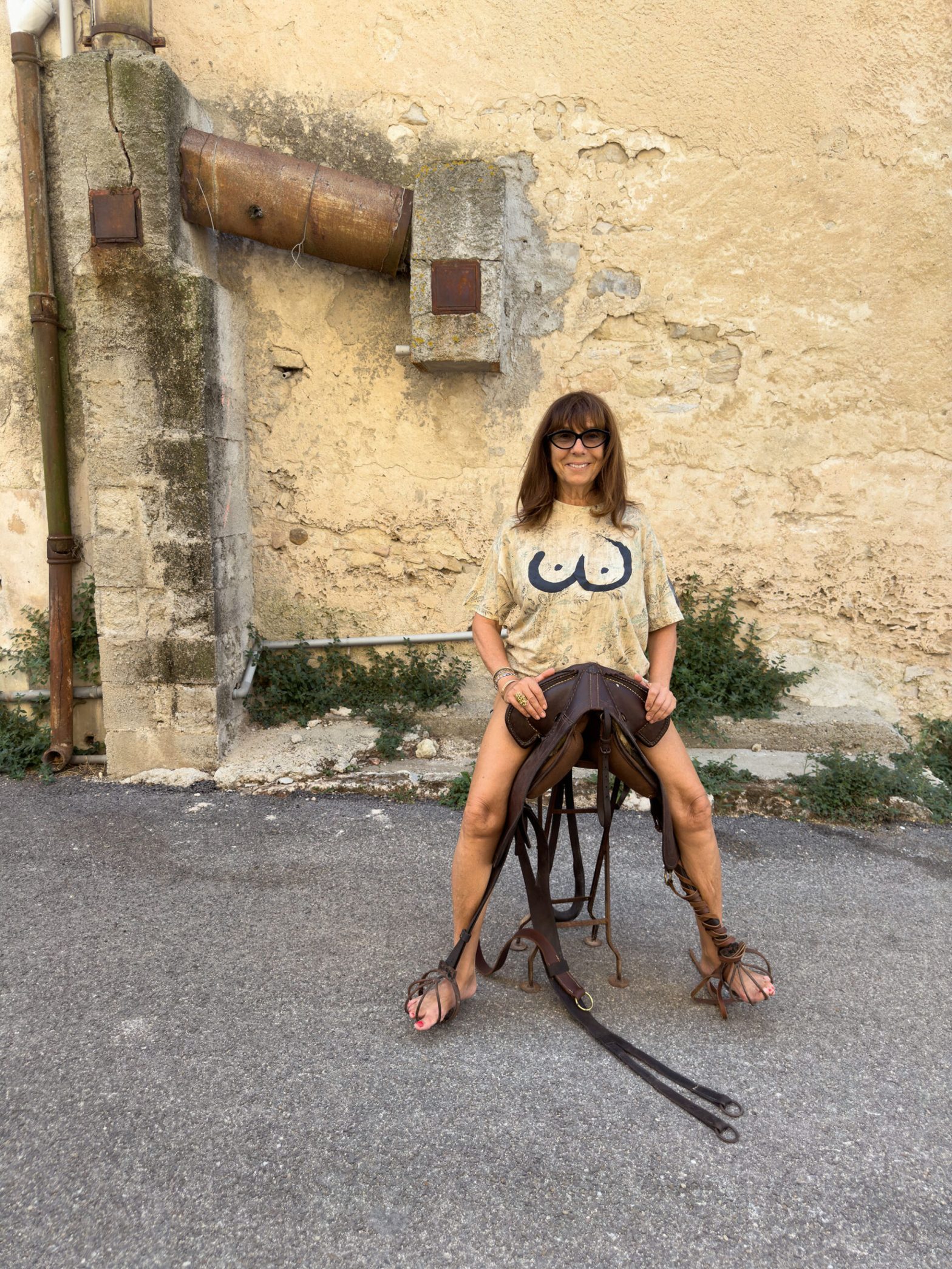
Encounters · No. 1
The Art of Following Someone
Sophie Calle has spent forty years turning other people’s lives — and her own grief — into something that looks, uncomfortably, like art.
By Bergotte
In January 1980, Sophie Calle followed a stranger to Venice. She had met him briefly at a party in Paris, not long enough to learn his name. He mentioned, in passing, that he was going to Venice. She decided to go too. She photographed him from behind — in alleyways, across bridges, at the edge of the Grand Canal — until he vanished into the city’s liquid geometry and she lost him for good. The resulting work, Suite Vénitienne, consists of those photographs and her diary entries, deadpan and tender and strange. It reads less like a thriller than like a meditation on what it means to want to be near someone without ever needing them to know.
This is, more or less, the founding gesture of Calle’s entire career: the chosen vulnerability of pursuit; the ethics of watching; the question of whether a document of intimacy constitutes intimacy at all. She was twenty-six. She did not yet know she was making art. “I was just curious,” she has said, in the slightly maddening way she tends to deflect. But the curiosity had a structure to it, a set of rules she imposed on herself, and that structure — arbitrary, obsessive, procedural — would become her signature.
Sophie Calle was born in Paris in 1953, the daughter of Robert Calle, an art collector and gallerist who would become one of her most loyal champions. She has described her childhood as comfortable and somewhat provisional — the kind of upbringing that leaves a person with excellent taste and a deep suspicion of settlement. In her twenties she drifted, living in the United States, working odd jobs, moving between cities with the focused aimlessness of someone running a private experiment. When she returned to Paris around 1979, she began following strangers as a way of giving her days a shape. It was, she has explained, a practice. A discipline against uncertainty.
She is not exactly a photographer, not exactly a writer, not exactly a performance artist. She is something for which we do not quite have a word.
The Hotel
In 1981, Calle got a job as a chambermaid at a Venetian hotel. She told no one that she was an artist — the management did not know; the guests certainly did not. Each morning she entered the rooms assigned to her, made the beds, cleaned the bathrooms, and photographed the guests’ belongings: the paperbacks on nightstands, the medication lined up on a shelf, the jumble of shoes, the letters folded into jacket pockets. She wrote descriptions of what she found.
The photographs from The Hotel are remarkably restrained. Calle resists the dramatic close-up, the knowing composition. The images have the flat, cataloguing quality of insurance photographs — which only makes them more unsettling. A tube of hemorrhoid cream next to a rosary. A child’s drawing propped against a lamp. A biography of de Gaulle, heavily annotated in pencil. These things were not meant to be seen together, were not meant to be seen at all. And yet here they are: a life in inventory, assembled by a stranger who made the bed afterwards and left.
The question her critics always reach for — is this ethical? — is, in a sense, the wrong question, because the work is precisely about the ethics of looking. Calle is not hiding that she looks. She is not pretending the looking is innocent. She is showing you, with great care and some glee, that looking is what we do, that it constitutes a form of intimacy we tend not to acknowledge, and that art is perhaps best understood as the moment that contract becomes explicit.
The Address Book
In 1983, Calle found a man’s address book on a Paris street. Rather than returning it to the address on the inside cover — which she could have done immediately — she photocopied the entire thing, returned the original, and spent the next month calling every person listed in it, asking them to describe the man. She published the results, serialised, in the newspaper Libération. The man — whose name was Pierre D. — eventually found out. He was furious. He sent Calle a nude photograph of herself in retaliation, which she published too.
The project, The Address Book, is many things at once: a portrait of a man assembled from other people’s impressions; a meditation on the gap between how we are known and how we know ourselves; a piece of journalism that breaks almost every journalistic convention. It is also, in its own brisk way, a social novel. The city of Paris assembles itself around Pierre D. through the voices of his acquaintances — his colleagues, his lovers, his dentist, his climbing partners. He becomes, through other people’s testimony, someone different from whoever he is. Which is, of course, exactly what happens to all of us, all the time. Calle simply made the mechanism visible.
She takes other people’s pain — and her own — and gives it a form so precise that it becomes, paradoxically, a relief.
Paul Auster, who became a close friend, was so captivated by Calle that he put a fictionalised version of her in his 1992 novel Leviathan, under the name Maria. The character is a woman who has organised her life into a series of private rituals and experiments — eating only white food for a week, limiting her wardrobe to a single colour per month — and who follows strangers for reasons she cannot entirely explain even to herself. Auster had to ask Calle’s permission to use her. She agreed, and then responded by actually performing some of Maria’s invented rituals — eating only white food: rice, fish, egg whites, cauliflower — and documenting the results. She called this Gotham Handbook. She turned his fiction of her into a fact of herself. The loop is vertiginous.
Exquisite Pain
In 1984 Calle received a grant to travel to Japan. Before she left, she and her then-partner agreed that he would call her on a specific date at a specific hotel in Kyoto. The call never came. He had met someone else. She returned to Paris and spent the next several years — nearly two decades, in fact — asking other people to tell her their worst memory of suffering, their own moment of greatest pain. She set these accounts against her own obsessive repetition of the story of the phone that did not ring: the same text, over and over, appearing on the right-hand side of each spread, while the interviewees’ stories varied on the left. By the hundredth repetition, her pain, she writes, had worn down to something manageable. The project, Exquisite Pain, was finally published as a book in 2003.
The formal device — repetition as therapy, public grief as private cure — is both intellectually elegant and emotionally devastating. You read the same story of the unreturned phone call a dozen times and something happens: the words begin to separate from their meaning, the way a word does when you say it aloud too many times. Calle is using the machinery of conceptual art — the rule-based structure, the systematic approach — to do something that conceptual art is supposed to be too cool for, which is to actually break your heart.
Take Care of Yourself
In 2004, Calle received a break-up email. The email ended with the line: Take care of yourself. She responded to it by sending it to 107 women — a lawyer, a clown, a dead-language scholar, a markswoman, a parrot trainer, a forensic analyst — and asking each of them to analyse, interpret, perform, or respond to it in the terms of their own expertise. The forensic analyst examined it for traces of duplicity in the language. The clown performed it as physical comedy. The literary critic applied theory. The markswoman shot it. The results were assembled as a book and an exhibition, which showed at the Venice Biennale in 2007.
Take Care of Yourself is, on its face, a very funny work. It is also an act of profound retaliation — not against the man, exactly, but against the passivity that grief tends to impose on its sufferer. Calle transforms her own vulnerability into an institution. She turns one man’s dismissal into the occasion for 107 women’s expertise. The email, which was meant to end something, instead becomes generative: it spawns interpretation, performance, analysis, scholarship. She takes the power away from the person who sent it, not by destroying the letter, as one might wish to, but by treating it as a text so rich that it requires a committee.
She turns one man’s dismissal into the occasion for 107 women’s expertise. The email becomes generative: it spawns interpretation, performance, scholarship.
There is something in this that belongs to a very old tradition — the cento, the florilegium, the commonplace book — but updated for an era in which the self is understood to be not one thing but a chorus, assembled from testimony. Calle’s self has always been collaborative in this sense. She recruits the world into her biography. The strangers she follows, the guests whose rooms she cleans, the women who interpret her ex-boyfriend’s email — all of them become, in some sense, her co-authors.
Grief, Finally
Her mother, Monique Sindler, died in 2006. In the last weeks of her life, she was unable to speak. Calle placed a video camera at the foot of her bed and recorded her continuously, in shifts, with friends. She documented the vigil. The work that emerged — Couldn’t Capture Death — is perhaps her most exposing, and her most technically simple: a video, a death, a daughter watching. It screened at the Pompidou. Critics found it difficult. Some found it unbearable. Calle found it necessary.
There is a risk, always, in writing about Calle, of making her sound clinical — as if the rules and procedures are a kind of armour, a way of keeping feeling at arm’s length. But the opposite is closer to the truth. The structure is what allows the feeling to be borne. The procedures — the following, the photographing, the repeating, the recruiting — are not ways of avoiding pain but of surviving it: of giving it enough shape that it can be held, looked at, shared. This is what all art is for, perhaps. Calle simply makes the mechanism unusually visible.
She once said, in an interview, that she has no interest in fiction because reality is already strange enough. This is true, but it misses something. What Calle has discovered is that the imposition of form onto reality does not diminish it. It amplifies it. By following a stranger according to a rule, by repeating a sentence ninety-nine times, by sending an email to 107 women, she does not flatten experience — she makes it resonate at a frequency ordinary life cannot reach. The stranger becomes everyone we have ever wanted to follow. The broken phone call becomes every silence we have ever waited inside. The dismissive email becomes every moment we have been made small by someone else’s indifference.
She is not exactly a photographer, not exactly a writer, not exactly a performance artist. She is something for which we do not quite have a word: a person who has made her life into a method, and her method into a form of love.
Works referenced: Suite Vénitienne (1980); The Hotel (1981); The Address Book (1983); Exquisite Pain (1984–2003); Take Care of Yourself (2007); Couldn’t Capture Death (2007). Paul Auster, Leviathan (Viking, 1992). This essay is part of an ongoing series, Encounters, on artists whose practice cannot be easily categorised.
Discover more from My World of Interiors
Subscribe to get the latest posts sent to your email.

