
Essay · Art & Lives
The Chief Loon and the World Inside the World
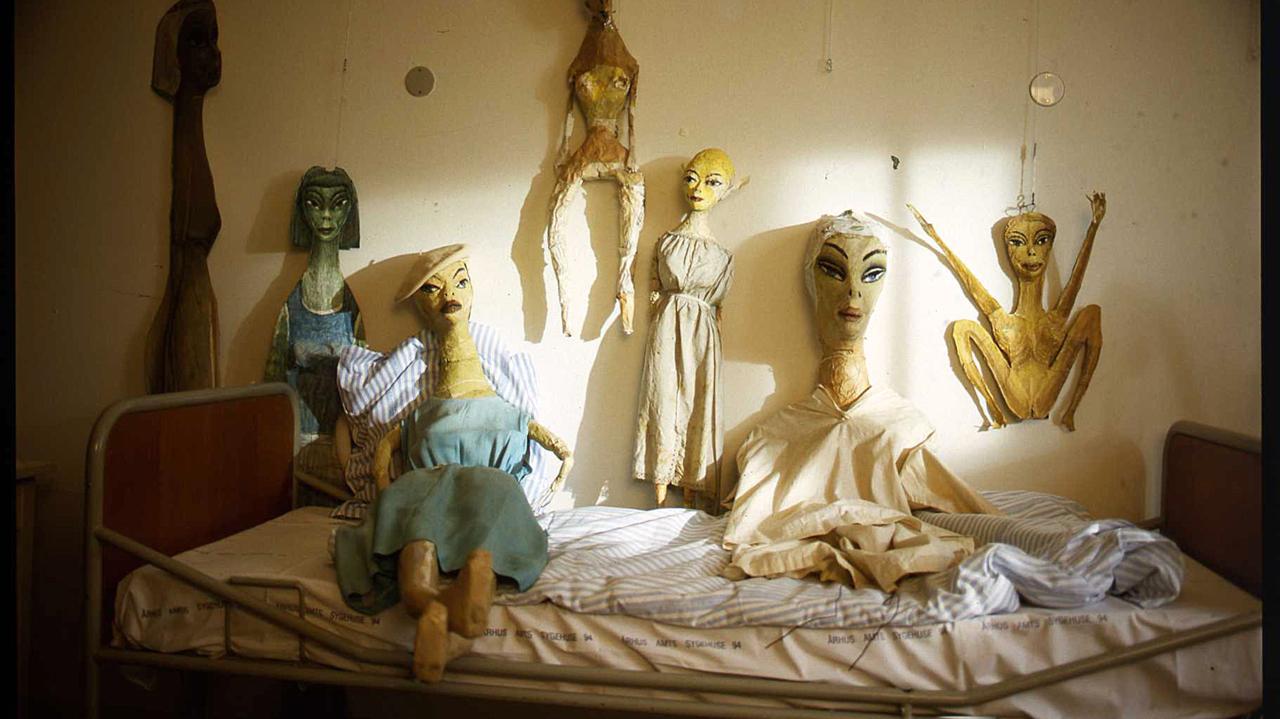
Ovartaci lived for fifty-six years inside a psychiatric hospital in Risskov, near Aarhus, and made, in those fifty-six years, approximately a thousand works of extraordinary formal intelligence and phantasmagoric density — paintings, drawings, sculptures, mixed media pieces built from whatever materials the institution made available — that constitute one of the most singular bodies of work in the history of Danish art and one of the most important examples of what Jean Dubuffet called art brut: art made outside the frameworks of professional training and institutional validation, from the raw material of a life and a mind that the official culture had decided to confine rather than engage with. The confinement produced the work. The work exceeds the confinement. These are the two facts between which any honest account of Ovartaci must navigate.
By Bergotte · Risskov, Denmark · Art & Lives
The name is its own first work. Louis Marcussen — born in Ebeltoft, Denmark, on September 26, 1894, apprenticed as a house painter and decorator, emigrated to Argentina in 1923 for work, wandered that country for six years in conditions of increasing physical and mental deterioration, returned to Denmark in a state that his family found alarming, and was committed to the psychiatric hospital at Risskov in 1929 — chose to rename himself after the hospital’s hierarchy of medical authority. The Jutlandic pronunciation of Overtosse — chief loon, the highest-ranking madman — reversed and respelled became Ovartaci, a word that announced, with the precision of a wit that the institution had not managed to extinguish, that the person bearing it was fully aware of the designation the world had given them and had decided to inhabit it with a completeness that made it theirs rather than the institution’s. It is a Duchampian gesture, a found name rather than a found object, and it precedes the art by several decades while being, in its own right, the most elegant of Ovartaci’s many transformations.
The hospital was Ovartaci’s world for more than half a century, and the world was simultaneously a constraint and a condition of production in the way that any sufficiently total institution becomes the material of the art made within it. The hospital provided time — enormous quantities of unhurried, unstructured time of the kind that professional artistic life rarely affords and that Ovartaci used with the completeness of someone who understood, without framing it in these terms, that the work was the life and the life was the work and that the distinction between the two was not one that applied to their situation. There was no career to manage, no market to navigate, no critical reception to respond to. There was the work, and the work accumulated, and the accumulation was its own form of argument.
Argentina, the Return, and the Cosmology That Followed
The Argentina years — 1923 to 1929, six years of wandering a country that was not his own, working and drifting and experimenting with drugs in the manner of someone for whom the available reality had become insufficient — are the period of Ovartaci’s life that most resists documentation, which is appropriate for a period that was, by all accounts, a dissolution rather than a construction. He left Denmark as a house painter and returned as something that his family and the medical establishment of 1929 did not have adequate language for, and the language they reached for — psychiatric commitment, institutionalisation, the assignment of a diagnosis that the records are somewhat inconsistent about — was the language of containment rather than of understanding.
What Ovartaci brought back from Argentina, and what the hospital years would develop into a complete and internally consistent cosmology, was a belief in the transmigration of souls — the Buddhist-inflected conviction that the self was not fixed but moving, that the boundaries between human and animal, male and female, present and past, were permeable and in some essential sense illusory. Ovartaci believed, with what the hospital staff described as paranoid certainty and what the work suggests was genuine metaphysical conviction, that they had lived previous lives as a tiger, as an ancient Egyptian labourer on the pyramids, as women of various historical periods, as animals whose forms appear in the paintings with the familiarity of beings one has inhabited rather than merely observed. The cosmology was not a symptom to be managed. It was a worldview, and the work is its expression.
The paintings and drawings that emerged from this cosmology are populated with women — exalted, powerful, sometimes winged, often inhabiting spaces of extraordinary decorative density — and with animals, particularly birds and feline creatures, that exist in the same pictorial space as the human figures with the ease of beings between whom the categorical distinction is not observed. The figures transform: a woman becomes a bird, a face emerges from a landscape, a body extends into something that is simultaneously human and architectural and organic. The transformations are not surrealist in the conventional sense — they do not produce the uncanny juxtaposition of the surrealist tradition, the shock of the incompatible brought together. They produce something more matter-of-fact: the visible of a world in which transformation is simply the condition of existence, in which everything is always in the process of becoming something else.
“Irrespective of whether you know about Ovartaci’s background and the story of his life, the work will always be etched on the viewer’s imagination. Everybody is touched by it.” — Mia Lejsted, Director of Museum Ovartaci
The Body and What Was Done With It
The question of Ovartaci’s gender identity is, in the context of contemporary art criticism, one of the more carefully attended aspects of the work, and the attention is right — not because the gender identity explains the art, which would be a reductive account, but because the relationship between the body Ovartaci inhabited and the body Ovartaci believed themselves to be is one of the primary subjects of the work, and the history of what Ovartaci did to achieve alignment between the two is one of the most harrowing and most courageous accounts in the history of art and of medicine.
Ovartaci began identifying as a woman in the 1950s and petitioned the hospital authorities for gender reassignment surgery with a persistence that the medical establishment of the period — which had not yet developed either the clinical framework or the ethical consensus that would eventually make such surgery a standard option — found difficult to manage. When the petition was refused, Ovartaci made two attempts at self-surgery, the second involving tools from the hospital carpentry workshop, that required medical intervention and that left the artist in a state of significant physical and psychological distress. The surgery was eventually granted and performed in two phases in 1955 and 1957, when Ovartaci was in their early sixties. After the surgery, Ovartaci dressed in women’s clothes, grew their hair long, requested to be addressed as Miss, and asked to be moved to the women’s ward. They became, by the accounts of hospital staff from that period, a calmer and more settled presence in the institution.
In 1972, Ovartaci ceased to identify as a woman and began identifying as a man, which they remained until their death in 1985. The oscillation — the movement between male and female identification, the decision to alter the body and then to step back from the altered body’s implications — is not a contradiction to be resolved but a condition to be understood, and the most useful framework for understanding it may be the cosmology itself: a person who believed that the soul moves through bodies of every kind, that the categories of gender are as provisional as the categories of species, that what matters is not the fixed identity but the movement between identities, would naturally experience their own gender not as a stable possession but as one of the available forms through which the self expresses itself in a given period.
The work both reflects and complicates this understanding. The female figures in the paintings are not the artist’s self-portraits in any simple sense, but they are charged with an identification that feels personal rather than merely representational, as though the women inhabiting those extraordinary painted spaces are inhabited in turn by the painter who made them, the relationship between maker and made being one of mutual presence rather than the conventional one-way flow of artistic creation.
The Work Itself
Ovartaci worked in paint, in drawing, in collage, in sculpture, in mixed media that combined found materials with painted and drawn elements, and the works across all these media share a quality that is easier to describe experientially than analytically: the quality of a world that is complete in itself, that has its own logic and its own weather, that the viewer enters rather than observes from outside. The density of the pictorial surface — the way every available space is occupied by figures and symbols and decorative elements that are simultaneously ornamental and meaningful, that accumulate not randomly but according to a system the works themselves are constructing — is reminiscent of the Gesamtkunstwerk ambition of the total artwork, except that in Ovartaci’s case the ambition was not aesthetic programme but natural consequence: this was how the world inside the work looked, and the work was simply recording it.
The female figures are the primary inhabitants of this world, and they are drawn with a physical authority and a psychological complexity that contradicts the assumption that untrained artists produce schematic rather than nuanced human forms. These are not stick figures or naive representations but fully realised presences whose expression and bearing carry emotional information of considerable subtlety — women who are powerful and melancholy and exalted and earthly simultaneously, who exist in the decorative density of the painted space with the ease of people who have always lived there. The animal figures — the birds, the tigers, the creatures that occupy the border between the animal and the human — are rendered with the same authority, as though the painter knows these beings from the inside, which the cosmology suggests was precisely the case.
The materials Ovartaci used included, at various points, whatever was available in the institution: hospital paper, cardboard, commercial paints, materials salvaged from the hospital’s workshops. One of the most remarkable objects in the Museum Ovartaci’s collection is the palette that Ovartaci made from hospital materials and used for decades — a palette with a colour wheel and a brush made from the artist’s own hair, an object that is simultaneously a tool and a self-portrait, the body’s material incorporated into the instrument of the work.
The Question of the Label
The designation of Ovartaci as an Outsider artist — or as a practitioner of Art Brut, in Dubuffet’s term for work made outside the art world’s institutional framework, from the raw material of a life unmediated by professional training or critical reception — is both accurate and, as the Museum Ovartaci’s director Mia Lejsted has argued, limiting in ways that prevent the work from receiving the full critical engagement it deserves. The label is accurate in the sociological sense: Ovartaci worked outside the art world, was not trained, did not exhibit during most of the working life, was not the subject of critical attention until very late and, in the international context, has only recently received the institutional visibility that the work’s qualities have always warranted.
But the label tends to position the work as a document of its maker’s psychology rather than as art, to make the biography the primary lens through which the work is approached, and to treat the formal qualities — the compositional intelligence, the colour, the extraordinary density and consistency of the pictorial world — as secondary to the narrative of the mad artist in the institution. This is a disservice to the work and to the person who made it, and it reflects the art world’s persistent difficulty with work that does not arrive through the institutional channels the world has constructed to validate and contextualise what it receives.
The Venice Biennale of 2022 included Ovartaci in its central exhibition “The Milk of Dreams,” curated by Cecelia Alemani, and the inclusion — alongside artists of established international reputation, in the most visible context in the contemporary art world — was both a recognition and an argument: that the work belongs in the conversation that the art world is conducting about transformation, about bodies and their possibilities, about the relationship between the self and the world it inhabits and the images it makes of both. The argument is correct, and the inclusion was right, and it came, as these things tend to come, decades after it should have.
The Third Place
Mia Lejsted’s formulation — that Ovartaci’s work gives access to “a third place that is neither outside nor inside” — is the most precise description of what the work actually does that the critical literature has produced, and it is worth dwelling on. The third place is not the art world and it is not the psychiatric institution. It is the space that the work itself creates and that it invites the viewer to inhabit, a space governed by the logic of Ovartaci’s cosmology rather than by the logic of either the art market or the medical establishment. In that space, the categories that organise the official world — the distinction between sanity and madness, between male and female, between human and animal, between the trained artist and the untrained one — are suspended, or more precisely, revealed as the provisional constructions they are rather than the natural facts they claim to be.
This is what the best art does, in whatever tradition and in whatever medium: it creates a space in which the categories that ordinarily organise experience are opened to question, in which the familiar is made strange and the strange is made available. That Ovartaci did this from inside a psychiatric hospital, with materials that the institution provided, in a cosmological framework that the institution considered symptomatic of illness, with a complete indifference to whether anyone would ever see the work, is not a qualification of the achievement but the condition of it. The fifty-six years were not a constraint from which the art escaped. They were the ground from which the art grew, and the ground was as peculiar and as particular and as fully inhabited as the figures that populate the thousand works that emerged from it.
Ovartaci died in Risskov on November 25, 1985, at ninety-one, having spent more of their life inside the hospital than outside it, having made one of the most remarkable bodies of work in the history of Danish visual art, and having been recognised as an artist — first in Denmark, at the Louisiana Museum of Modern Art’s 1979 Outsiders exhibition, and eventually in Venice and beyond — in the last years of a life that the official culture had spent most of its duration filing under a diagnosis rather than a name. The name Ovartaci chose was better than the diagnosis. The work that bore the name was better than either.
This essay draws on the Museum Ovartaci’s published catalogue and the research of its director Mia Lejsted, including the article “The Art of Ovartaci: Outside or Inside?” published in Epidemiology and Psychiatric Sciences (2021), artnet’s profile of the artist (2022), Brian Benjamin Hansen’s Ovartaci: The Signature of Madness (2022), and the exhibition catalogue for “The Milk of Dreams,” 59th Venice Biennale (2022). Ovartaci was born Louis Marcussen on September 26, 1894, in Ebeltoft, Denmark, and died November 25, 1985, in Risskov. Museum Ovartaci is located at Skovagervej 2, 8240 Risskov, Aarhus, Denmark.
Discover more from My World of Interiors
Subscribe to get the latest posts sent to your email.

