
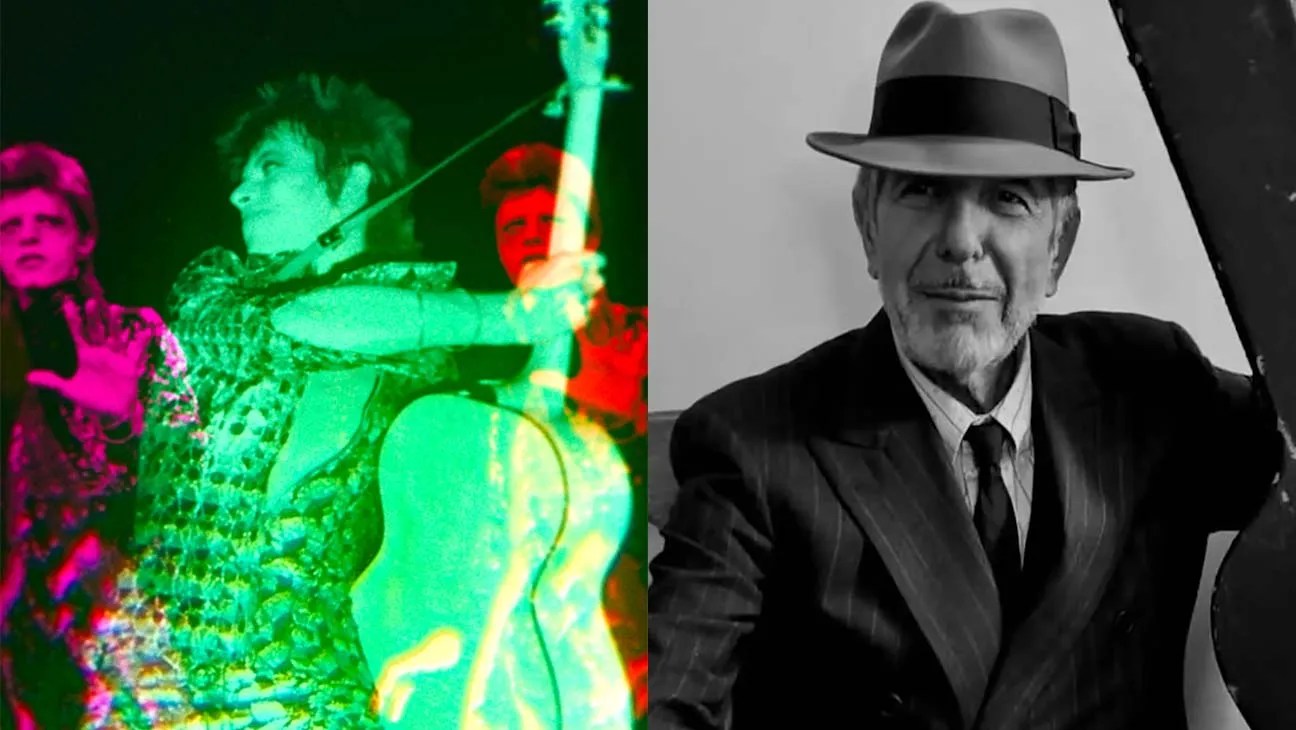
Essay · Music & Ideas
Two Ways of Dying in Public
Leonard Cohen and David Bowie both knew they were dying when they made their final albums. Both kept the knowledge largely to themselves. Both produced, from that knowledge, work of extraordinary quality that addressed mortality directly and without evasion. And there the similarity ends — or rather, there the similarity becomes the surface beneath which the real comparison begins, because the two albums they made are as different from each other as the two men were, and the difference tells us something important about what art is for when there is nothing left to do except make it.
By Bergotte · Montreal & New York · Music & Ideas
You Want It Darker was released on October 21, 2016. Leonard Cohen died on November 7, 2016, seventeen days later. Blackstar was released on January 8, 2016, David Bowie’s sixty-ninth birthday. Bowie died on January 10, 2016, two days later. The proximity of the releases to the deaths is, in both cases, so precise that it seems arranged — and in both cases, it was. Both men knew they were making a farewell. Both men constructed the farewell with the care of artists who understood that the final work would be read, inevitably, as testament, and who decided — separately, in very different ways — that if the work was going to be read as testament it should be made as testament, should carry the full weight of what there was to say, should not pretend that the occasion was anything other than what it was.
This decision is itself remarkable, because the alternative — the decision to pretend, to make work that does not acknowledge its own valedictory function, to spare the audience the discomfort of the farewell — is the more common one, and it is not without dignity. What Cohen and Bowie chose instead was the harder and the more generous thing: to use the knowledge of their own ending as the primary material of the work, to make of the dying a subject rather than a shadow, to give their audiences not the comfort of the pretence but the more lasting gift of the honest reckoning. That both men managed to do this without self-pity, without grandiosity, without the sentimentality that the occasion might have been expected to produce, is the measure of how fully formed as artists they each were at the end of their lives, and how much they had learned about the relationship between experience and form in the decades of work that preceded these final statements.
Cohen and the God He Argued With
Leonard Norman Cohen was born in Montreal on September 21, 1934, into a middle-class Jewish family of considerable cultural seriousness, and the tradition he was born into — the tradition of the Hebrew Bible, of Talmudic argument, of the long Jewish conversation with a God who is simultaneously present and demanding and frequently inexplicable — was the primary material of his art from the beginning and remained so to the end. He was a poet before he was a singer-songwriter, and the poet’s habits of mind — the compression, the precision, the willingness to work a single image until it had yielded every available meaning — shaped the music in ways that distinguished it from almost everything else in the singer-songwriter tradition. His songs are not folk songs or pop songs or rock songs, though they have been all of these things in various hands. They are arguments — arguments with God, with women, with the nature of desire and the nature of loss, arguments conducted with the wit of someone who has decided that the stakes are too high for anything less than full intelligence and the humility of someone who knows the arguments will not be resolved.
By 2016 Cohen was eighty-two. He had been ill for several years, had fallen at a recording session and injured himself, had spoken publicly about his proximity to death with the combination of serenity and dark humour that was entirely characteristic of someone who had always inhabited the border between the sacred and the comic. He had been working on what would become You Want It Darker with his son Adam, who produced the album, in sessions conducted partly in his home in Montreal, where his voice — which had been deepening for decades, moving from the nasal baritone of the early records through something richer and more resonant and finally to the bass-register incantation of the last work — was so diminished in physical capacity that he could no longer project or sustain in the way the earlier recordings required. The limitation became the aesthetic: the barely-there voice, the almost-spoken delivery, the sense of words being placed rather than sung, each one weighted with the deliberateness of someone for whom the energy to speak is no longer inexhaustible.
“Hineni, hineni — I’m ready, my Lord.” — Leonard Cohen, You Want It Darker, 2016
Hineni is the Hebrew word meaning “here I am” — the word Abraham speaks when God calls him, the word of absolute readiness and absolute submission that the Hebrew Bible uses at the moments of greatest divine demand. Cohen uses it as the album’s central statement, repeated through the title track in the voice that can barely carry it, and the effect is of a man addressing the God he has argued with and seduced and defied and returned to throughout his entire artistic life, and finding, at the end, that the argument is over and what remains is the readiness. It is not defeat. It is completion. The distinction matters enormously and Cohen knew it and the album knows it.
The music that surrounds the voice is spare and dark and liturgical: the Shaar Hashomayim synagogue choir of Montreal, which Cohen had attended as a child, providing a choral presence that roots the album in the specific tradition from which it emerges rather than reaching for any more ecumenical spiritual vocabulary. The production is minimal in the way that very late work is sometimes minimal — not as an aesthetic choice made from abundance but as the natural expression of a situation in which the unnecessary has been shed and what remains is what matters. There are no wasted notes on You Want It Darker. There is no space that is not doing work. The album is, formally, as compressed and as precise as any poem Cohen ever wrote, which is to say it is very compressed and very precise indeed.
The songs address the accumulated subjects of a lifetime: desire and its costs, faith and its demands, the women who have passed through the work, the God who has been present throughout, and the specific quality of the ending that Cohen can feel approaching. “Treaty,” the album’s most explicitly personal song, is a negotiation — the speaker asking God for a peace that the relationship has never quite achieved, acknowledging the mutual difficulty of the connection, neither condemning nor forgiving but simply naming, with the honesty of someone who has nothing left to conceal. It is the most intimate song on the album and one of the most intimate things Cohen ever recorded, and its intimacy is not the intimacy of confession but of reckoning: not what I have done but what I am, and whether that is enough, and the answer the song gives is not yes and not no but the question itself, held open with a steadiness that is its own form of faith.
Bowie and the Character Who Could Not Be Played
David Robert Jones was born in Brixton, London, on January 8, 1947, and spent his life constructing and deconstructing and reconstructing a series of selves so complete in their articulation and so fully inhabited that the question of which of them was the real David Bowie became, eventually, not merely unanswerable but uninteresting. Ziggy Stardust and Aladdin Sane and the Thin White Duke and Major Tom and the young Americans and the Berlin trilogy figures and the various personae of the 1980s and 1990s: these were not disguises worn over a stable self but the self’s primary mode of existence, the medium in which the artist thought and felt and made. Bowie was the artist whose art was the performance of selfhood, and the question that Blackstar poses — the question that the album was made, consciously and with full forethought, to pose — is what happens to that art when the self it has been performing is about to cease to exist.
The answer is Blackstar, which is one of the more unsettling and more formally audacious things in the history of popular music, and which operates on the listener differently depending on whether it is heard before or after the knowledge of Bowie’s death. Heard before — as most of the first listeners heard it, the death being two days away and unknown to the world — it is a remarkable and somewhat mysterious art rock album, formally experimental, drawing on jazz and on the avant-garde and on Bowie’s own long history of genre disruption, lyrically oblique in the manner of his best work. Heard after, it is something else: a document of a man who knew he was
Discover more from My World of Interiors
Subscribe to get the latest posts sent to your email.
 My World of Interiors