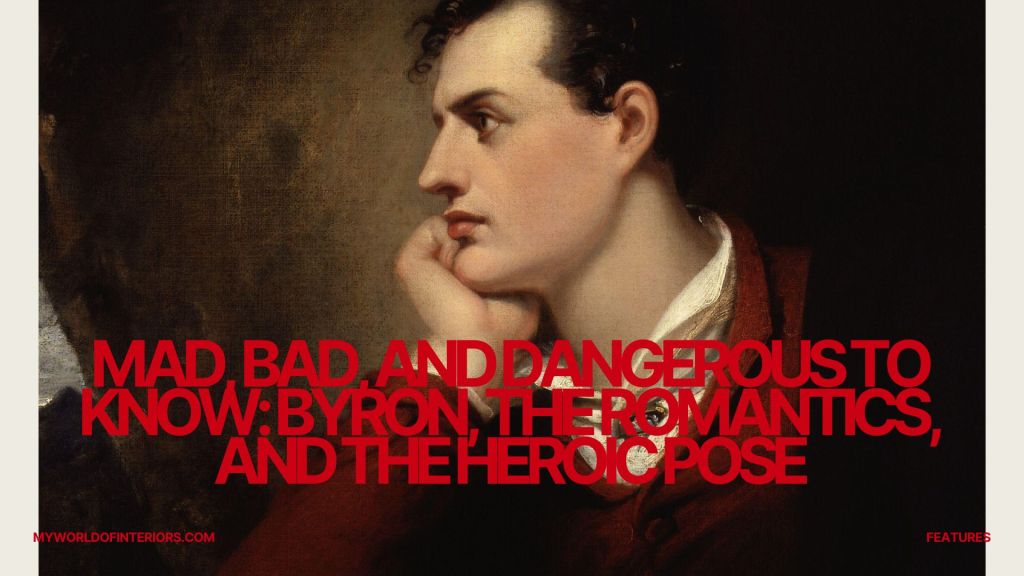
They were young, they were beautiful, they were consumed by their own myths and their own fevers before any of them reached forty. Byron, Shelley, and Keats between them invented the idea of the artist as hero — as outcast, visionary, martyr to beauty and freedom. The invention was magnificent and partly fraudulent and changed everything. We are still living inside it.
By Bergotte
Consider the deaths, because the deaths are the first thing — the thing that the mythology requires and that the mythology, in certain moods, seems almost to have arranged. John Keats died in Rome in February 1821, of tuberculosis, at twenty-five, having written, in the previous three years, a body of poetry that would sustain the attention of serious readers for two centuries. Percy Bysshe Shelley drowned in the Gulf of Spezia in July 1822, at twenty-nine, when his sailboat went down in a squall — his body washing ashore ten days later and being burned on the beach, in a ceremony that his friend Byron attended and from which Byron, reportedly, swam back to his yacht rather than watch the skull cave in. George Gordon, Lord Byron, died at Missolonghi in Greece in April 1824, at thirty-six, of fever and the treatments for fever administered by doctors whose ministrations were, in the assessment of most subsequent medical opinion, considerably more dangerous than the fever itself. He had gone to Greece to fight in the war of independence against the Ottomans, and he died before he had fought in anything.
The deaths are, in each case, partly real and partly theatrical — not in the sense that they were faked, but in the sense that they have been so thoroughly incorporated into the meaning of the lives and the work that it is almost impossible to think of the poetry without thinking of the dying, to read Keats’s odes without the awareness of the tuberculosis already present in the body that wrote them, to read Shelley’s “Adonais” — the elegy for Keats that is also, with a foresight that was almost certainly unconscious, an elegy for himself — without the knowledge of the drowned body on the Italian beach. The Romantics invented the idea of the poet as a figure who burns more brightly than the rest of us and for that reason burns out sooner. Then they died young and confirmed the invention. The fit between the myth and the life was so neat that it is still difficult to say which produced which.
This is the first thing to understand about the Romantics, and about Byron in particular: the myth was the work. Not separate from the work, not a distraction from the work, not the biographical packaging that the work arrived in — but the work itself, continuous with the poetry and the prose, part of the same project of self-creation and self-presentation that the poetry was conducting. Byron did not write poems and also construct a persona. He constructed a persona in which the writing of poems was one of the central activities, and the persona and the poems were, finally, the same object. This makes him very difficult to read clearly and very easy to mythologise further — and the mythologising has been going on, without significant interruption, for two hundred years.
The World They Were Reacting Against
To understand the Romantic heroic pose, you have to understand what it was a pose against — the specific historical and intellectual circumstances that made a certain kind of theatrical self-assertion feel not like vanity but like necessity, not like performance but like resistance.
The Romantics were born into the aftermath of two world-historical events that had promised everything and delivered something considerably more complicated. The French Revolution of 1789 had announced, with a rhetorical confidence that the eighteenth century’s faith in reason fully supported, that the application of rational principles to political organisation would produce liberty, equality, and fraternity — would, in short, remake the world along the lines that the philosophers had sketched. It produced, within a few years, the Terror, the Napoleonic wars, and the conservative reaction of the Restoration. The generation that came of age in the 1810s and 1820s had grown up watching this arc — had grown up with the knowledge that reason and revolution together had produced not freedom but blood, and that the political settlement that followed the blood was a restoration of almost everything that the revolution had promised to end.
Simultaneously, the Industrial Revolution was remaking the physical landscape of England with a speed and a thoroughness that had no historical precedent. The countryside that the English literary tradition had treated as the repository of a natural order — against which the corruptions of the city could be measured, from which the values that civilisation required were drawn — was being colonised by mills and mines and the new towns that grew up around them, by populations displaced from the land and crowded into conditions of unprecedented squalor. Blake’s “dark Satanic mills” were not a metaphor. They were the view from the road.
Against this double devastation — the failure of political reason and the destruction of the natural world — the Romantics proposed the imagination. Not as a consolation, not as a retreat into fantasy, but as the faculty that could grasp truths unavailable to reason, that could perceive the connections between the human and the natural that industrial capitalism was severing, that could articulate the freedom that political revolution had failed to deliver. This is Shelley’s claim, stated with maximum ambition in A Defence of Poetry: “Poets are the unacknowledged legislators of the world.” It is a claim of extraordinary reach, and it was made by a man who had been expelled from Oxford, who was in permanent exile from England, who had a readership of hundreds rather than thousands, whose direct political influence was approximately zero. The gap between the claim and the circumstances was not lost on Shelley. The gap was the point. The unacknowledged legislators were unacknowledged — unseen, unheard, working at a level of cultural reality that the acknowledged legislators, with their parliaments and their wars, could not access and could not therefore suppress.
The heroic pose — the Byronic attitude, the Shelleyan radicalism, the Keatsian devotion to beauty as a form of truth — was the form this claim took in individual lives. It was, simultaneously, a genuine philosophical position and a performance of that position, and the performance was inseparable from the position, because the claim that the poet was the world’s true legislator required the poet to live as though this were the case, to embody the freedom he was asserting, to refuse the compromises that the world offered and the world required.
Byron: The Construction of a Self
George Gordon, Lord Byron, arrived in the world already furnished with the raw materials of myth: a title, a ruined estate, a famously dissolute father who had died young, a mother of intense instability, a club foot that caused him lifelong pain and that he concealed with a ferocious vanity. He was beautiful — almost absurdly, inconveniently beautiful, in the manner of people whose beauty becomes a kind of burden — and he was intelligent with the specific quality of intelligence that knows what it can do and is not particularly humble about it. He was also, from very early, engaged in the project of constructing himself as a character: not merely living a life but shaping it for legibility, for effect, for the particular quality of impression he wanted to make on the world.
The publication of the first two cantos of Childe Harold’s Pilgrimage in 1812 — the narrative poem that followed a world-weary young aristocrat (not Byron, Byron insisted, though the resemblance was noted by everyone) through Portugal, Spain, and Greece, meditating on ruins and freedom and the vanity of human ambition — made him famous with a speed that the literary world of 1812 had no category for. He woke up famous, as he himself put it: the phrase has been quoted so many times that it has lost its strangeness, which was real. Within weeks of publication the poem had gone through multiple editions, every hostess in London wanted him at her dinner table, and the particular combination of melancholy grandeur and barely concealed transgression that the poem projected had become, in the reading public’s imagination, the defining image of the poet himself.
Byron understood what had happened, and he understood it with a clarity that is both impressive and somewhat chilling. He had produced a character — the Byronic hero, brooding, world-weary, haunted by unspecified but clearly serious sins, too large for the society he moved in, capable of both great tenderness and great cruelty — and the character had been accepted by the public as a portrait of the man. The question of whether it was a portrait of the man — whether Byron was performing the Byronic hero or simply being himself, and whether the distinction was meaningful — occupied him, in various forms, for the rest of his life.
The subsequent poetry deepened and complicated the character rather than abandoning it. Manfred (1817), the dramatic poem in which a figure of Faustian transgression summons spirits and refuses their authority in the name of an individualism so complete that it admits no master, human or supernatural, is Byron in his most self-consciously heroic mode — the hero as someone who has committed something unspeakable (incest is the implication, and the implication points, as everyone in Byron’s circle understood, toward his relationship with his half-sister Augusta Leigh) and who refuses to be diminished by it, who insists that the self that committed the act is still a self worth honouring. The ethics of this position are, on examination, fairly alarming. The poetry that expresses the position is extraordinary.
Don Juan, which Byron began in 1818 and was still working on when he died, is the countermovement — the poem in which the heroic pose is subject to the same intelligence that constructed it, examined from the inside with a comic ferocity that is all the more devastating because the comedy and the heroism coexist rather than cancel each other. Don Juan is passive where the Byronic hero is active, receptive where he is aggressive, swept along by events where the hero shapes them, and the reversal is deliberate: Byron is testing what the heroic mythology looks like when you remove the control, when the protagonist is the object of the plot rather than its subject. What you find, when you do this, is something more honest and more interesting than the heroic pose allows — a human being of ordinary inconsistency, capable of genuine feeling and genuine foolishness in approximately equal measure, adrift in a world that the heroic mythology had claimed to master and that resisted mastery at every turn.
Don Juan is Byron’s greatest work and his most honest, and it is, characteristically, unfinished — abandoned at sixteen cantos when he went to Greece, left incomplete by the death at Missolonghi. The unfinishedness feels right. The poem about the impossibility of the heroic completion was completed by the impossibility of the poet’s own completion of it.
The Byronic Body: Appetite, Performance, and the Costs
The heroic pose required a body, and Byron’s body — the beauty and the club foot and the weight that fluctuated wildly across his adult life as he oscillated between periods of near-starvation and periods of spectacular excess — was the stage on which the pose was most literally performed and most visibly contested.
He was bisexual in a period when the word did not exist and the practice was a hanging offence in England, and his sexual history — the boys at Cambridge, the men in Greece and the Ottoman territories, the women of the London drawing rooms and the Venetian casinos, the affairs that became scandals and the scandals that became legends — was conducted with a compulsiveness that suggests something considerably less voluntary than the libertine freedom the mythology projects. The appetite was real. The freedom was more ambiguous. People who cannot stop doing things are not, in the most precise sense, free; they are driven, and the drive is a form of unfreedom that the heroic narrative of erotic liberation consistently misnames.
His marriage to Annabella Milbanke in 1815 — contracted, it seems, partly out of a genuine if confused affection and partly out of an equally genuine desire to acquire the respectability that the marriage represented — lasted approximately a year before collapsing in circumstances that were never made fully public but that involved, by Annabella’s account, behaviour ranging from emotional cruelty to something that her later testimony implied was physical assault. He left England in 1816, following the separation, in circumstances of social ostracism that the scandal had produced, and did not return before his death. The exile suited the mythology perfectly. It confirmed the Byronic hero’s incompatibility with respectable society, his banishment for crimes that society lacked the courage to understand. It also reflected the reality of a man who had behaved badly toward a woman who had not deserved it, and who found it more comfortable to be a romantic exile than to sit with the specifics of what he had done.
The club foot is worth dwelling on, because it is almost always mentioned in passing — noted as a biographical detail, a piece of the picture — without adequate attention to what it meant to carry it. Byron swam competitively, rode obsessively, walked enormous distances, maintained a physical activity that was itself a form of argument with his own body — a refusal to be defined by the limitation, conducted with enough intensity that it became its own form of conspicuousness. The pose of physical heroism — the swimming of the Hellespont in 1810, the military exercises at Missolonghi — was not simply vanity. It was the heroic pose applied to the most intimate arena, the self overcoming the body’s own resistance. That it was not entirely successful — that the foot was always there, that the weight was always contested, that the body was never quite the instrument the poetry required — is part of what makes Byron a more interesting figure than the mythology allows.
Shelley: The Radical as Counterweight
If Byron’s heroism was personal — centred on the self, on the performance of an individual freedom that was simultaneously genuine and constructed — Percy Bysshe Shelley’s was political in a way that Byron’s never quite was, and the contrast between them illuminates the range of possibility within the Romantic heroic project.
Shelley was expelled from Oxford in 1811 for co-authoring a pamphlet titled The Necessity of Atheism — a detail that tells you almost everything you need to know about the difference between his version of the heroic pose and Byron’s. Byron transgressed socially and sexually; his outrages were personal, aimed at the conventions of the drawing room and the bedroom. Shelley transgressed intellectually and politically; his outrages were aimed at the foundations — at religion, at monarchy, at the institution of marriage, at the economic arrangements that produced poverty alongside wealth. He was, in the precise sense that means something, a revolutionary: he believed that the existing social order should be dismantled and replaced, and he believed that poetry was one of the instruments of the dismantling.
Queen Mab (1813), the long visionary-political poem he wrote at nineteen, imagines a spirit guide showing a sleeping woman the whole of human history as a record of tyranny and oppression, and envisions a future of radical freedom — atheist, anarchist, vegetarian, sexually liberated — that reads, two centuries later, simultaneously as naive and as more genuinely radical than almost anything his contemporaries were proposing. Prometheus Unbound (1820), the dramatic poem that is perhaps his greatest achievement, takes the Promethean myth — the Titan who stole fire from the gods and was punished for it — and reimagines it as an allegory of the human mind’s capacity to liberate itself from all forms of tyranny, including the internalized tyranny of submission to power. Prometheus refuses to hate Jupiter, his oppressor, and in refusing to hate him strips him of the authority that the hatred had sustained. The revolution is internal before it is external. The freedom is a quality of mind before it is a political condition.
This is both more intellectually serious and more politically useless than Byron’s version of freedom, and Shelley understood the tension. He wanted, genuinely and urgently, political change — he wrote pamphlets and corresponded with radicals and attended meetings — but the poetry kept insisting that the change had to begin in the imagination, and the insistence of the poetry kept outpacing the practicality of the politics. He was a better poet than he was a political organiser, which may be the condition of the best poets and is certainly not a comfortable position for someone who believed as deeply as Shelley did that the two were the same vocation.
His personal life was conducted with the same principled radicalism and the same practical carelessness that characterised his politics. He left his first wife, Harriet Westbrook, for Mary Godwin — Mary Shelley — when Harriet was pregnant with their second child. Harriet subsequently drowned herself in the Serpentine in Hyde Park, at twenty-one. Shelley and Mary married following Harriet’s death, and the marriage was, by the accounts of both, a genuine partnership of unusual intellectual depth. But the trail of real consequences left by the principled rejection of conventional obligation — Harriet’s death, the children’s instability, the friends and relatives damaged by the serial disruptions of Shelley’s existence — is not adequately addressed by the poetry’s luminous arguments for freedom.
He drowned at twenty-nine, the boat swamping in a squall that he might have survived if he had been a stronger swimmer or if the boat had been more seaworthy or if he had turned back when the weather changed. The circumstances are ordinary enough. The body washed ashore had a copy of Keats in his pocket, which is either true or has been added to the story by a tradition that understood what the story needed.
Keats: Beauty, Mortality, and the Outsider
John Keats is the counterweight that complicates the heroic project most thoroughly, because he was, in almost every respect, the wrong kind of person to be a Romantic hero — and his awareness of this fact, and the quality of thinking that the awareness produced, generated the most philosophically rich poetry of the period.
He was not an aristocrat. He was the son of a livery stable manager, educated at a good school but not at Oxford or Cambridge, trained as an apothecary-surgeon before abandoning medicine for poetry. He was short, he was not conventionally handsome, he was in chronic financial difficulty, and he was treated by Byron with a condescension that was, even by Byron’s standards, fairly unpleasant. Byron called his poetry “the Cockney school” — a class-based sneer that located Keats outside the tradition of educated literary authority — and wrote, after Keats’s death, that he had been “killed off by one critique,” implying that the savage review of Endymion in Blackwood’s Magazine had so unmanned him that he had wasted away from wounded pride. This was, in addition to being wrong about the cause of death, a projection of Byron’s own fragile relationship with critical opinion onto a poet who was, by the evidence of the letters, considerably more secure in his own judgment than Byron was in his.
The letters are the key to Keats — more, perhaps, than the letters of any other English poet, they constitute a sustained, developing, extraordinarily honest account of a mind thinking about what poetry is and what it is for. The concept he arrived at, and for which he is now principally known among critics, is “negative capability” — the capacity to remain “in uncertainties, mysteries, doubts, without any irritable reaching after fact and reason,” to stay inside the experience of not-knowing without the anxiety that demands resolution. This is the opposite of the Byronic heroic pose, which requires certainty — certainty about the self, about its own value, about the freedom it is asserting. The Byronic hero knows what he is. Keats was interested in the condition of not-knowing, in the way the imagination could inhabit a space before knowledge had foreclosed it.
“Ode to a Nightingale,” “Ode on a Grecian Urn,” “To Autumn,” “Ode on Melancholy” — the great odes of 1819, written in a burst of productivity that lasted roughly eight months and that constitutes one of the most concentrated periods of poetic achievement in the English language — are all, in different ways, meditations on the relationship between beauty and mortality, between the permanent and the transient, between what the imagination can grasp and what time takes away. “Beauty is truth, truth beauty” — the line from the Grecian Urn that has been the occasion of more critical argument than almost any other in the language — is not an aesthetic slogan. It is a desperate wager: the claim that the beautiful object, by being beautiful, participates in something that outlasts the individual life, that the experience of beauty is the experience of a truth that transcends the conditions of its production.
He was already coughing blood when he wrote most of them. The tuberculosis that would kill him at twenty-five was present in his body while he was writing about nightingales and Grecian urns and the season of mist and mellow fruitfulness, and the knowledge of the dying body is in the poetry — not as subject matter but as pressure, as the quality of attention that comes from understanding that the attention is finite and the object of the attention is not. He went to Rome in the autumn of 1820, in the hope that the warmer climate would help, and he died there in February 1821, in the apartment beside the Spanish Steps that is now a museum, cared for at the end by his friend Joseph Severn with a devotion that constitutes, in its quiet faithfulness, a form of heroism considerably less theatrical than anything Byron managed and considerably more useful.
His gravestone, which he dictated, reads: “Here lies one whose name was writ in water.” It is the most beautiful piece of self-mythologisation in the entire Romantic tradition, and it is also, unlike most Romantic self-mythologisation, genuinely humble — a statement not of greatness but of transience, an acknowledgment that the wager on beauty might not be paid off, that the water might simply close over the name and leave nothing. That the name was not, in fact, writ in water — that it was writ in something considerably more durable — is one of the quieter ironies of literary history.
The Women They Loved and the Women They Made
The Romantic poets’ relationships with women are simultaneously the most personally consequential dimension of their lives and the dimension most thoroughly obscured by the heroic mythology — obscured because the mythology requires the hero to be the subject of the story, and women, in the mythology, are most comfortably objects: the muse, the inspiration, the beloved, the nature-figure through whom the poet accesses the transcendent. The actual women — with their own intelligence, their own ambitions, their own entirely legitimate claims on the men involved — are inconvenient to this arrangement, and the history of Romanticism has largely accepted the inconvenience by minimising them.
Lady Caroline Lamb, who conducted a brief and spectacular affair with Byron in 1812 and described him, in a journal entry that became the most quoted sentence in the history of English Romanticism, as “mad, bad, and dangerous to know,” has been treated by most subsequent accounts as a footnote — the unstable aristocrat who couldn’t accept rejection, who sent Byron a lock of her pubic hair and threatened his life and eventually wrote a thinly disguised novel (Glenarvon, 1816) in which the Byron figure is the villain. The treatment is unfair. She was a woman of genuine literary talent and genuine perceptiveness — “mad, bad, and dangerous to know” is an assessment whose accuracy has not been improved upon by two centuries of subsequent commentary — who was genuinely damaged by a relationship with a man who pursued her, obtained what he wanted, and then subjected her to a campaign of rejection so cold and so public that it contributed materially to the breakdown that characterised the rest of her life. Byron’s biographers have generally been sympathetic to Byron in this story. The evidence does not entirely support the sympathy.
Teresa Guiccioli, the young Italian countess who became Byron’s last serious attachment and with whom he lived in Ravenna and Pisa for several years, is the figure in his life who most consistently resists the mythology’s reduction. She was eighteen when they met, married to a much older man as was conventional in her social class, and she entered the relationship with Byron — which was, by the conventions of the cavalier servente tradition, a socially acknowledged extra-marital attachment — with eyes open and, by all accounts, a very clear understanding of who and what Byron was. Their correspondence, and the memoir she wrote decades after his death, reveals a woman of considerable intelligence and considerable emotional resilience who genuinely loved Byron, understood his limitations with remarkable clarity, and mourned him with a steadiness that the more theatrical grievers in his life did not quite manage.
Augusta Leigh, his half-sister, is the figure around whom the most damaging speculation has always clustered — the implication, present in Manfred and in the gossip of the period, of a sexual relationship that crossed the one boundary that even the Romantic tradition acknowledged. Whether the relationship was sexual is not, finally, knowable from the evidence that survives. What is clear is that Augusta was, across Byron’s life, the person he most consistently returned to, the person whose affection he most trusted, and the person whose existence he fictionalised most extravagantly — made into the dark secret at the heart of the Byronic mythology. Whether she consented to this fictionalisation, and what it cost her, are questions the mythology has not been interested in asking.
Mary Shelley: The Critique from Within the Dream
Mary Wollstonecraft Godwin Shelley was eighteen years old when she began writing Frankenstein; or, The Modern Prometheus during the famous wet summer of 1816 at the Villa Diodati on Lake Geneva, in a house shared with Byron, Shelley, John Polidori, and Claire Clairmont. The circumstances have become mythological in their own right — the ghost story competition, the storm, the company of geniuses. What tends to be less carefully examined is the specific perspective that a young woman, living inside the Romantic heroic project, observing its practitioners at close quarters, brought to the story she produced.
Frankenstein is, among many other things, the most searching critique of the Romantic heroic fantasy that the Romantic period produced. Victor Frankenstein is the Romantic hero taken at his own valuation — a man of extraordinary gifts and extraordinary ambition, driven by the desire to transcend the limits of human knowledge and human possibility, willing to sacrifice ordinary domestic happiness for the sublime goal of creation. He achieves what the Romantic hero claims to seek: he crosses the boundary, he makes the impossible thing, he creates life from inert matter. And the result is catastrophic — not because the ambition was wrong in a simple moral sense, but because the hero’s relationship to his own creation is one of uncomprehending horror and irresponsible abandonment, because the creature he makes is a sentient being with legitimate claims on its creator that the creator refuses to acknowledge.
Mary Shelley had watched, from the inside, the consequences of Romantic heroic ambition: her father William Godwin’s radical philosophy and its practical inadequacy as a framework for actual domestic life; her mother Mary Wollstonecraft’s pioneering feminism and the cost it had exacted; Shelley’s own principled radicalism and the trail of damaged women and abandoned children that the radicalism had left in its wake. She was the daughter of two of the most important radical thinkers of the previous generation, and she was watching the next generation’s heroic programme from the position of one of its principal objects. The creature’s question to Frankenstein — “Did I request thee, Maker, from my clay / To mould me man?” — is the question that the objects of the heroic project were not, within the heroic mythology, supposed to be able to ask.
The novel is not a simple condemnation of the Romantic project; it is more ambivalent than that, and more generous to what the project was reaching for. But it is a sustained, clear-eyed examination of what the project costs when the hero cannot see beyond himself — when the capacity for the sublime is not accompanied by the capacity for responsibility, when the imagination that can conceive the extraordinary cannot extend to the ordinary claims of the creature it has made.
She was twenty when it was published, anonymously, in 1818. Shelley wrote the preface. For some time many readers assumed Shelley had written the novel. The assumption tells you something about the expectations the period brought to the question of who was doing the thinking.
Death, Myth, and the Necessary Exit
There is a structural argument to be made — and it is an uncomfortable one — about the relationship between the Romantic heroic mythology and the early deaths that sealed it. The argument is not that the deaths were wished for, still less that they were engineered. It is that the mythology required a conclusion that ordinary longevity could not supply, and that the deaths, coming when they did, provided it.
A Byron who lived to sixty would have been a problem. The Byronic hero — the figure of supreme individualism, of freedom purchased at the cost of happiness, of the flame that burns too bright for ordinary life — requires the early exit to remain legible. A Byron who aged, who compromised, who made the accommodations that long life requires, would have retroactively undermined the claim. The pose could only be maintained indefinitely by not being maintained indefinitely. This is not, to repeat, a theory of deliberate self-destruction. It is an observation about the logic of the mythology and the way the mythology was, in retrospect, confirmed by outcomes that the men involved neither sought nor foresaw.
Keats’s death is the most moving and in some ways the most honest of the three, because Keats had no mythology of heroic destruction to sustain him and was not, by the evidence of the letters, particularly comforted by the idea of a beautiful death. He wanted to live. He had work to do. He was in love with Fanny Brawne with a tenderness and an anguish that the final letters record with heartbreaking specificity, and the tenderness and the anguish were not heroic. They were simply human — the human fact of a young man dying before he wanted to, loving someone he would not see again, afraid of the darkness in the way that people who have been fully alive are afraid of the darkness.
Shelley’s death was an accident, probably, though there have been theories. What is clear is that Shelley was a poor sailor who owned a boat that was not seaworthy and who went out in weather that more cautious people did not go out in. Whether this constitutes a death wish or simply the optimism of a man who consistently believed that the world would arrange itself in accordance with his desires is a question the evidence doesn’t resolve. The life was full of near-misses and genuine catastrophes that Shelley survived, and there is no particular reason to think the drowning was anything other than bad luck in a life that had always contained a great deal of it.
Byron’s death at Missolonghi is the most theatrically appropriate and the most practically avoidable. He went to Greece knowing it was dangerous and went partly for the right reasons — genuine sympathy with the Greek cause, genuine desire to do something of consequence beyond the writing of poetry — and partly for reasons that had more to do with the mythology than with political calculation. He had, by 1823, a sense that Don Juan was as honest as he could be and that the heroic life was something he had written about more successfully than he had lived, and Greece offered the possibility of the living. He died of fever and of doctors who bled him repeatedly in the misguided conviction that bleeding helped fever, and the death was undignified in the way of most actual deaths and was immediately translated, by the Europe that received the news, into the mythological death it needed to be: the poet-hero dying for freedom in a foreign land, sacrificing himself on the altar of liberty, going out as he had lived.
The translation was not entirely false. He was there. He did care. He had spent a significant portion of his fortune on the Greek cause. But the translation was more than the facts quite supported, and the more than the facts supported was the Romantic tradition’s final gift to one of its own — the last, posthumous performance of the pose.
What They Made and What It Cost
The poetry survives, and it survives in the way that poetry survives when it has done something to language that makes the language permanently different afterward — when you cannot, after reading it, hear certain words or experience certain states without the poetry being present. “She walks in beauty like the night” — a line so beautiful and so simple that it is almost impossible to hear it freshly, so thoroughly has it been absorbed into the texture of what we mean when we mean beauty. “O wild West Wind, thou breath of Autumn’s being” — the opening of Shelley’s “Ode to the West Wind,” which addresses the wind as a revolutionary force and asks it to scatter the poet’s words like dead leaves across the world, like sparks from an unextinguished hearth. “A thing of beauty is a joy forever” — Keats’s wager on permanence, made in the body that was already in the process of dying.
The wager on permanence has paid off, which is not the same as saying the terms of the wager were always honest. The freedom the Romantics proclaimed was real and was also a performance of freedom rather than the thing itself. The heroism was genuine and was also a construction, maintained by the same intelligence that constructed it and vulnerable to examination by that intelligence, as Don Juan demonstrates with a comprehensiveness that Byron himself never quite faced. The deaths confirmed the mythology and also cut off the development — cut off the possibility of Keats at forty, of Shelley at fifty, of Byron at sixty, which might have been more interesting and more honest than the beautiful early endings but which the mythology could not have survived.
And the women — Harriet Westbrook drowned in the Serpentine, Caroline Lamb disintegrating in the drawing rooms of London, Annabella Milbanke maintaining a lifelong campaign against Byron’s reputation with the cold fury of someone who had been genuinely wronged — are the underside of the heroic project, the evidence that freedom asserted without responsibility for its consequences is not freedom but a performance of freedom at someone else’s expense. This is not the whole truth about the Romantics. But it is a truth that the heroic mythology consistently obscures, and that honesty requires maintaining alongside the beauty and the ambition and the genuine achievement.
Mary Shelley outlived them all — outlived Byron by twenty-seven years, outlived Shelley by twenty-nine, outlived Keats by thirty. She edited Shelley’s poems, wrote more novels, raised their son, managed on limited money, and continued to think and write in circumstances considerably less glamorous than the Villa Diodati summer. Her work in those years is uneven, as the work of people doing their best under difficult conditions tends to be. She is not always well-served by the comparison with the luminous early production. But she survived, and the survival was its own form of heroism — less theatrical, less mythologizable, more demanding than the beautiful deaths that the tradition preferred.
The Romantic heroic pose is still with us. It is in every rock star who burns out young, in every artist who mistakes self-destruction for authenticity, in every creative person who has absorbed the idea that suffering is the credential and the early exit is the proof of seriousness. The pose was magnificent when Byron wore it, and it was partly true, and it was partly the construction of a man who was, for all his gifts, not quite as free as he claimed. The construction and the truth coexisted, as they always do in the most interesting lives, and the coexistence is what the poetry is about — what the best of it, the most honest of it, Don Juan and the great odes and Prometheus Unbound, was always reaching for: not the pose, but the thing behind the pose, the freedom that was real and the life that was actually lived inside the performance of it.
The flame burns. It also consumes. This is not a paradox the Romantics invented. It is a paradox they lived at sufficient intensity that two centuries later we can still feel the heat.
The standard edition of Byron’s poetry is the Oxford edition, edited by Jerome McGann. Richard Holmes’s Shelley: The Pursuit is published by HarperCollins and is the definitive biography. Andrew Motion’s Keats is published by Faber & Faber. Fiona MacCarthy’s Byron: Life and Legend is published by John Murray. Mary Shelley’s Frankenstein is published in multiple editions; the 1818 first edition text, edited by Marilyn Butler, is published by Oxford World’s Classics. For the Romantic period in context, M.H. Abrams’s Natural Supernaturalism: Tradition and Revolution in Romantic Literature is published by Norton.

Leave a Reply