
Essay · Comedy & Culture
The Force That Arrived at Nineteen
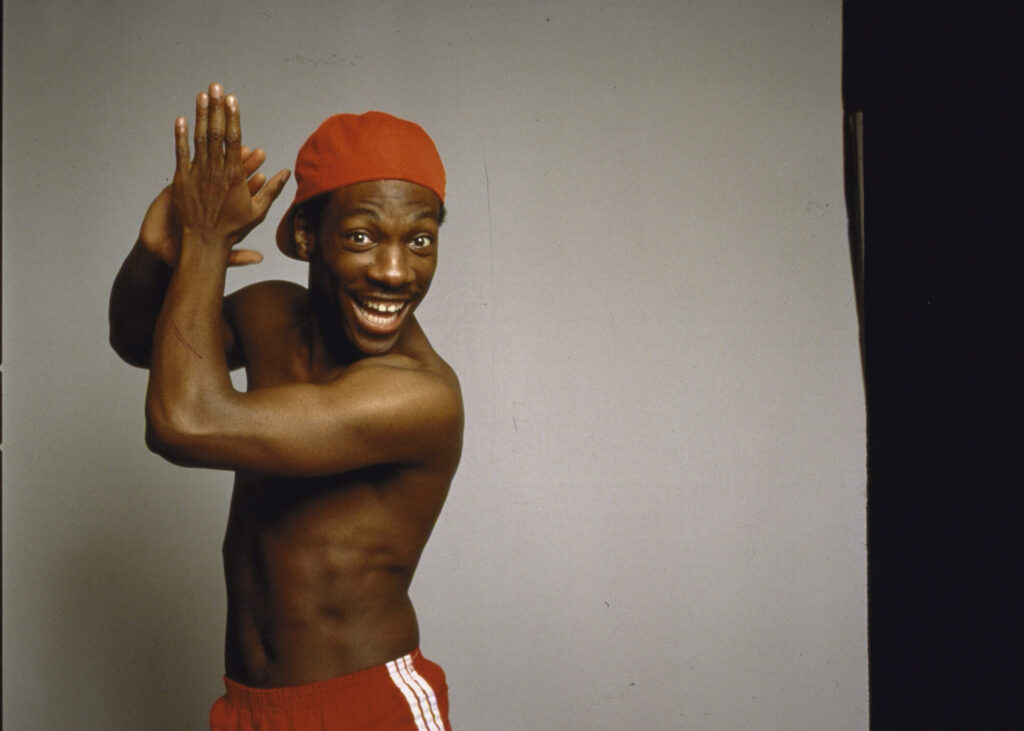
Eddie Murphy is the most naturally gifted comedian America has produced in the second half of the twentieth century, and the case for this claim is not primarily about the films, though the films at their best are extraordinary, and not primarily about the stand-up, though the stand-up specials of the early 1980s represent a high watermark of the form that very few performers have approached. The case is about what happened between 1980 and 1984 on Saturday Night Live, when a teenager from Brooklyn walked into a show that was dying and, through the sheer force of a talent so complete and so fully developed that it seemed less like a gift than like a natural phenomenon, saved it — and in saving it demonstrated a quality of comedic intelligence that the medium had not previously seen and has not seen in quite the same form since.
By Bergotte · Brooklyn & Hollywood · Comedy & Culture
He decided at fifteen that he was going to be a stand-up comedian. Not that he was going to try, not that he was interested in the possibility — he decided, with the certainty of someone who has looked at the available options and found only one of them adequate to what he actually is, and he began immediately: performing in clubs and youth centres in Roosevelt, Long Island, where his family lived, doing impressions of James Brown and Bill Cosby and Richard Pryor, developing the material and the stage presence and the timing that would make him, by the time he was nineteen, not a beginner but a working professional with years of experience that most performers his age did not have.
Edward Regan Murphy was born on April 3, 1961, in the Bushwick neighbourhood of Brooklyn, the son of Lillian, a telephone operator, and Charles, a transit police officer and amateur comedian who died when Eddie was eight. His mother remarried a man named Vernon Lynch, and the family moved to Roosevelt, a working-class suburb on Long Island, and it was there — in the suburban landscape that the comedy would never quite leave behind, the landscape of shopping malls and television and the specifically American boredom of the post-industrial middle — that the talent began its formation. He watched television with the attentiveness of a student studying a subject he intends to master: the variety shows, the sketch comedies, the stand-up specials, the sitcoms. He absorbed everything and began, immediately, to reproduce it — not as imitation but as material, the raw stuff of observation processed through a sensibility of unusual quickness and unusual range.
The influences were Richard Pryor above all. Pryor had done something that Murphy understood as a young teenager and that would shape his entire career: he had taken the full complexity of Black American life — the comedy and the pain, the street and the church, the sexual and the spiritual, the specific textures of a specific community rendered with the precision of a photographer rather than the broad strokes of the satirist — and made it available to anyone willing to listen, without mediation and without apology, in a voice that was simultaneously the most personal and the most universal voice in American comedy. Murphy took this as his standard, and the ambition it set was enormous, and the talent he brought to the ambition was, as it turned out, equal to it.
Studio 8H and the Resurrection of SNL
The Saturday Night Live that Eddie Murphy joined in 1980 was a show in crisis so severe that the word crisis understates it. Lorne Michaels had left at the end of the 1979-80 season, taking with him the original cast and the institutional memory that had made the show what it was, and his replacement, Jean Doumanian, had assembled a new cast of unknowns that the network, the critics, and the audience greeted with something close to contempt. The sixth season is the one that critics called “Saturday Night Dead,” and the description was apt: the show was unwatchable, the cast was flailing, and the question being seriously discussed in the NBC corridors was whether to cancel it entirely.
Murphy had auditioned and been hired as a featured player — a lesser designation than cast member, reflecting both his youth and the budget cuts that had reduced the show’s resources — and in the early episodes he was barely used, appearing in cameo roles that gave no indication of what was actually there. He had to fight for airtime, persistently and without embarrassment, and the fight was itself a statement: here was a young man who understood completely what he was capable of and was not prepared to wait for other people to discover it.
When he was given the space — on Weekend Update, in sketches that bore the mark of his own invention — the response was immediate and unmistakable. The audience woke up. The ratings, which had been in free fall, stabilised. Murphy’s Mr. Robinson’s Neighbourhood — his parody of Mr. Rogers, set not in the cheerful suburb of the original but in a decaying urban neighbourhood where the word of the day was “neighbourhood” and the cheerful homilies had been replaced by the sardonic wisdom of someone who understood what the cheerful homilies were designed to obscure — was, from its first appearance, one of the great recurring characters in SNL history, a piece of sustained satirical intelligence that operated on half a dozen levels simultaneously and that children found funny for the parody and adults found devastating for the critique.
“It is customary, and accurate, to say that Eddie Murphy is the only reason SNL survived the five-year wilderness without Lorne Michaels.” — Rolling Stone, 2015
Buckwheat, the Our Gang character reinterpreted as a Black adult with an incomprehensible speech pattern, was funnier than it had any right to be — funnier than the concept, funnier than the execution would be in less skilled hands — because Murphy found in the character not merely the comic potential of the impediment but a commentary on how Black people had been represented in American popular culture, the degrading stereotype held up to the light and made visible as such while simultaneously being so committed and so precise that it worked as comedy rather than merely as critique. Gumby — the clay animation character reimagined as a bad-tempered showbiz veteran — was pure invention, Murphy creating from the most improbable material a character of complete consistency and complete comedy. The Velvet Jones sketches — Murphy as a pimp-turned-self-help entrepreneur hawking books with titles like “I Wanna Be a Ho” — were the darkest and the most formally accomplished of the recurring characters, satire of the self-help industry and of the limited options available to Black women in America conducted with the straight face of a man who knows that the straight face makes the joke funnier and the critique sharper.
He was twenty years old. He saved the show. Rolling Stone’s survey of all one hundred and forty-one SNL cast members in 2015 ranked him second only to John Belushi, and the ranking understates the specificity of his achievement: Belushi was part of an ensemble of extraordinary performers, and his greatness was magnified by the company he kept. Murphy saved a dying show almost single-handedly, in conditions of institutional dysfunction and creative vacuum, and he did it by being, at twenty, already fully formed.
48 Hrs., Beverly Hills Cop, and the Film Star
The transition from television to film — which Murphy made while still a cast member of SNL, the first person to host the show while still a regular — was accomplished with the same completeness that characterised everything he did in the early 1980s. 48 Hrs. (1982), directed by Walter Hill, paired Murphy with Nick Nolte in a buddy-cop formula that Murphy elevated well beyond the formula by being, in every scene, more alive and more interesting than the material required. His Reggie Hammond — the convict let out for forty-eight hours to help a detective solve a case — is a character of total self-possession, a man who walks into every room as though he owns it and who owns it precisely because Murphy’s confidence in the character is absolute and that confidence is infectious.
The scene in which Hammond walks into a redneck bar and intimidates the entire clientele through sheer force of personality — announcing himself as a new sheriff, a Black sheriff, in a voice that manages to be simultaneously threatening and funny and entirely in control of the effect it is producing — is one of the defining scenes of 1980s American cinema, and it is a scene that works not because of the script but because of what Murphy brings to the script, which is the quality of someone who has spent years performing to rooms that were not necessarily receptive and has learned, through that experience, exactly how to make a room do what he wants it to do.
Beverly Hills Cop (1984) is the fullest realisation of what Murphy could do within the commercial Hollywood framework of the 1980s. Axel Foley — the Detroit detective loose in Beverly Hills, operating by instinct and by a form of intelligence that the wealthy, comfortable, slightly baffled world he has been dropped into cannot quite process — is one of the great comic creations of the decade, a character whose comedy derives not from the situations he is placed in but from the quality of his attention to those situations, from the speed and the precision with which he reads every room and finds in it the leverage he needs. The film grossed $234 million domestically, making it the highest-grossing comedy of all time at that point, and the achievement was less about the film than about the star: Murphy’s Axel Foley is the reason people watched Beverly Hills Cop, not the plot, not the direction, not the premise, but the specific quality of a specific intelligence working at full capacity in a specific role.
Delirious, Raw, and the Stand-Up at Its Height
The stand-up specials of the early and mid-1980s are, for many critics and fellow comedians, the truest expression of what Murphy was at his peak, and the case is strong. Delirious (1983) — filmed in Washington, D.C., Murphy in a red leather suit that was itself a statement — and Raw (1987) — filmed in New York and released theatrically, grossing fifty million dollars, a figure that tells you something about what Murphy’s name on a stand-up film meant in that decade — are records of a comedian working at the absolute height of his powers, in complete command of a room that is responding to him with the uninhibited enthusiasm of people who understand that they are in the presence of something exceptional.
The material is not, by the standards of subsequent decades, without its problems. The homophobia in Delirious — the AIDS material, the gay jokes — is real and was real at the time, and Murphy has acknowledged it, in the measured way of someone who understands that the acknowledgement is appropriate and that the acknowledgement does not erase the material. The context — the early 1980s, the AIDS crisis, the particular climate of a stand-up comedy tradition in which gay jokes were standard currency — explains it without excusing it, and Murphy himself has said that he would not make those jokes now and that he was wrong to make them then, which is the honest position and the only defensible one.
What the specials demonstrate, beyond and beneath the specific material, is a comedic intelligence of such range and such precision that almost everything else in the stand-up tradition of the period looks limited by comparison. Murphy’s ability to inhabit characters — to become, within the space of a set, a dozen different people, each with a distinct voice and a distinct physical presence and a distinct comic logic — was without precedent in the form. His ability to take the specific and make it universal, to find in the particular experience of a Black man from Long Island a comedy that was available to everyone who had ever felt the gap between who they were and what the world expected them to be, was the quality that Pryor had and that Murphy extended in his own direction. His timing — the pauses, the looks, the willingness to let a moment breathe before delivering the punchline — was the timing of someone who has spent years in rooms that didn’t give him anything and has learned, from those rooms, exactly how much silence the joke can carry before it needs the release.
Coming to America and the Multiple Self
Coming to America (1988) is the film that demonstrates most fully the aspect of Murphy’s talent that has been least adequately discussed: his ability to play multiple characters within a single film with the completeness of a classical actor inhabiting a role, finding in each a distinct psychology and a distinct physicality and a distinct comedy that do not bleed into one another. He played four roles in Coming to America — the African prince Akeem, two of the barbershop regulars, and Randy Watson of Sexual Chocolate — and each is fully realised, each has its own logic, each is funny in a different way and for different reasons. The tribute to Peter Sellers, Murphy’s other great idol alongside Pryor, is explicit: Sellers could become someone else so completely that the someone else had no trace of Peter Sellers, and Murphy understood this as the highest technical achievement available to a comedian and pursued it throughout his career.
The film itself — the story of an African prince who comes to Queens to find a wife who will love him for himself — is also, beneath the comedy, a piece of social observation of some sophistication. The Queens it depicts — the neighbourhood, the barbershop, the fast food restaurant, the apartment buildings — is rendered with the specificity of someone who grew up in a similar world and who understands it as a world of real texture and real dignity rather than as a backdrop for a fish-out-of-water comedy. The comedy works because the world it depicts is real, which is the rule that Murphy had always understood and that the lesser comedies of his career violated: the joke only works if the world it inhabits is believed.
The Wilderness and the Return
The decade between the mid-1990s and the mid-2000s is the period that Murphy’s critics invoke when they want to qualify the achievement of the early career, and the qualification is not unjust. The films of those years — Vampire in Brooklyn, Metro, Holy Man, Norbit, the second and third Nutty Professor sequels, the Dr. Dolittle franchise — range from the commercially successful but artistically negligible to the straightforwardly bad, and they represent, in aggregate, a sustained period of creative underachievement that is difficult to explain in purely commercial or institutional terms. Something was off — whether it was the difficulty of maintaining the hunger that had driven the early career from a position of enormous wealth and established reputation, whether it was the absence of the competitive pressure that had always been one of Murphy’s productive conditions, whether it was simply the natural rhythm of a career that burns intensely and then recalibrates — the result was a decade in which the talent was present and the results were consistently insufficient to it.
The Shrek franchise — begun in 2001, continued across three sequels and a spin-off — is a complicating factor in this assessment. The voice performance he gives as Donkey is, in the context of animated film, extraordinary: Murphy found in the character a specific comic identity that is completely his own and that has made Donkey one of the most beloved characters in the history of the animated film, the irrepressible, good-natured, slightly oblivious companion whose relationship with Shrek is the film’s emotional engine. The performance demonstrates that the talent was always there during the wilderness years; it was the material that was failing the talent rather than the reverse.
The full restoration came with Dolemite Is My Name (2019) — Murphy’s performance as Rudy Ray Moore, the blaxploitation-era comedian and filmmaker who built a career on pure force of personality and zero institutional support, which is a story Murphy understood from the inside. The performance is the best dramatic work of his career: generous, funny, physically alive, and possessed of a warmth and an admiration for Moore that gives the film its emotional dimension. It received the reviews that it deserved, which were very good, and it reminded a generation of critics who had been writing Murphy off for twenty years that the person they were writing off was Eddie Murphy, and that writing off Eddie Murphy was a category error of considerable proportions.
What the Gift Actually Is
The nature of Murphy’s gift is worth trying to describe precisely, because it is unusual enough that the usual descriptions — funny, charismatic, talented — fail to capture what distinguishes it from the gifts of other funny, charismatic, talented people. The gift is, at its core, an intelligence that operates at comic speed — faster than the conscious mind can track, faster than the audience can fully follow, leaving in its wake the impression of someone who is always three steps ahead of the situation he is in and is delighted by the distance.
It is also a physical gift: Murphy is, in the tradition of the great physical comedians, a performer whose entire body is involved in the comedy, whose timing is as much about how he holds his head and shifts his weight and uses his hands as about what he says. The leather suit in Delirious is not a costume but a statement, the physical confidence of a man who occupies his own body with the ease of someone for whom the body is a precision instrument rather than an awkward fact.
And it is a gift for identification — for finding, in the most specific and most personal material, the universal nerve that makes the specific available to everyone. Murphy’s comedy has always been, at its best, about the gap between the official story and the lived experience, between what the culture pretends and what the people inside the culture know, and the comedy is available to anyone who has ever inhabited that gap, which is everyone. This is why the early Murphy — the SNL characters, the stand-up specials, the best of the 1980s films — speaks to people who share none of his specific circumstances, who are not Black, not from Brooklyn, not young, not male, and who find in his comedy nonetheless something that is exactly about their own experience of the world.
He is sixty-four years old, and the fifth Beverly Hills Cop film is in development, and Shrek 5 is coming, and the career continues, and the talent that arrived at Studio 8H at nineteen — fully formed, already complete, requiring nothing from the institution except the space to demonstrate itself — is still there. The space it occupies in the history of American comedy is large and permanent and was earned, with extraordinary speed and extraordinary completeness, before most people who now celebrate it were old enough to watch television.
This essay draws on Eddie Murphy’s stand-up specials Delirious (1983) and Raw (1987), published interviews across four decades, James A. Miller and Tom Shales’s oral history Live From New York: The Complete, Uncensored History of Saturday Night Live (2002), and the Netflix documentary Being Eddie (2025). Eddie Murphy was born April 3, 1961, in Brooklyn, New York. His films have grossed over $6.7 billion worldwide, making him one of the highest-grossing actors in cinema history.
Discover more from My World of Interiors
Subscribe to get the latest posts sent to your email.


This was a really enjoyable read! Thanks for sharing.
LikeLike