
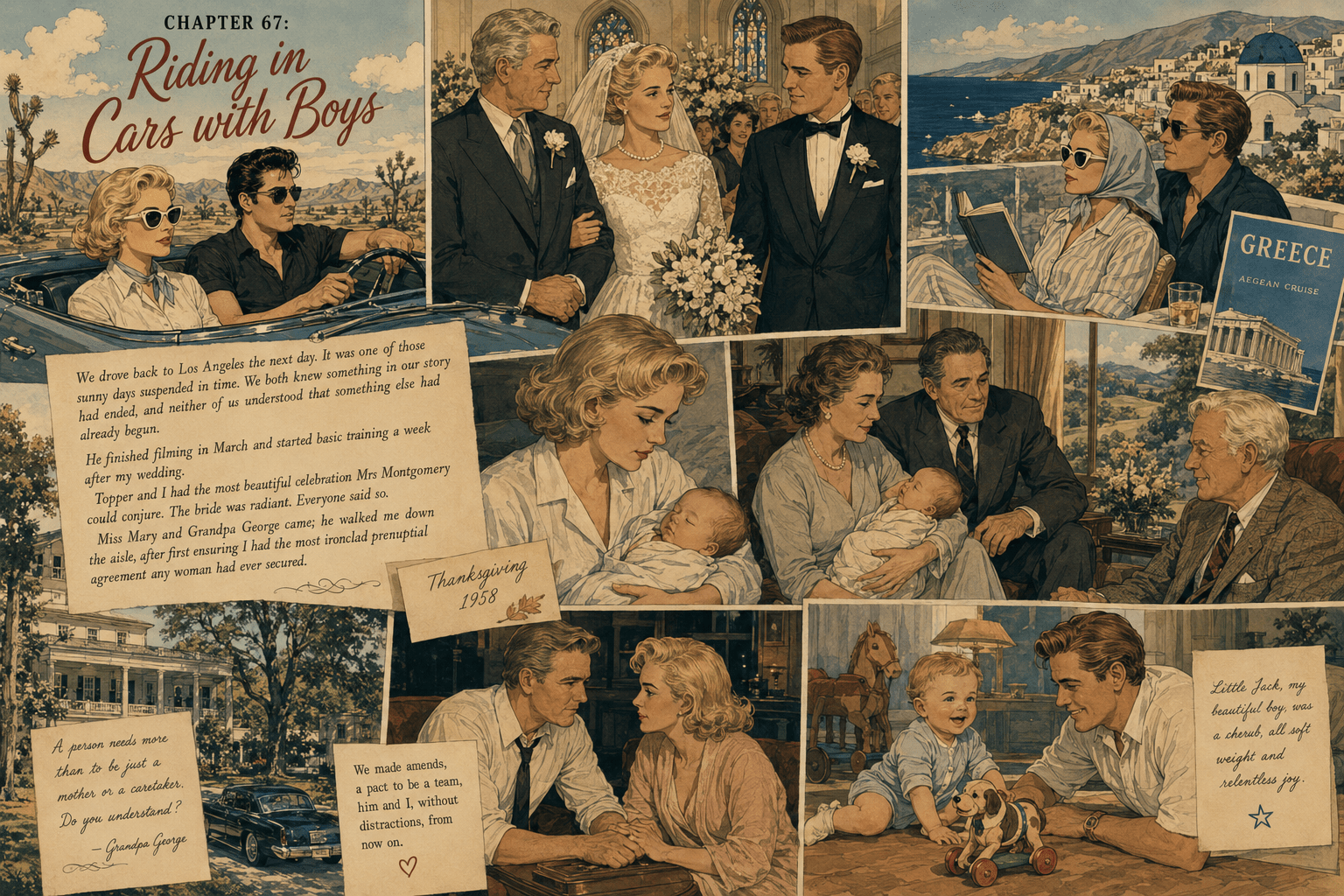
We drove back to Los Angeles the next day. It was one of those sunny days suspended in time. We both knew something in our story had ended, and neither of us understood that something else had already begun. When I said goodbye to him at his hotel, I pretended it was nothing. We didn’t linger. We feigned happiness, as if we’d see each other tomorrow, as if it were still the old days.
He finished filming in March and started basic training a week after my wedding.
Topper and I had the most beautiful celebration Mrs Montgomery could conjure. The bride was radiant. Everyone said so.
Miss Mary and Grandpa George came; he walked me down the aisle, after first ensuring I had the most ironclad prenuptial agreement any woman had ever secured. He wanted to be certain that what was his stayed mine, should trouble lie ahead.
My parents couldn’t be there; they sent their apologies. Mother was ill and couldn’t fly, they said.
We honeymooned in Greece, admiring old ruins, reading, drifting between quiet beaches. We sailed the Aegean until my morning sickness became too strong. Then we flew home, and I went to stay with Miss Mary while Topper worked for the Senator in D.C., already positioning Jack for a possible run in the 1960 race. When the heat grew unbearable, Miss Mary and I drove out to the country to stay with Grandpa George, and I remained there all summer, returning to Memphis only for Mrs P’s funeral in August.
I saw the boy only briefly at the service. By then I was six months pregnant and wearing a dress so roomy that he didn’t notice the growing bump. His mind was elsewhere. He was struck down with bottomless grief and heartbreak. I was grateful he didn’t see; it wasn’t the right time to tell him. Poor Mrs P, I thought. She died of a broken heart. I prayed for her son to recover.
The boy shipped out from New York in October, and my baby boy arrived on Thanksgiving, perfectly late and perfectly perfect. I asked Topper if it would be all right for the baby to have his own name, to break with tradition and not be christened Christopher Augustus Montgomery V. He didn’t think twice. He proposed naming him after Jack, who had slowly become both a friend and mentor to him, and I suggested Grandpa George. And so he became John George Lionel Montgomery, soon simply Little Jack, or JG. I was so completely in love with him that everything else faded into the background, the boy, Topper, my life outside of home.
There was something quietly momentous in his arrival, something that rippled through three generations at once. My parents crossed the ocean for him, our first meeting in a decade. They came not to New York or Washington, but to Grandpa George’s house in Tennessee, where the air was softer and the shadows less cruel. They moved through the rooms like figures from a half-remembered dream, still drifting in the dim afterlight of the war. But when my mother bent to take Little Jack into her arms, something in her seemed to steady, her hands sure, her breath catching only once. My father stood very still beside her, watching the two of them with an expression I had never seen directed at me: not joy, exactly, but recognition. A faint, trembling thread of life seemed to pass through them both, as if my boy had stirred some long-dormant part of their hearts. They were no longer entirely lost. For the first time since Tom died there was a tenuous warmth between us, a fragile bridge forming where grief had hollowed everything out.
Grandpa George, steadier than all of us, held Little JG with the uncomplicated devotion of a man who had never stopped loving his family in all its broken forms. He didn’t speak of inheritance or titles; he didn’t need to. His quiet pride was rooted not in lineage but in the simple fact that I was no longer alone. And yet, beneath it all, even he seemed to understand the quiet inevitability in the room: that this small, soft creature, Lord Winterset, as he would be styled, carried within him the continuation of two houses, two histories, two wounded worlds trying to steady themselves again. One day, he would become the Duke of Alderhurst, taking up the mantle his great-grandfather once believed lost forever. But for now, he was simply my baby, warm and breathing.
Grandpa George adored Little Jack without hesitation and with all the grounded joy of a man who understood both loss and renewal. And as Topper buried himself in work, I found myself going back home more often, staying with Miss Mary in Memphis or with Grandpa George in the country at the summer place. It was easier that way for all of us.
Little Jack, my beautiful boy, was a cherub, all soft weight and relentless joy. In him I saw all of my history and all of my future. He was the warm centre of my world. I needed nothing else, so long as he kept growing, so long as he stayed healthy.
“You need more than a baby in your life,” Grandpa George said one day as we were out inspecting the land. “A person needs more than to be just a mother or a caretaker. Do you understand?”
“Yes,” I replied.
He had brought me to America to experience adventure, to become somebody, to grow into my own person. I told him about wanting to create something in the visual arts, the urge I was too ashamed to share with anyone else, and he encouraged me to take it further.
“And Topper?” he asked. “Do you want to mend things with him?”
I said I did. That I missed him.
“He’s a good man,” Grandpa George said. “He has sacrificed a great deal for you. Not that it’s about that, but you need to make up your mind before you lose him.”
And I knew he was right. So I called Topper in D.C., and I went up to spend time with him, and we made amends, a pact to be a team, him and I, without distractions, from now on. And Topper couldn’t help but love the boy too, because that’s the way it is with children.
I didn’t tell the boy about Little Jack’s arrival. Did I have to? Wouldn’t someone else tell him? Would it be kinder if I didn’t? Did he already know? And was it even my place anymore, to drag him back into it? Wouldn’t that be a betrayal of Topper as well?
In the end, I decided I’d let the boy decide for himself.
Miss Mary loved the child as fiercely as anyone. In her way, he was hers too, her baby boy, her life’s work. She stayed on with us, not that there had ever been any doubt. She was family; now we simply had even more reason to keep her close.
And for the first time in a long while, it felt like the beginning of something gentler, something that might yet carry us all forward into the future, and eventually take my boy back to a much happier home than the one I had left all those years ago in England. That almost-mythical country house that would one day become his home too.
In loving memory of my friend and ‘American twin’, Matthew ‘Dutch’ Rooney

Author’s Note:
Great Are the Myths is a meditation on memory, myth-making, and the American 1950s. While the novel features fictionalised versions of real cultural figures, it is not a biographical work. I have taken significant creative liberties in imagining the interior lives and private moments of these individuals. My interest was not in documenting history but in exploring how we construct legends, how the mechanisms of fame transform people into symbols, and how those symbols shape our understanding of desire, class, and possibility.
The boy at the centre of this story is inspired by Elvis Presley’s cultural impact and public mythology, seen through the lens of a fictional companion who occupies the space between memory and imagination. Their thoughts, relationships, and private moments are entirely imagined. I have tried to honour the emotional truth of that era while acknowledging that this is, fundamentally, a work of fiction.
f you would rather listen to the audiobook, the full story is available for free on all the usual platforms. Info and links HERE
Discover more from My World of Interiors
Subscribe to get the latest posts sent to your email.

