
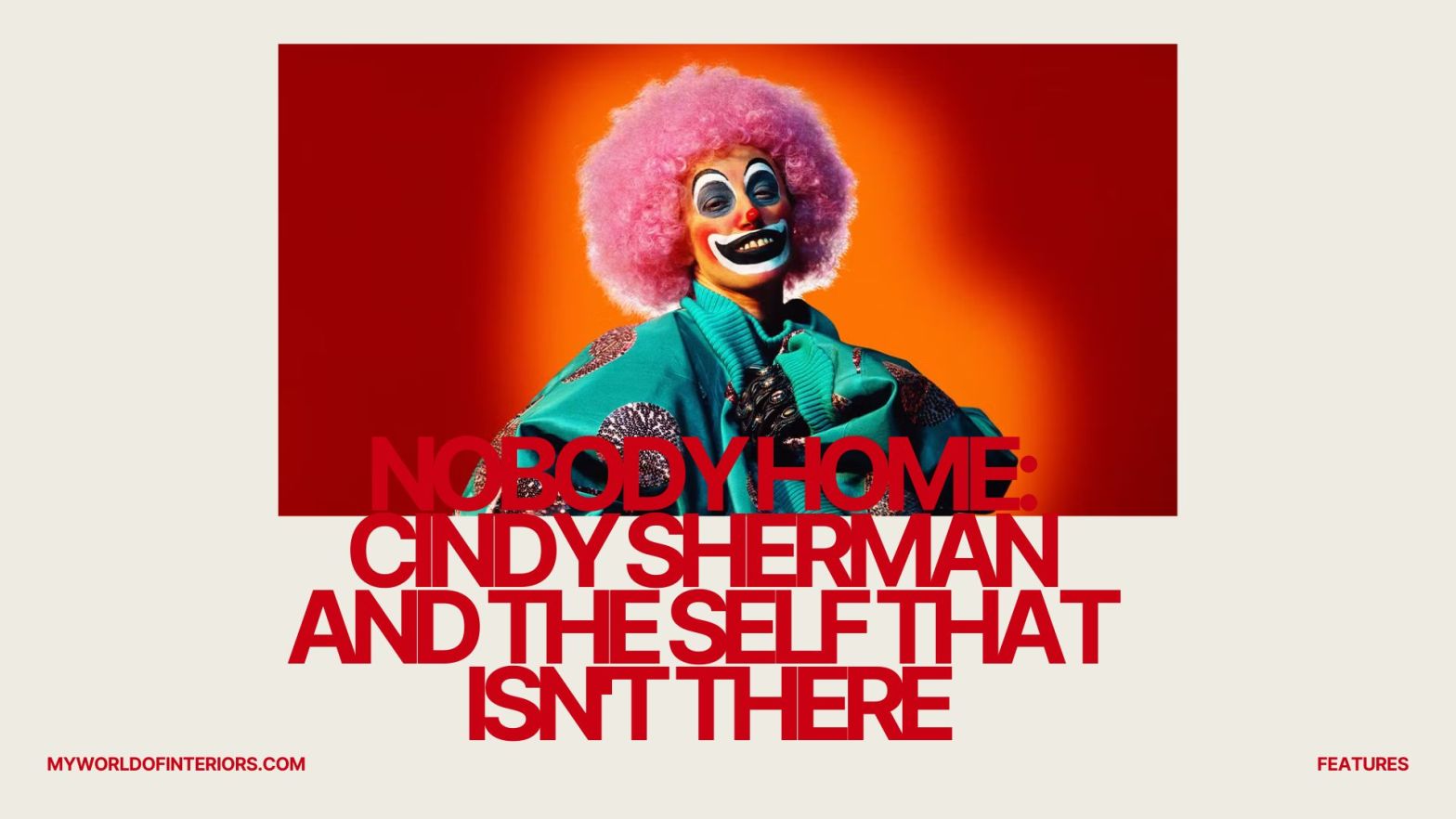
She has been a clown, a centrefold, a society matron, a fairy-tale victim, a film noir ingénue, a Renaissance duchess, a party guest, a disaster. She has never, in fifty years of making photographs, been herself. This is not evasion. It is the most radical position in contemporary art.
By Bergotte
There is no portrait of Cindy Sherman. This sounds like it cannot be true — she is the most photographed artist of the late twentieth century, the subject of retrospectives at the Museum of Modern Art and the San Francisco Museum of Modern Art and the Jeu de Paume in Paris and virtually every other major institution that has engaged seriously with contemporary art since the 1990s. There are thousands of photographs of Cindy Sherman. In all of them, she is someone else.
This is not a metaphor, or not only a metaphor. Sherman is a photographer who uses herself as her subject — her own face, her own body, subjected to increasingly extreme processes of transformation through makeup, costume, prosthetics, wigs, lighting, and the specific quality of attention she brings to each character she constructs — but the subject of the photographs is never, or almost never, herself. It is the character she has constructed, the role she has inhabited, the image she has staged. Sherman is always present in the photographs and never visible in them. The artist is the apparatus rather than the output. The self, if there is one, is the intelligence that assembles the fiction, not one of the fictions assembled.
This is, when you sit with it, one of the most unusual positions in the history of art. Portraiture — the tradition within which Sherman is working and against which her work is most productively read — has always been concerned, at some level, with the revelation of the self. The great portrait painters and portrait photographers understood their project as one of excavation: using the surface of the face and the body to work toward something beneath the surface, some quality of character or inner life that the image would allow the viewer to perceive. The portrait was supposed to give you the person. Sherman’s photographs give you everything except the person. They give you the person’s absence — the space where the person was, now occupied by a construction so thorough and so precise that the construction calls attention to its own constructedness, and in doing so calls attention to the constructedness of all the images it resembles.
She was born in 1954 in Glen Ridge, New Jersey, the youngest of five children, and grew up in Huntington, Long Island, in a family she has described as conventional in the most specific mid-century American sense — comfortable, suburban, not especially oriented toward culture, and certainly not expecting to produce one of the most consequential visual artists of the second half of the twentieth century. She was, by her own account, a shy child who retreated into dress-up with the compulsive focus of someone for whom the adoption of another identity was not a game but a vocation. She would spend hours at her grandmother’s dressing table, applying makeup and constructing costumes, becoming old women and glamorous strangers and characters that had no names. The camera came later, but the impulse — the impulse to construct and inhabit, to become something that was recognisably herself and recognisably not herself simultaneously — was present from the beginning.
Buffalo and the Pictures Generation
She studied art at the State University College at Buffalo, arriving in 1972, and it was there that she encountered both the conceptual art tradition — the work of artists like Vito Acconci and Bruce Nauman and Eleanor Antin, who were using the body and the photographic document as tools for inquiry into questions of identity and performance and institutional critique — and, more importantly, a community of artists who would shape her career in ways that the formal curriculum would not. Robert Longo was a fellow student; so was Charles Clough; and it was through this Buffalo circle that she made her way, eventually, to New York and to the community of artists and critics who would be retrospectively grouped under the label “the Pictures Generation.”
The label came from an exhibition — “Pictures,” curated by Douglas Crimp at Artists Space in New York in 1977 — that included work by Longo, Sherrie Levine, Philip Smith, Troy Brauntuch, and Jack Goldstein, and that was attempting to identify a shared tendency in the work of a group of young artists who were engaged with the image — with the way images circulate in culture, the way they construct rather than merely reflect reality, the way the images of popular culture (film, television, advertising, fashion photography) operate as a kind of unconscious grammar organising the way we understand ourselves and each other. Sherman was not in the original “Pictures” show, but she has been consistently — and correctly — associated with the generation it named, because the concerns that define the Pictures Generation define her work as precisely as they define anyone’s.
Those concerns were not invented in Buffalo or New York. They were in the air — the intellectual atmosphere of the late 1970s was saturated with the ideas of French structuralism and post-structuralism: Roland Barthes’s arguments about the death of the author and the mythology of the image, Jacques Lacan’s account of the mirror stage and the construction of the self through identification with images, Jean Baudrillard’s analysis of the simulacrum and the way the copy had, in consumer capitalism, come to precede and generate the original. These were ideas being taught in universities and debated in art journals and absorbed, with varying degrees of directness, into studio practice. Sherman’s engagement with them was, characteristically, more intuitive than theoretical — she has consistently described her process in terms of feeling and instinct rather than conceptual programme — but the intuition was, from the beginning, precise enough and rigorous enough that the ideas were genuinely present in the work, doing their work, without requiring the verbal scaffolding of an artist’s statement to make them legible.
The Untitled Film Stills: The Image Before It Exists
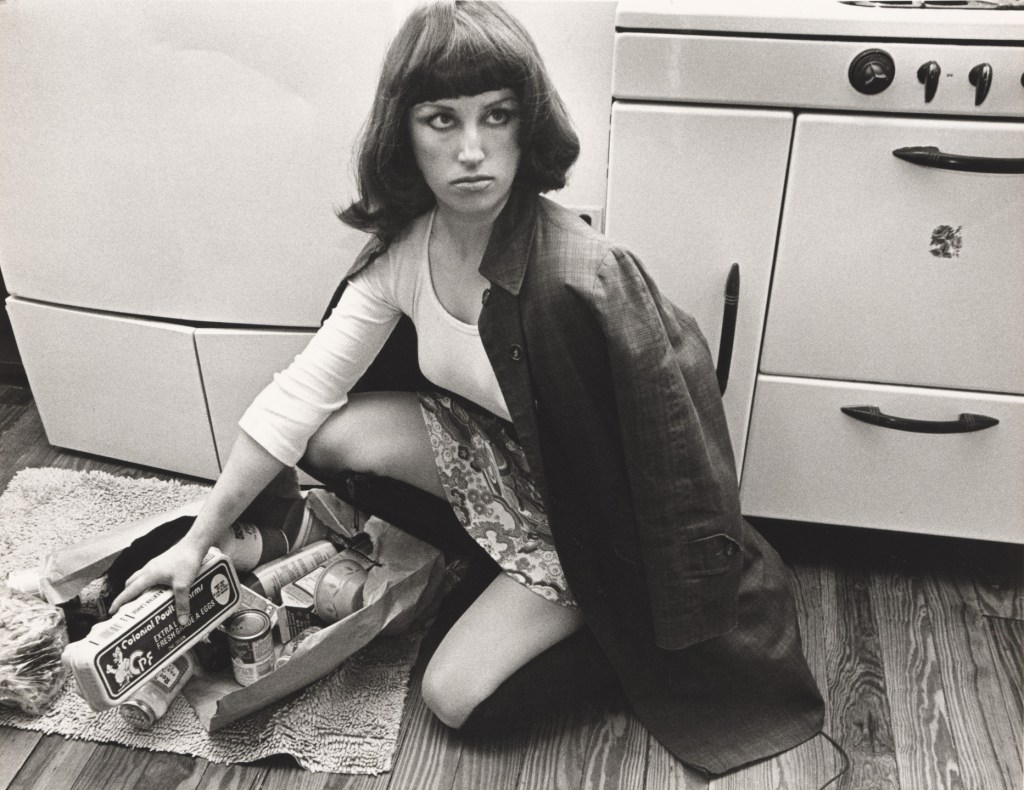
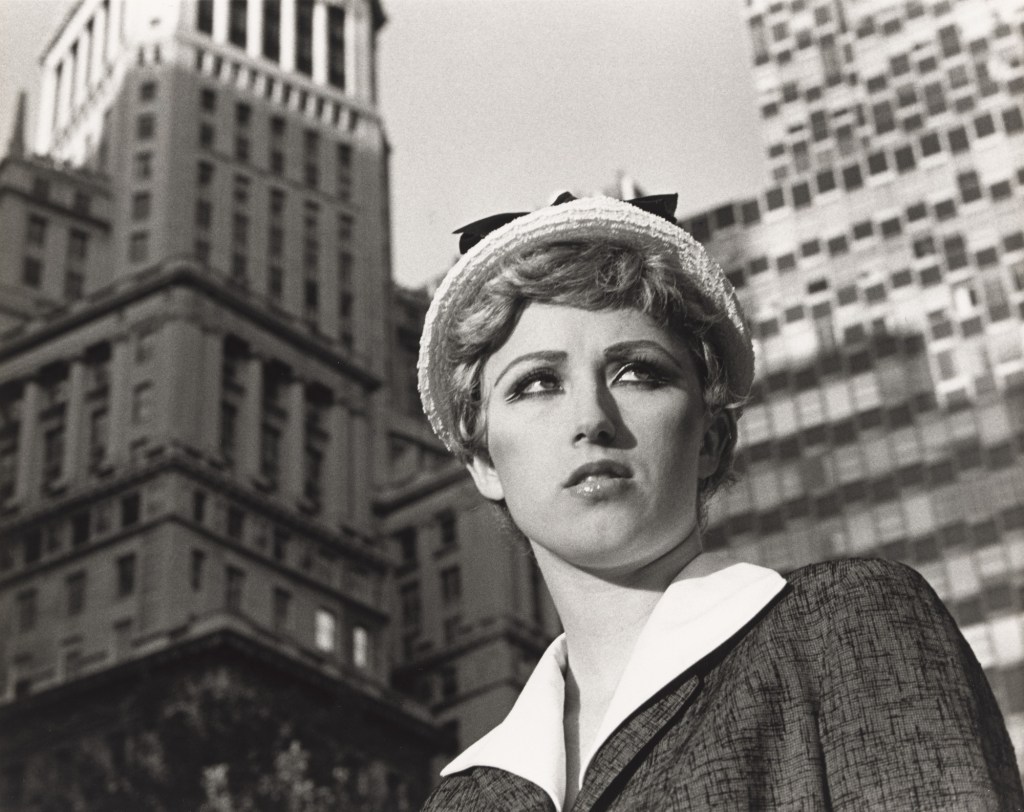
The work that established Sherman’s reputation — and that remains, for many critics and curators, the most fully realised body of work in her career — is the series of sixty-nine black-and-white photographs made between 1977 and 1980 and known as the Untitled Film Stills. The photographs are, in their surface appearance, exactly what the title suggests: stills from films that do not exist. Each shows a woman — Sherman herself, in costume and makeup and with the specific quality of posed unself-consciousness that film stills require — in a moment that has the texture of a specific cinematic period (roughly, European art cinema and American B-movies of the late 1950s and early 1960s) and the narrative incompleteness of a still taken from a longer narrative. You know, with something approaching certainty, that you have seen this film. You have not seen this film. No one has seen this film. The film does not exist.
The precision of the illusion is the point and also the analytical instrument. Because the films do not exist, you cannot verify your sense of recognition against an original — the image is self-sufficient, which means that the feeling of recognition is purely the product of the image itself, of the way Sherman has assembled the codes and conventions of a specific filmic moment so accurately that the viewer’s memory fills in the absent context automatically. What the Film Stills demonstrate, in other words, is the degree to which our sense of recognition — our feeling that we know something, that something is familiar, that a type is legible — is not the recognition of reality but the recognition of other representations, other images that have already processed reality into the forms we then learn to see as natural.
This is the Barthesian argument about mythology made visible: the way certain representations become so thoroughly naturalised that they appear to be simply true, simply the way things are, rather than the product of specific cultural choices made at specific historical moments by people with specific interests. The woman in the Film Stills — who is vulnerable in specific ways and desirable in specific ways and placed in relation to her environment in specific ways, all of which correspond precisely to the conventions of the film genres Sherman is invoking — is a myth in Barthes’s sense: a cultural construction that has been so thoroughly internalised that it presents itself as a natural type. Sherman makes the construction visible by constructing it, by showing you, with a precision that is itself a kind of argument, exactly what goes into the making of the apparently natural.
The philosophical substance of this project is considerable, and Sherman arrived at it — this cannot be said too often — not through theoretical reading but through the practice of dressing up and taking photographs. The intelligence is in the hands and the eye and the knowledge of images that she had accumulated through years of watching films with the attention of someone who was unconsciously learning a language. She knew what the images looked like because she had seen them, thousands of them, and the seeing had produced in her a capacity for accurate reproduction that was also, in the reproduction, a form of analysis. To reproduce an image with sufficient accuracy that the reproduction is indistinguishable from an original is also to reveal what the original consisted of — to show its seams, its conventions, its decisions, the choices that had been made and then concealed behind the appearance of inevitability.
The MoMA purchased the complete set of Untitled Film Stills in 1995 for approximately one million dollars — a purchase that was itself a kind of institutional statement about the importance of the work and about the degree to which the museum’s understanding of what photography was and what it was for had changed in the intervening decades. When Sherman made them, in her apartment and on the streets of New York and New Jersey, they were made for almost nothing and were sold for almost nothing. The distance between those two economic moments — the making and the institutional acquisition — is one measure of what happened to the art market in the intervening two decades, and one measure of what happened to the critical evaluation of photography as an art form, and one measure of what happened to Sherman herself.
Centerfolds and the Violence of the Look
In 1981, the artist Ingrid Sischy, then the editor of Artforum, commissioned Sherman to make a series of works for the magazine. What Sherman produced was the Centerfolds — a series of large-format colour photographs showing women (Sherman herself, as always) in poses and states of mind that referenced, with a deliberateness that was also a form of discomfort, the conventions of the magazine centrefold: horizontal format, close-up, intimate, the camera positioned above the subject in a relationship that has the quality of surveillance.
But the figures in Sherman’s Centerfolds are not available in the way that the centrefold convention requires. They are not displaying themselves to the camera; they are turned away from it, or looking past it, or caught in expressions that have nothing to do with the invitation to look that the format conventionally extends. They look frightened, or lost, or caught in the middle of a thought that has nothing to do with being looked at. The light, which is harsh and directional, casts shadows that make the images feel less like erotica than like crime scene photographs. The effect is profoundly unsettling — and it is unsettling in a way that requires the viewer to examine the source of the unsettlement, which is the viewer’s own participation in the convention the photographs are invoking and refusing simultaneously.
Sischy declined to publish the series, on the grounds that the images were too disturbing — that they would produce, in the reader of a magazine organised around the pleasures of looking at art, an experience that was closer to shame than to pleasure. This decision, which Sherman has discussed with characteristic directness, was itself revealing: the images were too honest about the convention they were referencing for the convention’s own preferred context to accommodate them. A magazine that published erotica would not have found them disturbing in the same way. Artforum, which published criticism of the conditions under which images of women circulate, found the images — which were doing exactly what Artforum‘s criticism was doing, but in a visual rather than verbal register — more than it had bargained for.
The Centerfolds were eventually exhibited and are now understood as one of the key works in the feminist critique of visual culture that was developing in and around the art world in the early 1980s — a critique that drew on the psychoanalytic film theory of Laura Mulvey and others, on the concept of the male gaze, on the argument that the conventions of looking encoded in cinema and photography and advertising were not neutral conventions but were organized around a specifically male spectatorial position that rendered women as objects rather than subjects of the image. Sherman’s Centerfolds make this argument not by stating it but by constructing it — by inhabiting the convention and refusing its terms from within, by being the woman in the centrefold who is not available to the centrefold gaze.
She has consistently resisted being claimed too completely by the feminist critical apparatus that has done most to explain and champion her work. “I’m not making work about feminist issues,” she told one interviewer, with a directness that contained some irritation. “I’m just making work.” This resistance is not disingenuous, but it requires careful reading. She is not denying that the work is engaged with questions of gender and representation and the politics of looking. She is denying that the work begins with a theoretical position and proceeds to illustrate it — and in this denial she is, again, accurate. The work begins with the image, with the specific image she wants to construct and inhabit, and the politics are in the image rather than imported into it by the verbal commentary.
Fairy Tales, Disasters, and the Body in Pieces
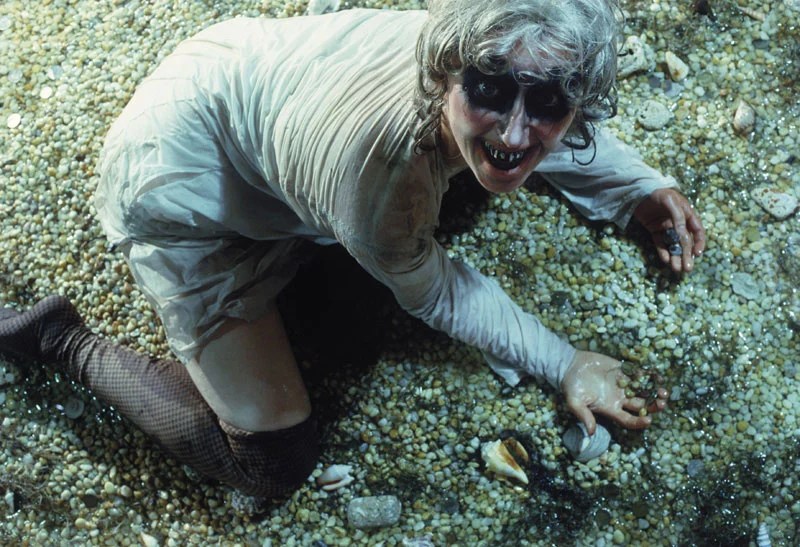
The series that followed the Centerfolds moved progressively further from the human and the recognisable — from the images that could be mistaken, by a sufficiently distracted viewer, for what they resembled. The Fairy Tales and Disasters series of the mid-1980s introduced prosthetics and artificial body parts, vomit and rot and the debris of the body in extremis, landscapes that looked like the aftermath of catastrophe. Sherman was still in the photographs — or rather, parts of her were, mixed with artificial body parts and other materials in arrangements that disrupted the coherence of the human figure.
This was, for many of her earlier admirers, a difficult development. The Film Stills and the Centerfolds had been legible — formally legible, in that the images were clearly images of a person, however staged that person was — in a way that made them accessible as critical objects. The Disasters were not legible in the same way. They were disturbing in a more fundamental register, bypassing the critical faculties that the earlier work had engaged and producing effects that were harder to intellectualise and harder to recuperate for the critical frameworks that had made sense of the earlier work.
This was, of course, the point. Sherman was following a logic that had been present from the beginning but had been operating within formal constraints that made it navigable: the logic of taking an image-type and pushing it to the point where it exceeded its own conventions, where the convention broke and something less comfortable emerged. The Film Stills pushed the film still to the point where the absence of the film became visible. The Centerfolds pushed the centrefold to the point where the gaze the convention assumed became an object of analysis. The Disasters pushed the human image to the point where the coherence of the human body — the body as a bounded, legible, self-contained entity — became questionable.
Julia Kristeva’s concept of the abject — the material that must be expelled from the body and from the field of the social for the coherent self to maintain itself: excrement, blood, decay, the evidence of the body’s relationship to mortality and to the biological processes that it would rather disavow — became, in the criticism of this period, the theoretical frame most frequently applied to the Disasters work. Sherman was, in this reading, working with the abject: staging encounters with the materials of bodily life that the culture had arranged to keep out of the field of legitimate representation. This reading is useful, up to a point. Its limit is that it tends to reduce the images to illustrations of the theory — to make them evidence for Kristeva rather than things in themselves, with their own particular qualities and their own claims on the attention. The images are stranger and more various than the theory accommodates.
History Portraits and the Grand Tradition
In the late 1980s and early 1990s, Sherman turned to the tradition she had, by that point, done most to disrupt, and engaged with it on its own terms — or rather, on terms that were simultaneously its own and hers. The History Portraits series (1988-1990) consists of photographs in which Sherman has made herself up and costumed herself to resemble specific figures — or rather, specific types of figure — from European old master painting: Renaissance noblewomen, Baroque aristocrats, Flemish merchants’ wives, the various species of represented person that populate the museums of Europe.
The photographs are funny and disturbing and technically extraordinary, and they are doing several things simultaneously. They are, first, a demonstration: of the constructedness of the image-types that old master painting established, of the fact that what we think we recognise in a Renaissance portrait as the presence of an individual is actually the presence of a set of conventions — conventions of pose and dress and lighting and expression — that can be reproduced with sufficient accuracy that the reproduction produces the same feeling of recognition as the original. The feeling of recognition, in other words, is not the recognition of a person but the recognition of a painting.
They are also, and more subtly, an engagement with the specific question of how old master painting represented women — with the conventions of the female portrait in the European tradition, the specific ways in which feminine beauty was codified and presented and made available for the pleasure of a gaze that was assumed to be male and aristocratic. Sherman’s figures are not simply reproductions of the convention; they are reproductions in which something is slightly off — the prosthetic breasts slightly too large, the nose slightly too long, the expression slightly too knowing, the lighting slightly too harsh for the soft Flemish glow that the original would have supplied. The convention is present and the deviation from the convention is present simultaneously, and the coexistence of the two produces an image that is simultaneously a homage and a critique, a love letter to the tradition and a question about what the tradition was doing with women.
The prosthetic breasts that appear in several of the History Portraits have attracted considerable critical attention, and they deserve it. They are, in some images, exposed — placed in the centre of the composition with the combination of matter-of-fact directness and slight absurdity that characterises Sherman’s best formal decisions. They are not real breasts and are obviously not real breasts; they are theatrical props of the kind used in low-budget film and theatre, slightly too large and slightly too uniform. Their presence in a work that references the high European tradition of portraiture is a collision of registers that produces, like all of Sherman’s best collisions, something that is more than the sum of the two registers: a question about what those portraits were doing with the bodies they painted, whose pleasure they were organised around, what the relationship between the beauty of the image and the objectification of the figure in the image was and still is.
Sex Pictures and the Limits of the Body
The Sex Pictures (1992) are the most extreme and most contested works in Sherman’s career — a series in which she replaced herself with medical mannequins and sexual prosthetics, assembling the parts into configurations of explicit sexuality that are, simultaneously, entirely devoid of anything recognisably sexual. The human body is absent; the props that culture uses to represent the sexual body are present in abundance, but their arrangements produce not desire but a kind of appalled bewilderment — the feeling of looking at a diagram rather than an image, of being presented with the components of an experience rather than the experience itself.
The timing was significant. The Sex Pictures were made in the context of the culture wars of the early 1990s — the debates about obscenity and public funding for the arts that had followed the controversy over Robert Mapplethorpe’s retrospective and the attempts by conservative politicians to restrict the activities of the National Endowment for the Arts. The art world was engaged in an argument about what images of the body — what images of the sexual body, in particular — could be shown in publicly funded spaces and to what audiences. Sherman’s contribution to this argument was characteristically indirect and characteristically precise: a series of images that were technically explicit in the sense that they depicted sexual acts or sexual body parts, but that were also entirely drained of the erotic charge that made explicit images politically controversial in the first place. The Sex Pictures could not titillate, because there was no body to titillate with — only the apparatus of the body, the hardware of sex, assembled in the cold light of a laboratory.
They were shocking, but the shock was of a different kind from the shock that the culture wars were organised around. The shock was ontological rather than moral: the shock of recognising that the sexual body, as represented in pornography and in the broader culture of explicit imagery, was itself a kind of prosthetic — an assemblage of parts organised for a specific kind of looking that had nothing to do with the actual complexity of embodied experience. This is not a comfortable recognition, and the images are not comfortable images. But the discomfort is, again, in the right place — directed not at the transgression of a moral boundary but at the conditions that made the transgression possible in the first place.
Society Portraits and the Comedy of Aspiration
By the mid-2000s, Sherman’s work had moved into territory that was, on the surface, more approachable — more immediately funny, more socially legible — than the Disasters or the Sex Pictures, and that contained, for that reason, a danger of being misread as purely satirical: as a joke at the expense of its subjects rather than an inquiry into the systems that produce them.
The Society Portraits (2008) show women of a certain age and a certain class — or rather, women who are performing a certain class through the specific technologies available to women of means in contemporary America: the Botox and the filler, the expensive hair, the designer clothes worn in ways that are slightly too careful, the expressions that are simultaneously confident and anxious in the way of people who have spent a great deal of money trying to look as though they have not spent a great deal of money trying. Sherman made herself up to inhabit these women with the same precision she had brought to the Film Stills thirty years earlier — but the cultural references were no longer European art cinema; they were the social pages of Town and Country and W magazine, the documentation of a species of American aspiration that was, in the Obama years, beginning to feel simultaneously triumphant and precarious.
The photographs are funny, and the comedy is not entirely sympathetic. There is something in the expressions — the slightly too-fixed smiles, the slightly too-rigid posture, the slight excess in every element of the presentation — that invites a readerly distance from the figures, a comfortable sense of superiority that the images seem, initially, to endorse. But Sherman has never been simply satirical, and the Society Portraits are not simply satire. The women in them are, like all her figures, both subject and object — both the woman in the image and the image of the woman, both the person trying to look like something and the thing they are trying to look like, and the gap between the two, which is the space in which all Sherman’s work is conducted, is here charged with a specific kind of pathos.
Because the thing these women are trying to look like is the image of a certain kind of successful femininity — an image produced by exactly the kind of cultural apparatus that Sherman has spent her career analysing. They are trying to conform to a standard that is itself a construction, performing a naturalness that is itself performed, spending enormous resources on the achievement of an appearance that is supposed to look effortless. The comedy is real, but so is the trap, and the women in the images are both the product of the trap and the evidence of its existence.
The Self That Is Not There
The question that any account of Sherman’s work eventually arrives at is the question of the self — of who is doing all this performing, and whether there is a Cindy Sherman beneath the costumes, and what, if anything, her perpetual self-concealment tells us about her own relationship to her own identity.
She has been asked this question many times, and her answers have been consistent in their refusal of the expected forms. She does not claim to be a chameleon with no self of her own. She does not make the opposite claim — that the characters she inhabits are simply costumes applied to a stable, coherent self that waits beneath them. She says, rather, that the self is not a fixed thing that precedes the performance but something that is produced through performance — that who she is is in some sense constituted by the characters she has inhabited, that the self is the accumulation of the looking and the constructing and the inhabiting rather than the thing that preceded all of it.
This is, again, more than a personal statement. It is a philosophical position — one that has affinities with the performativity theory developed by Judith Butler in the early 1990s, which argued that gender was not a property of the self but a repeated performance, a set of acts that produced the illusion of an inner gender identity that the acts supposedly expressed. Butler’s argument is about gender specifically; Sherman’s practice is about identity more broadly, about the way the self is constituted through identification with images and the performance of types, about the degree to which what we call the self is always already a kind of costume, a character we have assembled from the available cultural materials.
The photographs make this argument not by stating it but by performing it — by showing, with fifty years of formal precision and formal variety, that the figure in the image is always a construction, and that this constructedness is not a special property of the artistic image but the condition of all images, including the images we make of ourselves in the mirrors of our daily lives. Sherman’s photographs are, in the end, photographs about photography — about what photography does when it arrests the flux of appearance and makes a specific configuration of light and shadow into something that seems to have weight and truth and permanence. But they are also photographs about the self — about the strange, persistent, partially illusory sense that there is a self to be photographed, a person behind the image, a truth that the representation both conceals and reveals.
In her studio — which is not a studio in the conventional sense but a space entirely given over to the materials of construction, the wigs and the makeup and the prosthetics and the costumes and the lighting equipment and the camera, all the apparatus by which one person becomes many — she works alone. There are no assistants, no stylists, no collaborative partners of the kind that large-scale contemporary art production usually requires. She does everything herself: the makeup, the costume, the lighting, the posing, the shooting. She is, in each session, the director and the performer and the cinematographer and the subject, all at once. The images are the product of a single intelligence working through all the roles simultaneously — and the intelligence that holds all those roles together, that makes the decisions about which direction to push the character and when to click the shutter, is Cindy Sherman, the only Cindy Sherman there is, the one who has never appeared in any photograph.
What She Left in the Room
The retrospective that the Museum of Modern Art mounted in 2012 — the most comprehensive survey of her work to that point, filling the museum’s galleries with fifty years of images, from the early black-and-white experiments through the Film Stills and the Centerfolds and the History Portraits and the Society Portraits and the clowns and the disasters and the sex pictures — was one of those exhibitions that changes the way you see in the hours and days after you leave it. This is not a common effect. Most exhibitions leave you with information, with a sense of having been educated, with a few images that stay in the memory. The MoMA Sherman retrospective left visitors with something more fundamental: a heightened awareness of the constructedness of all the faces they subsequently encountered, on the street and in the media and in the mirror.
This is what the best art does — not merely shows you something but changes the apparatus of your seeing, so that the world you return to after the encounter is the same world but differently visible. Sherman’s work has this effect more reliably than almost any other contemporary art, because the subject it changes the way you see is the subject you cannot avoid: the human face, the gendered body, the social presentation of self, the images through which we understand each other and ourselves.
She is still working. In the years since the MoMA retrospective she has continued to make new series — including work made for Instagram, which she has engaged with in a way that is neither straightforwardly ironic nor straightforwardly earnest, that finds in the social media image the same structures and the same myths that she found in the movie still and the centrefold and the old master portrait, and that subjects them to the same process of loving, precise, slightly vertiginous examination. The platform is new. The inquiry is continuous. The self, as always, is nowhere to be found — which is, as always, exactly where it should be.
The standard monograph on Cindy Sherman is the Retrospective catalogue published by Thames & Hudson, with essays by Amanda Cruz, Elizabeth A.T. Smith, and Amelia Jones. Rosalind Krauss’s essay ‘Cindy Sherman: Untitled’ in Cindy Sherman: 1975-1993 (Rizzoli) remains essential critical reading. The complete Untitled Film Stills are in the collection of the Museum of Modern Art, New York. Sherman’s work is represented by Metro Pictures, New York, and Sprüth Magers, Berlin and London.
Discover more from My World of Interiors
Subscribe to get the latest posts sent to your email.

