Ancient Maya cities, henequen haciendas, colonial architecture and a flourishing contemporary cultural scene make Mexico’s Yucatán one of the Americas’ most rewarding destinations for travellers interested in art, history and design.
The great Maya city of Uxmal lies among the low hills and dry forests south of Mérida. Its buildings were constructed more than a thousand years ago, yet their architectural sophistication remains striking. Elaborate stone mosaics cover the upper sections of façades, while the lower walls are comparatively plain. The arrangement is deliberate, creating a balance between ornament and architectural mass that is characteristic of the Puuc style.
A few hours away, the grand houses of Mérida tell a considerably later story. Built with fortunes accumulated through the henequen industry, their European-inspired architecture records the ambitions of a commercial elite and the economic inequalities upon which its wealth depended.
These two architectural traditions are part of a much larger history. Yucatán brings together the achievements of the ancient Maya, the violence of Spanish colonisation, centuries of cultural continuity and a contemporary creative community increasingly engaged with the region’s extraordinary inheritance.
For travellers accustomed to associating the peninsula with the Caribbean resorts of Cancún and Tulum, its interior offers a considerably richer understanding of southeastern Mexico.
A Landscape Shaped by Water
The Yucatán Peninsula encompasses the Mexican states of Yucatán, Campeche and Quintana Roo, extending geographically into Belize and Guatemala. This journey concentrates on the Mexican state of Yucatán, with Mérida as its capital.
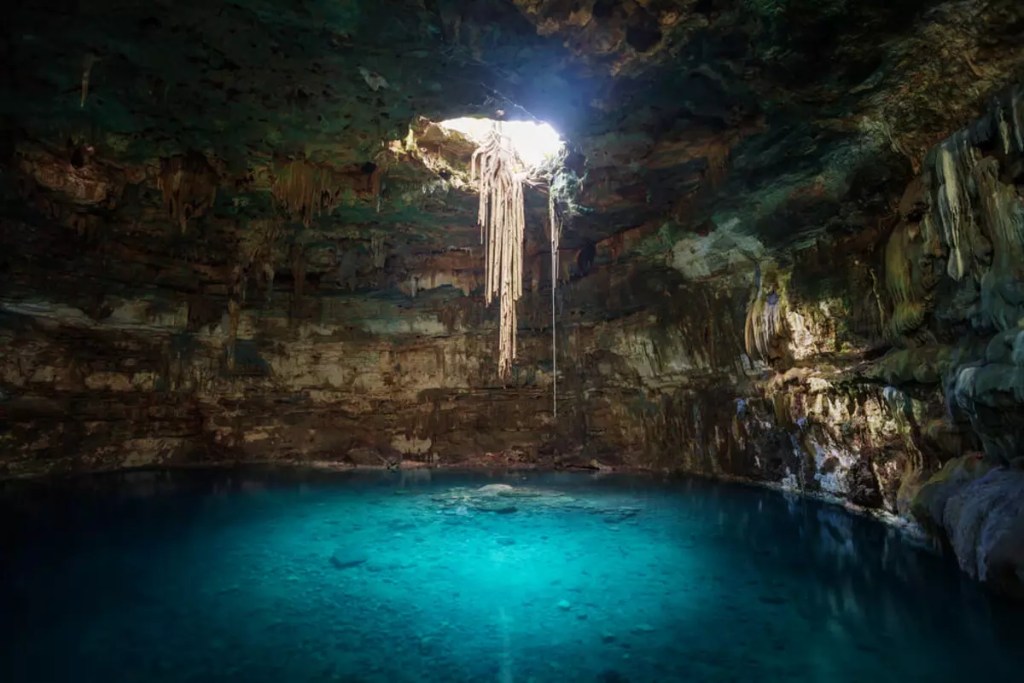
Much of the northern peninsula rests upon porous limestone. Rainwater passes through the rock, creating underground channels, caves and natural sinkholes known as cenotes. In an area with few substantial surface rivers, these subterranean water systems have influenced settlement, agriculture and religious life for centuries.
There is an extraordinary geological dimension to this landscape. Approximately 66 million years ago, an asteroid struck the area around present-day Chicxulub, north of Mérida. The impact is associated with the mass extinction that ended the age of the non-avian dinosaurs. A ring of cenotes broadly follows part of the buried crater’s geological boundary.
Water played an equally important role in Maya civilisation. Certain caves and cenotes were regarded as sacred places, and archaeological discoveries reveal their use for ritual offerings.
The Sacred Cenote at Chichén Itzá is among the best-known examples. It also demonstrates how closely the region’s geology and religious traditions were connected.
The Maya: An Ancient Civilisation with a Living Culture
The Maya developed one of the ancient Americas’ most sophisticated intellectual and artistic cultures. Their achievements included monumental architecture, complex political institutions, astronomical observation, mathematics and an elaborate hieroglyphic writing system.
Their cities were never components of a single, permanently unified empire. Political authority was distributed among competing kingdoms, with alliances and rivalries changing over time.
The decline of individual cities has frequently been presented as the disappearance of Maya civilisation. This is a serious historical misconception.
Maya communities survived political upheaval, Spanish conquest and centuries of colonial domination. Their languages, agricultural knowledge, crafts, food traditions and cultural practices remain central to contemporary life across the peninsula.
According to Mexico’s 2020 census, approximately 519,000 people in the state of Yucatán spoke the Maya language.
Traditional agricultural practices also continue. The milpa, a system of cultivating maize alongside crops such as beans and squash, reflects generations of ecological knowledge.
For an introduction to this history, the Gran Museo del Mundo Maya in Mérida is particularly valuable. Its exhibitions connect archaeological discoveries with the experiences and cultural practices of contemporary Maya communities.
The museum is a useful reminder that Yucatán’s Indigenous history cannot be confined to the archaeological sites visited by tourists.
Mérida: Architecture and the History of Power
Founded by Spanish colonisers in 1542 upon the Maya settlement of T’hó, Mérida developed around a formal colonial street plan.
Earlier structures were dismantled, and their stone was incorporated into buildings constructed under Spanish authority. The city’s architecture consequently preserves physical evidence of conquest within the fabric of its historic centre.
The Plaza Grande remains the principal starting point for exploring this history. Its cathedral, civic buildings and arcaded streets establish the architectural character of the colonial city.
Nearby, the Museo Casa Montejo occupies a sixteenth-century residence commissioned by the conquistador Francisco de Montejo. Its elaborate Plateresque façade incorporates heraldic ornament and figures intended to communicate the authority of its owners.
The building is particularly interesting as an architectural expression of the conquest. European Renaissance forms acquired a specific political meaning when reproduced in the Americas, where architecture became an instrument through which colonial power was made visible.
Today, Casa Montejo contains historical interiors and exhibition spaces.
A very different expression of authority emerged during the late nineteenth and early twentieth centuries, when Yucatán became one of the world’s leading producers of henequen.
The fibre-producing agave, sometimes called green gold, supplied the international market for rope and agricultural twine. Its cultivation brought extraordinary wealth to plantation owners.
Along the Paseo de Montejo, prosperous families constructed elaborate mansions inspired by French and other European architectural traditions.
One of the finest examples is the Palacio Cantón, completed in 1911 and now home to the Regional Museum of Anthropology. Its grand staircase, decorative plasterwork, marble and carefully proportioned interiors reveal the ambitions of Mérida’s wealthy elite.
The museum also offers an opportunity to consider the relationship between architecture and economic history.
These buildings were financed by an agricultural system heavily dependent upon coercive labour arrangements, including debt peonage, and accompanied by extensive Indigenous land dispossession.
Their architectural beauty deserves serious attention. So does the system that made it possible.
Contemporary Mérida: Artists, Architecture and Design
Mérida has developed an increasingly visible contemporary creative community, attracting architects, designers, artists and restaurateurs interested in the possibilities of its historic buildings.
Traditional domestic architecture offers particular opportunities for adaptation. Many houses are organised around internal courtyards, with high ceilings, thick masonry walls and openings designed to encourage ventilation.
These features developed in response to a demanding tropical climate. Their continued usefulness has encouraged architects working on contemporary residences and restorations to reconsider local building knowledge.
The resulting projects range from modest adaptations of domestic buildings to ambitious architectural interventions.
The city’s modern artistic history is also worth exploring. Fernando Castro Pacheco (1918–2013), whose paintings and murals addressed Mexican history and society, and Fernando García Ponce (1933–1987), a significant figure in Mexican abstraction, are among the artists associated with Yucatán.
Contemporary visual culture has been affected by changes to the city’s institutions. The former Museo de Arte Contemporáneo Ateneo de Yucatán, known as MACAY, has closed, and its collection has been distributed among other Yucatecan cultural and educational institutions.
That closure is worth noting in a city whose growing creative reputation has not always been matched by stable institutional support for contemporary art.
For visitors, Mérida’s architecture remains one of its greatest attractions. Walking through the historic centre reveals houses adapted as studios, restaurants, galleries and small hotels, alongside buildings that continue to serve their original domestic purposes.
The Haciendas and the Henequen Economy
The hacienda is one of Yucatán’s most recognisable architectural forms.
Many of these estates developed into extensive agricultural and industrial complexes during the nineteenth century. Their buildings included residential quarters, workshops, processing facilities, storage areas and transport infrastructure.
Today, abandoned haciendas are being restored as hotels, private homes and cultural spaces. Their architectural appeal is considerable, although sensitive restoration requires an understanding of their social and economic history.
At Hacienda Yaxcopoil, southwest of Mérida, visitors can examine a property that retains much of its historic character.
The estate’s monumental entrance, furnished rooms and surviving industrial buildings illustrate the combination of domestic and productive functions that defined the henequen hacienda.
Its preservation makes it particularly useful for understanding the scale of the industry.
Hacienda Sotuta de Peón provides a different experience, with demonstrations of henequen cultivation and traditional fibre processing.
Its restored machinery helps explain how a plant cultivated in the surrounding fields became a commodity traded internationally.
Both properties provide valuable historical context for the increasingly fashionable restoration of haciendas as luxury destinations.
The challenge facing contemporary owners is substantial. Conservation involves architectural decisions, but it also raises questions about the treatment of difficult histories, the role of surrounding communities and the future purpose of buildings originally constructed within highly unequal economic systems.
One of the most interesting contemporary responses is Hacienda Subín, an estate outside Mérida developed over many years by artist and designer Laura Kirar and her husband, Richard Frazier.
Their project combines the restoration of historic buildings with landscape design, hospitality and plans for artistic activities. It is sufficiently distinctive to deserve a separate examination.
Read our accompanying feature: Hacienda Subín
Uxmal and the Architecture of the Puuc Region
For anyone interested in architectural history, Uxmal is among the most rewarding places in Mexico.
The city flourished principally between the eighth and tenth centuries and is celebrated for its exceptionally accomplished stone architecture.
The Puuc style is characterised by carefully constructed masonry, comparatively restrained lower walls and elaborate upper façades decorated with geometric patterns and representations of the rain deity Chaac.
The Governor’s Palace is particularly impressive. Its long horizontal composition, elevated setting and complex ornamental programme reveal a highly developed understanding of architectural proportion.
Nearby, the so-called Nunnery Quadrangle surrounds a substantial courtyard with four buildings whose façades display variations of the region’s decorative vocabulary.
The Spanish name bears no relationship to the complex’s original Maya function.
The Pyramid of the Magician, with its unusual rounded plan and successive construction phases, provides another opportunity to examine the city’s architectural development.
Uxmal deserves several hours of careful exploration, ideally with a knowledgeable archaeological guide.
Its achievements are especially rewarding when considered within the wider history of world architecture. The organisation of space, sophistication of masonry and integration of ornament reveal architectural principles that developed independently of the classical traditions of Europe.
Nearby Kabah extends the experience.
Its celebrated Palace of the Masks incorporates numerous representations of Chaac, demonstrating the extraordinary importance of architectural ornament in the region.
Together, Uxmal and Kabah offer an excellent introduction to Puuc architecture.
Chichén Itzá and the Cities of Eastern Yucatán
Chichén Itzá is considerably more famous than Uxmal and usually much busier.
Nevertheless, its archaeological significance is immense.
The city’s architecture reflects periods of political and cultural development that involved exchanges with central Mexico.
The celebrated pyramid known as El Castillo, or the Temple of Kukulcán, dominates the site, but several other monuments deserve equal attention.
The Great Ball Court, Temple of the Warriors, El Caracol and the Sacred Cenote reveal different aspects of the city’s ceremonial, political and intellectual life.
Visiting with a qualified guide makes a substantial difference to understanding the relationship between these structures.
Further east, Valladolid offers a comfortable base for exploring the surrounding region.
Its historic streets preserve examples of colonial domestic architecture, while the Calzada de los Frailes has become known for small shops, restaurants and carefully restored buildings.
The Convent of San Bernardino de Siena is among its principal architectural monuments.
For visitors interested in traditional crafts and contemporary design, the Coqui Coqui perfumery is worth exploring. Founded by Nicolas Malleville and Francesca Bonato, the company has developed a distinctive approach to fragrance, hospitality and interiors informed by the botanical and cultural environment of the peninsula.
The town also offers access to Ek’ Balam, one of Yucatán’s most interesting archaeological sites.
Its Acropolis contains exceptionally fine sculptural decoration, including elaborate stucco work associated with the tomb of the ruler Ukit Kan Lek Tok’.
The surviving reliefs demonstrate the considerable achievements of Maya sculptors and the importance of architecture in communicating political authority.
Izamal and Maní: Two Histories of Colonial Yucatán
The town of Izamal is widely known for its buildings painted in shades of yellow and ochre. Yet its importance extends far beyond its appearance.
Izamal was an important Maya religious centre before the Spanish conquest.
The surviving Kinich Kakmó pyramid offers evidence of the settlement’s pre-Hispanic scale.
The sixteenth-century Convent of San Antonio de Padua, constructed over an earlier sacred complex, contains an exceptionally large arcaded atrium.
The juxtaposition of Maya monuments and Franciscan architecture makes Izamal an important place for examining the physical consequences of religious conquest.
For lunch, Kinich is a long-established restaurant specialising in regional Yucatecan cooking.
Further south, Maní occupies a particularly difficult place in the intellectual history of the peninsula.
In 1562, the Franciscan Diego de Landa oversaw the destruction of Maya religious objects and manuscripts during an auto-da-fé.
The loss of written material was devastating for the preservation of Indigenous intellectual traditions.
Landa subsequently produced an influential account of Maya culture, an uncomfortable historical irony given his responsibility for destroying some of its written sources.
Maní’s Franciscan architecture should be understood within this history of religious coercion and cultural loss. The town is also associated with regional cooking and longstanding embroidery traditions.
Cenotes and the Northern Coast
The cenotes remain among Yucatán’s most distinctive natural attractions.
Some are open pools surrounded by vegetation. Others lie beneath the ground, accessible through openings in the limestone.
Their ecological importance is considerable. The underground water system supplies communities and supports habitats that can be highly vulnerable to pollution.
Around Valladolid, cenotes such as Zací and X’Canché provide opportunities to experience these formations.
Visitors should follow local conservation rules, avoid introducing contaminants into the water and, where possible, support responsibly managed sites.
The northern and western coasts offer another landscape altogether.
At the Ría Celestún Biosphere Reserve, coastal lagoons, mangroves and shallow waters support numerous bird species, including American flamingos.
Further east, the Ría Lagartos Biosphere Reserve protects another significant wetland ecosystem.
Birdwatching excursions with authorised local guides are an excellent way to experience these environments, although wildlife sightings vary with the season.
The Yucatecan Table
Yucatán has one of Mexico’s most distinctive regional cuisines.
Its culinary traditions draw upon Maya agriculture and cooking methods, alongside ingredients and techniques introduced through centuries of trade and migration.
Achiote, sour orange, habanero chilli, maize, pumpkin seeds and regional herbs provide many of its characteristic flavours.
Cochinita pibil, pork marinated in achiote and sour orange and traditionally cooked underground, is perhaps the best-known dish.
Papadzules consist of tortillas filled with boiled eggs and covered in a pumpkin-seed sauce. Sopa de lima combines citrus with a fragrant broth, while relleno negro relies upon a dark preparation of roasted chillies.
Poc chuc, grilled pork prepared with sour orange, is especially associated with the region’s interior.
For traditional cooking in Mérida, Manjar Blanco, associated with chef Miriam Peraza, is an established address.
At the contemporary end of the city’s restaurant scene, Huniik offers a particularly interesting combination of gastronomy and visual art.
Chef Roberto Solís has spent much of his career exploring modern interpretations of Yucatecan cooking. At Huniik, the restaurant’s interiors were developed by Cuban artist Jorge Pardo, whose work incorporates bold colour and a sculptural approach to space.
Huniik received a Michelin star in 2026, a recognition that reflects Mérida’s increasing visibility as a gastronomic destination.
Micaela Mar & Leña provides a different experience, with seafood, fire-based cooking and a welcoming setting in the historic centre.
Outside Mérida, Ixi’im occupies the former engine house of a henequen estate at Chablé Yucatán.
Its architecture retains the industrial character of the original building, while the restaurant serves contemporary Mexican cuisine under chef Luis Ronzón, developed with Jorge Vallejo.
Ixi’im received both a Michelin star and a Michelin Green Star in 2026.
In Valladolid, IX CAT IK concentrates on traditional Maya cooking, using regional ingredients and established culinary techniques.
The most rewarding exploration of Yucatecan food should also include local markets, small traditional kitchens and an opportunity to learn about the agricultural practices behind the region’s cooking.
Embroidery, Hammocks and Living Craft Traditions
Yucatán’s cultural history also survives through everyday objects and traditional craftsmanship.
The hammock is particularly well adapted to the peninsula’s warm climate, allowing air to circulate around the body.
Traditional garments, including embroidered huipiles, demonstrate intricate knowledge of textiles, pattern and regional decorative traditions.
In 2024, UNESCO documented work undertaken with Yucatecan women embroiderers to develop strategies for safeguarding their craft.
The initiative involved artisans directly in discussions about the preservation, transmission and economic future of their work.
For visitors interested in craftsmanship, purchasing from local makers and cooperatives offers an opportunity to understand these traditions through the people who continue to practise them.
Where to Stay
Accommodation in Yucatán ranges from restored city residences to extensive hacienda properties whose architecture is an important part of the experience.
A historic residence in central Mérida, with courtyards, gardens and carefully considered interiors. Its location makes it a convenient base for exploring the city’s architecture, museums and restaurants on foot.
One of the region’s most ambitious hospitality projects, combining historic hacienda buildings with contemporary accommodation and landscape design. Its restaurant, Ixi’im, is an architectural and gastronomic attraction in its own right.
The company’s Valladolid perfumery offers an introduction to its distinctive combination of fragrance, botanical research and design. Accommodation arrangements should be confirmed directly, as individual properties and services may change.
A restored seventeenth-century estate developed by Laura Kirar and Richard Frazier. Its combination of historic architecture, carefully developed interiors and an evolving programme of cultural activities sets it apart from more conventional hotel conversions.
The property is the subject of our accompanying feature.
Planning a Cultural Journey
Yucatán can be visited throughout the year, although November to February generally offers more comfortable conditions for exploring archaeological sites and historic towns.
March and April become increasingly hot, particularly inland. The summer months bring high temperatures and humidity, while the Atlantic hurricane season runs from June through November.
Seven to ten nights would allow a rewarding introduction to the state.
Begin with three nights in Mérida, including visits to its museums, historic neighbourhoods and restaurants. From there, explore the henequen haciendas and devote a separate day to Uxmal and Kabah.
Continue towards Izamal and Valladolid, allowing time for Chichén Itzá, Ek’ Balam, cenotes and the region’s cultural institutions.
With additional time, travel to Celestún or Ría Lagartos for the coastal landscapes and birdlife.
A rental car provides flexibility for exploring the interior, although coach services and rail connections cover parts of the peninsula.
Before travelling, consult Mexico’s National Institute of Anthropology and History for current archaeological-site access, admission arrangements and restrictions.
As of October 2026, Mayapán remains closed to visitors. Other sites may occasionally be subject to temporary restrictions.
Yucatán rewards travellers prepared to explore beyond its most familiar monuments.
The restored mansions of Mérida, the architectural achievements of Uxmal, the regional food traditions and the continuing work of Maya communities all belong to a cultural history that remains active and contested.
For architects, artists and designers working in the region today, the possibilities of that inheritance are considerable.
At Hacienda Subín, an abandoned agricultural estate has become the setting for an ambitious and deeply personal creative project. Its development provides a particularly interesting example of how historic buildings can acquire new cultural purposes.

