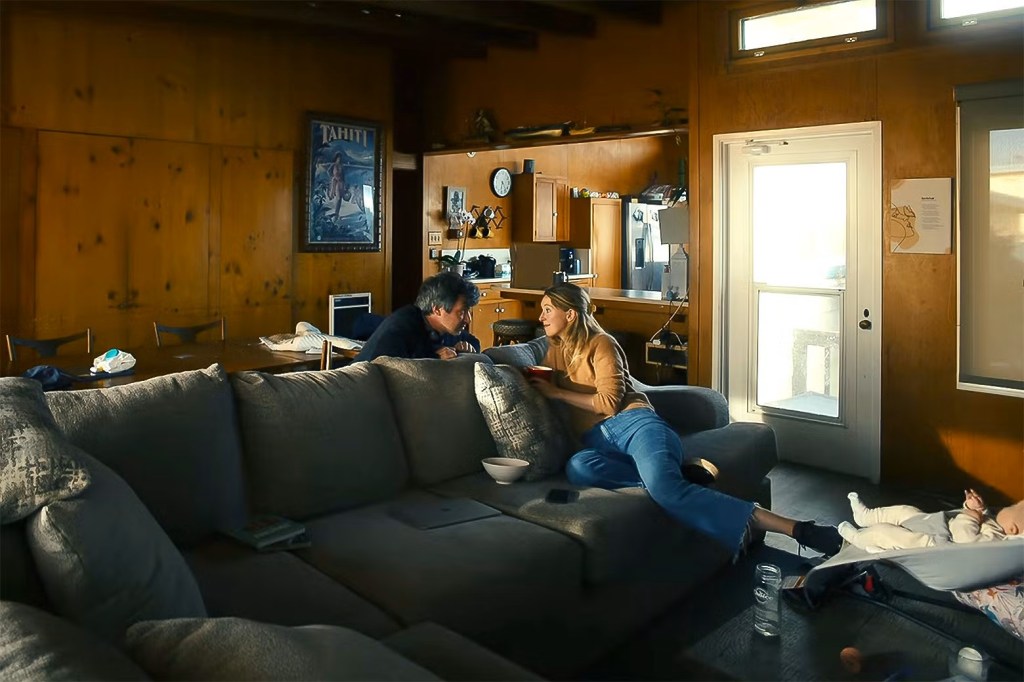
In one of the most audacious documentaries of recent years, Nathan Fielder and Lance Oppenheim move into the home of convicted Theranos founder Elizabeth Holmes, thirty-four days before she enters prison. What follows is a bewildering confrontation between two people whose careers have depended, in very different ways, upon manipulating appearances. Part psychological thriller, part philosophical experiment and frequently an exercise in excruciating comedy, You Can See Everything turns the familiar conventions of documentary filmmaking inside out. The result is a fascinating investigation into our increasingly precarious relationship with truth.
The Woman Who Wanted to Tell Her Story
There is something irresistible about the prospect of Nathan Fielder interviewing Elizabeth Holmes. One has built a career exposing the absurdities of human behaviour through elaborate exercises in deception; the other became one of Silicon Valley’s most notorious figures after convincing influential investors that her company possessed revolutionary medical technology. Putting them in the same room seems almost indecently entertaining.
Yet You Can See Everything, Fielder’s extraordinary new documentary co-directed with Lance Oppenheim, turns out to be considerably more sophisticated than the confrontation its premise suggests. Rather than exposing Holmes through a series of clever questions, the filmmakers gradually find themselves entangled in a situation where the distinction between sincerity and manipulation becomes increasingly difficult to establish.
In May 2023, just weeks before beginning her federal prison sentence, Holmes invited Fielder, Oppenheim and a small crew into the Southern California home she shared with her partner, Billy Evans, and their two young children. Their stated intention was to document her everyday life and allow audiences to encounter a woman whose public identity had been almost entirely defined by scandal.
Holmes wanted to correct the record. Fielder wanted to understand how someone convicted of fraud could remain so apparently convinced of her own innocence. Both entered the arrangement believing that access might produce clarity.
The film proceeds to dismantle that assumption with extraordinary ingenuity.
Holmes had founded Theranos in 2003, promising to transform medical diagnostics through blood-testing technology supposedly capable of performing extensive analyses using only a few drops of blood. Her spectacular rise depended upon a combination of scientific ambition, personal charisma and the peculiar susceptibility of Silicon Valley to individuals who present themselves as exceptional visionaries.
The black turtlenecks, deliberately controlled appearance and strikingly deep voice became as recognisable as the company’s technological promises. Holmes understood the power of an image long before the shortcomings of Theranos’s technology were exposed.
Following the investigations of journalist John Carreyrou, whose reporting formed the basis of Bad Blood, the company’s claims unravelled. In 2022, Holmes was convicted on four counts involving fraud against investors and subsequently sentenced to more than eleven years in prison.
Her decision to invite cameras into her home was therefore astonishingly bold. She had already become the subject of books, documentaries, podcasts and the acclaimed television drama The Dropout. Yet she remained determined to recover control over the narrative of her own life.
It is tempting to imagine that she simply underestimated Nathan Fielder. Watching the documentary, however, it becomes equally reasonable to wonder whether Fielder underestimated her.
Two Masters of the Constructed Reality
Fielder’s television career has been built upon the unstable relationship between authentic behaviour and manufactured circumstances. In Nathan for You, he devised increasingly preposterous business schemes, placing ordinary people in situations where the conventions of politeness and professional conduct became almost impossible to maintain. The results were frequently hilarious, but the comedy concealed an unusual sensitivity to the ways people perform socially acceptable versions of themselves.
His later HBO series The Rehearsal developed these experiments into something approaching philosophical theatre. Elaborate replicas of restaurants, apartments and other environments allowed participants to rehearse important moments in their lives. Actors were employed to anticipate possible responses, and Fielder attempted to eliminate uncertainty through increasingly sophisticated simulations.
The more elaborate his arrangements became, the more uncertain the distinction between reality and performance appeared.
With Elizabeth Holmes, Fielder encounters someone who seems to inhabit this ambiguity almost naturally. She presents herself with remarkable composure, insisting upon her innocence and interpreting the Theranos scandal through a narrative of misunderstood intentions. Questions about what her technology could actually accomplish are repeatedly redirected towards what she had hoped it might eventually achieve.
Fielder’s deadpan interrogation is perfectly suited to these exchanges. He possesses an extraordinary ability to make an apparently simple question feel like an instrument of psychological torture. He asks for clarification, waits through uncomfortable silences and returns to the same issue from a slightly different angle until the conversation begins to resemble an absurdist play.
At one point, he introduces Abbott and Costello’s famous Who’s on First? routine in an attempt to demonstrate how words can be manipulated through misunderstandings and evasions. Holmes appears unable to recognise the relevance of the performance to their own exchanges. Whether this represents genuine incomprehension or another defensive strategy remains impossible to determine.
This uncertainty is the film’s principal source of fascination. Holmes’s apparent sincerity does not make her assertions reliable, but neither does her criminal conviction provide complete access to her inner life. Fielder discovers that evidence of deception and knowledge of a person’s intentions are two very different things.
The distinction matters enormously. The verdict against Holmes remains a matter of legal record, supported by evidence presented in court. The documentary does not overturn it. What the film exposes is the difficulty of understanding someone whose interpretation of events appears almost entirely resistant to contradiction.
Rather than offering a reassuring psychological explanation, Fielder allows that difficulty to become increasingly uncomfortable. We are left watching two people attempting to establish authority over an account of reality that neither can fully control.
Radical Transparency and the Limits of the Camera
Holmes and Evans present their cooperation with the filmmakers as an exercise in radical transparency. It is a fashionable phrase within contemporary technological culture, where visibility has increasingly become synonymous with honesty. Corporate executives publish personal reflections, celebrities document their domestic lives, and social-media users transform private experience into continuous public performance.
The underlying proposition is seductive: the more we are permitted to see, the better we will understand.
Oppenheim’s cinematography quietly undermines this belief. Working with David Bolen, he transforms the apparently ordinary spaces of Holmes’s home into an environment of extraordinary psychological tension. Conversations take place in kitchens and bedrooms, around furniture and children’s belongings, while the camera studies every hesitation and facial expression with an intensity that makes even the preparation of breakfast seem potentially incriminating.
The close-ups are particularly unsettling. Holmes’s enormous blue eyes and Fielder’s impassive expression become almost abstract surfaces upon which the audience is encouraged to project meaning. A pause might indicate uncertainty, calculation or simple fatigue. An awkward smile may suggest embarrassment, dishonesty or a genuine inability to understand the person asking the question.
We watch intently, persuaded that some revealing detail must eventually emerge.
The difficulty is that images do not explain themselves.
The sociologist Erving Goffman explored related questions in his influential 1956 study, The Presentation of Self in Everyday Life. Drawing upon theatrical metaphors, Goffman argued that social interaction involves the continuous management of impressions. Individuals adjust their behaviour according to circumstances, audiences and the identities they wish to maintain.
What makes Fielder’s documentary so compelling is that everyone involved appears acutely aware of this process. Holmes wishes to present herself as a misunderstood entrepreneur and devoted mother. Evans wants to defend his partner while exercising influence over the production. Fielder presents himself as an investigator whose apparent social awkwardness conceals formidable analytical persistence.
Even the filmmakers’ commitment to transparency becomes a form of performance. Their cameras may document intimate encounters, but the subsequent selection and arrangement of those encounters inevitably creates another constructed account.
The documentary’s title is therefore its first great joke.
You cannot see everything. The camera can record an extraordinary quantity of information while leaving the essential motives of its subjects obscure.
Billy Evans and the Battle for Control
As the film progresses, Billy Evans becomes an increasingly important figure. Initially introduced as the supportive partner of a woman facing imprisonment, he gradually emerges as someone deeply invested in managing how she is perceived.
His relationship with Holmes is fascinating partly because it complicates the familiar account of her as a uniquely manipulative personality. Within their domestic arrangements, Evans appears determined to influence conversations, challenge the filmmakers’ interpretations and defend a shared version of events. Fielder becomes increasingly suspicious of the degree to which this influence shapes Holmes’s public and private life.
The film does not establish every implication of that suspicion, nor should the audience pretend otherwise. But it raises a compelling question about the relationship between intimacy and authority. When two people share a version of reality that outsiders find difficult to reconcile with established facts, how does that shared conviction function within their relationship?
The documentary’s most revealing moments are often unexpectedly mundane. Domestic disagreements acquire an almost unbearable tension because the viewer has been encouraged to interpret each gesture as evidence of some larger psychological arrangement. It is a brilliantly uncomfortable effect, though it also reveals the ethical danger inherent in this kind of filmmaking. Once a subject has acquired a reputation for dishonesty, almost anything they do can be interpreted as confirmation.
Fielder and Oppenheim are intelligent enough to recognise this trap. The longer their investigation continues, the more their own methods become implicated in the uncertainty they are attempting to resolve.
Holmes may be performing for the camera, but the filmmakers are also constructing a version of Holmes for us. The question is no longer simply whether we can trust the subject. It is whether we fully understand the interests, assumptions and interpretative choices of the people presenting her.
When Reality Becomes a Rehearsal
The following section discusses a major development in the film’s second half.
The arrival of Amanda Seyfried, who won an Emmy for her portrayal of Holmes in the 2022 television drama The Dropout, takes the documentary into genuinely extraordinary territory.
Seyfried has already spent considerable time studying Holmes, reproducing her voice, gestures and mannerisms to create a fictional interpretation that millions of viewers now associate with the real person. Fielder invites the actress into his investigation, initially allowing her to observe footage of Holmes responding to the television drama.
The situation is almost absurdly recursive: an actress watches a real woman watch the actress’s performance of that woman. Each representation informs the next, and the original subject seems increasingly difficult to separate from the images produced in her name.
Fielder then develops a series of reenactments, using Seyfried and other performers to reconstruct conversations and investigate aspects of his encounters with Holmes and Evans.
The method recalls The Rehearsal, but its purpose has shifted. Instead of preparing for uncertain future events, Fielder attempts to recover an elusive truth from the past. The reconstructions become increasingly elaborate, introducing fresh interpretations of situations that already seemed impossible to understand.
Seyfried’s participation is particularly impressive because she begins to question her own responsibilities as an actress. A dramatic portrayal may be based upon established facts, yet its emotional impact can persuade audiences that they have acquired intimate knowledge of a real person. The performance becomes so culturally authoritative that the distinction between historical evidence and artistic interpretation begins to disappear.
Here the film enters territory explored by Orson Welles in F for Fake (1973) and Abbas Kiarostami in Close-Up (1990). Both filmmakers understood that deception and performance are not merely obstacles to documentary truth; they can also become methods through which its complexity is revealed.
Fielder’s reenactments similarly demonstrate that reconstructing an event does not necessarily bring us closer to its original meaning. An actor introduces a new psychological interpretation, which may illuminate an encounter while simultaneously transforming it.
The simulation becomes another reality requiring explanation.
What makes the sequence so intellectually exhilarating is its willingness to turn the documentary’s own assumptions against it. The film begins with a belief that prolonged observation might expose the truth about Holmes. It eventually confronts the possibility that every new representation merely introduces another layer of interpretation.
The result is a documentary that becomes increasingly sceptical about documentary itself.
The Ethics of Looking
There is a particularly uncomfortable dimension to watching a convicted fraudster being subjected to Fielder’s methods. His work has often been criticised for exploiting the social vulnerabilities of his participants, and his willingness to pursue awkward encounters beyond conventional limits can feel deliberately cruel.
Holmes, however, is no ordinary unsuspecting subject. She has demonstrated extraordinary skill in constructing a public persona, and her decision to participate in the film is clearly motivated by the possibility of influencing her reputation.
This creates an unusually balanced struggle over representation. Holmes possesses experience in persuasion and image-making; Fielder controls the camera, the questions and ultimately the documentary’s construction. Both understand that public perception has consequences, and both are attempting to influence those consequences.
The relationship is further complicated by the presence of Holmes’s children and the circumstances of her imprisonment. Whatever one thinks of her criminal conduct, the emotional realities of family separation cannot simply be dismissed as another performance.
This is where You Can See Everything becomes considerably more mature than the elaborate pranks associated with Fielder’s earlier career. The possibility of genuine vulnerability begins to interfere with his investigative certainty.
Sympathy and accountability are not mutually exclusive, although contemporary media culture often treats them as competing positions. A person may be responsible for serious wrongdoing while remaining capable of love, distress and ordinary human attachment.
The film’s achievement lies in its refusal to resolve these contradictions through either sentimental rehabilitation or easy condemnation. Holmes’s documented conduct remains central to understanding her story, but the film also questions the audience’s appetite for reducing a complicated individual to a familiar cultural villain.
Richard Brody, writing in The New Yorker, has described the film’s extraordinary movement between suspicion and emotional complexity. It is precisely this instability that gives the documentary its unusual power.
The Post-Truth Documentary
The larger significance of You Can See Everything extends well beyond the Theranos scandal.
We are living through a period in which public life is increasingly organised around competing representations of reality. Social media rewards confidence and emotional immediacy, while artificial intelligence has further complicated the distinction between authentic and manufactured images. Public figures cultivate intimacy with audiences who may never encounter them beyond a screen.
Under such conditions, the relationship between seeing and believing becomes increasingly precarious.
The French philosopher Jean Baudrillard’s account of simulation is particularly relevant. His argument that representations can acquire an authority independent of the realities they supposedly describe feels uncannily appropriate to Holmes, whose fictional portrayal now forms part of the public understanding of her actual identity.
Yet Fielder’s film is more subtle than a straightforward illustration of postmodern theory. It recognises that uncertainty has limits. Some claims can be tested against evidence, and some actions carry consequences that cannot be dissolved through competing interpretations.
The central problem is not that truth has ceased to exist. It is that human beings frequently confuse their confidence in an interpretation with knowledge of the facts.
This distinction helps explain why the documentary has provoked such an extraordinary critical response. Its success lies not simply in revealing new information about Holmes, but in exposing the assumptions audiences bring to the act of looking.
Fielder and Oppenheim have created a film in which the viewer becomes increasingly conscious of participating in the construction of meaning. We interpret expressions, speculate about motivations, revise our judgements and occasionally discover that our certainty rested upon remarkably little.
For a documentary concerned with one of the most notorious examples of corporate deception in recent American history, this is an unexpectedly philosophical accomplishment.
The Unknowable Person
What remains after nearly three hours is not a definitive portrait of Elizabeth Holmes. Fielder’s investigation produces moments of apparent insight, but the accumulating footage never delivers the psychological certainty that both filmmaker and audience initially seem to desire.
This absence of resolution is the film’s greatest strength.
Holmes’s conviction establishes her legal responsibility for specific acts of fraud. It does not provide complete knowledge of her inner life, just as the extraordinary intimacy of the documentary cannot guarantee access to her intentions. The distinction between factual evidence and psychological interpretation becomes the organising principle of the entire work.
For Fielder, whose previous projects have frequently involved increasingly elaborate attempts to understand and control human behaviour, this represents a fascinating artistic development. His methods are pushed to the point where their limitations become impossible to ignore.
He has encountered a subject whose relationship with truth is extraordinarily difficult to decipher, and in attempting to understand her, he discovers that his own techniques of observation and reconstruction cannot deliver the certainty he seeks.
The resulting film is ambitious, uncomfortable, formally inventive and often very funny. Its nearly three-hour running time may seem extravagant for a documentary about an already extensively reported scandal, but the duration allows its central questions to develop with unusual complexity.
By the conclusion, the subject is no longer exclusively Elizabeth Holmes. It is the strange human conviction that sufficient observation will eventually reveal another person’s essential nature.
You Can See Everything dismantles that belief without surrendering to the idea that all interpretations are equally valid.
We may never entirely understand another person, but the difficulty does not absolve us of the responsibility to distinguish evidence from invention, sincerity from accuracy and understanding from mere familiarity.
Fielder’s great accomplishment is to make that intellectual problem feel like a psychological thriller. The film is a reminder that documentary cinema need not simply record the world as it appears. At its most adventurous, it can transform our understanding of what it means to look at the world in the first place.
And in an age saturated with images, that may be among the most important questions cinema can ask.
Film Information
You Can See Everything (2026)
Directed by Nathan Fielder and Lance Oppenheim
Cinematography by David Bolen
Featuring Elizabeth Holmes, Billy Evans, Nathan Fielder and Amanda Seyfried
Running time: 174 minutes
US theatrical release: 16 October 2026
Distributor: A24
Official film website, trailer and screening information — A24
Further Reading and Viewing
The Vertiginous Revelations of You Can See Everything — The New Yorker
Richard Brody examines the relationship between Fielder’s methods, Holmes’s apparent sincerity and the extraordinary emotional complications of the documentary.
You Can See Everything — The Guardian
Adrian Horton’s enthusiastic assessment of the film’s formal ingenuity and psychological complexity.
You Can See Everything — RogerEbert.com
Tomris Laffly considers the film’s experimental approach to documentary, its uncomfortable humour and its relationship with Fielder’s earlier work.
F for Fake — Orson Welles, 1973
A fascinating cinematic predecessor exploring forgery, performance, authenticity and the authority of the filmmaker.
Close-Up — Abbas Kiarostami, 1990
An essential work of experimental documentary cinema in which real individuals reenact events from their own lives, destabilising the boundaries between fiction and reality.
The definitive journalistic investigation into Theranos, providing the factual background against which the documentary’s psychological and philosophical experiments should be understood.

