
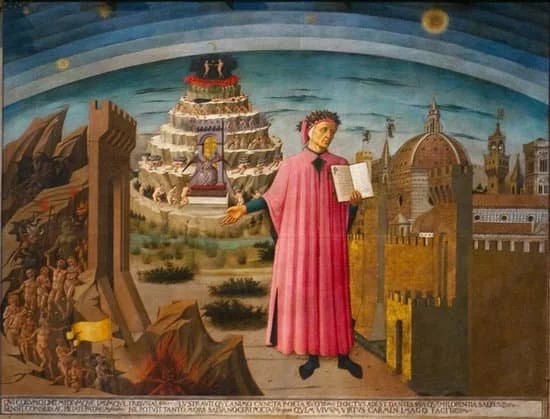
He was thirty-five years old, exiled from his city, stripped of everything that had defined him, when he began the most ambitious poem in the Western tradition. He set it in the middle of his own life because the middle of a life is where the crisis comes — when the path forward is no longer clear, when the structures that organised the first half have given way, when the question of who you are and what your life is for can no longer be deferred. He went to Hell first. This was, it turns out, the right order.
By Bergotte
“Nel mezzo del cammin di nostra vita” — in the middle of the journey of our life — the poem begins, and the first word is not I but we. Not in the middle of my life but of our life, the life we all live, the life that has a middle in which the pilgrim finds himself in a dark wood, the straight way lost. The choice of the first-person plural is the first philosophical act of the Commedia, and it announces everything that follows: this is not a private vision, not the record of one man’s peculiar spiritual crisis, but a map of the human condition drawn from the inside of it, the account of a journey that every conscious being makes in one form or another, whether they know it or not.
Dante Alighieri was born in Florence in 1265, into a city that was, in the second half of the thirteenth century, one of the most politically turbulent and culturally fertile in Europe. Florence was a city of factions — Guelph against Ghibelline, Black Guelph against White Guelph — in which the political temperature was such that the difference between prosperity and ruin could turn on a single papal letter, a single military defeat, a single shift in the complex web of alliances that organised Italian city-state politics. Dante entered this politics with enthusiasm and with the specific combination of moral seriousness and political naivety that makes for great poetry and catastrophic civic careers. He was elected to the governing council of Florence. He served with what appears to have been genuine conscientiousness. He was condemned in absentia, in 1302, on charges of corruption and opposition to the pope, sentenced to death if he returned, stripped of his property, expelled from the city that had formed him and that he would never see again.
He spent the remaining nineteen years of his life in exile, moving between the courts of various Italian lords who were willing to provide shelter to a poet of growing reputation and uncertain political utility. He began the Commedia — he called it a comedy in the technical medieval sense, meaning a work that begins in misery and ends in happiness rather than the reverse — sometime around 1308, and he was still writing the final cantos of the Paradiso when he died in Ravenna in 1321, at fifty-six. The poem was the exile’s work: produced in dispossession, shaped by the rage and the grief and the specific philosophical urgency of the man who has lost his city and is trying, through the act of the poem, to understand how that loss happened and what it means.
The Dark Wood: Where the Journey Begins
The dark wood of the opening is not a geographical location. It is a state — the specific state of the person who has lost her way, who has allowed the accumulation of habit and distraction and moral compromise to carry her to a point at which the straight way is no longer visible, in which the clear orientation toward the genuine good that the good life requires has been obscured by the dense growth of everything that is not that. It is the state of spiritual confusion — not dramatic sin, not deliberate evil, but the ordinary, gradual, almost imperceptible drifting from the path that the moral life requires sustained attention to maintain.
Dante encounters it at thirty-five — the midpoint of the biblical threescore years and ten, the point at which the first half of a life is complete and the shape of the second half must be determined. This is not accidental. The middle of a life is where the dark wood most naturally grows, because the first half of a life is typically organised around the acquisition of the things that define a self — the education, the relationships, the career, the social position, the accumulated markers of a life under way — and the acquisition can proceed so thoroughly and so successfully that when the acquisitions are complete the self that they were supposed to constitute is nowhere to be found. The path was lost not in a moment of dramatic crisis but in the daily, unremarkable, barely perceptible choices that carried the pilgrim, step by step, into the wood.
The three beasts that block Dante’s path out of the wood — the leopard, the lion, and the she-wolf — are the specific obstacles to the return to the straight way, and the she-wolf is the most dangerous: she represents concupiscence, the disordered desire for material goods that has no natural limit, that grows stronger the more it is fed, that is, in the moral vocabulary of the poem, the root of most human evil. She is Epicurus’s vain and empty desire given animal form, and she is the specific obstacle that the journey is designed to address — the specific disorder of the soul that the descent through Hell, the ascent through Purgatory, and the flight through Paradise are structured to cure.
Virgil appears — Dante’s guide through Hell and Purgatory, the Roman poet whom Dante considered the greatest poet who had ever lived and who represents, in the poem’s philosophical architecture, the highest achievement of human reason operating without divine revelation. He has been sent, he tells Dante, by Beatrice — the woman Dante had loved, who had died in 1290, who has descended from Paradise to ask for Virgil’s help in rescuing the living man from the wood. The journey begins as a rescue mission organised by love, guided by reason, aimed at the recovery of the straight way. This, the poem suggests from the beginning, is how the recovery of the moral life always works: the love that creates the desire for the journey, the reason that guides the first stages of it, and the revelation that takes over where reason ends.
The Inferno: Hell as Self-Knowledge
The principle that organises Dante’s Hell — the contrapasso, the correspondence between the sin and the punishment — is the most philosophically sophisticated element of the Inferno, and it is the element most thoroughly obscured by the popular reception of the poem, which tends to remember the spectacular torments and forget the argument they are making.
The contrapasso is not arbitrary cruelty. It is the demonstration of a philosophical claim: that what a person becomes through her choices is what she is, and that what she is, she is permanently. The damned in Hell are not being punished from outside for things they did. They are being shown, with absolute clarity and absolute permanence, what they made of themselves through the choices they made in life. The punishment is the sin, revealed in its true nature: the flatterers who are submerged in excrement are in the excrement that was the substance of their words. The fortune-tellers who presumed to see forward are twisted backward, forced to look only behind them. Paolo and Francesca, swept eternally in the whirlwind of the lustful, are in the storm they allowed their passion to become — together, yes, inseparable, yes, but never at rest, never at peace, never able to stop.
This is Aristotelian moral psychology taken to its extreme and made visible. Aristotle had argued that character is formed by habit — that we become just by doing just acts, cowardly by doing cowardly ones, that the repeated choices of a lifetime constitute the self that does the choosing. Hell is the Aristotelian account of character formation applied to its final consequence: the self that the choices made is the self that remains, permanently, without the possibility of further choice or further change. The damned are not people who made mistakes. They are people who made themselves into what they are, and what they are, they are forever.
The encounter with Farinata degli Uberti — the Florentine nobleman whom Dante places in the circle of the heretics, buried in a burning tomb — is the most politically charged encounter in the Inferno and one of the most philosophically rich. Farinata was the leader of the Ghibelline faction, the political enemies of Dante’s family, and he rises from his tomb with the bearing of a man who regards Hell itself with contempt, who has not been diminished by damnation, who maintains in eternal punishment the specific quality of pride that constituted his greatness and his sin simultaneously. Dante admires him — cannot help admiring him — and the admiration is part of the poem’s honesty: Hell contains people of genuine greatness whose greatness was also their undoing, and the poem does not pretend otherwise.
The encounter with Ulysses is the most philosophically troubling in the Inferno and has generated more commentary than almost any other passage in the poem. Dante places Ulysses in the circle of the fraudulent counsellors, where he burns eternally in a tongue of flame. And then he gives Ulysses a speech — the account of his final voyage past the Pillars of Hercules and into the unknown southern ocean — that is among the most beautiful things in the poem, a speech of such heroic magnificence that it seems to contradict the judgment that places its speaker in Hell:
“Consider your origins: you were not made to live like brutes, but to follow virtue and knowledge.”
The line is Ulysses’ great speech to his crew, urging them past the boundary that has been set for human knowledge, into the ocean that lies beyond it. It is magnificent. It is also, in the poem’s moral framework, precisely the sin: the Ulyssean drive to know without limit, to transgress the boundaries set for human reason, to pursue knowledge for its own sake without reference to the good that knowledge is supposed to serve. The speech that sounds like an affirmation of the highest human aspiration is also a description of the hubris that sends the ship down. Dante admires Ulysses and condemns him simultaneously, and the simultaneous admiration and condemnation is the poem’s most honest acknowledgment of the difficulty of the moral life: the things that make us great are the things that can destroy us, and the destruction and the greatness are not always clearly distinguishable from inside the experience of either.
At the bottom of Hell, frozen in the ice of the ninth circle, is Satan — not the magnificent rebel of later tradition but something almost more terrible: a figure of hideous size, mechanically beating his three pairs of wings and thereby generating the wind that freezes the ice that imprisons him, grinding with his three mouths the three great traitors Judas, Brutus, and Cassius. He is not magnificent. He is the reduction of the greatest created being to a machine — the eternal, mindless, self-defeating activity of the creature that chose itself absolutely and has become, in the choosing, nothing but the mechanism of its own punishment.
Dante and Virgil do not leave Hell upward. They climb down Satan’s body and emerge on the other side — in the southern hemisphere, at the foot of the mountain of Purgatory, under the stars. The descent through Hell has been the descent through the full range of human moral failure, the complete taxonomy of the things that the disordered soul does to itself and to others. The emergence is not triumphant. It is simply the completion of the necessary descent: you cannot begin to climb until you have gone all the way down.
The Purgatorio: The Mountain of Becoming
The Purgatorio is the least read and the most humanly rich of the three canticles, and its relative neglect is a cultural loss of some consequence. The Inferno has the dramatic torments and the magnificent sinners. The Paradiso has the blazing light and the theological sublimity. The Purgatorio has something rarer and more difficult: it has hope.
The souls in Purgatory are not being punished. They are being healed. The distinction is the most important in the poem’s moral architecture, and it is the distinction that the Purgatorio keeps insisting on in every encounter, every example, every image. The penitent on the mountain is the person who has the same disordered desires as the damned — the same pride, the same envy, the same lust, the same avarice — but who has, at the moment of death, turned toward the good rather than away from it, who has maintained the capacity for the redirection of desire that Hell’s permanent commitment to the self’s own disorder has extinguished. The difference between the damned and the penitent is not the nature of the sin. It is the orientation of the will.
The mountain is structured by the seven deadly sins, purged in ascending order from the heaviest to the lightest — pride at the base, then envy, wrath, sloth, avarice, gluttony, lust at the summit. Each terrace has its examples of the virtue opposed to the sin — images of humility against pride, images of generosity against avarice — and its examples of the sin’s punishment, so that the penitent encounters the moral landscape fully, from both sides, and can find in both the orientation that the sin has disordered.
The souls on the mountain suffer, but they suffer willingly — they embrace the purging as the necessary process of their own healing, they sing as they labour under their burdens, they regard the suffering not as punishment from outside but as the necessary work of the self’s own transformation. This is the poem’s most generous theological claim and its most philosophically interesting one: that the moral life is not the suppression of desire but its redirection, that the disordered love that produces the seven deadly sins is not eradicated but reordered, that the energy of the passion is the energy of the virtue when the passion has been turned toward its proper object.
It is on the Purgatorio’s final terrace — among the lustful — that Dante encounters his fellow Florentine and fellow poet Guido Guinizelli, one of the founders of the dolce stil novo, the sweet new style of poetry that Dante had inherited and transformed. The encounter is a meditation on the nature of poetic tradition, on what it means to receive an inheritance and what it means to surpass it, on the relationship between the poet and the community of poets that made his poetry possible. It is also, quietly, a meditation on the relationship between earthly love and the love that the poem is building toward: Guinizelli’s poetry had been the poetry of earthly love, beautiful and insufficient, and the Purgatorio’s final cantos are the approach to the love that transcends and fulfils it.
Virgil disappears at the summit of the mountain, in the earthly paradise that crowns it. He has brought Dante as far as reason can bring him — through the full moral landscape of human failure and human transformation, through the complete examination of what the disordered soul becomes and what the redirected soul is becoming. But Virgil cannot enter what comes next. He says farewell with the specific gentleness of a guide who has completed his work and knows that the work’s completion requires his departure:
“Expect no more of me in word or deed: your will is free, upright and whole — not to conform to it would be to err. Therefore I crown and mitre you over yourself.”
The crown and the mitre — the secular and the spiritual authority — given to the pilgrim over himself. The moral work of the journey has produced the self-governance that genuine freedom requires. Reason, having done its work, yields to what comes after it.
The Paradiso: The Light That Is Love
The Paradiso is the most difficult and the most underread of the three canticles, and the difficulty is the point. It is the record of an experience that Dante insists, repeatedly, is beyond the capacity of language to convey — the experience of the increasing apprehension of divine light, of the soul’s progressive orientation toward the source of all being, of the specific transformation that the approach to God produces in the consciousness that is approaching.
Beatrice is the guide now — the woman Dante had loved in life, who had died at twenty-four, who appears in the Earthly Paradise radiant and severe and overwhelming, who will guide him through the nine heavens to the Empyrean, the pure light beyond space and time where God is. The choice of Beatrice as guide through Paradise is the poem’s central theological claim: that love — the specific, embodied, particular love of one human being for another — is the form that divine love takes in the human world, and that the ascent to God proceeds not by the abandonment of earthly love but through its transformation and fulfilment.
This is the claim that the Symposium’s Diotima had made in Platonic terms — the ascent through love from the beautiful particular to Beauty itself — and Dante inherits it and Christianises it: the particular love is not abandoned on the way to the universal but is brought to its completion in it, the beloved not left behind but encountered again in her truest form, the love that began as earthly passion discovered to have been, all along, the love of the infinite expressing itself through the finite.
The souls in Paradise do not present themselves to Dante in their true home — the Empyrean — but condescend to his limited capacity for apprehension, appearing in the various heavens in a form adequate to what he can currently receive. As he ascends, the capacity for apprehension increases: the light becomes more intense, the music more complex, the speech more concentrated, the intervals between questions and answers more charged. The Paradiso is the record of a consciousness being stretched — being gradually enlarged to receive what it could not previously contain, being transformed by the encounter with what it is approaching.
The heaven of the Sun brings the theologians — Aquinas and Bonaventure, Dominican and Franciscan, circling in two rings of brilliant light and praising each other’s tradition with the specific generosity of souls that have been freed from the sectarian competitiveness of earthly theological debate. The heaven of Mars brings the warriors and martyrs who died for the faith, arranged in a luminous cross. The heaven of Jupiter spells out, in moving lights, the opening of the Book of Wisdom: “Love justice, you who judge the earth” — the political charge that runs through the entire poem arriving in its most concentrated form in Paradise, the justice of God the standard against which the injustices of human political life are measured and found catastrophically wanting.
The heaven of Saturn brings the contemplatives — and here the music that has accompanied Dante’s ascent through the lower heavens suddenly stops. The light is too intense, the reality too close, for the music that was adequate at lower levels. The approach to the divine involves, among other things, the progressive stripping away of the mediations that made the approach possible — the progressive dissolution of the forms that carried the content as the content becomes directly available.
The Final Vision: What Love Moves
The Empyrean — the pure light beyond all the heavens, the home of God and the angels and the souls of the blessed — is the place to which the entire journey has been tending, and Dante’s account of what he sees and does not see there is the most philosophically ambitious passage in the poem and possibly in all of medieval literature.
He sees, in the infinite light, the universe bound into a single volume — all the scattered pages of creation gathered into one book, the multiplicity of things resolved into the unity from which they came. He sees the Trinity — three circles of three colours occupying one space — and within the second circle, the human form: the mystery of the Incarnation, the infinite taking on the finite, God becoming human, the circle squaring itself. He cannot understand it. He cannot follow the intellect’s attempt to comprehend it. And then something strikes him — the grace that illuminates rather than the reason that grasps — and understanding is not achieved but given:
“Here power failed the lofty fantasy: but now was turning my desire and will, even as a wheel that equally is moved, the Love which moves the sun and other stars.”
The Love which moves the sun and other stars. The final line of the poem — the love that is the principle of all motion, the ground of all being, the force that turns the stars in their courses and turns the human will toward its proper end — and Dante’s will is turning with it, the pilgrim become a wheel in the great wheel of the universe, desire and will harmonised with the movement of the whole, the self that began in a dark wood having arrived at the place where the self and the love that constitutes it are, finally, the same thing.
The journey is complete. The argument is complete. Not because the mystery has been resolved — the poem ends in the failure of understanding and the gift of something beyond understanding — but because the philosophical question that the dark wood raised has been answered: how does the self recover the straight way? By descending into the full knowledge of what it becomes when it loses the way. By ascending through the gradual transformation of its disordered loves into their proper order. By being borne, finally, by the love that is both the journey’s engine and its destination.
The Exile and the Poem
The Commedia was written in exile, and the exile is not separable from the poem, not merely its biographical occasion but its animating condition. The man who has been expelled from his city, stripped of his property, condemned to death if he returns, deprived of everything that the first half of his life had been building — this man is writing a poem in which the journey begins with the loss of the straight way and ends with the recovery of the love that the straight way was always leading toward.
The political fury of the poem is inseparable from its theological sublimity. Dante puts popes in Hell — in the bolgia of the simoniacs, upside down in holes with their feet on fire, Nicholas III and Boniface VIII and Clement V together, the popes who sold the Church for political advantage. He puts his Florentine enemies in Hell with a specificity that the contemporary reader can sometimes miss and that the contemporary Florentine reader could not possibly miss. He puts Brutus and Cassius in the mouths of Satan, because they betrayed the legitimate political authority of Rome — and this is not a digression from the theological argument but part of it: the political order, properly constituted, is part of the divine order, and its betrayal is a theological as well as a political crime.
The Dante who writes the political fury into Hell is the same Dante who writes Beatrice into Paradise, and the identity is the point. The poem does not separate the political from the spiritual, the civic from the divine, the earthly love from the heavenly one. It insists, throughout, on their connection: that the city which exiled Dante was not merely unjust but disordered in the way that Hell is disordered — organised around the disordered loves that place the self’s own interest above the common good, that confuse the means for the end, that mistake the accumulation of factional power for the genuine political good that the city is supposed to achieve.
And the Dante who lost his city is the Dante who could write the poem that mapped the human condition with sufficient breadth and sufficient depth to remain the most complete such map in the European tradition. The exile is the dark wood, and the dark wood is where the journey begins, and the journey is the poem, and the poem is the argument that the loss of the straight way is not the end of the story. The straight way can be recovered. The recovery requires the descent, the ascent, the flight. It requires Virgil and it requires Beatrice. It requires the willingness to look at Hell clearly and to see in it not the fate of others but the potential fate of the self. And it requires the specific love — for Beatrice, for Florence, for the language and the tradition and the community of poets and the common life of the city — that is, properly ordered, the love that moves the sun and the other stars.
The Poem as Philosophical Act
What the Commedia argues — what only the poem, with its specific combination of narrative and music and theological architecture, can argue in the way it argues it — is something that no philosophical treatise has quite managed to say in the same way: that the examination of the human condition requires the full descent into it, that knowledge of the self requires the encounter with what the self becomes when it loses its way, that the recovery of the good requires not the bypassing of the bad but the passage through it.
The journey is not a flight from the world. It is an immersion in it — a descent into the full reality of what human freedom can make of itself, in all its magnificence and all its horror, and then an ascent through the gradual ordering of what the descent has revealed. The Inferno is not an indulgence in horror. It is self-knowledge. The Purgatorio is not a waiting room. It is the moral life in process. The Paradiso is not an escape into abstraction. It is the arrival at what the journey was always toward.
The poem that begins in the middle of a life — in the ordinary, human, almost universal experience of finding oneself in a dark wood with the straight way lost — ends in the experience that is the opposite of the dark wood’s confusion: the experience of the will and desire moving with the love that moves everything, the experience of the self that has, through the full arc of the journey, been brought into alignment with the principle of its own being.
This is the philosophical argument. It cannot be stated as a proposition. It can only be made as a journey, which is why Dante made it as a journey, which is why the poem that makes it is a poem and not a treatise, which is why the last line — the love that moves the sun and the other stars, turning the pilgrim’s will and desire like a wheel — is not a conclusion but an arrival.
He stood at the beginning in a dark wood, the straight way lost. He arrived, after the full arc of the journey, at the love that was always the straight way’s destination. The wood and the stars are the same poem. The exile and the vision are the same life.
Nel mezzo del cammin. In the middle of the journey. It is always the middle. The journey does not end. But the love that moves it — that was there before the wood and will be there after — that does not end either.
The standard English translation for the complete Commedia is the three-volume Penguin edition translated by Robin Kirkpatrick, which is the most poetically sensitive modern version. The Inferno is available separately in translations by Ciaran Carson (Granta), which is the most musical, and by Robert Hollander and Jean Hollander (Doubleday), which is the most annotated. For commentary and philosophical analysis, Charles Singleton’s six-volume Dante’s Commedia (Princeton University Press) remains the most comprehensive scholarly apparatus in English. Erich Auerbach’s essay “Farinata and Cavalcante” in Mimesis (Princeton University Press) is the finest single essay of Dante criticism in any language. For the political context, John Scott’s Understanding Dante (University of Notre Dame Press) is rigorous and accessible. Giorgio Petrocchi’s Italian critical edition is the standard scholarly text.
Discover more from My World of Interiors
Subscribe to get the latest posts sent to your email.

