
“Am I glad to see you!” Tilly picks me up at Idlewild Airport. She’s back from Europe, and she looks so English now it makes me chortle. She notices.
“I’m transmorphing into that little English rose you arrived as,” she smiles, then adds, with bite: “A bit more sophisticated, though.” She adjusts her hair in the rearview mirror and lights a cigarette.
“How was it?” I ask.
“Divine, darling,” she exhales. “Absolutely divine. I met two of your devilish cousins at Cambridge.”
“Oh lord, no,” I say gasping.
She laughs. “They were adorable boys. All English boys are adorable. So pubescent. So impressed with women, all women.” She studies me for a reaction.
I just listen. I have no idea. I haven’t been to England in years. I only know American boys, so I fill the space with scraps of memory about each cousin. Tilly moves on to the friends she’s made in Cambridge, an American girl called Sylvia, a genius and much too clever for Tilly’s liking, with Tilly being used to taking the top spot, and this Sylvia being much the same. I listen and take in her stories, noticing the newfound independence in her, the added layer of worldly maturity.
Then, abruptly bored, she waves a hand. “We can talk about Cambridge later. How was the backwaters?” She glances at me, quick and dismissive.
I tell her. She ignores it. “And more importantly, how are you and Topper?”
She looks satisfied, puffs her cigarette, leaving lipstick on the filter. “I always knew you two would get together. You’re so well suited.”
“He’s wonderful,” I say, hearing how silly I sound. Too vulnerable.
“He was the ace up my sleeve,” she leads with dramatic pause. “And I gave him to you. Remember that at your wedding.” She smirks.
At her parents’ house on the Upper East Side, she tosses the keys to their man and links her arm through mine.
“Gorgeous girl, let me take a good look at you.” And then: “If only all my girlfriends were as pretty as you, ” she laughs, squeezing my arm, “I’d be so much happier and have less to complain about.”
“Home sweet home!” she declares as she glides into the foyer.
***
I’m thinking about the boy as I get dressed for cocktails. The last few days at home, he’d been on his very best behaviour. He even came to the club with me, spent time with Mabel and Bingham, and played football in the park with Red and his old gang. He was nicer and more attentive than he’s been in a long while.
“A real pleasure,” I tell myself as I twirl in the mirror to see if my dress is alright. I glance around the room at Tilly’s parents’ place, check I haven’t forgotten anything, grab my gloves, switch off the lights, and head for the drawing room.
“Thank you for having me,” I say, kissing Tilly’s parents hello.
Topper and Buddy are here too. Tilly’s mother has invited all her old friends for a homecoming party, and I’m happy to see Cornelia and Artie as well.
“I don’t see you enough,” Cornelia says. “Do something about that.” I promise I will.
“Okay,” she says, “let’s have a party.”
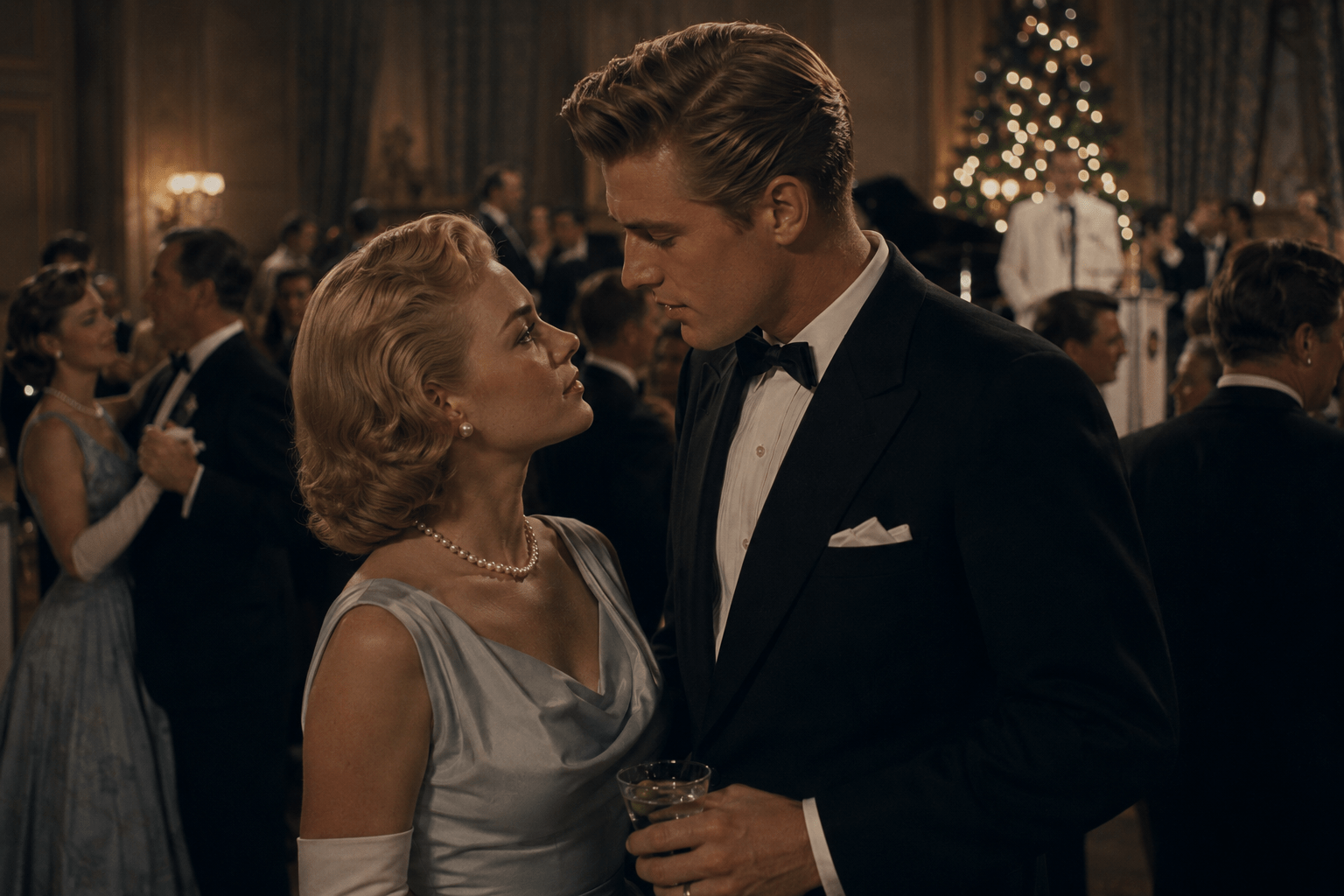
We have the best night. Tilly’s parents politely retire early, and the ballroom heaving as more people arrive, the City set, prep school friends, family friends’ offspring.
Topper and I dance all night to Mr Sinatra, Perry Como, Doris Day, Pat Boone, Eddie Fisher, anything that isn’t the boy, Black, or Southern. It strikes me that the boy and his success don’t exist in these circles, he’s even frowned upon. Not high-brow enough. The snobbery irritates me, their blinkered world view. And I’m grateful, again, for Miss Mary, who’s taken most of that out of me and anchored me differently as a citizen of the world.
I’m so happy to see Topper again that we make out in corners and cloakrooms all evening, and Cornelia keeps telling me to fix my hair whenever I run into her. Topper holds my hand tightly; I can tell he’s beginning to want more from me than he’s being given. And I think the world of him, and I fancy him, and I love him, and I want to be as close to him as I can. I kiss him under the stars on the balcony, we clink glasses and toast Tilly’s homecoming, and promise to see each other every day this Christmas.
He is so handsome. He’s grown into the most beautiful, sharply drawn, sandy-haired young man, icy blue eyes, easy tan, features that speak of good breeding and a line of beautiful mothers in his roots. I lean in, feel the strength of him, and tell him I adore him.
***
There’s a charity ball for one of Tilly’s mother’s foundations. Something to do with the arts, the ballet, the opera, or the museum, I can’t remember which, only that it isn’t benefiting children’s hospitals or feeding the poor. Tilly and I have been summoned to be witty and ornamental, to add a little youth to the affair.
Reluctantly, Tilly agreed to go.
“Mother, darling, we don’t want to,” she’d complained over breakfast a week earlier. “But if we can order those dresses from Dior’s New Look collection, we might reconsider…”
There were sighs, silences, smiles, and hugs, and now we’re off to pick up some lesser gowns from New York, because it will take several fittings, and too much time, before we have the coveted Dior pieces “in our dirty little paws,” as Tilly puts it. She’s thrilled. To underline the point, she throws her head back and cackles like a witch. I laugh in surprise.
“Mother, you know it’s the right thing,” she told her. “You want me to be married before too long, don’t you?”
And here we are, being taken down Fifth to collect the gowns. But first, we stop at the Rockefeller Plaza ice rink to drink hot cocoa and get into the Christmas spirit.
***
“Two gimlets, please,” Tilly smiles at the bartender. Then we turn back to the party.
“Gosh,” she says, glancing around, “it’s such a snooze. Let’s just get a little tipsy.”
We toast to being the coolest cats in the room.
“We have to be careful, though,” she adds, looking at me. “We can’t get out of control. Mother will kill us.”
I don’t like getting drunk anyway, so I don’t see a problem.
“Ah, there’s Truman,” Tilly says, waving toward Mr Capote, whom I briefly met years ago when we were still children.
“Darling girl,” he says in his light little voice. Then, turning to me: “And you, I recognise you.”
I greet him. “I love your work.”
Tilly snaps me a look that tells me I’m being too pedestrian for her taste. Truman laughs.
“Thank you, dear girl. Anything in particular?”
“I adored Other Voices, Other Rooms.”
He gives Tilly an ironic look. “I like your friend,” he says, and winks at her.
Then, to me: “Why, you are just gorgeous, aren’t you? Where did you come from?”
He takes my hand and twirls me like a doll he needs to inspect.
I pretend not to mind. I do the usual society thing, smile, laugh, perform.
“Wait,” he says suddenly. “Are you the girl from the South?”
“Yes, I am,” I say, surprised.
He giggles. “I’ve heard all about you.”
Then: “Tell me everything you can about this new Presley fellow. I want to know everything.”
I look at Tilly in horror. I don’t want to divulge anything private about the boy. Every part of me says not to.
He senses my reluctance and shifts tactics, talks about the South, about his own childhood in Louisiana, then circles back.
“Are you two going steady?” he asks.
He says he thinks Elvis is “the most wonderful, visceral expression of the South today,” –that he has this “enigmatic, wild, animalistic presence.”
“How do you deal with it?” he asks.
And I fall, just a foot, into his trap. He’s charmed me, and now I’m performing for him, saying idiotic things like:
“Never love a wild thing…”
He’s intrigued. “What do you mean?”
Still in the spell, I continue:
“If you love a wild thing, baby…”
Yes, I say baby. To Truman Capote. I really do. It’s awful. But I keep going,
“…you’re just going to end up looking up at the sky.”
In that moment, I catch myself.
What on earth am I doing?
I’m showing off for the fancy writer, and I don’t usually do that. But there’s something bewitching in his insistence; I’ve never experienced anything like it.
He knows he’s gotten what he came for. He claps his hands and performs right back at me.
“He is so handsome! My loins catch fire when I see him.”
And just like that, I’m back on earth, slightly queasy from my own behaviour.
I slide out of the performance and back into myself. “As with every teenage girl in America,” I say.
“And their mothers.” Mr Capote chuckles devilishly.
“You’re a pistol, honey.”
Tilly steps in, saving me. They talk about college work. He invites us out for lunch next time we’re in the city. Then he spots Lee Bouvier and Babe Paley across the room and leaves without saying goodbye.
“Quirky character,” I say.
“I’d say you were a quirky character there,” Tilly replies, looking me up and down.
“I don’t know what got into me,” I admit.
She shakes her head. “He has that effect on people. But you were good not to give him any real information. I think your madness saved you from ending up in one of his stories.”
She smiles. “Good girl.”
“I’ve had enough of this scene,” she adds, setting our drinks on a passing tray. She takes my hand. “Let’s go meet Buddy and Topper, they’re at the Peacock Club. You’ll like it. It’s jazz and fun, and downtown enough for your sloppy taste.”
***
The club is heaving, thick with smoke, humid from the press of bodies moving all around. We find the boys at a table, drinking and watching the scene unfold from a safe, almost anthropological distance. Topper sees us and gets up. Buddy comes over to greet us and kisses Tilly in a familiar way I haven’t seen before. She pretends it’s nothing, and I can tell it’s too vulnerable for her to address, so I pretend it’s nothing too.
I go straight to Topper, and I feel my face flush with heat when he looks at me.
“Darling little you,” he says. “Am I glad you came.”
And to both of us: “You two look like a couple of minor European royals.”
Tilly blows him a kiss.
“Or proprietors of a dictator state,” Buddy adds, slipping his arm around her as she glides into the booth beside him.
“You know it, boy,” she says, and kisses him on the mouth. I’m most perplexed.
After a while, Cornelia arrives, then Barbara and some of the other girls from Miss Porter’s, and more boys from Choate, St. Paul’s, Harvard, and Haverford. We exchange details with the Haverford boys so we can see a play they’re putting on in the new year. They went to school with Topper at St. Paul’s. They aren’t hitting on us, they’re funny and warm and arty, and I wonder why I’ve spent so much time missing everything down South when almost all my quality people are here in the Northeast.
But I know why.
Just thinking of the boy floods me with a fever I can’t describe. The draw is unlike anything else.
Still, I look at Topper, and I want to jump his bones too.
In a different way.
Topper doesn’t make me whole like the boy does. He isn’t the other half of me.
He complements me. He sees me differently.
With Topper, I am Natasha Rostova and he is Andrei Bolkonsky, there’s no other way to express it.
I watch him interacting with everyone in the club, how Cornelia makes him laugh in a way that’s real and unguarded and funny. I lean against him, and I kind of know: he was made for me. But the boy was made from me, and I from him.
Topper is my present for surviving my childhood and coming out intact.
He is my baby, and I love him.
The boy is something else. He is intoxication. He’s someone I need to fuse with.
I don’t want to think about it. I want to be here, now.
I whisper to Topper if he knew about Tilly and Buddy, and he says he’s always known.
And why haven’t I? He wonders.
A jazz singer begins My Love Has No Beginning, My Love Has No End, and I feel like I’m exactly where I belong.
Discover more from My World of Interiors
Subscribe to get the latest posts sent to your email.

