
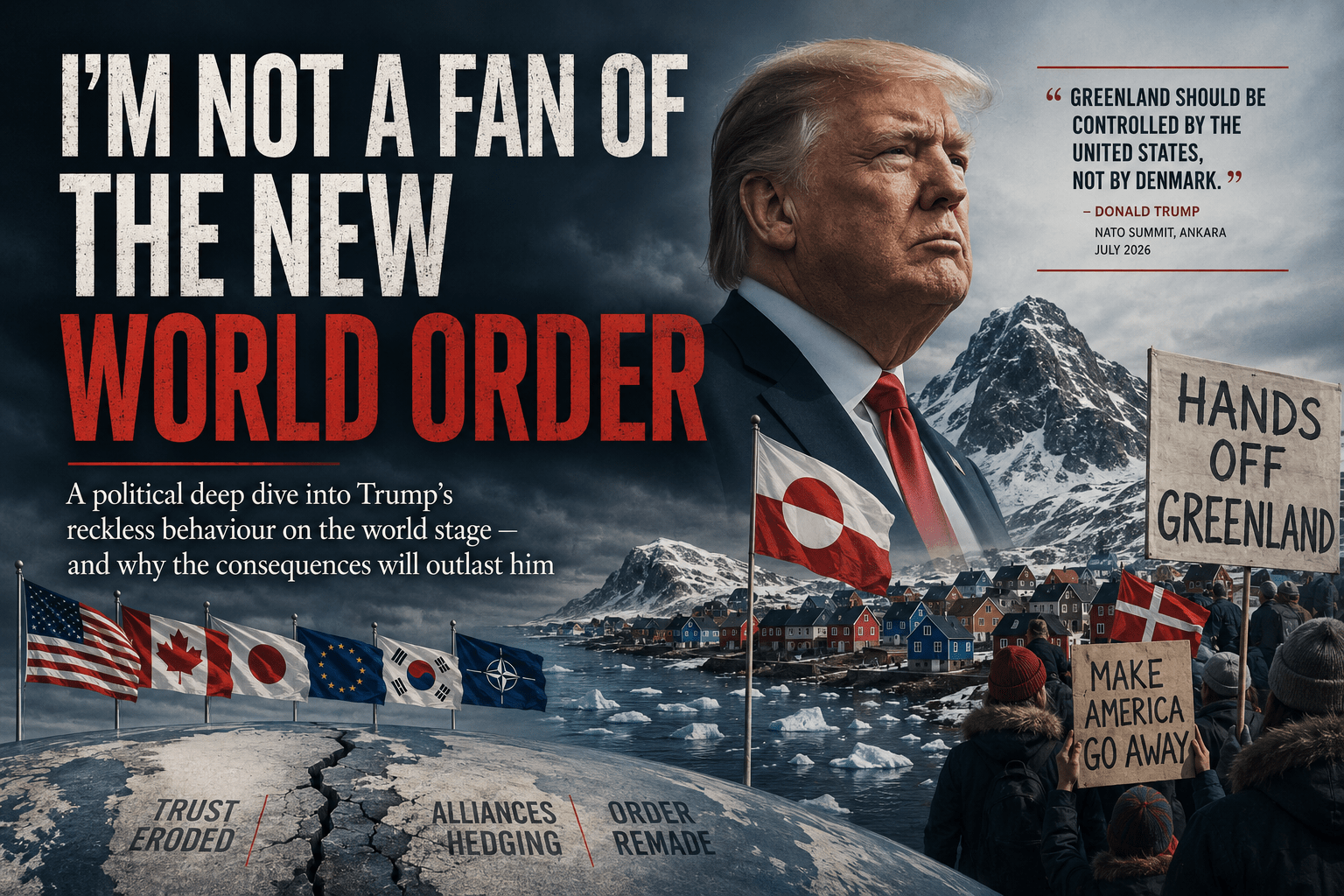
A political deep dive into Trump’s reckless behaviour on the world stage — and why the consequences will outlast him
Introduction
Foreign policy is usually a slow-moving business. Alliances take decades to build, trade relationships are negotiated over years, and a nation’s credibility is a resource accumulated patiently across generations of diplomats, treaties, and crises weathered together. It can also be spent quickly. Since returning to office, Donald Trump has treated America’s accumulated credibility less like a foundation to build on and more like a bargaining chip to be thrown on the table — again and again, often against America’s own long-term interests.
This piece is not an argument that Trump’s approach has produced no short-term “wins.” It has, in places. It is an argument that the wins are frequently transactional, personal, and unstable, while the costs — a shattered reputation for reliability, alliances that are quietly hedging their bets, and a rules-based order that others are now building without Washington — are structural and will likely persist long after Trump leaves office. Nowhere is this dynamic captured more precisely, or more absurdly, than in the ongoing dispute over Greenland.
The Transactional Turn
The through-line of Trump’s second-term foreign policy is a belief that the United States has spent decades under-using its raw power, and that alliances, institutions, and even long-settled sovereignty arrangements are all, in principle, negotiable. Historian Hal Brands has described this as a genuinely open question: the administration has racked up plenty of tactical “wins” on its own terms, but whether those wins actually strengthen America’s long-term position is far less clear.
In practice, this has meant a foreign policy built on unpredictability as leverage. World leaders adjust their behaviour to avoid provoking Trump personally, which can produce short-term movement on stalled issues. But unpredictability that works as leverage against individual leaders does not scale into a stable international order — it merely shifts the burden of managing chaos onto everyone else, while eroding the very trust that makes durable cooperation possible.
Concretely, this has looked like: a trade war launched against Canada and Mexico while continuing the standing one with China; open threats to annex Canada, Greenland, and the Panama Canal; a purge of career diplomats and national-security professionals in favour of loyalty-based appointments; and a Defense Secretary publicly warning allies in Asia against deepening economic ties with Beijing — even as Washington’s own tariff regime pushed those same allies to look for alternatives.
The Trust Deficit, By the Numbers
Rhetoric is one thing; measurable erosion of trust is another, and the data here is not subtle. A Pew Research Center survey of more than 40,000 adults across 36 countries, released in mid-2026, found that roughly three-quarters of respondents have no confidence in Trump’s leadership, and a majority now view the United States unfavourably overall. The collapse in perceived reliability — a narrower and arguably more important measure for a security guarantor — is the most striking part. Canada’s view of the US as a reliable partner fell from 83% in 2022 to just 35% in 2026. Sweden, the Netherlands, and Germany saw drops of more than 40 percentage points. Even Japan, a treaty ally with no serious daylight between it and Washington, saw reliability ratings fall from 76% to 59%.
Notably, the one clear exception was Hungary under Viktor Orbán, where confidence in the US actually rose — a reminder that Trump’s approach is not universally corrosive; it is corrosive specifically among the traditional, rules-based democratic allies that have underwritten American power since 1945, while it improves standing with illiberal and populist-aligned governments. That is not a neutral trade. It is a re-orientation of who America’s friends are, away from the coalition that built the postwar order.
Strategic Drift: Allies Hedge Their Bets
Trust, once broken, does not simply get repaired at the next summit — it changes behaviour. The Center for American Progress has documented how Trump’s willingness to threaten new tariffs even on allies with existing trade deals has pushed Canada, India, Japan, South Korea, and the European Union to explore new trade arrangements that do not include the United States. Every one of those deals represents a market that American exporters used to have privileged access to, now being redrawn by others’ rules.
The same dynamic is visible in defence policy. Rather than producing more efficient burden-sharing, the fixation on headline defence-spending percentages has pushed US allies in Asia toward expensive, prestige-driven procurement — long-range missiles, advanced fighters, blue-water naval platforms — instead of the kind of localized, interoperable capability that would actually make collective defence more resilient. Analysts at the Stimson Center argue this is a rational response to conditional commitments: when American guarantees are contingent on political alignment rather than treaty obligation, allies compete for favour rather than build genuine shared capability. That is a weaker alliance system dressed up as a stronger one.
The European Union Institute for Security Studies frames the broader shift starkly: unlike the first Trump term, which many European leaders treated as an aberration to be waited out, the second term has convinced most of them that the erosion of transatlantic trust may be permanent, regardless of who occupies the White House next. Once that assumption takes hold in foreign ministries in Paris, Berlin, and Tokyo, it does not reverse on inauguration day 2029. It becomes embedded in procurement decisions, intelligence-sharing protocols, and diplomatic default settings for a generation.
Why This Is Strategically Short-Sighted
The case against Trump’s approach is not fundamentally a moral one — it is a strategic one. Three mechanisms explain why apparent short-term wins convert into long-term losses:
1. Alliances are trust technology, and trust is expensive to rebuild. The value of NATO, or of the US-Japan security treaty, was never really the paper commitments — it was the shared expectation that America would show up. Once allies build contingency plans around the assumption that it might not, the alliance’s deterrent value degrades even if no formal treaty is ever broken.
2. Adversaries benefit passively from allied hedging. Russia and China do not need to win an argument with Washington; they only need Washington’s allies to become less certain of American backing. The European Union Institute for Security Studies notes that both powers have approached Trump’s second term with cautious optimism specifically because they expect to gain from the widening gap between the US and its traditional partners.
3. Reputational capital, unlike military capital, cannot be surged. You cannot rebuild a fifty-year reputation for reliability with a single summit or a change of administration. The distrust documented in the Pew data reflects a behavioural pattern — tariff threats deployed for political leverage, annexation rhetoric against a NATO ally, unilateral troop withdrawals announced with no coordination — and behavioural patterns are judged over time, not reset by an election.
None of this requires attributing bad faith to any individual decision. Even judged purely on realist, national-interest grounds, a foreign policy that maximizes short-term leverage at the cost of long-term reliability is a policy that is borrowing against a future the current administration will not be around to repay.
The Greenland Case Study: Seen From Nuuk and Copenhagen
If one episode captures the entire dynamic in miniature, it is Greenland.
From a Danish and Greenlandic vantage point, the past eighteen months have been read not as a negotiation but as a friend behaving like an adversary. Trump has repeatedly said the US needs Greenland “for the protection of the world,” argued that the territory is important to Washington but not to Denmark, and — during the same period — suggested the US could withdraw its troops from Europe entirely if the region continued to resist. At the July 2026 NATO summit in Ankara, he said plainly that Greenland “should be controlled by the United States, not by Denmark.”
Danish Prime Minister Mette Frederiksen’s response has been consistent and unambiguous: Denmark is ready to defend “every inch” of NATO territory, including its own, and has called Article 5 the country’s insurance policy. Greenland’s own Prime Minister, Jens-Frederik Nielsen, has said Trump will not “get” Greenland, that it is not for sale, and — tellingly — that when forced to choose between the US and Denmark, Greenland chooses Denmark. A joint statement from every party in Greenland’s parliament went further, stating plainly that Greenlanders do not want to become Americans.
The practical consequences have already materialized. Denmark’s Defence Intelligence Service, for the first time in its history, named the United States itself as a potential threat to national security. Denmark and eight NATO allies deployed forces to the territory in response to the pressure. Large “Hands Off Greenland” protests spread across Copenhagen, Aarhus, and Nuuk, with the slogan “Make America Go Away” becoming a genuine cultural touchstone rather than a fringe chant. Perhaps most significantly for Greenland’s own politics: the US pressure campaign has actually paused the island’s homegrown independence movement, since Greenlanders now perceive Denmark — the very metropole they were debating separating from — as the safer harbour against an assertive Washington.
That last point deserves emphasis, because it is the clearest evidence of strategic self-defeat available in this entire saga. If the genuine, defensible American interest in Greenland is Arctic security — countering Chinese and Russian activity in a rapidly changing region, as NATO Secretary General Mark Rutte has said is the actual underlying concern — that interest would have been far better served by quiet defence cooperation with a friendly, autonomy-seeking Greenlandic government than by threats of annexation that drove Greenlanders back into Copenhagen’s arms and put the whole Kingdom of Denmark on a war footing against its oldest ally. Locals on the ground in Nuuk have publicly questioned the premise of the threat entirely, noting they see far more evidence of American commercial interest than of Chinese or Russian encroachment. Trump did, in January 2026, pull back from imposing threatened tariffs on Denmark, Norway, Sweden, France, Germany, the UK, the Netherlands, and Finland after talks with Rutte — but the “framework of a future deal” he described has not been accepted by either Copenhagen or Nuuk, both of which maintain that Greenland’s sovereignty is not on the table. The episode has cost Washington goodwill in Scandinavia, hardened Greenlandic public opinion against the US for a generation, and produced, as of this writing, no actual change in Greenland’s legal status. It is difficult to construct a version of this outcome that reads as a strategic victory for the United States.
A Fairer Hearing: What the Other Side Would Say
An honest deep dive owes space to the counter-case, because it is not a frivolous one.
Defenders of Trump’s approach argue that decades of “predictable” American foreign policy produced exactly the kind of freeloading and stasis Trump was elected to break: European defence spending had stagnated below NATO targets for years, and the shock of Trump’s rhetoric — however crude — has demonstrably accelerated the very burden-sharing that previous administrations spent a decade politely requesting. NATO’s Secretary General has himself credited Trump directly for the alliance’s newer, higher spending commitments. Supporters also point to concrete deliverables: a role, however contested, in a Gaza ceasefire; military pressure that, in the administration’s telling, has kept Taiwan’s defence posture credible against Chinese planning; and a domestic political coalition that clearly finds this brand of unapologetic assertiveness to be exactly the correction American foreign policy needed after years of perceived overextension and diminishing returns from multilateralism.
There is also a reasonable, non-partisan observation buried in the academic literature on this period: some erosion of US commitment to multilateral institutions predates Trump entirely, reflecting real relative American decline and growing domestic skepticism of liberal internationalism that would likely have surfaced under a different president too, if less dramatically. Judging the full long-term verdict on any of this — Greenland included — will require the kind of hindsight that only the next decade can provide.
Conclusion
The title of this piece is a personal one, but the argument underneath it does not need to be. Whatever one’s view of Trump personally, the empirical record so far — falling reliability ratings among America’s oldest allies, trading partners actively building alternatives that exclude the US, a NATO ally treating Washington’s rhetoric as a genuine national-security threat for the first time in its history — describes a foreign policy spending down reputational capital faster than it is building strategic capital. Short-term leverage over individual leaders is not the same thing as long-term American strength. The bill for that difference, in Greenland and everywhere else this pattern repeats, is likely to come due well after the man who ran it up has left office — and it will be paid, as such bills usually are, by the country, not the president.
Sources referenced: Pew Research Center (2026 global attitudes survey); CNBC, NPR, The Hill, and Washington Times reporting on the July 2026 NATO summit; the Wikipedia entries on the “Greenland crisis” and “Foreign policy of the second Trump administration”; the House of Commons Library briefing on Trump and Greenland; analysis from the Center for American Progress, the EU Institute for Security Studies, the Stimson Center, the Council on Foreign Relations, TIME, and Al Jazeera.
Discover more from My World of Interiors
Subscribe to get the latest posts sent to your email.

