
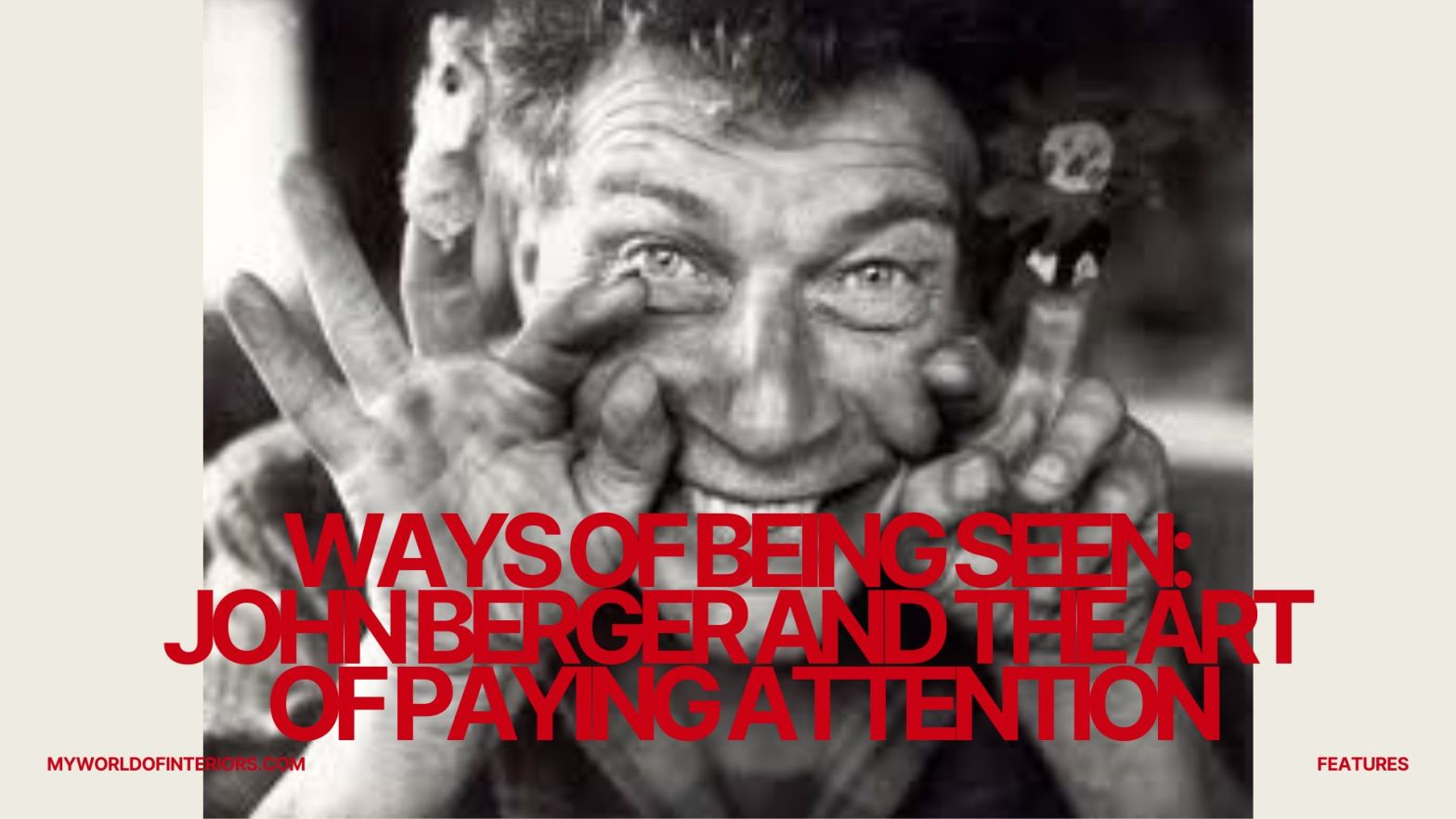
Eight years after his death, the critic, novelist, and storyteller who changed how we look at art remains the most generous — and the most radical — writer England ever produced.
By Bergotte
There is a moment in the first episode of Ways of Seeing — the 1972 BBC television series that made John Berger, unexpectedly and somewhat against the grain of his temperament, a household name — that has lost none of its force across the half-century since it was broadcast. Berger stands in a gallery before Botticelli’s Venus and Mars, and he picks up a small transistor radio and holds it beside the painting. “If we can begin to see art in relation to our own lives,” he says, in his low, unhurried voice, with the accent of a man who has been educated in one England and chosen to live in quite another, “rather than in relation to the history of art, we might be able to find in that past a past that belongs to us.” He clicks the radio on. Pop music — tinny, present-tense, incongruously alive — fills the gallery. The painting and the music coexist for a moment. Then he clicks it off. The point has been made, not by argument but by juxtaposition, and you feel it before you understand it.
This quality — of making a point felt before it is understood, of trusting the sensory intelligence of the audience over their capacity for abstract ratiocination — was the signature of everything John Berger wrote. He was a Marxist art critic who could write about a peasant’s hands with the attention of a lover. He was a novelist who embedded his fiction in the history and geology of the Alpine village where he chose to spend the better part of his adult life. He was a storyteller, an essayist, a poet, a screenwriter, a polemicist, a drawer — he drew obsessively, from life, throughout his life, because looking at something hard enough to draw it was, he believed, the deepest form of attention available to a human being. He died in January 2017, at the age of ninety, at his home in Antony, a suburb of Paris, just after completing what would become Confabulations, a collection of short prose pieces that reads, in the way of late work, like a mind taking its own temperature.
He was born in London in 1926, to a mother who sang in the house and a father who had been an officer in the First World War and who came back from it, as so many came back, with something permanently altered. He grew up in the shadow of one war and came of age in another; by the time he was twenty he had been to art school, served in the infantry, and discovered the commitments — to socialism, to the centrality of visual experience, to the lives of ordinary people who are not usually considered subjects for serious cultural writing — that would organise his entire career. He was twenty-five when he began writing art criticism for The New Statesman, and the pieces he published there in the early 1950s were unlike anything that had appeared in a British cultural journal before: written in plain, forceful English, refusing the decorative vagueness of much art writing, insisting on the relationship between the paintings under discussion and the social conditions in which they were made and in which they were seen.
He made enemies early, as people who write plainly and forcefully tend to do. The art establishment of the period was not grateful for the attention of a young man who wanted to know what paintings were for, in a social sense, rather than how they fitted into the narrative of stylistic development. He wrote about Courbet and Léger; he wrote about the Old Masters with a materialist eye, asking who had commissioned them and why and what they had cost; he wrote about contemporary painters — including, controversially, a defence of the Soviet Realist tradition, which was at that moment the aesthetic equivalent of a political declaration, and was received as such. He was not without self-promotion, but the self being promoted was genuinely unusual, and the promotion was always in service of the argument rather than the reverse.
The Uses of Beauty
To read Berger’s art criticism — collected, imperfectly, across various volumes, from the early Permanent Red (1960) through to About Looking (1980) and the later The Shape of a Pocket (2001) — is to encounter a writer for whom the aesthetic and the political are not competing but mutually constitutive. This is not, or not primarily, a political criticism in the reductive sense: it does not reduce paintings to their ideological function or read them as mere expressions of class interest. It is more subtle and more interesting than that. It is a criticism that asks, at every turn, what it means for a human being to make something beautiful — and what the existence of beauty, produced under conditions of exploitation and suffering, tells us about human possibility.
The key essay is probably “The Moment of Cubism,” collected in The Look of Things (1972), in which Berger makes the remarkable argument that Cubism — the most apparently hermetic and formally self-absorbed of modernist movements — was, in fact, an expression of optimism: a visual language adequate to a moment when everything seemed possible, when the old hierarchies of space and time were being dissolved by technology and revolution and the imagination’s first, ecstatic encounter with the twentieth century. The argument is not exactly right — it is, like all of Berger’s large claims, a deliberate overstatement in the service of a truth that a more careful formulation would miss — but it is exhilarating in the way that great criticism is exhilarating: it makes you see differently.
This is the test he applied to criticism and the test by which his own should be judged. Does it change how you see? Not: does it provide the correct account, the accurate historical contextualisation, the properly footnoted interpretation? But: does it alter the relationship between the eye and the world? Berger cared about being right, but he cared more about being useful, and useful meant, first and foremost, making the encounter with a work of art more alive. He had a gift — rarer than it sounds — for describing what it is actually like to stand in front of a painting: the physical sensation of it, the way the light falls, the way the eye moves across the surface, the moment of recognition when something in the image connects with something you have not quite been able to name in your own experience.
He wrote, in Ways of Seeing, about the nude — about the long tradition of the female nude in European painting and the structures of looking that tradition both assumes and produces. This was 1972, which is to say it was early: second-wave feminism was only beginning to develop the critical vocabulary of the gaze, and Berger’s contribution to that vocabulary, made in plain language on television and in a short paperback sold for the price of a pint of beer, was a democratic intervention in what had been, until then, a fairly patrician conversation. His argument — that the nude is constructed for the pleasure of a male spectator who is not depicted, and that this construction says something important about the unequal distribution of power between those who look and those who are looked at — is now so familiar that it is difficult to recover its original force. But the force was real. The women who saw the programme and read the book describe an experience of recognition — of being given, suddenly, a language for something they had felt but could not articulate.
What distinguished Berger’s treatment of these questions from much of what came after was the refusal of bitterness. He was angry — he was always, at some level, angry, with the inequalities he documented and the culture that produced and naturalised them — but the anger was not the dominant note. The dominant note was something closer to wonder: at what human beings have been able to make despite everything, at the persistence of beauty in conditions that would seem to preclude it, at the extraordinary stubbornness of the human desire to see and to be seen.
G. and the Novel
In 1972 — the same year as Ways of Seeing — Berger published his novel G., a loose fictionalization of the life of a Don Juan figure set against the backdrop of European history at the turn of the twentieth century: the Milanese workers’ uprising of 1898, the first crossing of the Alps by aeroplane, the slow accumulation of forces that would detonate, in 1914, into the First World War. The novel won the Booker Prize. The acceptance speech Berger gave on receiving it is one of the most remarkable documents in the history of the prize: he announced that he was giving half the prize money to the British Black Panther Movement, on the grounds that Booker McConnell, the conglomerate that sponsored the prize, had made its fortune from sugar plantations in the Caribbean and that the money was, in some sense, owed. He then spent the other half on the research for his next project, a study of the lives of migrant workers in Europe that became A Seventh Man (1975).
The gesture was pure Berger: simultaneously principled and theatrical, a making-visible of connections that the culture preferred to keep invisible. He understood that accepting a prize is itself a kind of statement and that the appropriate response was not grateful neutrality but an insistence on the conditions of the money, the history inside the cheque. Some found it sanctimonious. Some found it heroic. It was, at minimum, consistent: Berger never accepted a honour, a platform, a piece of institutional recognition without asking what it was connected to.
G. itself is a stranger and more difficult book than its public reception suggested. The Booker tends, even now, to draw attention to the accessibility rather than the difficulty of its winners, and G. is not an accessible novel. It is self-consciously experimental, interrupting its narrative with long passages of essayistic reflection, questioning its own authority as a narrator (“I am an author,” Berger writes at one point, “because I am a man who paints with words”), holding the historical and the erotic in a tension that is never quite resolved. The sexual politics of the novel — G. is a seducer, and Berger follows the erotic encounters with an unflinching attention that discomfited some feminist critics — is genuinely complex: he is not celebrating G.’s conquests but anatomising them, trying to understand what the compulsion to seduce reveals about the relationships of power and vulnerability in which all sexual experience is conducted.
The novel is not his best work — or rather, it is not the work in which his gifts are most fully realised. That distinction belongs, in most critical reckonings, to the trilogy that followed: Pig Earth (1979), Once in Europa (1987), and Lilac and Flag (1990), published together as Into Their Labours. These books, which follow the lives of peasants in an unnamed Alpine community through the twentieth century and then track the migration of their children and grandchildren to the cities, are among the strangest and most beautiful works of fiction produced by any British writer in the postwar period. They are also, in the most literal sense, the product of where he had chosen to live.
The Village
In the early 1970s, Berger moved to Quincy, a small village in the Haute-Savoie, in the French Alps. He would live there, with various departures and in various configurations, for the rest of his life. The move was not the affectation of a metropolitan intellectual seeking pastoral authenticity — it was, characteristically, a political and philosophical commitment. He wanted to understand, from the inside, the lives of the rural poor: not as a sociologist or an anthropologist, arriving with his categories and his detachment, but as a neighbour, a participant, someone who helped with the harvest and kept his own vegetable plot and learned, slowly and imperfectly, what it meant to live in a place defined by the rhythms of agricultural labour.
What he found there, and what the Into Their Labours trilogy is about, is the specific quality of a form of life that was, before his eyes, in the process of disappearing. The small-scale peasant agriculture of the French Alps — a practice continuous, in its basic organisation, with the medieval period — was being extinguished by modernity: by mechanisation, by the economics of the Common Agricultural Policy, by the migration of young people to the cities in search of work and freedom. Berger watched this disappearance and documented it with a grief that was never sentimental, because he refused the sentimental option of idealising what was being lost.
What he did instead was stranger and more valuable. He tried to inhabit, imaginatively and analytically, the phenomenology of peasant life: the relationship to time, to land, to animals, to the dead, to the body’s own labour. The peasant, he argued — in Pig Earth and in the essays collected in About Looking — lives in a relationship to the past that is radically different from the relationship available to the urban, the educated, the historically mobile. For the peasant, the past is not history; it is the ground, literally and metaphorically, on which the present stands. The dead are not over; they are present, in the field, in the tool with the worn handle, in the knowledge of where the spring floods come and how deep the soil is on the south-facing slope. This is not a mystical claim. It is an observation about the epistemological consequences of living in one place, doing one kind of work, for generations.
This attention to the lives of people who are not usually considered subjects for serious cultural writing — peasants, migrant workers, the rural poor, the elderly, the physically labouring — is, perhaps, Berger’s most distinctive contribution to English letters. It was not entirely unprecedented: George Orwell had done something related, with more politics and less phenomenology; Raymond Williams had done something related, with more sociology and less poetry. But Berger’s version was his own, and it could not have been produced by anyone without his particular combination of gifts: the painter’s eye, the Marxist’s historical consciousness, the novelist’s capacity for imaginative inhabitation, and the essayist’s ability to find the conceptual stakes in a specific, concrete detail.
Ways of Seeing — and Being Seen
The television programme and book that bear this title remain, four decades later, the most widely read work of art criticism in the English language. They are on the syllabus of almost every art school, every photography course, every media studies programme in the Anglophone world. They have been translated into dozens of languages. The paperback — designed by Richard Hollis, incorporating images in a layout that was itself a kind of argument, insisting that the reader’s eye do the work rather than receiving a purely verbal account — has never gone out of print.
What accounts for this longevity? Partly the argument itself, which remains substantially correct even where it has been refined or complicated by subsequent scholarship. Partly the form: Berger understood, as few critics before him had, that television was not merely a delivery mechanism for content but a medium with its own rhetoric, and he used that rhetoric — the direct address to the camera, the juxtaposition of image and commentary, the deliberate breaking of the conventions of the museum documentary — to make points that could not have been made in print alone. And partly the prose, which has the quality, rare in critical writing, of sounding like a human being thinking rather than an institution pronouncing.
The book’s central arguments — that the invention of perspective in Renaissance painting reorganised visual experience around the single, fixed viewpoint of the individual spectator; that the development of oil painting was inseparable from the emergence of a mercantile class interested in the visual possession of the world; that advertising is a system of images that works by borrowing the glamour of oil painting and attaching it to commodities — are arguments that have been contested and qualified and extended. But they have not been superseded. They belong to the small body of critical propositions that have become part of the way educated people in the late twentieth and early twenty-first century understand their own visual experience.
What is less often noted is the degree to which Ways of Seeing is also a book about looking as a form of relationship — about the encounter between the viewer and the viewed as something mutual, charged, ethically significant. The famous opening line — “Seeing comes before words” — is usually read as a claim about the primacy of visual experience over linguistic interpretation. This is correct, but it is also something more. It is a claim about the inescapably relational nature of perception: we see, and we are seen. The act of looking is never unilateral. And the terms on which we are seen — the social conditions that determine whose gaze is authoritative and whose is subject to it, who has the power to look and who is constructed as the object of looking — are among the most consequential facts of our collective life.
The Migrant and the Witness
A Seventh Man (1975), produced in collaboration with the photographer Jean Mohr, is the book that Berger’s admirers most often cite as his most important and his least read. It is a documentary study — combining Mohr’s photographs with Berger’s text, statistics, poetry, and the testimony of migrant workers themselves — of the experience of labour migration in postwar Europe: the men who left Turkey, Greece, Portugal, North Africa, to work in the factories and building sites of Germany, France, Switzerland, and Britain, and who sent money home and lived in dormitories and were called Gastarbeiter — guest workers — as if they were guests rather than the labour force on which the European economic miracle depended.
The book is a work of witness. Berger’s procedure, throughout his career, when confronting experiences not his own, was to try to make the imaginative leap of inhabitation — not claiming to experience what the other had experienced, not speaking for them, but attempting, with the writer’s peculiar tools, to make their experience legible to those who had not had it. He is explicit about the limits of this procedure: he knows that he is a middle-class European intellectual writing about people whose conditions of life are radically unlike his own, and this knowledge is present in the writing, complicating it, preventing it from becoming merely sympathetic in the comfortable sense. The book does not ask you to feel sorry for the migrant workers. It asks you to understand the system — political, economic, cultural — that produces their situation. It asks you to see yourself, as a consumer of the products their labour makes, as complicit in that system.
This quality of implication — of refusing to allow the reader a position of innocent spectatorship — runs through all of Berger’s political writing. He was not interested in making you feel bad, exactly; he was interested in making you see clearly, and clear seeing, in his account, was not compatible with comfort. The political dimension of his work was never separable from the aesthetic: both were, at bottom, about the quality of attention, about the refusal of the convenient blur, the insistence on seeing what is actually there rather than what the dominant culture has arranged for you to see.
Drawing as Thinking
Among the lesser-known dimensions of Berger’s practice is drawing. He drew throughout his life — figures, faces, animals, landscapes, objects — and he wrote about drawing with an insight that comes from practice rather than theory alone. The essay “Drawing,” collected in Keeping a Rendezvous (1992), is one of the finest things ever written about the act: “When I began to draw an animal,” he writes, “it was as if I was being watched by the animal. And I was glad of that.” This is not a whimsical observation but a precise phenomenological report. The encounter between the drawer and the drawn, in Berger’s account, is not a one-way extraction of information but a mutual recognition, a form of presence.
Drawing, for Berger, was the purest form of the attention he valued. To draw something is to commit to looking at it for long enough to translate it into gesture, and in the course of that translation you discover things about it that no amount of passive looking would have revealed. The structure beneath the surface, the relationship between the parts, the way the weight is distributed, the way light falls differently on the near side and the far side of a form — all of this becomes available through drawing in a way it does not through merely looking. “The act of drawing,” he wrote elsewhere, “is making a visual statement about what it is to be alive.” This is hyperbole in the service of truth: drawing is not merely a technical skill but an epistemological practice, a way of knowing the world through the body’s encounter with it.
He drew other writers, friends, strangers, the animals he kept and the animals he watched in the mountains. He drew in notebooks that accompanied him everywhere. The drawings are not, by any conventional standard, masterworks — Berger was a trained painter but not a virtuoso draughtsman — but they have a quality of presence that comes from the particular quality of attention that produced them. To look at his drawings is to understand, viscerally, what he meant when he talked about paying attention: you can feel the looking in them.
The Late Work and the Question of Death
In the last two decades of his life, Berger’s work became increasingly preoccupied with death — not in the morbid sense, not as an obsession with endings, but in the sense of a sustained, unsentimental inquiry into what it means to live in the knowledge of finitude. The essays collected in Hold Everything Dear (2007) and Bento’s Sketchbook (2011) — the latter a meditation on the philosopher Spinoza, on drawing, and on the political present, all woven together in a way that defies easy categorisation — have a quality of late Beethoven or late Rembrandt: a willingness to leave things unresolved, to sit with contradiction, to allow the work to be as difficult as the reality it is engaging with.
Here Is Where We Meet (2005), perhaps the most formally unusual of his late books, is a series of imagined encounters with the dead — his mother, friends, historical figures — in various cities. It is, among other things, a meditation on what the dead leave behind and how the living carry it. His mother appears in Lisbon; they have a conversation that is tender and uneasy and honest about what was unresolved between them. The dead, in Berger’s account, are not departed but transformed: they become part of the landscape, part of the texture of place, available for encounter if you have developed the quality of attention required to perceive them. This is not spiritualism; it is phenomenology. It is Berger doing, for the experience of loss, what he had always done for the experience of visual art: trying to describe, with scrupulous accuracy, what actually happens when we are present to something.
He was present to the political moment, too, always and sometimes uncomfortably. He wrote about the Iraq War and the Palestinian struggle and the financial crisis of 2008 with the same directness and the same willingness to make large claims that had characterised his early Marxist criticism. He was never without a position. Some of these late political positions were more nuanced than others; the Palestinian writing, in particular, came from a place of deep moral conviction and genuine knowledge, and it cost him, in some quarters, as moral conviction tends to. He was not interested in the cowardice of balanced views on questions where he felt the balance was false.
Against Consolation
There is a phrase that runs, in various forms, through Berger’s work, and it is useful to end with it. He returns, repeatedly, to the idea of art as “a way of sharing loneliness” — not of dissolving it, not of pretending that the fundamental isolation of conscious experience can be overcome, but of making it less absolute through the act of communication between one isolated consciousness and another. The painting, the novel, the essay: all are, at some level, a message sent from one solitude to another, a gesture across the gap between selves that cannot quite be bridged.
This is not a consoling formulation. Berger, despite the warmth that everyone who knew him reports — a warmth that comes through even in the writing, in the steadiness of the attention, in the refusal to condescend — was not fundamentally in the business of consolation. He was in the business of honesty. And honesty, in his account, meant seeing clearly, saying what you saw, and accepting the discomfort that clarity produces.
He was a European intellectual in the old sense — one who believed that ideas had political consequences, that culture was a site of struggle, that the intellectual’s responsibility was not to provide expert opinion to institutions but to maintain the kind of independent, uncomfortable vision that institutions cannot accommodate. This is an unfashionable position — it has been unfashionable, in British culture particularly, for most of his career, since the British distrust of the intellectual as a category is deep and old. He did not care. He had left England young and had made himself something that England did not quite have a category for, and he spent his life using that freedom.
He leaves behind a body of work that is more various, and harder to summarise, than almost any comparable figure: the art criticism, the novels, the documentary books, the poetry, the screenplays, the drawings, the late essays. What holds it together is not a system — Berger was allergic to systems, which is perhaps surprising for a man who identified as a Marxist — but a method, a posture, a quality of attention. The method is to begin with what you can actually see, and to follow the seeing wherever it leads, without flinching, without consolation, and without condescension toward the people and the things you are looking at. To see, and to go on seeing. To look, and to keep looking.
There is a passage, near the end of And Our Faces, My Heart, Brief as Photos (1984) — the most lyrical of his books, a meditation on time, love, poetry, and exile — that returns to me whenever I try to think about what Berger’s work, taken whole, amounts to. He is talking about the experience of being held in someone’s attention: about what it means to be seen, truly seen, rather than merely observed. “Never again will a single story be told,” he writes, quoting John Berger quoting himself in a kind of loop that feels deliberate, “as though it were the only one.” This is both a political statement — against the singular narrative, against the authority of the official account, in favour of the many stories that coexist with and contradict it — and a personal one, a statement about the ethics of attention, about the obligation to see more than one thing at a time, to resist the reduction of the world to a story that fits.
John Berger spent ninety years resisting that reduction. He saw more things, more carefully, with more generosity and more rigour, than almost any writer of his time. He looked. He kept looking. He made us want to look.
The major works of John Berger, including Ways of Seeing, About Looking, and the Into Their Labours trilogy, are published by Penguin Modern Classics. A Seventh Man, with photographs by Jean Mohr, is published by Verso. Bento’s Sketchbook is published by Verso. Benjamin Moser’s biography of Susan Sontag is published by Allen Lane.
Discover more from My World of Interiors
Subscribe to get the latest posts sent to your email.

