
“Where do you usually summer?” asks a man in his early thirties. He has a mess of sandy hair and a broad grin and has stopped to chat on the beach. He introduces himself to me as Jack. He looks familiar, though I can’t place him.
I hesitate, half amused, half at a loss. I study his face. “All over,” I reply.
“Stop harassing Birdie!” Tilly calls from farther down the shore. “She’s European.”
“Oh,” he says, brightening. “England?”
“England, yes,” I reply, offering a polite, measured smile.
“Hold on,” he says suddenly. “I think I know you.”
“I doubt that very much,” I protest.
“No, I do. I think I have the pictures to prove it.” His voice shifts to a sombre tone. “I hate to bring this up, but… was your brother part of the 5th Battalion Coldstream Guards?”
The question knocks me for five. “Yes,” I say solemnly.
“I’m so sorry for your loss.”
“It’s okay.” I look down.
Tilly’s caught up to us and seems confused.
“I think you were a flower girl at my sister Kick’s wedding,” he says. And now I understand.
“I was. Hartington’s wedding. Were you there? I can’t remember it fully anymore, I was only nine,” I say, smiling.
He shakes his head. Only his older brother, Joe, also lost in the war.
“I remember him. So handsome and so wonderful,” I blurt out, forgetting about composure.
Jack smiles. “He was,” he agrees. “He really was.”
I shake my head. “I don’t know why they wanted a flower girl,” I say, changing the subject. “It was just at the Chelsea Town Hall.” We chortle, jovially, eager to get away from talk of dead brothers and sisters.
“I met you when you were yay high,” Jack continues, insistently. He holds out his hand and measures my height to somewhere around his knee. We laugh again. “A very chatty little thing you were. It was back when my father was the U.S. Ambassador over there, before the war.”
“I see.” I smile to myself at the thought of me being a chatty little thing as a child.
We fall into easy talk about Debo and her sisters. “Tom was mad about Debo,” I tell him. “Then she married Andrew.” We laugh that laugh that comes with the relief of unexpected familiarity.
A younger, preppy-looking man, who is clearly his brother, runs over. “Bobby,” he greets me as he shakes my hand and then hugs Tilly. Jack tells him who I am and the younger one realises he too has met me and says, “Yes, yes, of course. How marvellous to see you again. Do send my regards to your family.”
“Are you girls coming over for drinks this evening?” Jack asks.
I feel a sudden homesickness for Miss Mary and the boy. These brothers make me miss Tom, and I want to be near the boy when I am missing Tom. He’s the only one who understands. The only one who can fix it.
“Sure. Are the ’rents invited too?” Tilly asks.
“Afraid so,” says the elder, turning to go. “Come for sundowners, it’ll be swell. Bring friends.” He turns back around and quickly half hugs Tilly and air-kisses her cheek before turning his back for a final time.
We watch them go, sand kicking up in their wake.
“What a coincidence,” Tilly says.
“I did not foresee you knowing Jack and Bobby, but here we are.”
“What a small world we all live in,” I say, watching them turn into dots on the horizon. We turn and start on the walk back to the house.
“Topper’s coming tomorrow,” Tilly says out of nowhere, almost too casually, “just in case you wanted to know.”
“Well, I didn’t,” I say, tackling her to the ground before tearing off down the sand.
***
In the afternoon, Tilly’s father and two brothers sail us over to Hyannis Port. Everyone is drinking on the boat, and they seem so blasé about it.
“Whisky soda, please,” Tilly’s father says to her mother, who happily fixes him another drink. “Coming right up.”
The Kennedys greet us as we jump onto the dock. There are so many of them.
“So wonderful to see you again!” There are hugs, smiles, and pleasantries all round. They seem like a very jolly, energetic bunch. A younger man, closer to our age, Ted, greets Tilly like a sister.
Tilly tells me Teddy’s the black sheep.
We move into a large sitting room. It’s light, airy, comfortable, lived in the right way, by an active family who use the rooms well.
It’s a spirited evening. The family are experts at entertaining. We’re persuaded to stay for dinner.
Everyone has big grins, wide jaws, and lots of hair, except old Joe Kennedy, who’s balding and stern, but manages to smile all the same. They all seem so very happy and so very sad at the same time.
When the men disappear to talk politics, we all know what they’re discussing: Korea, and what America should or shouldn’t do. Voices carry through the half-open doors:
“We can’t afford to appear weak on communism, not after the fall of China.”
“But MacArthur’s itching for a war with China. We’re not ready for that. No one is.”
“This war could be Truman’s grave, politically. We need to be smart, not just loud.”
The rest of us, all of us kids, walk down to the beach, free to be frivolous, even though there’s a war on.
“What are we fighting for, exactly?” one boy asks.
“Seems like the poor always go to war, and the sons of men like us get deferments,” says another.
When I say that all war is hell, everyone around me stops and stares at me before shuffling along.
There are shrugs, then a shift to easier topics.
***
I’m in Edgartown, pottering about with Topper, who has insisted on taking me out for the afternoon.
“So, how did you find the Kennedys?” he asks, all in good cheer.
“I found them charming,” I say.
“Is that it?” He grins.
I don’t know what to say. “Okay,” I admit, hesitating. “They’re a bit too smooth and all-American for my liking. It’s as if they’re the prototype for preppy posh people who love to run around doing sporty things.”
Topper bends over laughing. “Oh, darling, they’re so much more than that. They just hide it well.”
“Have you read The Great Gatsby?” he asks as we flick through a postcard stand.
“Of course I have. Why?”
“Well, old Joe is not unlike our Jay Gatsby.”
“You’re kidding me. He wasn’t a bootlegger, was he?” I gasp in horror. In truth, I honestly don’t care.
“Stop yourself, Christopher Montgomery, this is all too gossipy for me. I don’t want to know any of this. It’s none of my business.”
“Just warning you. I hear some of the boys are looking for wives.”
“I’m not even fifteen!” I shout. “And they’re Catholic! My father would kill me.” I laugh. Personally, I don’t care about religion, or which one I’ll eventually marry into. As long as I don’t have to be devout and phony. Sometimes I think it’s the most religious who are the most sinful, the ones hiding their true faces behind the mask of piety.
“Well, I’m Protestant and I’d marry you in a flash,” Topper says, turning back onto the street and putting on his sunglasses.
I realise he’s jealous, and it takes me by surprise. I watch him rifle through a case of old books outside a store, his face in the sunlight, and I can’t help it, I think he is beautiful. It’s the first time he’s said anything like that out loud, but I have the boy at home, and this is all nonsense.
“Ugh,” I mutter. “You’re being a nuisance.”
“Let’s go to the beach,” he says, bumping his shoulder against mine as we walk, and I hate that I am fantasising about him holding my hand as we walk side by side towards the waterfront.
***
We spend summer days being lazy, on the boat, by the beach, in town, and at the vacation houses of some of the other girls from school. We’re a small crew out here this summer. Everyone else is scattered until September, Europe, the Hamptons, Maine, even Canada, but some of us are here, on a small island off the East Coast, in a time full of promise, rapid change, and adventure, in a world that feels new and shiny to me.
People Like Us are having fun. Our only anxiety is the vague, lingering idea of nuclear disaster, our faraway war with Korea, and the Cold War brewing beneath the surface, but we live in America, and we’ll be safe. No one’s ever won a war against the U.S. of A., and I doubt anyone’s going to. We’re privileged, modern teenagers, and we’re having a marvellous time.
…And yet, here I am, missing a poor country boy who doesn’t even have a telephone at his parents’ home. When I call, I have to ring his neighbour’s apartment.
I feel ashamed even comparing the two worlds. How dare I?
“I’m free as a bird,” I tell myself. I can think and do as I please, escape my background and all expectations. Tilly says I have a case of nostalgie de la boue, which I vehemently deny. I like the boy because he’s a rare soul in the universe, one that so perfectly matches mine, not because I’m some class tourist poking around the lower echelons of society. I’ve never disagreed with her more.
I’ll go home in the morning. I’ll see the boy again soon.
This has been fun, safe, warm, cosy, familiar, but I like the feeling I have with him more. I can’t explain it, but it feels more like an adventure. Like uncharted shores, him, the South, the depth and mystique of it all. There’s something in the dirt and the humid air that grabs me, something that fascinates me more than this perfect happiness with my friends.
It’s endless down South. The North is everything I instinctively already know.
***
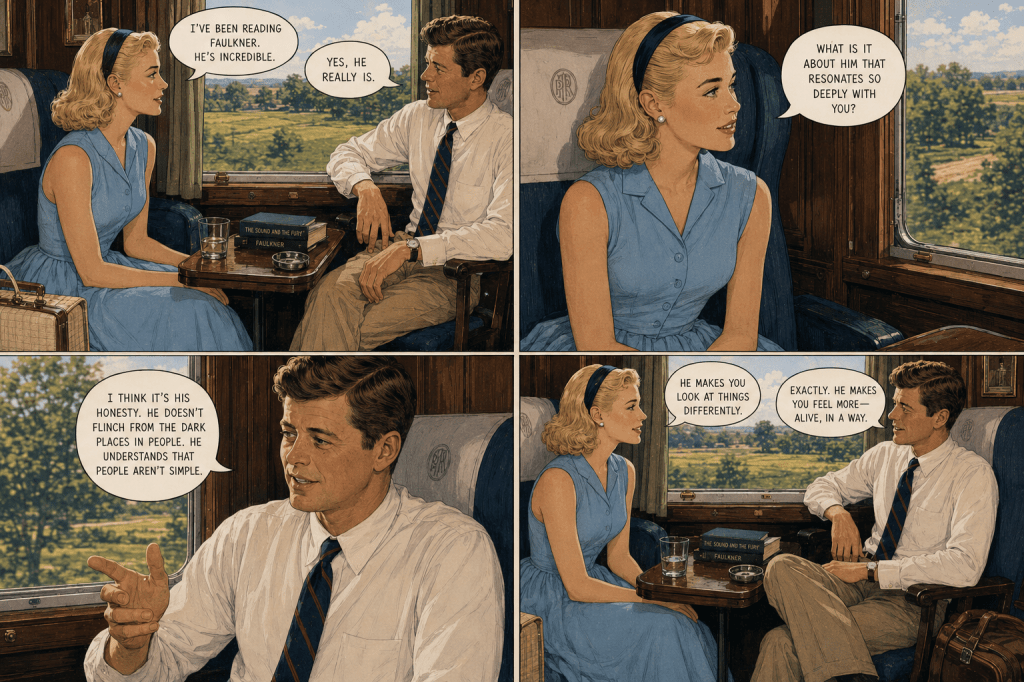
Jack Kennedy is going down to Boston on the train and offers to chaperone me. I hesitate, I don’t particularly want to be alone with a man in his early thirties, but I’m curious about him. He’s been kind all summer, and I want to talk about books and other serious topics without Tilly interrupting. I accept.
To my surprise, he doesn’t throw himself at me, I even wonder for a moment if I smell, but I’m glad his reputation doesn’t entirely hold true. He’s friendly, asking about my first fifteen years on planet Earth: what it’s like down South, the segregation, the music, the landscape. We talk about Hemingway, Faulkner, Wolfe, Agee. I mention that I like Tennessee Williams and Zora Neale Hurston. He remembers Carson McCullers, and I suggest Eudora Welty, Richard Wright, and Robert Penn Warren, which makes him smile.
“Of course,” he says. “Thank you. I’ll have to write them down.” He pulls out a leather-bound diary.
At the station in Boston, he calls a porter to help us with the luggage.
“Let me take you to the airport,” he says. “It’s been such a delight meeting you and your young friends this summer, even if you are by far the most tricky one. I’ve grown to like you,” he adds, placing a hand on my shoulder. He laughs, not in a dirty way, just kind of brotherly.
I say goodbye. “A pleasure to travel with you, Mr Kennedy. Godspeed.”
I don’t know why I say Godspeed, but it sounds so patriotic and true-blue and in the moment.
My novel GREAT ARE THE MYTHS will be serialised (one chapter each day) over the summer of 2026. If you would rather listen to the audiobook, the full story is available for free on all the usual platforms. Info and links HERE

