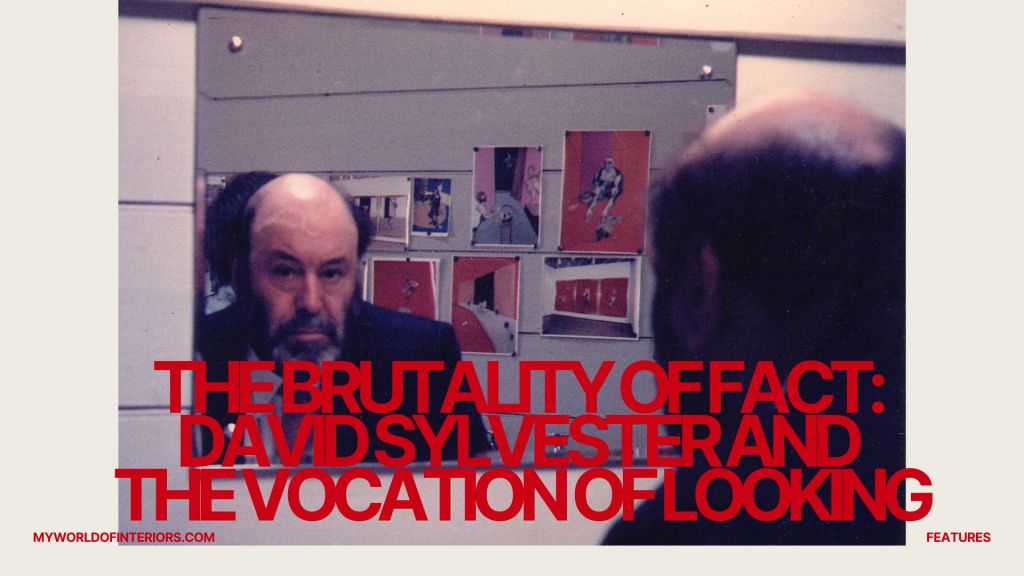
The greatest British art critic of the twentieth century never wrote a book he was satisfied with. What he left behind instead was something rarer — a model of attention so exacting it changed what art could ask of its audience.
By Bergotte
There is a way of sitting in front of a painting that most people never learn. It requires, first of all, time — more time than the average museum visitor spends in front of any single work, more time than feels, in the first instance, comfortable or productive. It requires the surrender of the desire to arrive at a conclusion, the willingness to remain in a state of unresolved looking, receiving without yet understanding. It requires what one might call a tolerance for the unknown — a capacity to stay with the painting while the painting does its work on you, rather than rushing to impose your interpretation on it. David Sylvester spent his professional life practising this way of sitting, and in spending a career trying to describe what he saw when he sat that way, he produced some of the most searching and most honest writing about visual art that the twentieth century has to offer.
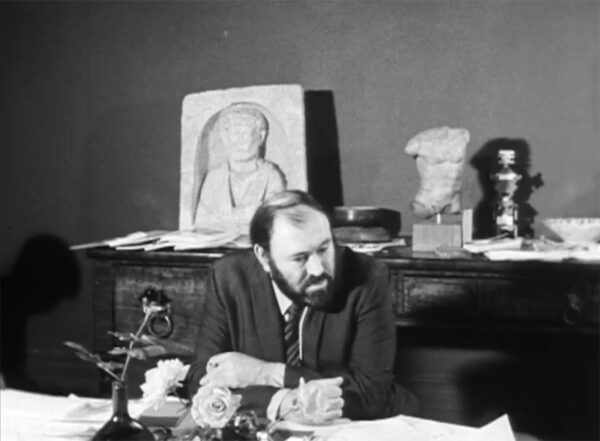
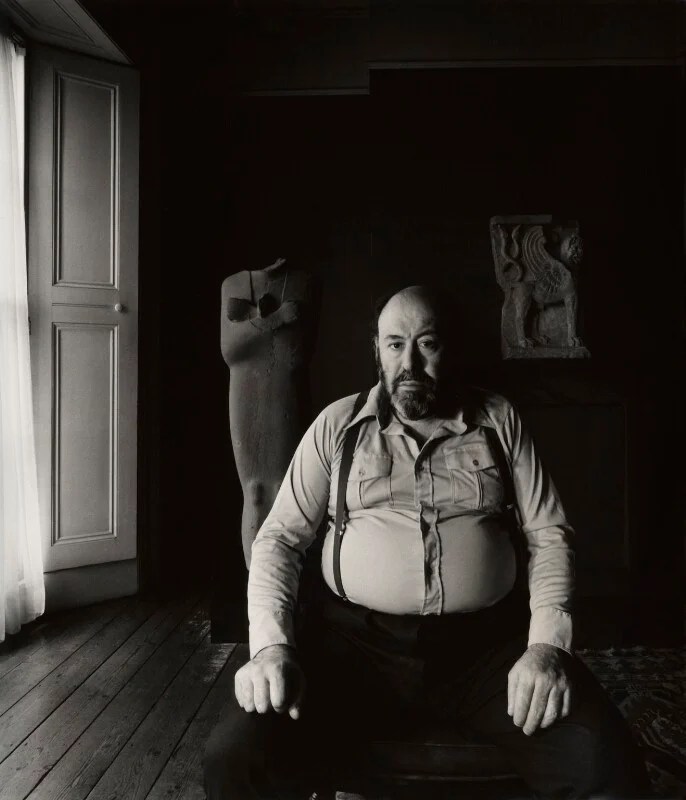
He was not, by most accounts, an easy man. He was large — physically large, over six feet and broad, with a presence in a room that people who knew him remember as something close to weather. He was opinionated in the particular way of those for whom opinions are not merely positions but expressions of identity: a challenge to what he thought was not a challenge to his argument but to himself. He could be wounding. He could be generous. He was, by all reports, an extraordinary talker — the kind of talker who thinks aloud, who finds what he means in the act of saying it, who treats conversation as a collaborative form of inquiry rather than a performance of already-settled views. He drank. He ate well. He pursued women with the same compulsive thoroughness he brought to art, and with similarly mixed results.
He was born in London in 1924, into a Jewish family of Lithuanian origin, and grew up in the particular intellectual atmosphere of North London Jewish life between the wars — an atmosphere that produced, with some regularity, minds of unusual seriousness and ambition. He did not go to university. This was, for his generation and his milieu, unusual enough to require explanation, and the explanation seems to be that he was in too much of a hurry — too impatient to look at art, to write about art, to be in the proximity of artists — to submit to the detour of formal education. By his late teens he was already moving in the circles that would define his life: the Soho pubs and the Fitzrovia cafés where the London art world conducted its serious business in the 1940s and 1950s, the Colony Room and the Gargoyle Club and the French House, the world of Bacon and Freud and Giacometti and their various satellites, admirers, and fellow travellers.
He began writing art criticism in his early twenties, for Tribune and New Statesman, and he continued to write criticism, on and off, for the rest of his life. He curated exhibitions — important ones, including the landmark Henry Moore retrospective at the Tate in 1968 and the Magritte retrospective at the Hayward Gallery in 1969. He worked for the Arts Council. He broadcast for the BBC. He sat on committees and boards and advisory panels. He was, in the institutional sense, a significant figure in the postwar British art world — one of the people who decided what would be shown, who would be considered, which reputations would be built and which would be quietly allowed to diminish.
But none of this is why he matters. He matters because of how he looked, and because of what he was able to do — rarely, imperfectly, but at his best with an intensity that has not been matched in British criticism — with what he saw.
The Education of a Looker
The formation of a critic is usually described in terms of influences, mentors, the books and ideas that shaped a sensibility. In Sylvester’s case, the formation was more physical than intellectual — it happened through the eyes, in galleries and studios, in the accumulated experience of being in the presence of works of art over decades. He was not a theorist. He was not, in any systematic sense, a philosopher of aesthetics. He read — he read widely, and the reading shows in the writing — but the reading was always in service of the looking, never a substitute for it.
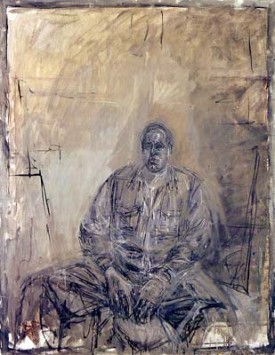
His most important education was probably the time he spent in Paris in the late 1940s and early 1950s — the Paris of postwar reconstruction, of existentialism, of the last years of the École de Paris before New York definitively claimed the centre of the modern art world. He went to see Giacometti, whom he had read about and who would become one of the central preoccupations of his critical life. The encounter was transformative in the way that certain encounters are when you are young enough to be genuinely changed by them: Giacometti’s sculpture — the attenuated figures, standing at the edge of disappearance, both present and spectral, occupying space in a way that seemed to make the surrounding air more visible — offered Sylvester a kind of object lesson in the problem he would spend his career thinking about. How does a work of art create the sensation of presence? What is the relationship between the material object — the bronze, the canvas, the paint — and the experience of aliveness it produces? How can something made of inert matter give the impression of being about to move, about to speak?
These were not questions Sylvester arrived at through reading philosophy. He arrived at them through looking, which is another way of saying that he arrived at them through his body — through the sensation, standing in front of a Giacometti figure, that the normal relationship between the self and the other had been altered, that some threshold had been crossed. This somatic quality of his criticism — the degree to which it is grounded in the physical experience of being in the presence of works of art — is what distinguishes it from almost all of its contemporaries, and from most of what has been written in its wake.
Francis Bacon and the Interviews
The work for which Sylvester is most widely known — the interviews with Francis Bacon, conducted between 1962 and 1986 and published in various editions, the fullest of which appeared as Interviews with Francis Bacon in 1975 and was later expanded — occupies an unusual position in the literature of art. It is not, strictly speaking, criticism; the critic becomes, in the interview, a facilitator, a questioner, a presence designed to draw out the subject rather than to assert his own view. And yet the interviews bear Sylvester’s imprint so completely that they cannot be read without him. The questions are the point. The questions reveal a mind at work — a mind that has spent years looking at the paintings and thinking about them and arriving at questions that are precise enough to produce useful answers but open enough to allow the conversation to move.
The interviews have entered the canon not merely as documents about Bacon — though they are the most important documents we have about his intentions and his self-understanding — but as a model of a certain kind of critical dialogue. Bacon was an extraordinary talker, fluent and paradoxical and willing to make large claims with a casual certainty that could, if you were not paying close attention, seem like mere bravura but turned out, again and again, to be the product of genuine, sustained reflection on the nature of painting and the nature of experience. Sylvester was the interlocutor who could meet him at that level, who could press without provoking, who could sit with an answer long enough to hear what it actually said before responding.
The central subject of the interviews is what Bacon called “the brutality of fact” — the desire to make images that had the directness and the impact of raw sensation, that bypassed the “illustrational” mode (as he scornfully called it) of most figurative painting and struck the viewer at a level below interpretation. This was a project that was connected, in ways both Bacon and Sylvester were explicit about, to the tradition of physiological aesthetics — the tradition that runs from Nietzsche through Cézanne and the early modernists and that insists on the body rather than the mind as the primary site of aesthetic experience. Bacon wanted his paintings to act on the nervous system directly; he wanted them to do what a great piece of music does, producing an effect that cannot be paraphrased or explained but only felt.
What Sylvester understood, and what the interviews allow us to see with unusual clarity, is that this project was both more and less successful than it appeared. The paintings are extraordinarily powerful — no serious person who has stood in front of a late Bacon triptych can doubt this — but the power does not come from the simple mechanism Bacon sometimes described, the direct imprinting of sensation on the nervous system. It comes from the interplay between the formal decisions (the brilliant manipulation of paint, the spatial organisation, the use of the single figure in the featureless space) and the content (the distorted bodies, the violence half-implied and half-explicit, the sense of the human figure under extreme psychic or physical pressure). Sylvester’s criticism of Bacon — most fully realised not in the interviews but in the essay “The Geometric and the Gestural,” and in the long study he published in 1975 — navigates this complexity with a delicacy that the interviews’ conversational form could not, by its nature, quite allow.
The relationship between the two men was not without tension. Bacon was not, fundamentally, a critic’s painter — he was suspicious of interpretation, resistant to the idea that his paintings could be adequately described, impatient with what he saw as the inevitable reductionism of verbal commentary. Sylvester understood this and accommodated it, to a degree, by making the interviews as much about the process of making as about the meaning of what was made. But he also, in his critical writing, went further than Bacon wanted anyone to go, made connections and drew conclusions that Bacon might not have endorsed. This was Sylvester’s right and his responsibility as a critic. He was not Bacon’s publicist. He was a writer trying to understand paintings, and if the understanding required going beyond what the painter had said or intended, then the understanding required it.
Magritte and the Problem of the Image
If the Bacon work represents Sylvester at his most visceral and his most invested — he was, by any account, genuinely moved by Bacon’s paintings in a way that was not entirely critical in the cold sense — then the Magritte work represents him at his most analytical and, in some ways, his most ambitious. The catalogue essay he wrote for the 1969 Hayward retrospective, and the extended study Magritte published in 1992, are the fullest demonstrations of his critical intelligence working at full stretch on a problem that resisted the kind of phenomenological approach that served him so well with Bacon.
Magritte is, on the face of it, a Sylvester-proof painter. The work operates through concept — through the precise, almost bureaucratic deployment of incongruity, the placing of objects in contexts that violate their normal relationships in ways calculated to produce a particular quality of unease. The paintings are, at one level, arguments: propositions about the relationship between images and reality, between words and the things they name, between the familiar and the strange. They are the painter most amenable to verbal interpretation, the painter most easily converted into a theoretical demonstration. They seem to be waiting for the philosopher or the semiotician, not the phenomenologist.
What Sylvester found in Magritte, and what makes his account of the work so valuable, is something that resists the conceptual reading: the quality of the paint surface itself, the specific way the images are rendered, the relationship between the intellectual conceit and the physical fact of the canvas. Magritte painted, deliberately and systematically, in a manner that was almost devoid of painterly distinction — the surfaces are smooth, the brushwork invisible, the colour applied with a flatness that seems to deny the painting’s status as a made object. This was not incompetence; it was a considered formal decision, one that served to increase the work’s claim to a kind of objective truth, to make the painted image seem as reliable and as neutral as a photograph. Sylvester understood this, and his analysis of it — of the relationship between Magritte’s deliberately flat technique and the epistemological claims implicit in the subject matter — is some of the finest technical criticism of the twentieth century.
He also, characteristically, spent a great deal of time with the paintings themselves — visiting them in collections around the world, looking at them over and again, refusing the temptation to rely on reproductions. This insistence on the original was one of his most deeply held critical commitments, and it sets him apart from much contemporary art criticism, which increasingly conducts its business through images on screens. Sylvester believed, passionately and with some justification, that the experience of the original was qualitatively different from any reproductive version — not merely because of the surface qualities that reproduction cannot capture, but because the original object has a presence, an aura in the Benjaminian sense, that depends on its history, its uniqueness, its status as the thing that was actually touched by the artist’s hand.
The Problem of Influence
To write about Sylvester’s influence is to confront immediately the paradox of a critic whose primary gift — the quality of his looking, the precision of his phenomenological attention — is precisely the thing that cannot be taught or transmitted. Criticism as method can be inherited: you can learn from Ruskin how to describe a painting, from Greenberg how to construct a formal argument, from Berger how to connect aesthetic experience to political context. But you cannot learn from Sylvester how to look, because looking of the kind he practised is not a technique but a disposition — something closer to a character trait than a professional skill.
What you can learn from him — and what many writers and curators and artists have, in varying degrees, absorbed from him — is the value of that disposition: the conviction that sustained, patient, attentive looking is not merely a preliminary to criticism but its substance. He modelled a refusal to be in a hurry, a willingness to acknowledge uncertainty, a resistance to the premature conclusion. These are qualities that are, in the current conditions of cultural journalism, increasingly rare and increasingly precious. The conditions of contemporary cultural criticism — the pressure to produce quickly, to have an instant take, to express a position legible within the attention span of the social media feed — are precisely the conditions in which Sylvester’s kind of looking cannot flourish.
His influence is therefore most visible not in criticism, where it is genuinely hard to identify direct descendants who have matched the quality of his attention, but in curatorial practice and in the practice of living artists. The artists who were looked at by Sylvester, and who were aware of being looked at by him with that quality of attention — Bacon, Freud, Giacometti, but also younger figures like Cy Twombly and Sean Scully, on whom he wrote with an acuity that revealed, in both cases, aspects of the work that other accounts had missed — describe an experience of feeling genuinely seen, genuinely understood. This is not a small thing. The experience of being truly looked at — of having one’s work encountered by a sensibility of the first order — is, for a visual artist, one of the conditions of development.
The Unwritten Book
Sylvester was famously a slow writer, and famously dissatisfied with what he had written. The books he published — the Bacon study, the Magritte monograph, the essay collections About Modern Art (1996) and Encounters with Degas — represent, by his own account, a fraction of what he had intended to write and a considerably imperfect version of what he had actually thought. He spent decades contemplating, and never completing, a comprehensive study of the relationship between Cézanne and the development of modern painting. He left behind a filing system of considerable complexity and not, apparently, of much practical utility — notes and drafts and clippings that have not yet been fully examined and that may or may not yield the book he never wrote.
This failure — if it is a failure — is worth thinking about, because it is not simply a matter of temperament or of the usual procrastination that afflicts writers of all kinds. It is, at least partly, a consequence of the critical method itself. To insist on the primacy of looking, to refuse the short-cut of theory, to demand that every general claim be grounded in a specific encounter with a specific work: this is a method that generates endless complication, endless qualification, an endless supply of evidence that the argument you thought you had is not quite right, that the painting you were about to use as a demonstration does not quite do what you needed it to do. The critics who finish their books are often the critics who are willing to do some violence to the material — to simplify, to schematise, to let the argument override the experience. Sylvester was not willing to do that. The result was, commercially and institutionally, a relatively thin bibliography. The result was also, in the writing that did get finished, a density and a precision that cannot be separated from the difficulty of producing it.
There is, too, something specific to his moment. Sylvester came of age in the years when the major critical battles of modernism were still being fought, when the question of what painting was for — what it could do that no other art form could, why it mattered, whether it was still alive as a form — felt genuinely urgent. The criticism he admired, and in some ways modelled himself on — Baudelaire’s Salon reviews, Roger Fry’s early essays, Rilke on Cézanne — was criticism written when the stakes were high and the arguments were consequential. As his career developed, and as the art world became increasingly institutionalised, financialised, and self-referential, he found it harder to believe that criticism of the kind he practised could have the purchase on events that it had seemed to promise in the 1950s. This is not defeatism, exactly, but it is a loss of a particular kind of confidence — a loss that the incomplete bibliography reflects.
On Sculpture
It is worth pausing on Sylvester’s writing about sculpture, which is among the finest in the language and which is, even by the standards of his other work, strikingly physical — strikingly concerned with the experience of the body in the presence of three-dimensional objects. The pieces on Giacometti, Moore, David Smith, and Anthony Caro that are scattered through the essay collections reveal a critic who understood, in a way relatively few writers on art have managed, that the encounter with sculpture is fundamentally different from the encounter with painting — different in its demands on the viewer’s body, different in its relationship to space and time, different in the kind of attention it requires.
Sculpture asks you to move. It asks you to walk around it, to approach it and recede from it, to encounter it from multiple angles and in changing light, to understand it as a three-dimensional object in a three-dimensional space rather than as a surface to be read. This demands a different kind of attention from the kind that painting requires — less frontal, more exploratory, more willing to revise the initial impression as the viewing position changes. Sylvester understood this and wrote about it with an almost choreographic precision: his descriptions of how a Moore figure changes as you move around it, of the way a Giacometti standing figure seems to collapse into flatness when seen from the side and to expand into an impossible depth when seen from the front, are exercises in spatial analysis that require the reader to participate in the looking, to reconstruct imaginatively the experience the critic is describing.
The essay on Giacometti’s Walking Man — one of the most reproduced and most casually encountered works of twentieth-century sculpture — is a small masterpiece of this kind of analysis. Sylvester refuses the usual account, which focuses on the work’s metaphorical content (the existentialist themes of alienation, solitude, the fragility of the human presence in an indifferent universe), and attends instead to the specific formal decisions that produce the work’s effect: the elongation of the figure, the texture of the bronze surface, the relationship between the stride depicted and the sense of arrested motion, the way the work occupies its base and its surrounding space. The metaphorical reading is not rejected — it is, Sylvester allows, genuinely present — but it is shown to be grounded in the formal decisions, not floating free of them. The loneliness is in the bronze.
The Critic as Lover
There is a quality in Sylvester’s best writing that is difficult to name without resorting to the language of intimacy. He wrote about paintings the way a person who has lived with a lover for years writes about that person: with an awareness of the familiar and the unfamiliar coexisting, with the knowledge that long acquaintance does not exhaust mystery, with a certain tenderness toward the object’s particularity that is quite distinct from the detachment of the analyst. This is a quality that his criticism shares with the best writing of his predecessors — with Rilke’s letters about Cézanne, with Lawrence’s essays on painting, with Ruskin at his most fully present — and it is a quality that is, by its nature, resistant to methodological extraction.
He did not believe that criticism should be objective in the sense of impersonal. He believed, rather, that the critic’s subjectivity — carefully developed, honestly examined, rigorously tested against the work — was the primary instrument of understanding, and that the pretence of objectivity was not only false but actively harmful: it concealed the real source of critical authority (the quality of individual experience) behind a mask of institutional or methodological credibility. He was willing to say “I think” and “I feel” in contexts where many of his contemporaries would have resorted to the impersonal third person, the passive construction, the citational apparatus that makes academic criticism sound as though the ideas are producing themselves without human involvement.
This is, in the current critical climate, a position of some courage. The dominant modes of academic art history and criticism are not hospitable to the first person, to the record of subjective encounter, to the kind of writing that is frankly about experience rather than about the analysis of visual language or the decoding of cultural meaning. The institutional pressures run all in the other direction. What Sylvester’s work represents, and what makes it worth returning to in an era of increasing methodological conformity, is the proof that the subjective and the rigorous are not incompatible — that the critic who knows what she has felt, and is honest about it, and follows the feeling into analysis, can produce criticism that is both more truthful and more useful than the criticism that pretends feelings are not part of the transaction.
The Weight of Looking
Sylvester died in June 2001, in London, at the age of seventy-six. He had been ill for some time — his last years were difficult physically, though those who saw him in that period report that the intellectual ferocity remained, that he was still capable, even when movement was painful, of arguing with complete conviction about a painting he had seen or a book he had read. He left behind the published work — less of it than he wanted, more of it than is generally acknowledged — and a reputation that was, in the final decades of his life, in the process of being revised upward from the position of important journalist and curator to something closer to its proper standing.
That proper standing is this: he was the most scrupulously attentive art critic that Britain produced in the twentieth century. He was not the most wide-ranging — Berger wrote about more, and with a broader political and historical consciousness. He was not the most intellectually systematic — there are critics whose contribution to the theoretical apparatus of art history has been more substantial. He was not, in the journalistic sense, the most influential — his relative slowness as a writer, and his unwillingness to produce work he was not satisfied with, meant that his published output was modest compared to critics who wrote more fluently and more freely.
What he was, and what he remains, is a model of a particular kind of critical seriousness — a seriousness that begins and ends with the work itself, that submits the critical intelligence fully to the demands of the aesthetic encounter, that refuses every shortcut and every consolation of theory, that insists on staying in front of the painting for as long as the painting requires. This is not, in the current dispensation, a fashionable form of seriousness. The fashionable forms of seriousness are about context, about power, about the social conditions in which art is produced and received. These are not unimportant subjects. But they are not substitutes for the encounter itself, and the encounter, Sylvester believed, was where it started and where, in the end, it had to return.
He was right about this. He was right in the way that people are right who have paid, over a long time, the cost of their conviction — who have not merely stated a position but lived it, tested it, found it repeatedly confirmed by experience even as the culture moved in other directions. The paintings that mattered to him have not stopped mattering. The quality of attention he brought to them has not become easier to achieve, or easier to sustain, or less necessary. If anything, in the decades since his death, as the conditions of looking have become more distracted, more mediated, more subject to the noise of a cultural conversation that is conducted with increasing velocity and decreasing patience, his model of what it means to really look has become more urgent, not less.
You can still do it. You can still walk into a gallery, find the painting, and sit down in front of it for longer than feels comfortable. You can still wait, and resist the desire for resolution, and allow the work to work on you. What Sylvester teaches, in the end, is not a method but a permission: the permission to take the encounter seriously, to trust what you see, to follow the looking wherever it leads. The paintings are still there. The looking is still possible. The rest is attention.
David Sylvester’s essay collections, including About Modern Art and Looking at Giacometti, are published by Pimlico and Chatto & Windus. Interviews with Francis Bacon is published by Thames & Hudson. Magritte: The Silence of the World is published by Abrams.

