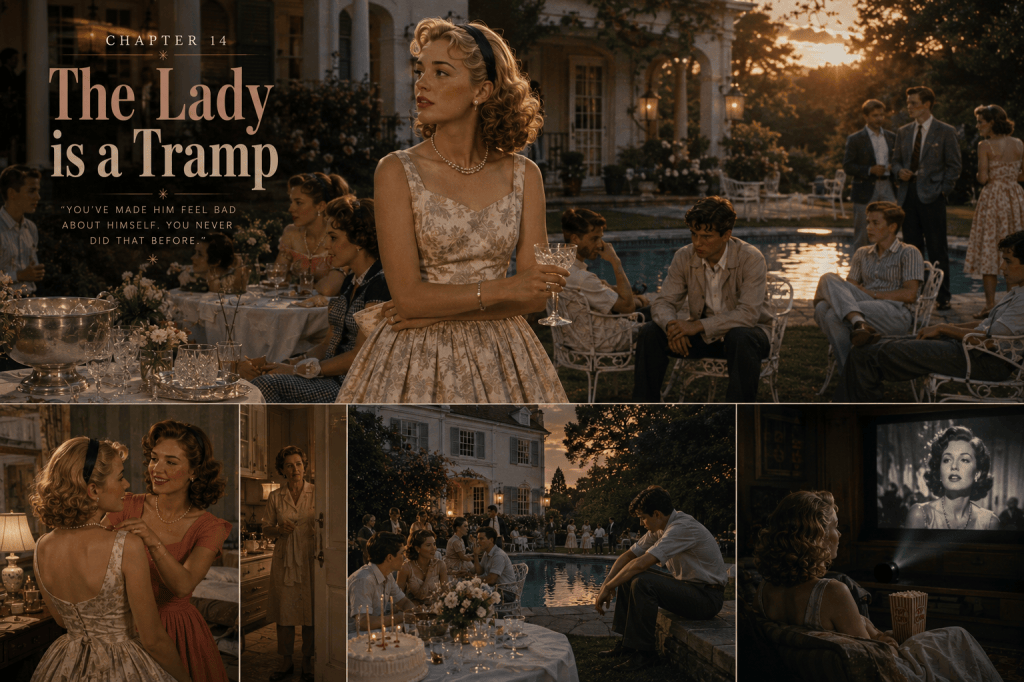
Everyone says I look great, that I have become more sophisticated and cool, that my new fashionable hair-do and subtle makeup suit me – that I look like a real lady now – not just plain old English as I did before.
Mabel especially thinks it’s wild how much I have changed.
“Let’s go shopping,” she begs. “I need your help upgrading my image too.” She says I look like I have walked straight out of the pages of a ladies’ magazine, and that I must teach her how.
The summer wardrobe I have brought back to Memphis is so very obviously different from last year’s. I divvy up my new clothes so Mabel can have whatever she likes. “I don’t need it all,” I tell her. Then I show her how the girls at school do their makeup. I feel so grown up and important that it might go to my head a little.
***
The boy feels alienated. I sense that he is insecure around me this summer, that he is embarrassed about the difference between us that somehow seemed less important before. When I tell him about the Vineyard, the girls from school, the people I keep meeting and summer society events, his eyes water, and I feel he is retreating away from me.
“Can we talk about something else?” he asks.
“Of course,” I reply, but then I am bored with what he wants to tell me, his day-to-day, the school I already know, comic books he finds funny. I can’t help it, but I am becoming a person I didn’t think I could be: superior, a little haughty like Tilly, and, not least, dismissive of small-potatoes life.
***
On my fifteenth birthday I invite a group of my friends over for a tête-à-tête in the garden. Miss Mary and I have ordered catering from The Peabody Hotel, so she can relax and just be present.
Miss Mary warns that it might not come off the way I want it to, but I shrug it off and assure her everyone will think it marvellous and be grateful to be invited to such an adult affair.
I know at least Mabel thinks it’s a swell idea, and she comes over before the party to get ready in my room and borrow a dress from my ever expanding collection.
***
The party begins at noon. I have invited a mix of kids from Humes, the country club, and, of course, the boy and his friends. It’s awkward from the start. I don’t notice at first because I am feeling myself big time, watching myself from outside my body playing host, thinking I am in a movie, pouring flavoured fizzy water into my guests’ glasses, laughing in a way I imagine Katharine Hepburn would if it were her party, “ha ha ha. Wonderful, just wonderful. More champagne?”
It’s like I’ve suddenly outgrown them all. My old school friends seem so young in comparison, so provincial.
Miss Mary tells me I should be ashamed of myself, as I moan to her in the kitchen when I am in there picking up some extra forks for the cake.
“Who suddenly grew out of their ballet slippers?” she asks. “Shape up and learn to see people with a little more generosity. Don’t you ever think so highly of yourself just because you left and went to the big city.”
“Farmington is smaller than here,” I retort, and immediately know I shouldn’t have.
“Really?” she says. “Well, you sure have come back a small-minded little lady.”
I know she’s right, so I apologise and promise her I’ll try harder.
“You’d better. Or you’ll be spending a great deal of your life mostly alone,” she says, looking at me stone-faced.
The boy and his friends are getting rowdy. I tell them to be quiet several times as they laugh and play-fight at the table, the canyon between us widening. When I correct him quietly about his table manners, he flips and simply stops speaking to me for the rest of the afternoon.
When the party is over, we end it with swimming in the pool and a game of water polo between the boys and the girls.
I am exhausted and deflated. The boy left early.
***
In the early evening, after I have helped clear up, Miss Mary sits me down for a chat.
“Miss Birdie,” she starts, “how do you feel the party went today? Any thoughts?”
“I don’t think it went as well as I had expected,” I tell her sadly. “No one appreciated all the care I had taken to make this day special.”
“I see,” Miss Mary continues. “Anything else?”
“No,” I say. “Do you?”
“Would you say people had a good time?” she asks gently.
“Not really,” I say.
“Why do you think that might be?”
“I don’t know.”
“Well, let me tell you…” she says, and starts on one of the only real telling-offs she has ever given me.
She says I’ve been insensitive to just about everyone except Mabel. She says the boy has spent the last few weeks heartbroken, convinced I’ve started treating him like my inferior, showing off and acting high-and-mighty since my return from Martha’s Vineyard.
I’m surprised and humbled. Have I really become such a rotten egg? Instead of admitting any wrongdoing, I argue back, saying things like, “I just wanted everyone to have a good time.” Even as I say it, I know it’s not entirely true, I wanted to show off. I’d fallen in love with the image Mabel reflected back to me: a sophisticated young big-city girl.
I’m quiet for a while. Then I ask Miss Mary what I should do about the boy, and if he’s really upset with me.
“You’ve hurt him,” she says. “When you hurt another person, it takes effort and time to rebuild the trust, and the love.”
My heart sinks. “Is it really that bad?”
She sighs. “You’ve made him feel bad about himself. You never did that before.”
Then I think of England, of how my parents so often ignored me, how I sometimes thought they didn’t love me, and I realise exactly what I’ve done.
“You two have always complemented each other so well,” Miss Mary says. “Love is about accepting each other, about helping each other along and embracing every perceived flaw and asset in that person. Do you understand?”
“Yes.” I whisper.
“Friendship is the same. If you want to be a good friend to the boy, you will take him for what he is.
I start to cry.
“You will not treat him like your servant, Birdie, and you will stop bossing your friends about right this minute.” Miss Mary is not done yet, even if I am sitting here weeping, there is more she has to get off her chest.
“I love you,” she says, “but remember you are not the centre of the universe. A proper lady does not crave attention in the way you did today, showing off all afternoon with no concern for your guests. She catches my eye; she needs me to listen.
“Having good manners is about always making your guests feel at ease in your presence. It’s about catering to them, and making sure they are having a good time. It is about listening and asking and complimenting, and have I made myself clear?”
She puts her arm around me. She sees I can’t take any more now.
“Now, now, Miss Birdie. It’s not all bad. You can still make it up to everyone. I will take you round to see the boy tomorrow and you can apologise to him in person, with humility and regret.”
I don’t say anything; I just sniffle through my tears.
***
I knock on the door to the boy’s apartment and ask if I can persuade him to go for a walk. I tell him I want to apologise.
He tells me he is busy today, that he doesn’t have time for me.
“When do you have time to see me?” I ask, my voice cracking.
“I don’t know,” he answers. “Anything else?”
I turn around and go back to the car. Miss Mary takes a very quiet me back to the house.
“Where do I go from here?” I ask her.
She tells me I should think very carefully about it, and not do anything rash. That big mistakes demand big-girl decision making.“This is part of growing up,” she says, gentler than yesterday. “Everyone makes mistakes, but the trick is to learn from them and do better as you move on.”
I tell her I will go up to my room and think about it.
“Good, girl,” she says. “You go and do just that. I’ll be here when you are done.”
***
I go over everything I’ve done to upset the boy these past few weeks: ignoring him, not listening, mocking his interior life, the way he sits at a table, the way he eats, and what he fills his head with.
When I see the full scope of it, I’m shocked at how awful I’ve been. Shame floors me. Then I decide to write him a formal letter of apology, one that’s honest about my shortcomings, takes responsibility for my actions, and offers to make it up to him in any way I can.
Miss Mary reads the letter and tells me she’s proud I’ve learned my lesson so quickly. She says she’ll take it over to the boy in the morning, and then we’ll just have to wait and see.
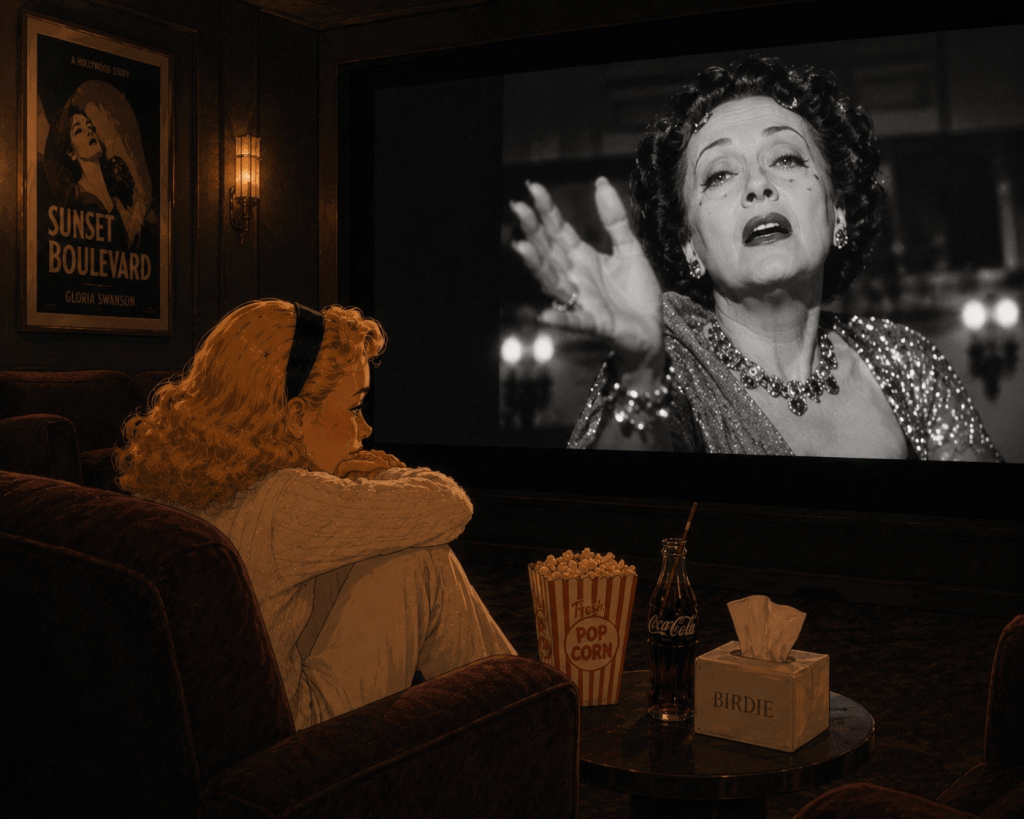
In the evening I watch Sunset Boulevard on my own downstairs, and am overcome with fear that I will end up like Norma Desmond if I’m not careful.
I wake the next morning from a nightmare. Joe Gillis’s voice in my head:
“A great big white elephant of a place… A neglected house gets an unhappy look. This one had it in spades. It was like that old woman in “Great Expectations”. That Miss Havisham in her rotting wedding dress and her torn veil…”
I hope this will not be my future. I will do everything in my power to change my current trajectory, that’s for certain, and for the first time since Tom went to war I pray to God.
My novel GREAT ARE THE MYTHS will be serialised (one chapter each day) over the summer of 2026. If you would rather listen to the audiobook, the full story is available for free on all the usual platforms. Info and links HERE

