
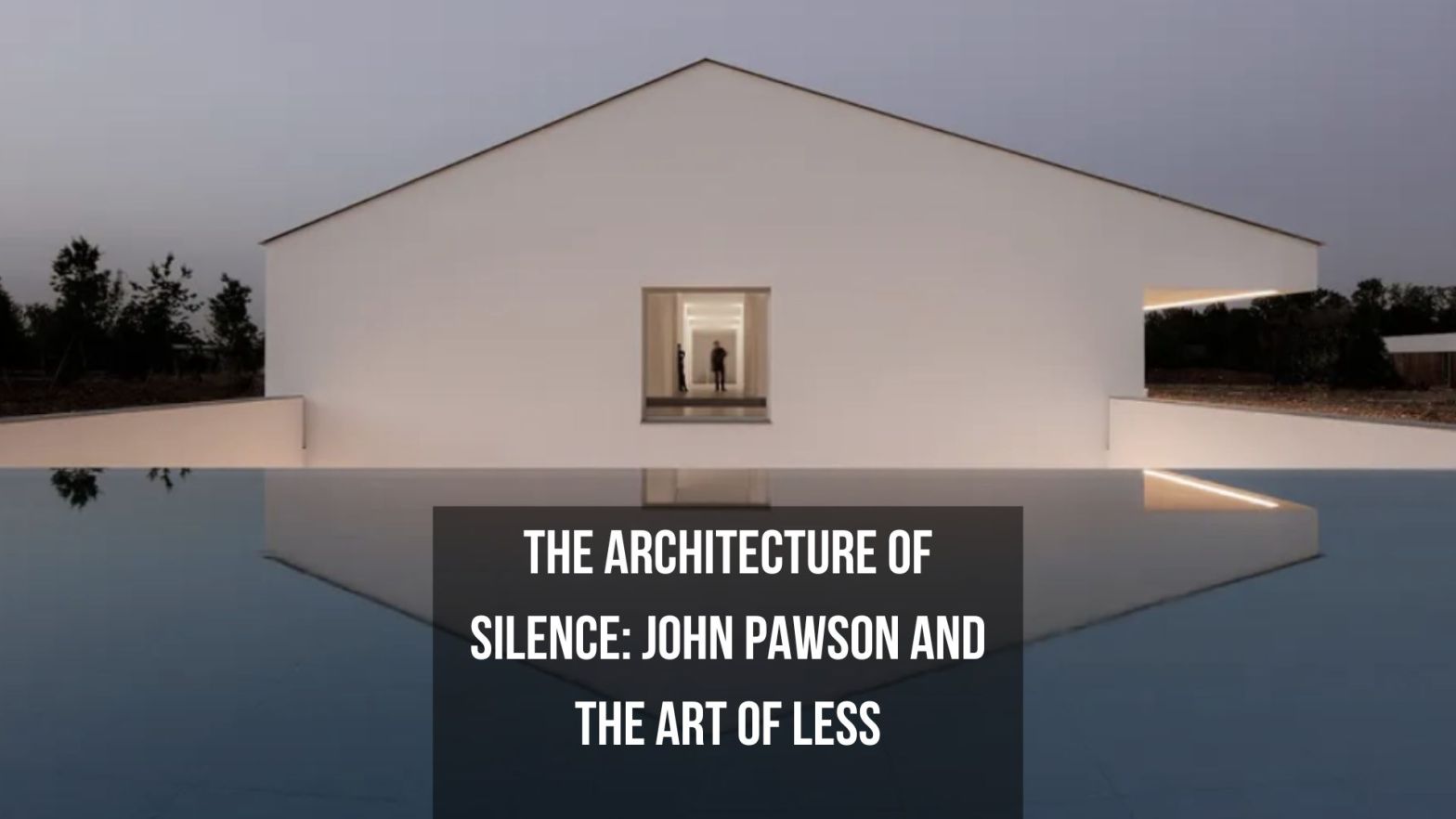
He has built monasteries, fashion temples, and homes for the hyper-wealthy. But John Pawson’s real subject has always been the same: what happens when you take everything away.
By Bergotte
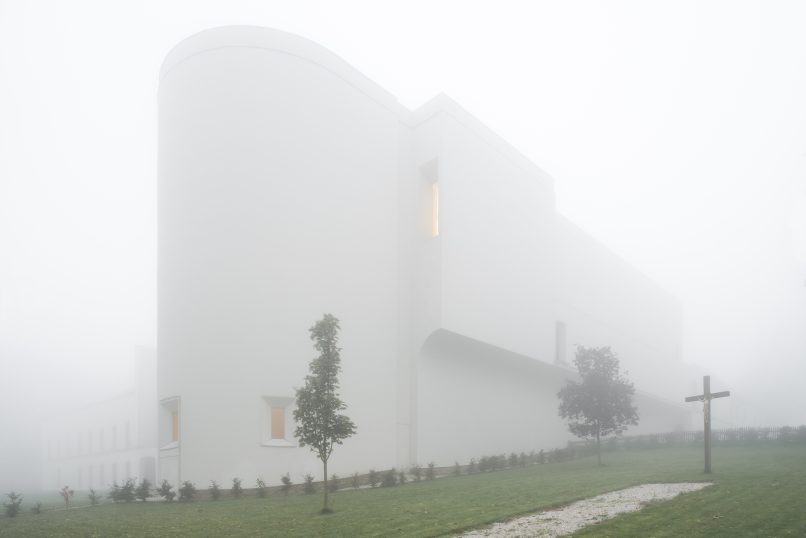
There is a room in the Czech countryside, an hour south of Prague, that has no decoration whatsoever. Its walls are limestone. Its floor is limestone. A single, precisely proportioned window opens onto a meadow that, in winter, turns the colour of old paper. The room belongs to the monastery of Nový Dvůr, a Cistercian community that retreated here in 2004, and it was designed by a Yorkshireman who had never trained as an architect in any conventional sense, who once failed his A-levels, who spent his early twenties drifting between the family textile business and the bars of Halifax, and who became, in the final decades of the twentieth century, one of the most influential architects alive.
John Pawson is now in his mid-seventies. He works from a studio in west London that is, predictably, immaculate. He is a tall man with a deliberate manner of speaking, someone who appears to weigh each sentence before releasing it. He is not, by temperament, a polemicist. He has never written the theoretical manifestos that adorn the careers of his more academically inclined contemporaries. What he has done instead is build things — shops, houses, apartments, airports, a swimming pool in a converted Victorian bathhouse, a gallery extension in Germany, a crossing over a lake in the Royal Botanic Gardens at Kew — and allowed those things to speak in his place. The language they speak is quieter than almost anything else in contemporary architecture. It is also, in its way, more radical.
The story of how Pawson became Pawson begins in Japan. In 1974, aged twenty-five, he went to teach English in Nagoya, and stayed for three years. The experience was, by his own account, transformative in ways that had less to do with Japan’s architectural tradition than with its domestic culture: the way a tatami room made you aware of the quality of light at different hours of the day; the way sliding screens could transform the geometry of a space without adding a single object to it; the way neatness was not merely tidiness but a form of attention, a philosophical commitment. He has spoken, in various interviews, of being struck by the home of the designer Shiro Kuramata, with whom he worked during this period — a space so spare, so precisely calibrated, that the air inside it seemed to have a different quality from the air outside.
He returned to England, spent time at the Architectural Association in London, and began, in the early 1980s, to practise. His early commissions were modest: apartments for friends, small commercial fitouts. But already a sensibility was visible. Pawson’s interiors stripped walls back to plaster, eliminated skirting boards and cornices, hid all storage behind flush panels, reduced the visual field to the essential geometry of the room itself. He was working in a period when the dominant aesthetic in London interiors was maximalist — the swags and frills and historical pastiches of the post-modern moment — and his work had an almost aggressively contrary quality. Clients who hired him tended to be people who had arrived at a similar place intuitively, who felt, in some inchoate way, that their environments were too loud, too full of signals, and who wanted relief.
His 1996 book, Minimum, became something close to a manifesto for this tendency, though Pawson would resist that word. The book is less an architectural argument than a meditation: images of sand dunes, Shaker furniture, Japanese rock gardens, medieval cloisters, and Pawson’s own work placed side by side without much commentary, as if the juxtaposition were self-evidently meaningful. It sold widely and was read well beyond the architectural profession, finding an audience among designers, artists, and the simply overstimulated. It arrived at a cultural moment — the mid-nineties — when minimalism had become a genuine movement, when Helmut Lang and Jil Sander were stripping fashion back to its structure, when the concept of “decluttering” had not yet become a lifestyle industry but was beginning to feel like a moral position. Pawson was its architectural avatar.
The commission that made his international reputation arrived in 1994, when Calvin Klein selected him to design his flagship store on Madison Avenue. The brief, as Pawson describes it, was almost absurdly simple: the client wanted everything unnecessary removed. What remained, in the completed building, was a series of rooms in which the clothes hung like objects in a gallery, spaced so widely that each garment seemed to exist in its own silence. The floors were poured stone. The walls were plaster the colour of unbleached linen. The light came from concealed sources that produced no visible shadow. Shoppers — or perhaps pilgrims is the better word — moved through the space in a state of unusual self-consciousness, aware that they were being asked to pay a different kind of attention than the one retail environments typically demanded.
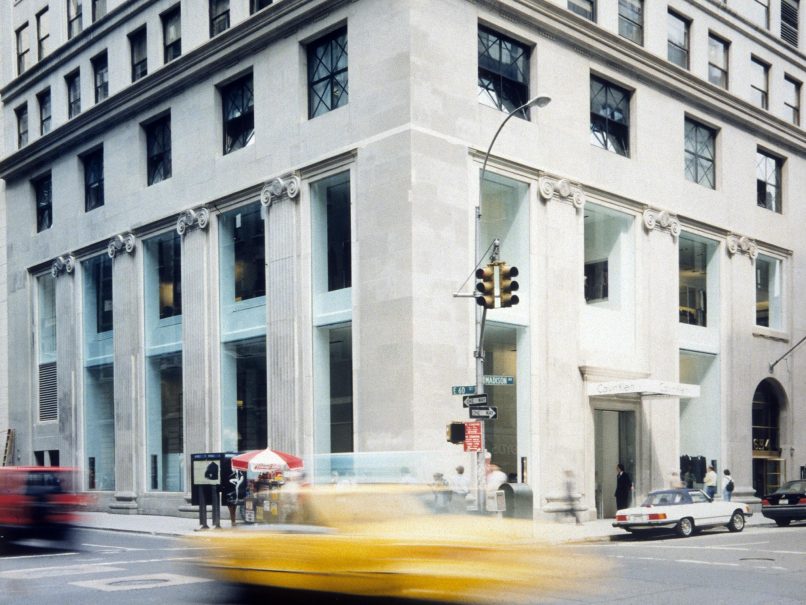
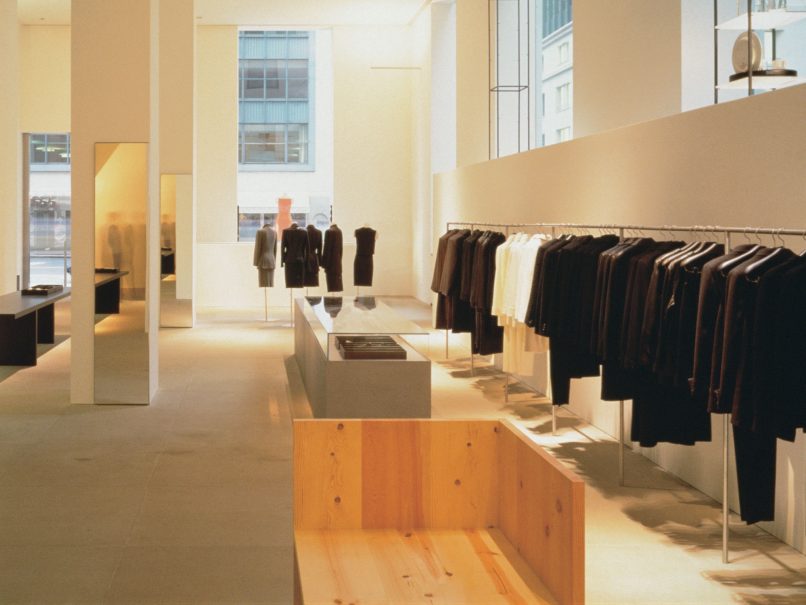
The store was widely photographed, widely discussed, and widely imitated, and it established a set of associations that have followed Pawson ever since. His architecture became linked, in the popular imagination, with luxury — with the kind of wealth so secure it no longer needs to announce itself through ornament. There is something in this association that Pawson finds, if not exactly irritating, then somewhat reductive. His buildings are expensive to construct, certainly: the materials he specifies tend to be the most refined versions of themselves, and the craftsmanship required to achieve seamless junctions, perfectly flat surfaces, and the right proportions in every detail is painstaking and therefore costly. But the equation of minimalism with affluence misses what he has always insisted is the deeper point.
“I’m not interested in emptiness,” he has said. “I’m interested in space.” The distinction matters. Emptiness is a lack; space, in Pawson’s sense, is a presence. His rooms are calibrated to produce a particular kind of experience in the body: a slowing of the heart rate, a widening of attention, a state that falls somewhere between contemplation and relief. He has borrowed, consciously, from the vocabulary of monastic architecture — the long corridors, the proportions of refectory and cloister, the quality of light admitted through an opening sized not merely for visibility but for a specific emotional effect. And he has applied this vocabulary to secular contexts: private houses, hotel lobbies, airport lounges, the public spaces of museums. In doing so, he has argued, implicitly, that the kind of peace monasteries are designed to produce is not the exclusive property of the religious, but a basic human need, available to anyone who encounters the right spatial conditions.
The monastery at Nový Dvůr is the work that, for many architects and critics, represents Pawson’s most complete achievement. The commission came to him through a circuitous route — a mutual friend had mentioned his name to the Cistercian abbot — and it was not, on the face of it, an obvious fit. Pawson is not a practising Christian. He has described himself, when pressed, as spiritual but not religious, a formulation that covers a great deal of ground. But the Cistercian tradition, he quickly recognised, was built on principles almost identical to his own. The order was founded in the eleventh century as a reform movement against the ornamental excess of Cluny; its founding principle was that decoration distracts from devotion, that architecture should serve the spirit rather than impress the eye. The monk and theologian Bernard of Clairvaux wrote ferociously against the grotesque figurations that adorned the churches of his day — the half-human, half-animal creatures carved into Romanesque capitals — and demanded that the house of God be restored to simplicity and light. Reading Bernard, Pawson has said, felt like reading his own convictions in a medieval voice.
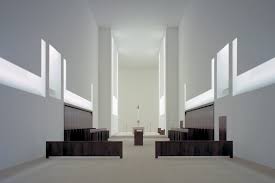
The building that resulted is, by any measure, remarkable. Pawson inserted his contemporary structures into a Baroque farmstead, leaving the historical fabric intact while transforming the interior entirely. The church is a long, white room. It has no decoration. Its altar is a block of stone. Its windows admit light at angles calculated to change throughout the day, so that the quality of illumination in the room is never static but always in slow motion. The monks for whom it was built have spoken of inhabiting a space that seems, paradoxically, to require nothing of them and to give them everything. There is no moment, inside the church at Nový Dvůr, when you are uncertain about what architecture is for.
Pawson’s influence on the profession has been pervasive but also, in certain respects, double-edged. The visual language he helped to define has been absorbed into mainstream architectural culture to the point where it is now almost inescapable: the frameless kitchen, the concealed storage, the bathroom as a study in material and light, the absence of visible hardware. These elements appear now in developer apartments, hotel chains, and the sets of television programmes about interior design. The democratisation of minimalist aesthetics might be read as a vindication of Pawson’s formal arguments — if the language is now available to anyone, surely its humanising qualities are equally available? — but it has also produced a kind of entropy, a dilution of intention that converts a rigorous spatial philosophy into a lifestyle option among others.
The architecture writer and historian Kenneth Frampton, who has spent his career insisting on the ethical dimensions of built form, once described minimalism as the style that capitalism found most useful in the late twentieth century: clean, aspirational, infinitely reproducible, scrubbed of anything that might disturb the logic of the market. There is something in this critique that needs to be taken seriously. The minimalist aesthetic, in its most widespread commercial application, tends to erase the marks of labour — the seams, the joints, the evidence of making — in ways that produce not transparency but a kind of refined concealment. Everything is hidden so that the surface may appear effortless, and the effortlessness, in turn, can be sold as a quality in itself.
Pawson’s own work, at its best, resists this logic, though not always in ways that are immediately visible. The distinction lies in the relationship to materials. Where commercial minimalism tends toward the generic — surfaces that could be any stone, any wood, any plaster — Pawson is obsessively specific. He has spent years developing relationships with particular quarries, particular craftsmen, particular producers of lime mortar and handmade brick. The stone in his buildings is chosen not only for its colour but for its geological character, the way its grain catches light, the way it ages. His floors are not floors that happen to be stone; they are this stone, from this place, laid in a way that takes account of these particular qualities. The difference between a Pawson interior and an approximation of a Pawson interior is, in this sense, the difference between an original and a reproduction — which is to say, a difference that can be felt but is difficult to articulate.
There is, inevitably, a psychological dimension to the architecture, one that Pawson has always been willing to acknowledge. He grew up, by his own account, in a state of considerable domestic discomfort: a large and chaotic household, a father who was a pragmatic businessman with no particular interest in aesthetics, a school experience that was undistinguished in every respect. He left the family business, with which he had been expected to continue, in his mid-twenties, and the departure was painful. The years in Japan were, in part, a flight — though a productive one, a flight toward something. The spaces he subsequently created have sometimes been read as a sustained act of self-therapy: environments from which the disorder and noise of ordinary life have been removed, in which it is possible to breathe at a different rate, to think at a different pace, to inhabit the present rather than ricocheting between past and future.
He does not discourage this interpretation, but he complicates it. The point of his spaces, he has argued, is not to eliminate discomfort but to create the conditions for attention. A room that asks nothing of you, that is merely soothing, is ultimately boring. What he is trying to build is a room that holds its own, a room that continues to reward looking, a room in which nothing is fixed but everything is precise. The distinction is subtle but crucial. Emptiness, to return to his earlier formulation, is static. Space is dynamic: it changes with the light, with the body moving through it, with the season and the time of day and the emotional temperature of whoever inhabits it.
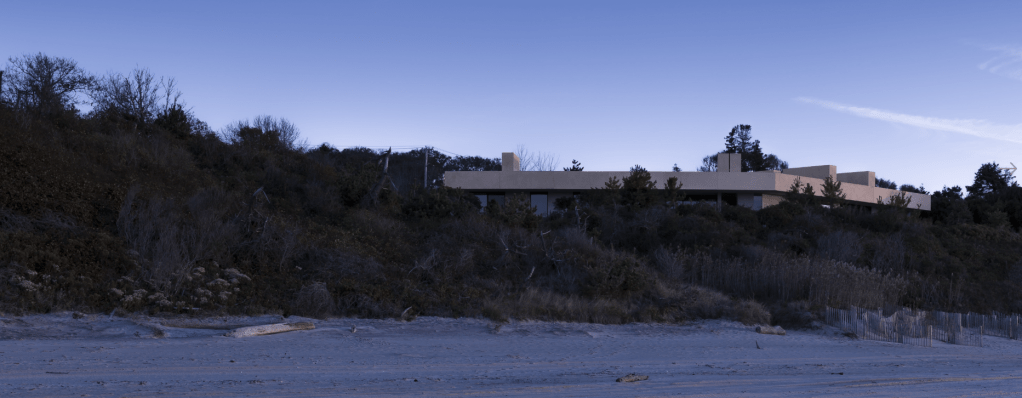
His more recent projects have extended the vocabulary without substantially revising it. The Life House, a rental retreat in rural Wales completed in 2016 in collaboration with Living Architecture, applies Pawson’s principles to a single domestic building: a long, low structure in Welsh stone, oriented to frame a view of moorland, with interiors that reduce the palette to light and natural material and the sound of wind. The Design Museum’s new home in the former Commonwealth Institute building in Kensington — a project Pawson led alongside designers and curators — opened to wide admiration in the same year, its vast, tent-like roof structure suspended over a newly carved interior of white concrete and oak. And his apartment designs and private houses continue to appear in the places where serious contemporary architecture is discussed: a residence in New York, a house on a Greek island, a flat in a converted Victorian warehouse in London.
What the late body of work makes clear is that Pawson’s project has never been primarily formal — not really about the look of things — but existential: about the way spaces condition experience, the way architecture can be an argument about what it means to live well. In this respect, he belongs in a line that runs through Le Corbusier’s thinking about light and proportion, through the Japanese tradition of ma — the meaningful pause, the productive interval — through the Shaker belief that beauty and function are not separable. He is a builder who has arrived at a philosophy, or a philosopher who found, late and somewhat accidentally, that building was the medium in which his thoughts could be expressed most completely.
The room at Nový Dvůr is still there. The monks still sit in its limestone silence, watching the light move. Most of the people who will read about it will never visit it. But architecture, at its most persuasive, works not only on the bodies that inhabit it directly but on the imaginations of those who encounter it at a distance — who carry the idea of it around with them, as a kind of standard, a measure of what space can be made to feel. John Pawson has spent half a century building those standards, and the culture, whether it fully acknowledges the debt or not, is quieter for it.
John Pawson’s monograph Spectrum was published by Phaidon. The monastery of Nový Dvůr is located near Toužim in the Bohemian region of the Czech Republic and is open to limited public visits.
Discover more from My World of Interiors
Subscribe to get the latest posts sent to your email.

