
By Bergotte
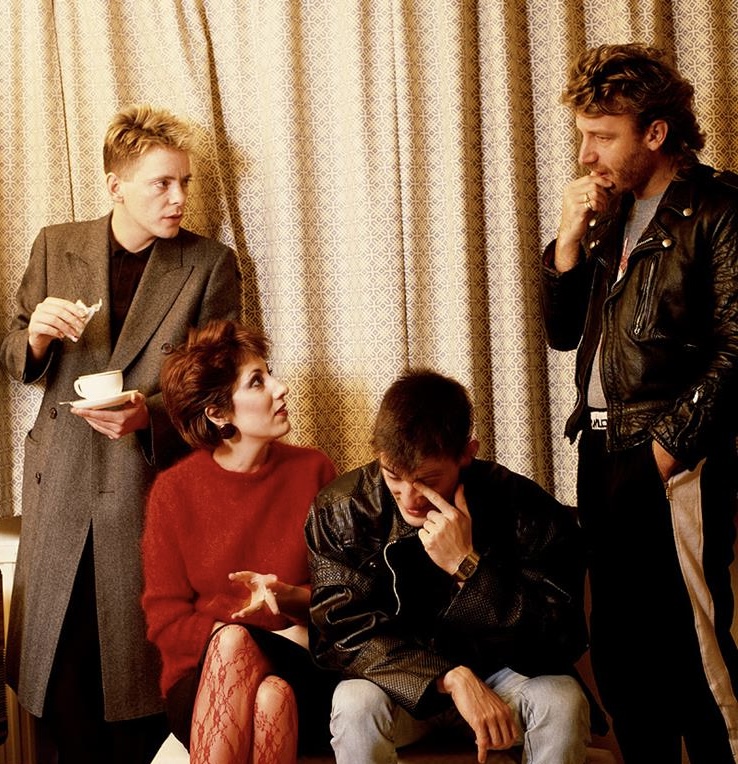
New Order made the most unlikely record in the history of popular music. Three people whose previous band had defined the outer limits of post-industrial English despair, whose singer had hanged himself eight months before the recording sessions began, whose entire artistic identity had been built on darkness and weight and the refusal of consolation — these three people went to New York, heard the music coming out of the clubs, and came back to Manchester and made a record that made people dance. Not reluctantly. Not ironically. Not as a therapeutic exercise in moving on. They made a record of such euphoric, overwhelming, physically irresistible joy that it became the best-selling twelve-inch single in the history of recorded music. The question of how they did this, and what it cost them, and what it means — about grief, about survival, about the relationship between the body and the mind when the mind is broken — is one of the most interesting questions in the history of popular music, and the music itself is the only honest answer to it.
The three who remained
Bernard Sumner, Peter Hook, and Stephen Morris did not immediately know what they were going to do after Ian Curtis died. They knew, with a certainty that seems to have formed quickly and held firm, that they were going to continue making music together — that the band did not die with Curtis, that the three of them had their own creative identities and their own claims on what they had built. But they did not know what form the continuation would take, what it would sound like, what name it would carry.
The name they chose — New Order — was, in retrospect, a statement of intent so precise it almost seems calculated, though by all accounts it was arrived at with rather less philosophical self-consciousness than it has since been given credit for. A new order. Not a recovery of the old order. Not a continuation of the old order under different circumstances. Something structurally different, built from the same materials but organised around a different principle, pointing in a different direction.
They added Gillian Gilbert, Morris’s girlfriend, on keyboards and guitar, which gave them a four-piece again and gave them, crucially, a keyboard player at the moment when keyboard playing was about to become the dominant formal choice in British popular music. And they began, cautiously, to find out what the new order sounded like.
The first New Order single, “Ceremony,” released in March 1981, was the answer to the question of what happens at the exact seam between the two bands: it was a Joy Division song, written by Curtis before his death, recorded by the surviving three and Gilbert after it. It sounds like both things simultaneously — like Joy Division played by people who are no longer Joy Division, like grief in the act of becoming something else without yet knowing what. Sumner’s vocal is not Curtis’s — nobody’s vocal is Curtis’s — and the difference is not a deficiency but a statement: this is a different voice, a different person, singing words that belong to the dead and carrying them forward into a world the dead will not inhabit. The song is an elegy for its own origins. It is the necessary first step.
New York and the education of the body
The transformation that produced New Order’s mature sound did not happen in Manchester. It happened in New York, specifically in the clubs of lower Manhattan and the Bronx in the early 1980s, where a music was developing that was unlike anything in the British post-punk tradition they had come from.
What they encountered in those clubs — Paradise Garage, the Loft, the Danceteria — was the music that would come to be called house and electro, music built on drum machines and synthesizers and the Kraftwerk records that had already crossed the Atlantic and been received with an enthusiasm that their German makers had not entirely anticipated. Afrika Bambaataa had already built “Planet Rock” on the bones of “Trans-Europe Express.” Larry Levan was playing four-hour sets that moved between Giorgio Moroder and Philadelphia soul and electronic experimentation with a DJ’s sense of what a room full of bodies needed. The dancefloor was the instrument, and the instrument was teaching everyone who played it a new vocabulary.
Sumner has spoken about the experience of those New York clubs with a consistency across decades of interviews that suggests genuine formative importance: the feeling of being inside music rather than watching it, the physical surrender that the music demanded and that he — coming from a tradition in which music was something you attended to intellectually and emotionally but not physically, in which the body was at best a vehicle and at worst a distraction — found both overwhelming and revelatory. He was, by his own account, not a natural dancer. The music made him dance anyway. The fact of that involuntary response told him something about what he wanted to make.
This is one of the decisive moments in the history of British popular music: the moment when the post-punk tradition encountered the dancefloor and discovered that the encounter was not a betrayal of seriousness but an extension of it. The body has its own intelligence. The dancefloor has its own form of knowledge. The ecstasy of physical surrender to a groove is not the opposite of the intellectual and emotional rigour of Joy Division. It is a different mode of the same investigation into what it means to be alive.
What they brought back to Manchester was not simply a set of new techniques — the Roland drum machines, the sequencers, the synthesizer bass sounds that would define their mature sound — but a new question: what happens when the darkness that Joy Division inhabited discovers the dancefloor? What is the music that lives at the intersection of grief and euphoria, of the weight of the past and the animal insistence of the body on being present, on moving, on continuing?
Movement and the unfinished thing
The first New Order album, Movement, released in November 1981, is an honest record precisely because it does not resolve this question. It is a transitional record in the fullest sense: a document of people in the act of becoming something they have not yet become, reaching toward the sound they can hear in the distance without yet being able to play it.
The Joy Division inheritance is still heavy on Movement — the textures are dark, the tempos slow, the mood more Closer than anything that will come after. But the synthesizers are more prominent, the drum machine is present alongside Morris’s live playing, and there are moments — on “Chosen Time” and “ICB” especially — where the music opens briefly into a lightness that has no precedent in the Joy Division catalogue, a hint of something airborne, something that wants to move. The album is most interesting, listened to now, as a record of the space between: the space between Joy Division and what New Order are about to become, the space that grief creates and that must be crossed before the arrival can happen.
Sumner’s development as a lyricist is already visible on Movement and deserves attention because it is one of the most undervalued aspects of the New Order story. He is a completely different writer from Curtis: less literary, less systematic, more fragmented, more likely to stumble toward meaning than to arrive at it in full possession of it. His lyrics are often criticised for their apparent incoherence, their non-sequiturs, their willingness to place lines next to each other that don’t obviously connect. The criticism misses the point. The fragmentation is the style, and the style matches the content: these are songs about states of feeling that resist coherent narrative, that move between registers without warning, that know what they feel before they know why. The intelligence is emotional rather than literary, and it is entirely genuine.
Blue Monday: the problem it solved
“Blue Monday” was released in March 1983, and everything about it was unprecedented.
It was seven minutes and twenty-nine seconds long. It had no guitar. It was built almost entirely from sequenced synthesizers and a Roland TR-808 drum machine, with bass guitar added by Hook but placed in the mix as a melodic rather than a rhythmic element. The twelve-inch sleeve, designed by Peter Saville, was die-cut in the shape of a floppy disk and cost so much to produce that Factory Records lost money on every copy sold. It sold over three million copies. It is still the best-selling twelve-inch single ever released in the United Kingdom.
None of this explains why it is great. Commercial success and greatness are different things, as this series has had occasion to observe many times, and “Blue Monday” is not great because it sold three million copies. It sold three million copies because it is great, and the greatness requires more careful account.
The record opens with a drum machine pattern — the TR-808, in the specific configuration that Sumner and Morris programmed, which has since become one of the most recognisable sounds in the history of electronic music — and the pattern is at once completely mechanical and completely alive. It is mechanical because it is a machine, because it does not breathe or hesitate or deviate from the pattern it has been given, because every hit is identical to the one before it in a way that no human drummer’s hits are identical. And it is alive because the pattern itself is musical rather than merely rhythmic, because the specific combination of kick drum, snare, hi-hat, and clap that Morris and Sumner arrived at has an internal logic that is not simply functional but expressive, that moves through time with something that feels, despite everything, like intention.
Over this foundation, the synthesizer bass sequence arrives — four notes, repeated, the most minimal possible melodic statement — and then the synthesizer chords, and then Hook’s bass guitar, and then the vocal. The architecture of the record is so spacious, so clearly delineated, so confident in its own structure, that each element’s arrival feels like an event rather than an addition. The mix is a demonstration of negative space: what you leave out of the record is as important as what you put in, and what is left out of “Blue Monday” — the guitars, the conventional rock dynamics, the humanising roughness — creates a space that the listener inhabits rather than observes.
Sumner’s vocal, when it arrives, is among the most unlikely things about the record: tentative, slightly uncertain of its own pitch at moments, not the voice of someone commanding a dancefloor but the voice of someone on the dancefloor, confused, looking for something they have lost, moving anyway because the music demands it. The lyric — how does it feel, to treat me like you do — is a question directed at someone or something that does not answer, and the unanswered quality of the question persists through the entire seven minutes without resolution. The record does not resolve. It fades. The question is still unanswered. The drums are still running. The body is still moving.
This, finally, is the answer to the question the previous essay ended with: how do you go on? You go on like this. You take the grief and you take the drum machine and you take the New York dancefloor and you put them in a room together and you let what comes out come out, and what comes out is seven minutes of music that contains both the darkness and the joy, that refuses to choose between them, that says: the body continues even when the mind is broken, the music continues even when the singer is gone, the pulse continues because the pulse is what life is, and as long as it is running there is something to dance to.
Power, Corruption and Lies: the full arrival
The album that followed “Blue Monday” — Power, Corruption and Lies, released in May 1983 — is the record on which New Order arrived fully at the sound they had been moving toward since Curtis’s death. It is, by any measure, one of the great albums of the 1980s: a record that holds the Joy Division inheritance and the New York dancefloor influence in a balance so perfect that neither cancels the other, that is simultaneously serious and euphoric, dark and bright, English and transatlantic.
The cover — Peter Saville’s reproduction of a Henri Fantin-Latour flower painting, placed against a colour-coded graphic border with no text, no band name, no album title — announces the record’s aesthetic position before you have heard a note: this is a record that takes beauty seriously, that is not embarrassed by it, that places a nineteenth-century French painting of roses on a post-punk electronic album without irony and without apology. The juxtaposition is the point. Beauty and darkness are not opposites. They have never been opposites.
“Age of Consent” opens the album with a guitar figure of such irrepressible energy that it is impossible not to respond to it physically — not a slow burn but an immediate release, the music arriving at its full force within seconds. Hook’s bass is melodic, high, insistent. Sumner’s vocal is more confident than on Movement, more certain of where it is, less tentative about what it wants to say. “We all stand, and we all fall, and we look for something more.” It is not a complex lyric. It is an accurate one. The falling and the standing are simultaneous, as they are in “Blue Monday,” as they are in Joy Division, as they are in the cluster’s whole argument about what it means to make music under conditions of loss.
“Your Silent Face” is the album’s most purely beautiful track: a synthesizer piece of extraordinary delicacy, a melody that arrives and expands and is harmonised with itself until it fills the space entirely, Sumner’s vocal placed over it with the tentativeness that is his signature, the whole thing amounting to something that functions, structurally, as a kind of secular hymn — a piece of music that addresses itself to a silence and finds, in the addressing, a form of solace that stops short of consolation. Consolation would be too much. The silence is still there. But the music that addresses it is real.
The years that followed
New Order continued for another decade after Power, Corruption and Lies, making records that moved through the landscape of 1980s and 1990s popular music with the particular confidence of a band that had already been somewhere nobody else had been and knew, therefore, that they could handle where they were going. Low-Life (1985), Brotherhood (1986), Technique (1989) — each album a different shade of the synthesis they had developed, each one finding a new balance between the electronic and the organic, the dark and the light.
Technique, recorded in Ibiza at the height of the acid house explosion that Ibiza was then hosting, is the record that made the synthesis most explicit: the Roland synthesizers and the Joy Division inheritance meeting the Spanish sun and the MDMA-drenched euphoria of the late 1980s dancefloor, and the meeting producing something that is genuinely, uncomplicatedly joyful in a way that no earlier New Order record had quite managed to be. “Fine Time” and “Vanishing Point” are among the most purely pleasurable things they made. The darkness had not gone. It never went. But it had been metabolised into something that could share a room with joy without extinguishing it.
The band broke up in 1993, reformed, broke up again, reformed. The personal relationships between the members — always complex, often strained, the business disputes eventually serious enough to require litigation — have been the subject of two extensive and mutually contradictory memoir accounts by Sumner and Hook respectively, and the disputes are real and have caused real damage. This is true and it is less important, for the purposes of this essay, than the music that the disputes have not been able to cancel.
What the dancefloor knew
The argument of this cluster — Kraftwerk, Joy Division, New Order — has been building toward a conclusion that the New Order essay is positioned to make. Here it is.
The machines that Kraftwerk built in Düsseldorf in the 1970s were instruments for expressing the feeling of being human in the modern world: the motorway, the mainframe, the electromagnetic signal crossing the air. Joy Division received that language and filled it with the specific weight of an English post-industrial city, a consciousness at its limit, the darkness shaped into something that could be shared. New Order took what remained after the worst thing had happened — three people and a drum machine and the memory of a friend — and discovered, in New York and in Manchester and in the act of making music together in the absence of the person around whom the music had previously organised itself, that the pulse does not stop. That the body continues. That the dancefloor knows something that the grieving mind cannot access by itself, which is that life persists and that persistence, in the end, is a form of fidelity to the dead rather than a betrayal of them.
“Blue Monday” is not a happy record. It is not a sad record. It is something much more interesting and much more useful: it is the record that holds both states at once, that refuses to resolve the tension between them, that says the tension is the truth. How does it feel? It feels like this. Like a drum machine running in the dark. Like a question with no answer. Like a body that keeps moving anyway. Like seven minutes and twenty-nine seconds of something that is simultaneously an ending and a beginning, that contains within it the whole arc from Düsseldorf to Manchester to New York and back, that is made of grief and electronics and the irresistible physics of the dancefloor.
It feels like being alive when you weren’t sure you were going to be. And there is no better feeling than that, and there is no better music for it, and that is why it still sounds, four decades after it was made, like something that is happening right now.
Sources and further reading
Primary works
New Order. Movement. Factory Records, 1981. The transitional record; essential for understanding the arc, less immediately satisfying than what follows.
New Order. Power, Corruption and Lies. Factory Records, 1983. The full arrival; “Age of Consent,” “Your Silent Face,” and “5-8-6” are the essential tracks.
New Order. Low-Life. Factory Records, 1985. The consolidation; “The Perfect Kiss” and “Sooner Than You Think” are particularly strong.
New Order. Technique. Factory Records, 1989. The Ibiza album; the most purely joyful record they made and the fullest realisation of the synthesis between electronic pop and dancefloor euphoria.
New Order. Substance. Factory Records, 1987. The essential singles compilation; “Blue Monday,” “Bizarre Love Triangle,” “True Faith,” and “Shellshock” are the indispensable tracks for any listener new to the catalogue.
Biographical and critical writing
Hook, Peter. Substance: Inside New Order. Simon & Schuster, 2016. Hook’s account of the New Order years; partial, combative, and invaluable as primary material. Read alongside his Joy Division memoir for the full arc.
Sumner, Bernard. Chapter and Verse: New Order, Joy Division and Me. Bantam Press, 2014. Sumner’s counter-account; more reflective than Hook’s and particularly strong on the New York experiences that transformed the band’s musical direction.
Middles, Mick. From Joy Division to New Order: The Factory Story. Virgin Books, 1996. The most comprehensive single-volume account of the full arc from Joy Division to New Order within the Factory Records context; essential background on Tony Wilson, Peter Saville, and the cultural infrastructure that made the music possible.
Reynolds, Simon. Rip It Up and Start Again: Post-Punk 1978–1984. Faber and Faber, 2005. The New Order chapters are among Reynolds’s best; the account of the New York influence and the development of the synthesizer pop aesthetic is definitive.
On Factory Records and the Manchester context
Wilson, Tony. 24 Hour Party People: What the Sleeve Notes Never Tell You. Channel 4 Books, 2002. Wilson’s own account of Factory Records; unreliable as biography and indispensable as atmosphere, the book of a man who understood that what he was doing was historically significant and was determined to say so at maximum volume.
Haslam, Dave. Manchester, England: The Story of the Pop Cult City. Fourth Estate, 1999. The cultural geography of Manchester as a music city; the account of the Haçienda — the Factory-owned club where New Order’s dancefloor sensibility found its natural home — is particularly strong.
On the electronic music context
Lawrence, Tim. Love Saves the Day: A History of American Dance Music Culture 1970–79. Duke University Press, 2003. The New York club scene that transformed New Order’s musical direction; the chapters on Paradise Garage and Larry Levan are the best available account of what Sumner and his bandmates encountered and why it mattered.
Brewster, Bill, and Frank Broughton. Last Night a DJ Saved My Life: The History of the Disc Jockey. Headline, 1999. Places the New York club experience within the broader history of DJ culture; useful for understanding the specific musical intelligence that New Order absorbed from the dancefloor.
Discover more from My World of Interiors
Subscribe to get the latest posts sent to your email.

