
He was the most gifted prose writer in the history of philosophy and the most dangerous thinker in the Western tradition. He gave us the Forms, the cave, the immortal soul, the philosopher-king, and the suspicion — never quite extinguished in the two and a half thousand years since — that the world we see is not the world that is. He was also, by the evidence of his own political philosophy, capable of an authoritarianism so thorough that it makes most subsequent totalitarianisms look improvised. Both of these things are the same thinker, and the essay that follows holds them together, because anything less would be a failure of the seriousness that Plato himself demanded.
By Bergotte
Begin with the writing, because the writing is where Plato is most immediately extraordinary and most immediately confusing. He is the greatest prose stylist in ancient Greek — possibly the greatest prose stylist in any philosophical tradition — and he chose to write not in his own voice but in the voices of characters in dialogues, chief among them the voice of a man who wrote nothing and claimed to know nothing, who was dead before Plato was thirty. The decision to make Socrates the mouthpiece of a philosophy that Socrates himself may not have held, to put into the mouth of the executed gadfly the most elaborate and most systematic metaphysical structure in ancient thought, is one of the most consequential literary decisions in intellectual history.
It means that Plato is always at one remove from his own philosophy — always the ventriloquist rather than the speaker, always in the peculiar position of the writer who expresses his deepest convictions through a character whose deepest conviction was that convictions should be questioned rather than expressed. It also means that the dialogues are something rarer and more difficult than philosophical treatises: they are philosophical performances, in which the argument is enacted in the drama of the conversation, in which what is said is inseparable from who says it and to whom and under what circumstances and with what result.
Whitehead’s famous remark — that the history of European philosophy is a series of footnotes to Plato — is an overstatement that contains a truth large enough to matter. Almost every major question that subsequent Western philosophy has asked — about knowledge and its limits, about the nature of reality and its relationship to appearance, about the soul and its fate, about justice and its requirements, about beauty and its sources — was asked first, and in many cases most penetratingly, by Plato. The footnotes are substantial. The original text is inexhaustible.
The Theory of Forms: Reality Behind Appearance
Plato was born in Athens in approximately 428 BCE, into a family of considerable aristocratic distinction — his stepfather Pyrilampes was a friend of Pericles, and his relatives included Critias and Charmides, two of the Thirty Tyrants who briefly and brutally governed Athens after its defeat by Sparta in 404 BCE. He was young, brilliant, politically ambitious, and deeply attached to Socrates, whose trial and execution in 399 BCE he did not witness — he was ill, the Phaedo tells us — and whose death organised the subsequent fifty years of his philosophical life.
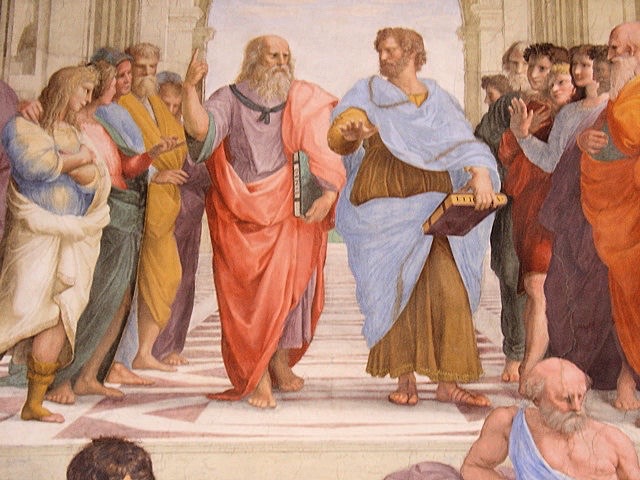
He founded the Academy in Athens around 387 BCE — the first institution of higher learning in the Western world, the ancestor of the university — and ran it until his death in 348 or 347 BCE. Among its students was Aristotle, who arrived at seventeen and stayed for twenty years, absorbing everything Plato had to offer and then, with the calm thoroughness of a genuinely independent mind, disagreeing with most of it.
The philosophy that Plato developed across thirty-six dialogues — a body of work that survived antiquity intact, which is almost miraculous given the rate of loss — is organised around a distinction that he takes from the Socratic tradition and radicalises into a complete metaphysical system: the distinction between the world of appearances and the world of reality, between what we perceive through the senses and what genuinely is.
The Forms — the Ideas, in the Latin translation that shaped the subsequent reception — are the genuinely real things: the eternal, unchanging, perfect archetypes of which the particular things of the sensory world are imperfect, temporary, impermanent copies. There is a Form of Beauty — perfect, eternal, self-identical, never coming into being and never passing away — of which every beautiful thing we encounter in the sensory world is a partial and imperfect instantiation. There is a Form of Justice, a Form of Equality, a Form of the Good. And there is the Form of the Good itself — the highest Form, the one that illuminates all the others, the source of being and truth in the intelligible realm, as the sun is the source of light and growth in the sensory one.
The argument for the existence of the Forms is not primarily logical — it is not a deductive proof from premises that no honest mind can deny. It is something closer to an argument from experience: from the specific experience of recognising that particular beautiful things are beautiful not because of their specific sensory properties but because they participate in something that transcends their specific sensory properties, something that is the same in all beautiful things and that persists even when the particular beautiful thing perishes. Mathematical objects — which are perfectly equal, perfectly circular, perfectly triangular in a way that no sensory object ever is — provided Plato with his strongest case: the mathematical truths we know are not truths about the imperfect circles and triangles we draw on paper, but about the perfect Forms that the drawn figures imperfectly represent.
Heraclitus had said: everything flows. Plato took this seriously and concluded from it that the flowing world cannot be the world that genuine knowledge is about, because genuine knowledge must be stable — must be of something that does not change, that cannot be otherwise, that is always what it is. Heraclitus’s logos — the principle that runs through the flowing world — became, in Plato’s hands, the world of Forms: the eternal, intelligible realm of which the logos was the ordering principle. The logos stopped flowing and became permanent. Heraclitus would not have recognised his own insight in what Plato made of it.
The Cave: The Diagnosis of the Human Condition
The allegory of the cave — introduced in the Republic in the context of an argument about the nature of philosophical education and political authority — is the most famous image in the history of philosophy, and it has already appeared in the Socrates essay because Plato puts it in Socrates’ mouth. But it deserves its own treatment here, in the context of Plato’s broader metaphysical project, because its significance extends far beyond the pedagogical point it is making in its immediate context.
The prisoners in the cave are not stupid. They are not deficient in intelligence or observation. They are experts in the only world available to them — they know the shadows intimately, they can predict their sequences, they have developed the kind of practical wisdom that the shadow-world requires. What they lack is not cleverness but the experience of genuine reality — the exposure to the light that would allow them to see that the shadows are shadows, that the world they have taken for reality is a projection of something more real that they have never encountered.
The ascent from the cave is painful and disorienting because genuine education is painful and disorienting — because the adjustment from appearance to reality involves the loss of the comfortable certainties of the shadow-world, the discomfort of the light, the specific grief of discovering that what one took for knowledge was not knowledge at all. The philosopher who returns to the cave is not welcomed. She cannot see the shadows anymore. The prisoners take her blindness for damage and her report of the sun for madness.
What the allegory describes is not merely the situation of the prisoner who has never studied philosophy. It describes the fundamental situation of the human being as such — the situation of the consciousness that is embodied in a sensory world, that takes the deliverances of the senses for reality, that organises its life around the pursuit of sensory goods without knowing that the goods it is pursuing are shadows of the real goods it has never encountered. The cave is the human condition, and the ascent from the cave is the philosophical life, and most people — the allegory is explicit about this — do not make the ascent and will resist and resent those who do.
The political implication — that the philosophers who have made the ascent should return to govern those who have not — is one of the most consequential and most controversial developments in the history of political thought. Plato believed it with a seriousness that two decades of attempting to put it into practice in Sicily demonstrated was not merely theoretical. He went to Syracuse three times, attempting to educate the tyrant Dionysius I and then his son Dionysius II in philosophy, with the aim of producing the philosopher-king that the Republic had described. The attempts were disasters of varying degrees. He was nearly sold into slavery on the first visit. The second and third visits produced nothing but disillusionment and the confirmation that the gap between the philosophical ideal and the political reality was not a small gap to be closed by patient instruction.
The Soul and Its Fate
The Phaedo — the dialogue set in Socrates’ prison cell on his final day — is the most sustained and the most emotionally intense of Plato’s arguments for the immortality of the soul, and it is here that the specific quality of Platonic dualism — the sharp separation of soul from body, of the intelligible from the sensory, of the eternal from the temporal — is most fully expressed and most fully felt.
The soul, for Plato, is the real self — the part of the human being that knows, that reasons, that participates in the Forms, that is genuinely akin to the eternal and the divine. The body is the prison, the tomb, the source of the distortions and confusions that prevent the soul from achieving the clear vision of reality that is its proper aim. The senses lie — or rather, they tell the truth about the sensory world, which is the world of appearance rather than reality, and the soul that is too deeply invested in the sensory world is the soul that has mistaken the shadow for the thing.
Death, in this account, is not a loss but a liberation — the release of the soul from the body’s confusions, the return of the eternal to the eternal realm in which it has always truly belonged. The philosopher who has spent her life pursuing genuine knowledge — who has, in the language of the allegory, made the ascent from the cave and adjusted her eyes to the sunlight — is the person for whom death is least frightening, because she has spent her life in the practice of dying: in the progressive detachment from the sensory world and the sensory goods that most people organise their lives around, in the increasing orientation toward the intelligible that is also the orientation toward the soul’s genuine home.
This is the most seductive and the most dangerous aspect of Platonic philosophy — the promise that the soul is not merely a temporary pattern in the physical world, as Heraclitus might have said, but something eternal and indestructible, something that predates the body and will survive it, something that has, in a previous existence, seen the Forms directly and that remembers them — however dimly — in the act of recognition that we call learning.
The theory of recollection — that all genuine learning is a form of remembering what the soul knew before its embodiment — is offered in the Meno as the solution to a paradox about knowledge: how can we learn what we do not know, given that we would not recognise the answer when we found it unless we already knew it? The answer Plato gives is that we do already know it — that the soul has seen the Forms directly, that the recognition of mathematical and philosophical truths is the activation of a knowledge that was present before the birth of the specific embodied individual who is doing the recognising.
It is a beautiful theory and probably not true. The objection that Aristotle would eventually make — that the Forms, even if they existed, would not help explain the particular things of the sensory world, because a perfect Form of horse does not explain why this particular horse is a horse — is not the only objection, but it is among the most effective. The theory of recollection requires a pre-existence of the soul that the theory of the Forms does not by itself establish, and the arguments for the soul’s immortality in the Phaedo, as we noted in the Socrates essay, are not conclusive even to the participants in the dialogue.
But the beauty of the theory — the sense it gives of the self as something larger than its current embodied instantiation, the intimation that genuine understanding is a form of homecoming — has proved more durable than the arguments. The Platonic soul is not a philosophical demonstration. It is a picture, and it is a picture that has organised the self-understanding of Western civilisation for two and a half thousand years.
Eros and the Ascent to Beauty
The Symposium — the dialogue set at a drinking party at which a series of speeches in praise of Eros are delivered — contains, in the speech that Socrates attributes to the priestess Diotima of Mantinea, the most beautiful and the most philosophically rich account of the relationship between love and knowledge in ancient philosophy.
Diotima’s account of the ascent through love — beginning with the love of a single beautiful body, rising to the love of beautiful bodies in general, then to the love of beautiful souls, then to beautiful activities and laws and knowledge, and finally to the vision of Beauty itself: eternal, pure, unmixed with the beauty of any particular thing — is the counterpart to the allegory of the cave, but conducted in the register of desire rather than cognition. The philosopher ascends to the Forms through intellectual discipline; the lover ascends to the Form of Beauty through the progressive purification of erotic longing.
This is not the domestication of Eros — the reduction of sexual desire to a manageable, socially sanctioned sentiment. It is something stranger and more demanding: the recognition that Eros, at its deepest, is not primarily a desire for another body or even another person but a desire for the immortal, for the permanent, for the beautiful that does not fade or die. The beautiful boy who first arouses the philosopher’s love is not the end of the journey but its beginning — the first rung of a ladder that leads, if the lover has the courage and the discipline to climb it, to the vision of Beauty itself.
The ascent is, again, a form of dying — a progressive detachment from the particular that can feel, at each stage, like loss rather than gain. To move from the love of one beautiful body to the love of beautiful bodies in general is to loosen the grip of the particular attachment, to recognise that what the lover loves is not the specific features of the specific beloved but the participation in Beauty that those features instantiate. This is, from the beloved’s perspective, potentially devastating — to be loved as an instance of a Form rather than as an irreplaceable individual — and it is one of the places where the coldness at the heart of the Platonic vision is most visible.
Alcibiades arrives drunk at the end of the Symposium and delivers a speech in praise of Socrates that is also, implicitly, a speech in praise of the Platonic ideal of philosophical love — and a complaint about its costs. Alcibiades has tried to seduce Socrates and failed. He has offered his beautiful body — the most beautiful body in Athens, by common agreement — and Socrates has declined, with a gentleness and a seriousness that is more wounding than rejection. Socrates, for whom Alcibiades’ beauty is genuinely present and genuinely perceived, cannot go further than perception because the pursuit of the particular beautiful thing would interrupt the ascent toward Beauty itself.
It is one of the most philosophically charged moments of sexual frustration in literature. It is also the demonstration, conducted in the flesh, of what the philosophical life costs the people around the philosopher as well as the philosopher herself.
Justice and the Philosopher-King: The Most Dangerous Idea
The Republic is the most ambitious and the most controversial of the dialogues — a sustained, carefully constructed argument about the nature of justice that expands, by the logic of analogy, into a complete account of the ideal political community and its relationship to the ideal soul.
Plato’s argument about justice begins with the soul: justice in the individual, he argues, is the condition in which each part of the soul — reason, spirit, and appetite — performs its proper function, with reason ruling over spirit and appetite, spirit supporting reason’s authority, and appetite pursuing its objects within the limits that reason sets. The just soul is not the soul that suppresses its lower parts but the soul in which the parts are properly ordered, each doing what it is fitted to do, the whole functioning with the harmony of an organism in health.
By analogy, justice in the city is the condition in which each class — the philosopher-rulers, the warrior-guardians, the producers — performs its proper function, with the philosophers ruling on the basis of their knowledge of the Forms, the warriors defending the city on the basis of their courageous obedience to the philosophers’ wisdom, and the producers providing the material goods that the city requires. The just city is not the city that suppresses its lower classes but the city in which the classes are properly ordered, each doing what it is fitted to do.
The philosopher-rulers — who are produced by a rigorous educational programme that begins in childhood and culminates in the vision of the Form of the Good that the allegory of the cave describes — govern not because they want to but because they must, because they are the only ones who know what genuine justice and genuine goodness are, and because governing is, for them, a burden that they accept for the city’s sake rather than an ambition they pursue for their own.
The logic is internally consistent and the conclusion is, by the standards of liberal democratic thought, catastrophic. The philosopher-rulers will decide what art is permitted — poetry that misrepresents the gods and arouses the passions will be expelled from the city, as Plato expels Homer in a passage of extraordinary severity. They will decide what music is permitted — only the modes that produce courage and temperance, not the modes that produce pleasure or grief. They will control reproduction — pairing the best with the best in the interest of the city’s human stock. They will tell noble lies — the myth of the metals, in which the people are told that they were born with gold or silver or bronze in their souls — to maintain the social order that the philosophers’ knowledge has produced.
Karl Popper, in The Open Society and Its Enemies, identified Plato as one of the intellectual ancestors of twentieth-century totalitarianism, and the identification has force even if the genealogy is more complicated than Popper allows. The philosopher-king who rules on the basis of knowledge rather than consent, who suppresses the art and music that might disturb the social order, who regards the opinions of the many as the shadows of shadows — this figure has proved remarkably productive as a model for those who believe that they know what is good for others and that this knowledge gives them the right to enforce it.
Plato would have been horrified by the Nazis and the Stalinists. He would also, if he were honest, have recognised in their contempt for ordinary people’s opinions and their confidence in the superior knowledge of the ruling class a distant and distorted echo of something he had said. The distance and the distortion matter. But so does the echo.
What Plato Got Wrong, and Why It Matters
The difficulty with Plato is not that he was wrong about everything. It is that he was wrong about some things in ways that had enormous consequences, and right about other things with a depth that makes the wrongness all the more frustrating.
He was wrong about the Forms — or at least, the Forms as he describes them, separate from the sensory world, eternal, unchanging, self-subsistent, face the objections that Aristotle raised in such definitive terms that Plato himself, in the late dialogue Parmenides, had already anticipated the most devastating of them: the third man argument, which shows that the introduction of a Form to explain the common properties of a group of things generates an infinite regress. If the Form of Largeness explains what large things have in common, what explains what the Form of Largeness and the large things have in common? A further Form of Largeness, and a further one, and so on without end.
He was wrong about the soul’s immortality — or at least the arguments he offers for it are not sufficient to establish the conclusion, as the characters in the Phaedo themselves acknowledge.
He was wrong, catastrophically, about the relationship between knowledge and political authority — about the entitlement that superior understanding gives to those who possess it to override the expressed preferences of those who do not. This is the most practically dangerous error in the history of philosophy, and its influence has been immense.
And yet. He was right about something that makes every subsequent refutation somehow insufficient: the intimation that genuine knowledge is different in kind from the accumulation of opinion, that the world we take for granted is not all there is, that there is something in the human mind that reaches past the immediate and the particular toward something more permanent and more real. He was right that the examined life is different from the unexamined one in ways that cannot be captured by the vocabulary of preference and desire alone. He was right that justice — whatever justice turns out to be — is not merely a matter of convention, not merely what the powerful say it is, not reducible to the calculations of utility or the registering of preference.
He may have been right, in the end, about something he never quite says directly but that the dialogues embody in their form as much as their content: that the pursuit of wisdom is a form of love, that the love of the Forms is a love of something genuinely worth loving, and that the human being who has genuinely felt this love is, whatever else may be said about her, not living a small life.
Who We Are According to Plato
We are souls in bodies — and the souls are the real part, the part that knows and loves and reaches toward the eternal, while the bodies are the temporary, confusing, pleasure-and-pain-generating instruments through which the souls are currently operating. The souls have seen the Forms, in some previous existence, and they remember them — dimly, imperfectly, with the specific ache of recognition that genuine learning produces. We are pilgrims, in this account: beings who are not quite at home in the sensory world, who carry within them a memory of a reality they have not quite lost access to, who are capable — if they have the courage and the discipline and the guidance — of the ascent that returns them, however briefly and however partially, to the vision of the real.
We are prisoners who can be freed — who are not constitutively confined to the cave, who are capable of the painful, disorienting, ultimately liberating ascent to the light. The freedom is not guaranteed. The ascent requires a guide — the philosopher who has already made it and returned — and it requires the courage to endure the discomfort of the adjustment and the grief of losing the comfortable certainties of the cave. Most prisoners, the allegory says without sentimentality, will not make it. But the possibility is there, and the possibility is what defines the human being as distinct from the beings who cannot make the ascent at all.
We are lovers — beings whose Eros, at its deepest and most genuine, is a desire for the permanent and the beautiful rather than the temporary and the sensory. The lover who follows Eros honestly, who does not mistake the first rung of the ladder for the destination, who has the discipline to use the love of the particular beautiful thing as the beginning of the ascent toward Beauty itself — this lover is doing what the human being is most fully capable of, engaging with the highest object available to a consciousness that is temporarily embodied in the sensory world.
We are, finally, the beings for whom the question of justice — of what is genuinely owed to each, of what the well-ordered soul and the well-ordered community look like — is not merely a practical question about the management of competing interests but a question about reality: about what the soul genuinely is and what it genuinely requires, about what the community genuinely is and what it genuinely needs. The Forms are the answer Plato gives to this question — an answer that most subsequent philosophy has found unsatisfactory and that no subsequent philosophy has been able entirely to ignore.
The sun is there, beyond the cave. We are in the cave. The question is whether we can bear the light.
The essential Plato texts are the Republic, the Phaedo, the Symposium, the Meno, and the Apology — all available in the Hackett Plato: Complete Works, edited by John M. Cooper, which is the standard scholarly edition with excellent translations by various hands. The Republic is available separately in the translation by G.M.A. Grube, revised by C.D.C. Reeve (Hackett), which is the most widely used. For philosophical commentary, Julia Annas’s An Introduction to Plato’s Republic (Oxford University Press) is rigorous and readable. Karl Popper’s critique is in The Open Society and Its Enemies, Volume I: The Spell of Plato (Routledge). For the literary and dramatic qualities of the dialogues, Eva Brann’s The Music of the Republic (Paul Dry Books) is illuminating. A.N. Whitehead’s remark about footnotes to Plato appears in Process and Reality (Free Press).
Discover more from My World of Interiors
Subscribe to get the latest posts sent to your email.

