
Encounters · No. 9
Everyone, All at Once
Pieter Bruegel the Elder painted crowds, seasons, proverbs, and catastrophes. He was the first painter to look at ordinary people and decide that their lives were the whole subject. Five centuries later, no one has done it better.
By Bergotte
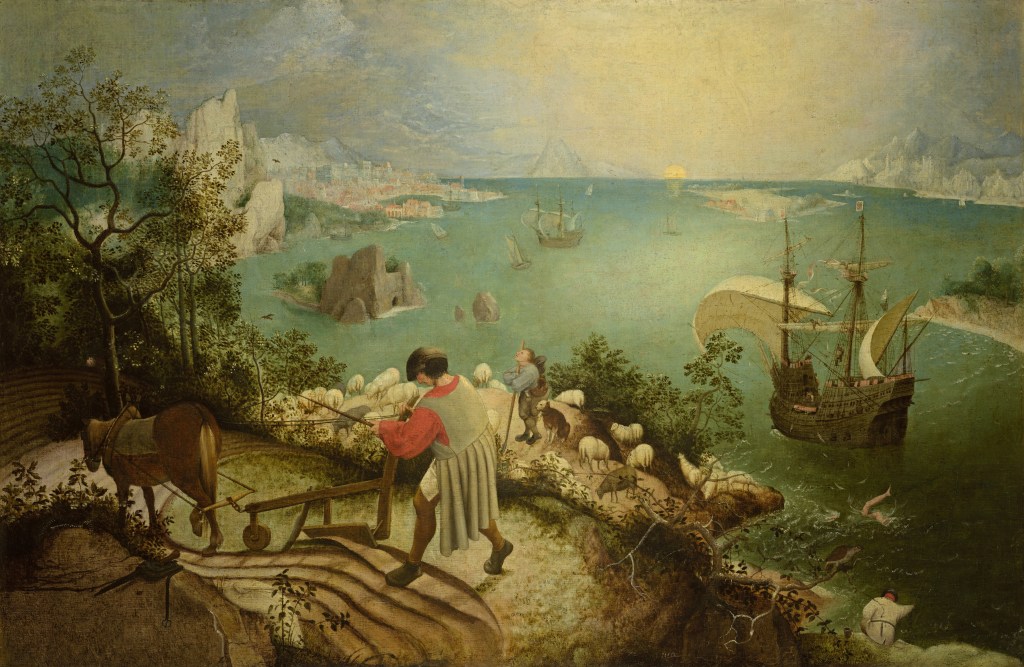
In the lower right corner of a painting completed around 1558, a pair of legs disappears into a calm green sea. The legs belong to Icarus. He has just fallen from the sky, his wax wings dissolved by the sun, and the sea is receiving him with the absolute indifference of something that has better things to do. In the foreground, a ploughman turns a furrow. A shepherd leans on his crook and looks up — but not at Icarus, at something else entirely. A ship sails past. The world continues. The painting is called Landscape with the Fall of Icarus, and it is one of the most quietly devastating works in the history of Western art, a painting in which the mythological catastrophe that gives it its name is the least important thing in it.
W. H. Auden wrote a poem about it in 1938, called “Musée des Beaux Arts,” which begins by observing that the Old Masters were never wrong about suffering — how it takes place while someone else is eating or opening a window or just walking dully along. The poem is very good. But it is also, in its way, a slightly insufficient response to what Bruegel was doing, because it treats the painting as a meditation on human indifference to suffering, when it is really about something at once simpler and more radical: the democracy of the visual field. In Bruegel’s world, Icarus does not get more canvas than the ploughman. He gets, in fact, considerably less. This is not a statement about indifference. It is a statement about proportion — about the actual distribution of significance in a world that contains both mythological heroes and people who need to finish ploughing before dark.
In Bruegel’s world, Icarus does not get more canvas than the ploughman. This is not a statement about indifference. It is a statement about proportion — about the actual distribution of significance in a world that has both mythological heroes and people who need to finish ploughing before dark.
The Man We Do Not Know
Almost nothing is known about Pieter Bruegel the Elder’s life. He was born sometime around 1525 — the date is not certain — probably in the town of Breda, in what is now the Netherlands, though possibly in a village whose name he may have taken as his own. He trained in Antwerp, became a master in the painters’ guild there in 1551, travelled to Italy in the early 1550s — as Flemish painters were expected to do, absorbing the Renaissance grammar of composition and figure — and returned to the Netherlands largely unimpressed. He married in Brussels around 1563, had children, two of whom became painters, and died in 1569, probably in his early forties. He left behind roughly forty surviving paintings and a body of drawings and prints. That is nearly the complete record.
The obscurity is, in a sense, fitting. Bruegel spent his career making paintings in which no single person is more important than any other, in which the individual face is almost always too small to read, in which what matters is the totality — the crowd, the season, the landscape, the human activity distributed across the surface of the world. A biography of Bruegel, if we had one, would be an anomaly: the record of one particular person in the work of a painter who was not especially interested in particular persons.
What we have instead of biography is Italy, and what Italy gave Bruegel is, by the evidence of the paintings, primarily landscape. Not the classical landscape of the Italian masters, with its ordered distances and Arcadian light, but the specific quality of seeing that comes from travelling through mountain terrain — through the Alps, which Bruegel crossed twice — and understanding, perhaps for the first time, the actual scale of the world relative to the human figure. His Alpine drawings, made on the journey south and back, show a man learning to see from above, learning to place the human figure in a setting so vast that it nearly disappears. This is the visual lesson he brought back to the Netherlands, and it is the governing principle of almost everything he subsequently painted.
The Peasants
Bruegel’s nickname — Peasant Bruegel, Boeren Bruegel — was given to him partly because of his subject matter and partly because of a story, probably apocryphal, that he would disguise himself as a peasant and attend village fairs and weddings to observe without being observed. Whether or not the story is true, it captures something real about the paintings: they have the quality of sustained, sympathetic, unsentimental observation. The peasants in Bruegel are not elevated into symbols of rustic virtue, as they sometimes are in later Flemish painting. They are not degraded into comic grotesques, as they are in the moralising prints of the period. They are doing what they do. They are harvesting, drinking, dancing, fighting, defecating, giving birth, dying. They are, in the most precise sense, going about their lives.
The Peasant Wedding, painted around 1567, is one of the great paintings of food. People are eating — not in the polished, allegorical way of the Last Supper tradition, but with the focused, slightly graceless attention of people who are genuinely hungry and the food is genuinely good. Dishes are being carried through the crowd on an improvised plank. Someone is pouring. Someone else is already done and looking around. A child in the foreground licks something from a finger. The scene is warm, specific, unromanticised, and entirely without condescension. Bruegel is not slumming. He is attending.
The peasants in Bruegel are not elevated into symbols of rustic virtue, nor degraded into comic grotesques. They are doing what they do — harvesting, drinking, dancing, fighting. They are, in the most precise sense, going about their lives.
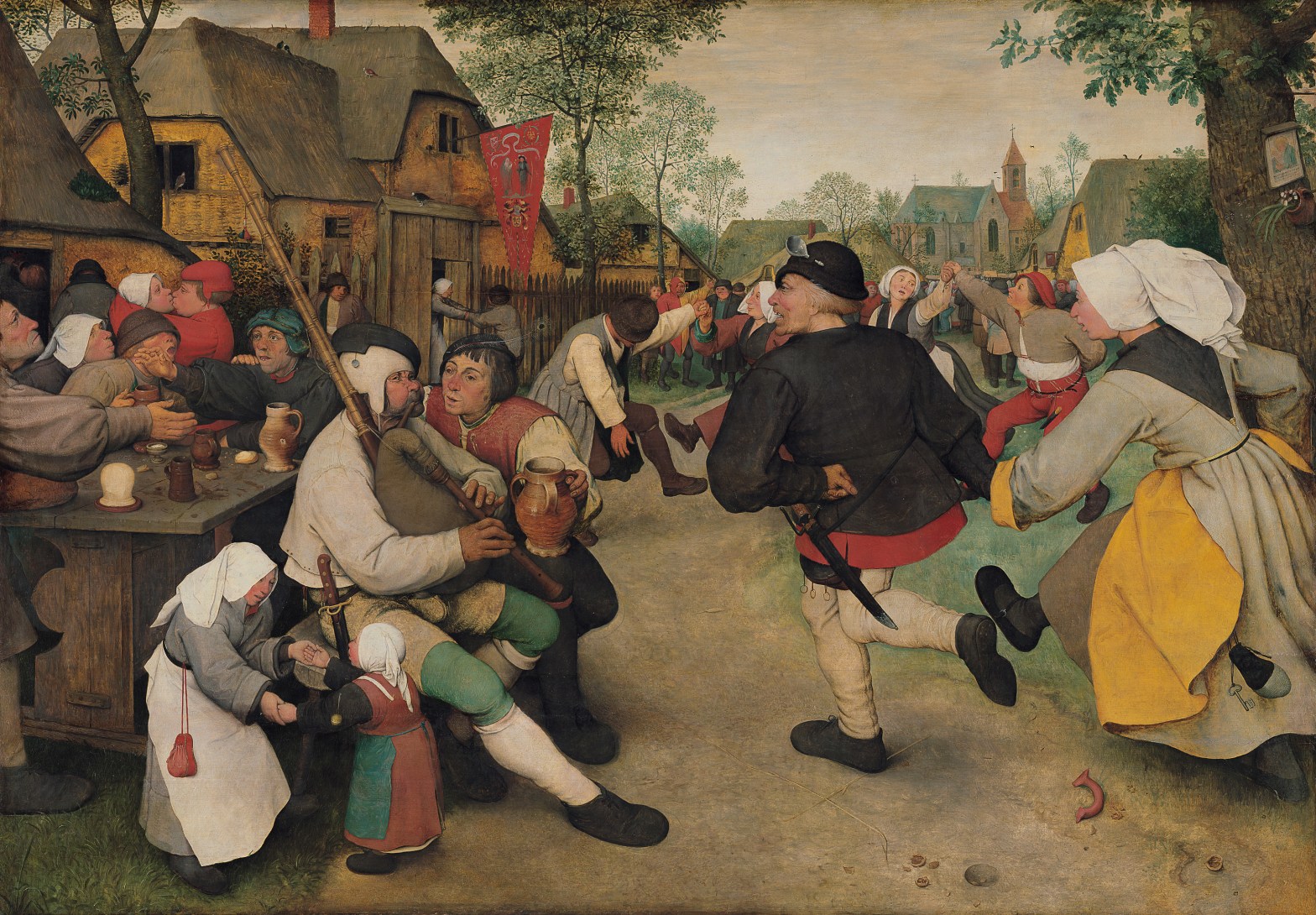
The same quality governs Peasant Dance, its companion piece: a village celebration in which everyone is slightly too loud, slightly too physical, slightly too present in their own bodies for the conventions of Renaissance painting. A couple kisses in the background with a directness that would not be out of place in a Nan Goldin photograph. A man in the foreground is dancing with the specific urgency of someone who has been waiting all week to dance. The bagpiper plays. The painter watches, or seems to watch, with the clear-eyed affection of someone who knows these people — not condescending, not celebratory, simply there.
The Seasons
In 1565, a wealthy Antwerp merchant named Niclaes Jonghelinck commissioned Bruegel to paint a cycle of the months — probably twelve panels originally, of which five survive. They are among the most ambitious paintings of the sixteenth century and among the most quietly revolutionary in the entire Western tradition. The surviving panels — Hunters in the Snow for January and February, The Gloomy Day for early spring, The Hay Harvest for summer, The Harvesters for late summer, The Return of the Herd for autumn — each construct a world so complete, so internally consistent in its light and its atmosphere and its human activity, that to stand in front of one is to feel the temperature change.
Hunters in the Snow is the most famous, and its fame is entirely deserved. Three hunters return across a hillside in the grey-white of a January afternoon, their dogs low and tired at their heels, the village spread below them and the frozen ponds already occupied by skaters who have been there long enough that the hunting party’s return does not distract them. The colour is extraordinary: the warm ochre of the inn sign in the upper left, the bare black verticals of the trees against the sky, the cold greens and whites of the landscape receding into a distance so deep it seems to contain the whole winter. It is a painting about exhaustion and cold and the particular quality of the light at the end of a short day in January, and it is so precisely true that people who have never been to sixteenth-century Flanders recognise it immediately.
What Bruegel was doing in the seasons cycle had no real precedent. The subject of the months existed as a tradition — in illuminated manuscripts, in calendar cycles, in decorative programmes — but always in a codified, emblematic form: March means ploughing, September means harvest, and the figures performing these activities are types rather than people. Bruegel took the types and gave them weight, breath, fatigue, a specific quality of attention to what they were doing. He took the calendar and turned it into weather, into light, into the feeling of being a body in a particular season of a particular year.
Babel
The two versions of The Tower of Babel — a large panel in Vienna and a smaller one in Rotterdam — are, among Bruegel’s works, the ones that have aged most interestingly. They show a tower of extraordinary ambition, spiralling upward in tiers of arches and scaffolding and half-completed masonry, already partly consumed by cloud at its upper levels, already partly crumbling at its lower ones — the construction and the decay proceeding simultaneously, the human enterprise outpaced by its own ambition. At the base, tiny figures swarm: workers, architects, the king inspecting his project. They are, relative to the tower, almost invisible.
The paintings are usually read as moral allegories — the pride of Nimrod, the hubris of human ambition, the inevitable punishment — and they are that. But they are also, and more interestingly, paintings about the relationship between human scale and the scale of human projects. The tower in Bruegel is not yet complete, not yet failed. It is in the midst of being built, which is precisely the most interesting moment: the moment when the ambition is still credible, the outcome still uncertain, the workers still convinced that what they are building is possible. Bruegel does not tell us it will fail. He shows us how it looks from the inside of the attempt, when the end is not yet visible and the work continues.
He shows us how the tower looks from the inside of the attempt, when the end is not yet visible and the work continues.
The World as It Is
There is a painting called The Misanthrope, completed in 1568, a year before Bruegel’s death. It shows a hooded figure — old, cloaked, walking with his eyes downcast — being robbed by a small figure enclosed in a glass sphere. An inscription reads: because the world is so faithless, I am going into mourning. It is one of the most explicitly personal statements in Bruegel’s work, and it arrives late, at the end of a career spent painting the world with what looks, from the outside, like equanimity. Whether the misanthrope is Bruegel himself, or a figure he is gently mocking, or both simultaneously, the painting does not resolve. It sits with the ambiguity, as his best work always does.
What Bruegel painted, across forty-odd surviving works and a life of perhaps forty-odd years, was the world as it actually is: enormous, various, mostly indifferent to the fates of individuals, organised around labour and season and weather and appetite, capable of great beauty and considerable cruelty and an inexhaustible supply of moments in which the mythological catastrophe and the man finishing his ploughing occupy the same frame without either cancelling the other out. No painter before him had looked at this world with such patience and such scope. Very few since have managed it as well.
Icarus’s legs disappear into the sea. The ploughman turns another furrow. The ship sails on. The world is faithless and the work continues and the light on the snow at the end of the January afternoon is, still, precisely that.
Works referenced: Landscape with the Fall of Icarus (c.1558); The Tower of Babel (1563, 1568); The Seasons cycle (1565): Hunters in the Snow, The Gloomy Day, The Hay Harvest, The Harvesters, The Return of the Herd; The Peasant Wedding (c.1567); Peasant Dance (c.1568); The Misanthrope (1568). W. H. Auden, “Musée des Beaux Arts” (1938). This essay is part of an ongoing series, Encounters, on artists whose practice cannot be easily categorised.
Discover more from My World of Interiors
Subscribe to get the latest posts sent to your email.

