
The Passenger is a weekly dispatch on travel — places, hotels, restaurants, the strange logistics of being elsewhere. It is written by Bergotte.
Istanbul in October, and the case for one of the world’s great cities at its most completely itself
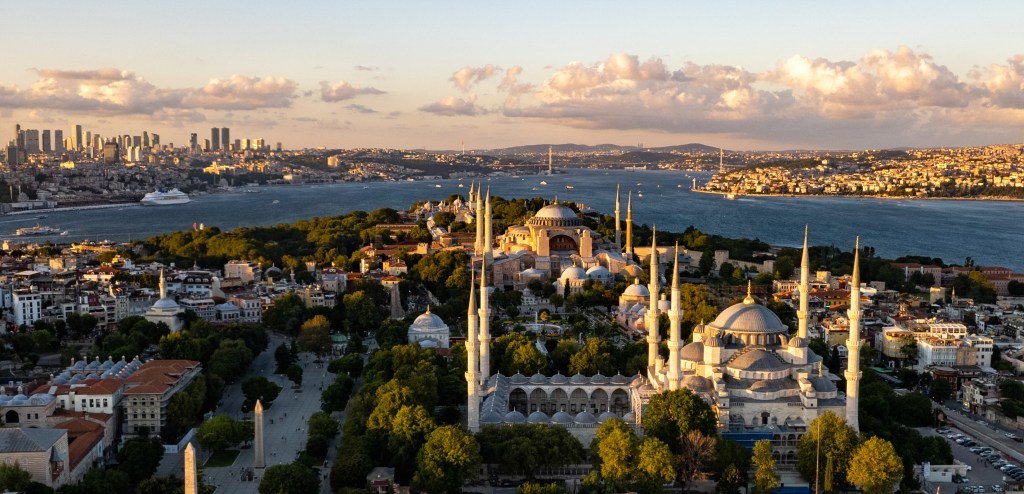
There is a moment, arriving in Istanbul for the first time, when the scale of the city’s ambition becomes briefly visible all at once. It happens most reliably from the Bosphorus — from a ferry crossing between the European and Asian shores, or from the deck of a boat heading south toward the Sea of Marmara — when you see the minarets and domes of the old city rising above the Golden Horn on one side, and the steel and glass towers of the financial district on the other, and the water itself threading between them, and you understand that you are in a place that has been the capital of civilisations for a very long time and carries that accumulated weight not as a burden but as the actual substance of its identity. Istanbul is the only city in the world that straddles two continents. It has been the capital of the Roman Empire, the Byzantine Empire, and the Ottoman Empire, and the traces of all three are simultaneously present in its streets, its buildings, its food, and the specific density of its atmosphere.
Most people who visit Istanbul in summer do so in considerable discomfort. The city in July and August is hot, humid, and extraordinarily crowded — the queues for Hagia Sophia alone are sufficient to test the commitment of the most determined visitor. In October this is all corrected. The summer crowds have departed. The temperatures drop into the mid-to-high teens — cool, occasionally brisk, the kind of weather in which a city is most legible on foot. The light turns. In October, Istanbul’s light does something that is difficult to describe and easy to recognise: a warm, angled, late-season quality that falls on the domes and minarets and the water of the Bosphorus in a way that makes the city look permanently like a painting of itself. Orhan Pamuk, Istanbul’s most devoted literary chronicler, has written about the city’s particular melancholy — hüzün, the collective sadness of a city that was once an empire — and October is when that quality is most present and most beautiful.
This is the right month. Come now.
The city in layers
Istanbul resists the visitor who tries to understand it as a single thing. It is at least three cities layered on top of each other, and the serious visitor attends all of them.
The first is Sultanahmet and the old city — the imperial core of Constantinople and then Istanbul, the peninsula of land between the Golden Horn and the Sea of Marmara where the Romans built their capital and the Ottomans built theirs on top. Hagia Sophia, the Blue Mosque, the Topkapı Palace, the Grand Bazaar, the Basilica Cistern: this is the Istanbul of the history books, and it delivers on every expectation. The challenge is to see it without the mediation of the tourist infrastructure that has grown around it — to arrive at Hagia Sophia before the crowds, to find the streets behind the Grand Bazaar where the actual commerce of the city is still conducted, to understand that the old city is not a museum but a working district of two million people who live and eat and argue in the shadow of the greatest accumulation of imperial architecture in the world.
The second is Beyoğlu and Karaköy — the European district across the Golden Horn, connected to the old city by the Galata Bridge, which has been a site of continuous human activity for centuries and currently functions as a kind of informal social club for the fishermen who line its railings at all hours regardless of weather or result. Beyoğlu is the Istanbul of the 19th century, when the city was the cosmopolitan capital of a declining empire and the Levantine merchant class built their apartments and churches and embassies along the Grande Rue de Péra — now Istiklal Caddesi, the great pedestrian street that runs from Taksim Square down to the Galata Tower. Below Istiklal, in Karaköy and along the Bankalar Caddesi — the old banking district — the most interesting contemporary life of the city is concentrated: galleries, design hotels, restaurants that are doing something genuinely new with Turkish food, the art institutions that have made Istanbul one of the most active contemporary art cities in Europe.
The third is Kadıköy and the Asian shore — reached by a twelve-minute ferry from Eminönü, a crossing that manages to be both practical and one of the more pleasurable experiences in the city. Kadıköy is where Istanbul lives when it isn’t performing for visitors: a neighbourhood of fish markets and wine bars and the best food in the city, inhabited by writers, academics, musicians, and the general population of a city that has always been more complicated than its monuments suggest. Most travel writing about Istanbul does not cross the Bosphorus. This is a significant editorial failure, and one that this column intends to correct.
Where to stay: The Bank Hotel Istanbul
The hotel occupies a former bank on Bankalar Caddesi — the old banking street of Karaköy, a neoclassical boulevard of 19th-century financial institutions that have been gradually converting, over the past decade, into galleries, restaurants, and the most design-serious hotels in the city. The Bank Hotel is the standout: a marriage of grand marble banking hall and eclectic contemporary interiors designed by Sinan Kafadar, who took the building’s institutional seriousness as a starting point rather than something to be disguised. The result is a hotel of jewel tones and abstract art and the specific pleasure of sleeping inside a beautiful building that knows what it was before it became what it is now.
The hotel has an in-house curator who organises cultural events — talks, performances, exhibitions — that connect it to the neighbourhood’s gallery and arts scene, which is the most active in the city. Karaköy itself is the correct address: the Galata Bridge is five minutes’ walk; the Istanbul Modern museum of contemporary art is ten; the old city is a tram ride or a vigorous walk across the bridge; and the streets immediately around the hotel contain the restaurants and galleries and coffee shops that constitute the most alive part of Istanbul’s creative life.
The Bank Hotel Istanbul — Bankalar Caddesi No. 5, Karaköy, Beyoğlu, Istanbul 34421.
For a mid-range alternative in the same neighbourhood, 10 Karakoy is the established option — a 71-room hotel in another neoclassical building, rooftop restaurant, Bosphorus views from the upper floors, and the same Karaköy address that puts the best of the city within walking distance.
The monuments: a considered approach
Hagia Sophia is the experience around which everything else organises itself. Built by Justinian I in 537 AD and functioning as the largest cathedral in the world for nearly a thousand years before becoming a mosque under Mehmed II in 1453 and a museum under Atatürk in 1934 and a mosque again under Erdoğan in 2020, it carries more history per square metre than almost any building on earth. The interior — the vast dome appearing to float unsupported above the nave, the gold mosaics emerging from the semi-darkness, the scale that even in photographs is somehow still surprising in person — is one of those spaces that makes people stand still and lose track of time. Go at opening, when the light is coming through the eastern windows at an angle that Justinian’s architects specifically designed for. Queue times in October are a fraction of the summer peak.
Topkapı Palace, the administrative and residential centre of the Ottoman Empire from the 15th to the 19th century, is correctly understood as a city rather than a building — a complex of courts and pavilions and gardens and treasuries spread across the tip of the Sultanahmet peninsula, with views over the Bosphorus that the sultans used to good psychological effect. The Harem is the most intimate part of the complex and requires a separate ticket; it is also the most architecturally extraordinary — a labyrinth of tiled chambers and painted ceilings and private apartments where the private life of the Ottoman court was conducted for four centuries.
http://www.millisaraylar.gov.tr
The Basilica Cistern, below the streets of Sultanahmet, is the ancient Roman water storage system that supplied Constantinople — a vast underground space of 336 columns reflected in the shallow water below, lit by warm light, with two Medusa heads repurposed as column bases in the far corner at angles that have puzzled scholars for centuries. It is cool, quiet, and unlike anything above ground, and in October it provides the specific pleasure of being underground when the weather outside has turned.
The Istanbul Modern and the Biennial
The Istanbul Modern, relocated to its new building on the Karaköy waterfront designed by Renzo Piano and opened in 2023, is the city’s principal museum of modern and contemporary art — a glass and steel building that sits directly on the Bosphorus and uses the water as both backdrop and argument. The permanent collection covers Turkish art from the late 19th century to the present; the temporary programme has consistently been one of the most ambitious in the region. In October the autumn programme is in full swing, and the building alone — Piano’s characteristic clarity, the light off the water — justifies an afternoon.
The 18th Istanbul Biennial, curated by Christine Tohmé under the title The Three-Legged Cat, is running across three years from 2025 to 2027. The first leg — an exhibition of 47 artists across eight venues in the Beyoğlu district — concluded in November 2025. The 2026 programme is dedicated to public events, an academy, and collaborations with local initiatives: talks, workshops, performances distributed across the city. For the visitor arriving in October 2026, this means the Biennial’s institutional presence is active and the Beyoğlu venues it animated remain part of the city’s cultural conversation. Check the Biennial’s programme for specific October events.
Also in October: Filmekimi, Istanbul’s autumn film festival, runs from 9 to 18 October 2026 — a curated selection of award-winning international films from Cannes, Berlin, and Venice, screened at cinemas across Beyoğlu and Kadıköy. For the film-inclined visitor, the overlap of the festival with the city’s most atmospheric month creates the kind of programme-driven trip that rewards planning.
And on 29 October, Republic Day — the anniversary of the proclamation of the Turkish Republic in 1923 — is marked across the city with fireworks over the Bosphorus Bridge and public celebrations in the main squares. As a civic occasion it offers a window into Istanbul’s relationship with its own modernity that the monuments of Sultanahmet do not.
Where to eat
Istanbul has been through an extraordinary food transformation in the past decade, driven in part by a generation of chefs who grew up watching Turkish cuisine either ignored internationally or reduced to the döner kebab, and decided to do something about it. The result is a city where the tourist-facing restaurants of Sultanahmet are as forgettable as they have always been, and the serious restaurants of Beyoğlu, Karaköy, and Kadıköy are producing food that deserves the same attention as the food scenes of Copenhagen or Tokyo.
For the most serious expression of what Turkish food can be when it is taken seriously: Mikla, on the 18th floor of the Marmara Pera hotel in Beyoğlu, is the essential address. Chef Mehmet Gürs — Turkish-Finnish, trained in Scandinavia, returned to Istanbul in 1996 and spent the following decades building what he has called the New Anatolian Kitchen — employs a full-time food anthropologist to travel Turkey’s villages and recover forgotten ingredients and techniques, which then appear on a daily-changing menu of extraordinary precision and depth. The Michelin star is deserved. The view from the terrace — a 360-degree panorama over the old city, the Golden Horn, and the Bosphorus — is one of the great restaurant views in the world. Reserve weeks ahead.
http://www.miklarestaurant.com
For the other essential Istanbul food experience — the one that costs almost nothing and reveals more about the city’s culinary depth than any tasting menu — take the ferry to Kadıköy and go to Çiya Sofrası. It is run by Musa Dağdeviren, a chef from Gaziantep who has spent his career researching and preserving the near-forgotten regional cuisines of Anatolia — dishes that were disappearing from the repertoire as fast food and globalisation reshaped the Turkish table. The restaurant operates as a cafeteria: you walk along the counter and point at what you want from twenty or thirty dishes that change daily, depending on season and what Dağdeviren has been researching. Sour pomegranate molasses lamb, Taurus mountain herb soups, Kurdish yoghurt dishes, the specific flavours of a culinary tradition that extends across the entire breadth of what was once the Ottoman world. It is, by near-universal consensus among serious food people, one of the most important restaurants in the world.
For the street food education that Istanbul provides at every corner: the balık ekmek — the fish sandwich sold from boats moored at the Eminönü waterfront, grilled mackerel in bread with lettuce and onion — is the correct introduction to eating in the city and costs next to nothing. The fish market in Kadıköy is the correct place to understand what Istanbul’s relationship with the sea actually looks like. And the Turkish breakfast — kahvaltı — spread across an entire table of cheeses, olives, eggs, jams, fresh bread, and the specific abundance of a culture that takes the first meal of the day with exceptional seriousness — is best had in Karaköy or Kadıköy at one of the neighbourhood breakfast restaurants that open early and fill with locals before the tourists arrive.
The Bosphorus
The Bosphorus is not a backdrop to Istanbul. It is Istanbul’s reason — the narrow strait connecting the Black Sea to the Sea of Marmara that has been one of the world’s most strategically important waterways for three thousand years, and that continues to function as a working shipping channel for supertankers and container ships while simultaneously being the most beautiful urban waterway in Europe. To take the public ferry — the vapur — from Eminönü up the Bosphorus toward the Black Sea is one of the great urban journeys: the successive villages of the European and Asian shores, the Ottoman yalıs (wooden waterside mansions) in various states of grandeur and decay, the two great bridges, the hills rising on both sides, the water doing what water does when it carries the history of everything that has ever crossed it.
The full Bosphorus trip takes approximately ninety minutes to the upper strait and back, operates multiple times daily, and costs a few lira. It is the single most economical and rewarding experience in Istanbul, and it is almost never mentioned in the same sentence as the Blue Mosque or the Grand Bazaar, which is an error that should be corrected immediately.
The essentials
Stay
The Bank Hotel Istanbul — Bankalar Caddesi No. 5, Karaköy, Beyoğlu, Istanbul 34421. Former bank; design hotel; cultural programme.
http://www.thebankhotel.com
10 Karakoy — Kemankeş Caddesi No. 2, Karaköy, Istanbul 34425. Boutique; mid-range; rooftop; Bosphorus views.
http://www.10karakoy.com
Eat
Mikla — Meşrutiyet Caddesi No. 15, Beyoğlu, Istanbul 34430. 18th floor; Michelin star; New Anatolian Kitchen. Book weeks ahead.
http://www.miklarestaurant.com
Çiya Sofrası — Güneşlibahçe Sokak No. 43, Kadıköy, Istanbul 34710. Ferry to Kadıköy; go for lunch; no reservations.
http://www.ciya.com.tr
Balık ekmek — Eminönü waterfront, below the Galata Bridge. The fish sandwich boats. No reservations; no website; essential.
See
Hagia Sophia — Sultanahmet, Istanbul 34122. Arrive at opening. Book timed entry ahead.
Topkapı Palace — Cankurtaran, Istanbul 34122. Allow a full day. Harem requires separate ticket.
http://www.millisaraylar.gov.tr
Basilica Cistern — Yerebatan Caddesi 1/3, Sultanahmet, Istanbul 34110.
http://www.yerebatan.com
Istanbul Modern — Meclis-i Mebusan Caddesi, Liman Işletmeleri Sahası, Antrepo 4, Karaköy, Istanbul 34433.
http://www.istanbulmodern.org
October events
Filmekimi film festival — 9 to 18 October 2026. Cinemas across Beyoğlu and Kadıköy.
http://www.filmekimi.iksv.org
Istanbul Biennial public programme — ongoing through 2026 across the Beyoğlu district.
http://www.bienal.iksv.org
Republic Day — 29 October 2026. Fireworks over the Bosphorus Bridge. Citywide.
Do not miss
The Bosphorus ferry from Eminönü — departs multiple times daily; takes 90 minutes to the upper strait. Board at Eminönü pier. Costs almost nothing.
The Kadıköy fish market — take the ferry from Eminönü to Kadıköy. Morning is best.
Bankalar Caddesi, Karaköy — the old banking street; galleries, design studios, the Bank Hotel. Walk its entire length.
Fly into
Istanbul Airport (IST) — the main international hub, 35–45 minutes from the city centre by metro or taxi.
Sabiha Gökçen Airport (SAW) — on the Asian side; useful if staying in Kadıköy, otherwise less convenient.
The Passenger publishes every Friday.
— Bergotte
Discover more from My World of Interiors
Subscribe to get the latest posts sent to your email.

