
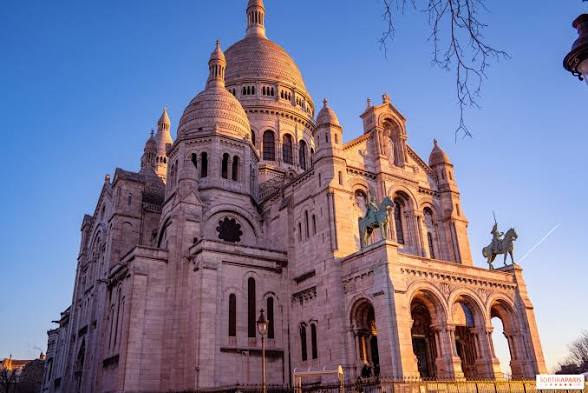
Sacré-Cœur occupies an unusual place in the imagination of Paris. Its white domes are immediately recognisable, yet the familiarity of the silhouette can obscure the complexity of the building beneath it. Above Montmartre’s streets, the basilica brings together religious devotion, nineteenth-century political conflict and an architecture designed to make belief visible across a city. Its position gives it an extraordinary authority over the skyline; its history makes that authority a matter for examination.
There is also a more intimate way to encounter it. Visitors who register for a night of Eucharistic adoration can sleep in the adjacent guesthouse, undertaking an hour of prayer inside the basilica during the night. The arrangement opens a different perspective on a monument usually experienced through crowds, photographs and panoramic views. To understand its significance, however, requires looking beyond the appealing prospect of a bed above Paris.
A National Vow in a Divided France
The origins of Sacré-Cœur lie in the crisis of the Franco-Prussian War. In December 1870, the Catholic layman Alexandre Legentil proposed the construction of a Parisian church dedicated to the Sacred Heart of Jesus. Joined by Hubert Rohault de Fleury, he developed the undertaking into a national vow: a religious response to military defeat and to what its supporters understood as France’s moral and spiritual failures.
This chronology matters. The proposal preceded the Paris Commune, which lasted from March to May 1871. The frequently repeated claim that Sacré-Cœur was originally conceived to punish the Communards therefore compresses distinct events into a misleading account. Its first impulse emerged from wartime catastrophe, expressed through the Catholic language of penitence, hope and national regeneration.
The project nevertheless acquired its public authority in the political aftermath of the Commune. In 1873, the National Assembly declared the proposed church a work of public utility. A devotional undertaking became a national construction project at a moment when the meaning of France itself was fiercely contested.
The Politics of the Hill
Montmartre gave that contest a particularly charged setting. The hill was associated with important events in the Commune, and the appearance of a monumental Catholic sanctuary above it could carry meanings far beyond worship. For republican opponents, the project embodied the influence of conservative Catholicism and the ambitions of monarchist restoration.
In his 1979 study Monument and Myth, the geographer David Harvey examined Sacré-Cœur as a political intervention in urban space. His account traces the support the project received from ultraconservative and monarchist circles, alongside efforts by republican Paris to prevent its completion. The basilica’s visibility was integral to this struggle: a building placed above the city could make a particular interpretation of national history seem permanent.
The founding vow and the subsequent political symbolism should therefore be considered together. The project’s existence before the Commune establishes its origins; the circumstances of its authorisation and construction explain why it became so contentious. Reading its history through both perspectives allows us to take religious conviction seriously while examining the power exercised in its name.
An Architecture of Monumental Presence
Paul Abadie won the architectural competition in 1874, and the foundation stone was laid in June 1875. The basilica was consecrated on 16 October 1919, after a prolonged building campaign supported by donations.
Its Romano-Byzantine vocabulary draws on rounded arches, domes and the mass of Romanesque architecture. Abadie’s work on the domed cathedral of Saint-Front at Périgueux provided an important precedent. At Montmartre, these historical references were assembled into a conspicuously nineteenth-century project: an architecture that sought authority through an imagined continuity with earlier Christian civilisation.
The exterior’s pale limestone contributes strongly to that impression. Often called Château-Landon stone, the material whitens where rain washes over it. Yet the apparent ease of the basilica’s presence conceals substantial engineering. Eighty-three deep foundation shafts were required to establish its stability on the hill.
The building can consequently be read at two scales. From across Paris, its clustered domes compose a distant emblem; at close range, its weight, arches and surfaces establish a more physical encounter. The movement between these scales is central to its effect. A sanctuary intended for individual prayer also announces itself to an entire city.
Gold, Devotion and the Image of France
Inside, the great apse mosaic brings the basilica’s religious and national themes into a single visual field. Inaugurated in 1923, it covers approximately 475 square metres. Its central Christ, dressed in white with arms extended and a radiant golden heart, gives visible form to the dedication of the church.
The surrounding figures connect universal Catholic history with a specifically French devotional narrative. Saints, popes and representatives of the wider world appear alongside French saints and episodes associated with national vows to the Sacred Heart. At Christ’s feet, France is personified as a woman offering her crown.
Read as a visual argument, the composition presents a relationship between spiritual authority and collective identity. France appears within a sacred order, its history gathered into an act of offering. The mosaic makes explicit what the exterior communicates more indirectly: the basilica’s religious purpose was imagined in relation to the fate of a nation.
Its scale also shapes the experience of looking. The figure of Christ commands the architectural space, while the surrounding groups invite a slower examination of detail. The visitor encounters both the immediate force of the image and the historical programme through which that force is organised.
The Prayer That Continues After Closing
Sacré-Cœur’s daily life gives another dimension to its monumentality. Eucharistic adoration began on 1 August 1885, while construction was still underway. According to the basilica, it has continued without interruption since then, including through the world wars and the pandemic.
In Catholic belief, the consecrated host is the real presence of Christ. Adoration consists of prayer before the Blessed Sacrament, which is exposed in the basilica’s choir. This theological understanding explains why the nightly vigil has a purpose beyond keeping a church occupied.
The continuity depends on a succession of people giving their time. Each participant assumes responsibility for a portion of the night, allowing the prayer to pass from one person to the next. There is something striking about this relationship between an enormous building and a modest human commitment. Stone can establish a monument’s durability; repeated acts of attention sustain its religious life.
For a reader outside the faith, this remains a revealing distinction. A historic church may be approached as architecture or cultural inheritance, while its worshippers understand it as a place of encounter. Sacré-Cœur accommodates these overlapping perceptions, although the night of adoration belongs specifically to its devotional practice.
Spending the Night at Sacré-Cœur
The basilica’s nuit d’adoration allows registered participants to stay in its guesthouse and undertake at least one hour of silent prayer during the night. The sleeping accommodation is separate from the church. Guests choose their prayer hour on arrival, in coordination with the staff responsible for maintaining the continuous vigil.
There is an accommodation contribution, with breakfast included. The published rates, checked in October 2026, are:
| Accommodation | Contribution per person |
| Dormitory space | €15 |
| Single room with washbasin and shower | €40 |
| Single room with washbasin, shower and private toilet | €45 |
Arrival is between 20:30 and 21:30 at 35, rue du Chevalier de la Barre; accommodation must be vacated by 09:00. Book at least 48 hours ahead to satisfy the longer notice requested on the general registration page, and obtain confirmation. Registration is available by telephone on +33 1 53 41 89 00 or through the basilica’s contact form. The arrangement is limited to one night per week, and Monday to Wednesday generally offer better availability than weekends.
Participation entails a religious commitment. Its appeal lies in entering the life of the sanctuary and accepting responsibility for an hour within it.
Encountering a Living Monument
Sacré-Cœur demands a form of attention capable of holding several histories together. Its architecture belongs to the ambitions of nineteenth-century religious revival; its political associations expose divisions over revolution, nationhood and public space; its continuing worship gives it a present tense that heritage alone cannot explain.
The Ministry of Culture’s announcement of historic-monument protection in December 2022 explicitly recognised the complexity of its history. Preservation allows such a building to remain available for scrutiny as well as admiration. Architectural significance does not require agreement with every political meaning attached to it.
A night at Sacré-Cœur offers a particularly intimate approach to these questions. The participant enters a building shaped by public conflict and spends an hour within a practice sustained by individual devotion. To remain there after the daytime visitors have departed is to encounter the basilica through a different measure of time: the duration of a vigil, the passage of responsibility between strangers, and the continuing use of a monument whose meanings are still being made.
Sources / Read More
- Basilique du Sacré-Cœur de Montmartre: History and the national vow, and historical timeline. These establish the project’s origins before the Commune and its subsequent construction.
- David Harvey: “Monument and Myth”, Annals of the Association of American Geographers, 69, no. 3 (1979), pp. 362–381. A study of the basilica’s contested political symbolism.
- Ville de Paris: Sacré-Cœur’s architecture, materials and construction.
- Basilique du Sacré-Cœur: The choir mosaic, Eucharistic adoration and its continuity since 1885.
- Basilique du Sacré-Cœur: Night of adoration: accommodation and registration and general booking conditions. Current prices, arrival times and participation requirements.
- Ministère de la Culture: Historic-monument protection for Sacré-Cœur and Square Louise-Michel, 9 December 2022.
Discover more from My World of Interiors
Subscribe to get the latest posts sent to your email.

