
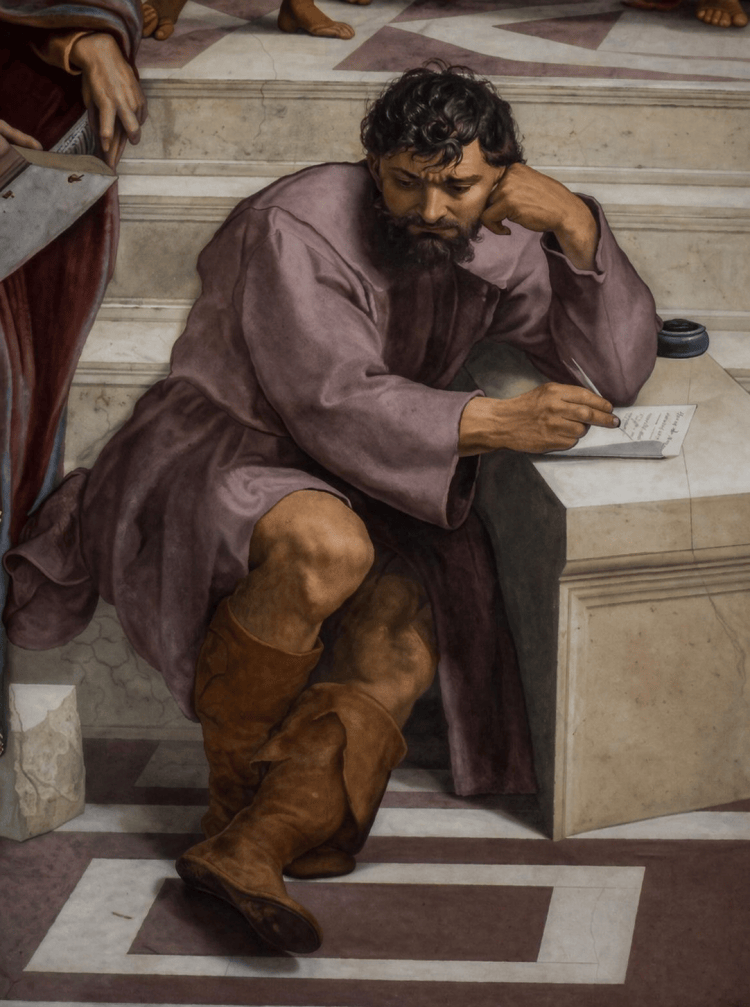
He wrote one book, deposited it in the temple of Artemis at Ephesus, and walked into the mountains. What survives of the book is approximately a hundred and thirty fragments — sentences, half-sentences, paradoxes, riddles — that have been puzzling serious readers for two and a half thousand years. He is the most difficult and the most electrifying philosopher in the ancient world, and he understood the nature of reality with a precision that most subsequent philosophy has been trying, and failing, to improve upon.
By Bergotte
He was called the Obscure. He was called the Riddler. He was called the Weeping Philosopher, in contrast to Democritus the Laughing Philosopher, as though the two between them had divided the appropriate responses to the human condition and each had taken his half. These epithets tell you something about the quality of the encounter his work produced in those who read him — the specific frustration and the specific illumination of a text that gives you the feeling of being on the verge of understanding something enormous, a feeling that does not entirely resolve into the understanding itself but that does not quite go away either.
Heraclitus of Ephesus was born sometime around 540 BCE, in a city on the coast of what is now Turkey, in the intellectual ferment of the pre-Socratic tradition — the period before Socrates reorganised Greek philosophy around the question of how to live and toward the question of what exists. He came from a noble family and reportedly renounced his hereditary kingship to his brother, preferring the examined poverty of the philosopher to the administered wealth of the aristocrat. He was contemptuous of his contemporaries — of Hesiod and Pythagoras and Xenophanes, whom he names specifically, accusing them of learning much without understanding anything — and of the Ephesian people, whom he thought insufficiently serious about the things that mattered.
He went, toward the end of his life, into the mountains. He ate plants and grass. He developed dropsy and returned to the city and asked the doctors, in a riddle — can you turn a flood into a drought? — whether they could cure him. They could not answer the riddle. He tried to cure himself by burying himself in dung, on the theory that the heat would draw out the excess moisture. It did not work. He died, around 480 BCE, either of the dropsy or of the treatment.
The biography is partly legendary and probably unreliable in its details, and Heraclitus would not have cared. He was not interested in his own life as a story to be transmitted. He was interested in the logos — the principle, the account, the rational structure that runs through all things — and the logos was what he wanted the reader to attend to, not the person who had understood it.
The Logos: The Word That Is the World
The opening of Heraclitus’s book — reconstructed, with some confidence, from the fragments — announced its subject with a directness unusual even by the standards of Greek philosophical prose:
“Although this logos is always, humans are uncomprehending, both before they hear it and once they have heard it. Although everything happens in accordance with this logos, they are like those without experience when they experience the things and the words I set out, as I distinguish each thing according to its nature and show what it is. Other people are unaware of what they do when they are awake, just as they forget what they do when asleep.”
The logos — the Greek word that means, variously, word, reason, account, proportion, principle — is the central concept of Heraclitian philosophy and one of the most influential and most contested concepts in the history of Western thought. It was absorbed into the Gospel of John, which opens with the declaration “In the beginning was the logos, and the logos was with God, and the logos was God.” It was taken up by the Stoics as the rational principle that organises the universe. It reappears, transformed but recognisable, in Hegel’s concept of Reason as the moving principle of history, in Heidegger’s account of language as the house of Being, in the various twentieth-century attempts to identify the deep structure of reality beneath its surface appearances.
What Heraclitus means by the logos is not entirely clear — which is to say that it is clear enough to be generative and ambiguous enough to be inexhaustible. The logos is the rational principle that runs through all things — the account of reality that is also, in some sense, reality’s own self-account, the way things are when understood at the deepest level available. It is not a personal God — Heraclitus is explicit that the logos is not what most people mean by Zeus, though it is divine in the sense of being the highest principle. It is not merely human reason — it transcends any individual’s understanding, and the failure to understand it is the fundamental human problem. It is the structure of things — the principle of their organisation, the account that makes the diversity of phenomena into a cosmos rather than a chaos.
The opening fragment’s accusation — humans are uncomprehending — is not a condescending remark about other people’s stupidity. It is a philosophical claim about the condition of ordinary human consciousness. We go through the world taking it for granted — understanding things in terms of the categories that practical life requires, attending to the particular and the immediate, missing the pattern that runs through everything. We are like sleepwalkers, Heraclitus says — present in the world but not genuinely awake to it, experiencing without comprehending, moving through the logos without seeing it.
The River and the Fire: The World in Motion
The fragment that everyone knows, whether they know they know it, is: “You cannot step into the same river twice.” The version usually quoted is actually a paraphrase by Plato — the original Heraclitean formulation is stranger and more precise: “On those who step into the same rivers, different and again different waters flow.” And there is another fragment, from a different source, that goes further: “We step and do not step into the same rivers; we are and we are not.”
The point seems simple: the river changes constantly, new water always flowing, so the river you step into a second time is not, in the most literal sense, the same river you stepped into the first time. This is true. But it is not all that Heraclitus is saying. He is also saying something about the stepper — about the “we” that steps and does not step. The river changes, and we change, and the identity we attribute to both — this river, this person — is not the fixed, substantial identity we assume it to be. It is a pattern maintained through change, a unity achieved through the constant movement of its parts, a form that persists precisely because it does not remain static.
This is the most radical claim in ancient philosophy, and it has not been adequately absorbed by most of the philosophy that followed it. The world is not primarily constituted by stable things with accidental properties that happen to change. The world is primarily constituted by change, and the stable things are — as Heraclitus’s contemporary Parmenides could not accept and built his entire system to deny — the relatively stable patterns that the ongoing change produces and sustains. The river is not a container through which water flows. The river is the flowing.
Fire is Heraclitus’s preferred image for this — the element that most visibly demonstrates the principle. Fire is pure process: it has no fixed substance, it is constituted entirely by the consuming of fuel and the production of light and heat, it is the activity rather than the thing. The world, for Heraclitus, is fire in this sense: “This cosmos, the same for all, no one of gods or humans has made, but it was always and is and will be an ever-living fire, kindling in measures and going out in measures.”
The fire that is the cosmos is not a literal fire, though Heraclitus was probably not using it purely as a metaphor either — his cosmology is not cleanly separable from his physics in the way that later philosophical systems try to separate the two. The fire is the image of the logos made material: the principle of constant transformation, the unity that is achieved through and not despite the constant change of all things.
The Unity of Opposites
The fragment that most directly states the Heraclitean insight into the structure of reality is one of the most philosophically productive sentences ever written: “The road up and the road down are one and the same.”
The obvious reading — that the road going up a hill and the road going down the same hill are the same physical road, traversed in different directions — is correct and also insufficient. Heraclitus is making a more general claim: that what appear to be opposites are, at the level of genuine understanding, aspects of the same thing, and that the opposition between them is not a final fact about reality but a perspective produced by attending to each in isolation.
He multiplies the examples: Day and night are one. Hot and cold are one. Living and dead are one: “Immortals are mortal, mortals immortal, living each other’s death, dying each other’s life.” The bow and the lyre, whose function depends on the tension of the string, are images of the unity of opposites: the bow exists to kill, the lyre to make music, but both are constituted by the same structure, the tension between the pulled string and the bent wood, the opposition that is also a unity. “They do not understand how, while differing with itself, it agrees with itself: a back-turning connection like that of a bow or a lyre.”
The concept of the unity of opposites is not merely a logical curiosity or a verbal trick. It is the ontological claim that the things that appear most fundamentally opposed — being and non-being, identity and difference, rest and motion — are not separately real but are aspects of a deeper unity that produces them through their opposition. Without cold there is no hot; without death there is no life; without the descending road there is no ascending one. The opposites require each other, generate each other, are constituted by their mutual opposition, and the unity that contains them is not a synthesis that eliminates the opposition but the tension that sustains it.
Hegel read this and built his entire dialectic — the movement of thesis through antithesis to synthesis — on its foundation, though he systematised it in ways that Heraclitus, who distrusted systematic thinkers, would probably have considered a betrayal of the original insight. The insight does not require the systematic apparatus. It can be stated in a fragment and experienced in the specific quality of attention it produces: the moment when you see that what you had taken for two things is one thing seen from two angles, that the apparent contradiction is the condition of the apparent coherence, that the opposition is the unity.
War Is the Father of All
“War is the father of all and king of all, and some he shows as gods, others as humans; some he makes slaves, others free.”
This is the fragment that has most often been used to make Heraclitus into a proto-fascist or a philosopher of domination, and the reading is wrong in ways that matter. Heraclitus is not celebrating war in the sense of military conflict, not advocating violence, not saying that the strong have the right to subjugate the weak. He is making the philosophical claim that follows directly from the unity of opposites: that strife — the conflict between opposing forces — is not an aberration in an otherwise harmonious world but the generative principle of the world’s existence.
Without the conflict between opposites there is nothing. The logos operates through opposition — through the tension of the lyre string, the clash of fire and water, the interplay of day and night, the competition of hot and cold. The world is not the resolution of conflict into harmony. It is the ongoing conflict that produces the appearance of harmony — the dynamic equilibrium of opposing forces that is the only kind of stability actually available in a world constituted by constant change.
The hidden harmony is better than the obvious harmony — another fragment. The harmony that is achieved through the resolution of opposition, through the elimination of tension, through the forcing of things into a false agreement — this is not genuine harmony. It is the suppression of the logos, the imposition of a false stillness on a world that is constituted by motion. The genuine harmony is the one that sustains the opposition — that holds the tension without releasing it into the false resolution that would destroy the dynamic that the tension generates.
This has consequences for the question of who we are that Heraclitus draws explicitly: “You would not find the limits of the soul by travelling in any direction, so deep is its logos.” The soul — the self — is not a fixed, bounded, self-identical thing. It is, like the river, a pattern maintained through change; like the fire, a process rather than a substance; like the cosmos itself, a unity achieved through and not despite the constant opposition of forces within it. The self is not what it seems when observed from the outside or felt from within the comfortable certainties of the unexamined life. It is something deeper, more various, more constituted by its own internal contradictions than the surface of consciousness reveals.
The Sleeping and the Waking: The Epistemology of Attention
Heraclitus returns repeatedly to the distinction between sleeping and waking, between those who are genuinely awake to the logos and those who move through the world in the dream of ordinary consciousness. But his account of what genuine waking consists of is not the rationalism of a later tradition — not the application of logical method, not the construction of a system, not the patient deduction of truth from first principles.
The waking that Heraclitus values is something more like what we would call attention — the specific quality of presence to the world that allows the logos to be perceived in the things it runs through. “The things of which there is sight, hearing, understanding, these I value most” — the philosopher values the senses, the direct encounter with the world, the testimony of experience. But experience alone is insufficient: “Eyes and ears are poor witnesses for those with barbarian souls” — those who cannot receive the logos that the senses transmit, who perceive without comprehending.
The quality of attention he is describing is something between perception and reason — not the brute registering of sensory data and not the abstract manipulation of concepts, but the specific activity of the mind that is genuinely open to the world, that perceives the logos in the things the senses present, that follows the connections between apparently separate phenomena to the unity that underlies them. It is the quality of attention that the physician brings to symptoms, the navigator to winds and currents, the poet to the specific textures of experience that carry more than their surface reveals.
He is harsh about those who substitute learning for understanding: “Much learning does not teach intelligence; otherwise it would have taught Hesiod and Pythagoras, and again Xenophanes and Hecataeus.” The accumulation of information — the knowing of many things — is not the same as the understanding of the logos. It can even, by providing the comfort of apparent knowledge, substitute for it. The person who knows many facts about the world may be less genuinely awake to it than the person who knows fewer facts and attends to them more carefully.
This has a sharpness that cuts across the entire subsequent history of academic philosophy, with its systems and its commentaries and its careful accumulation of positions and objections. Heraclitus would have been bored by most of it. He was interested in the logos, and the logos was not a problem to be solved by the accumulation of scholarly apparatus but a reality to be attended to in the things of which there is sight, hearing, understanding.
The God That Is Not God
Heraclitus’s divinity is one of the strangest in ancient thought — strange because it is simultaneously more and less than the divinity of the Greek religious tradition. “The one thing, the only truly wise thing, is unwilling and willing to be called by the name of Zeus.”
The logos, which is what Heraclitus means by the divine, is not a personal being — not a being with intentions and preferences and the capacity for intervention in human affairs that the Olympian gods possessed. It is the rational principle that runs through all things — the account that everything gives of itself when attended to with sufficient care. It is divine in the sense of being the highest principle, the one thing genuinely worthy of the reverence that most people distribute among the gods of the popular tradition. And it is not divine in the sense that the popular tradition requires — it does not hear prayers, does not respond to sacrifice, does not care about human affairs in the way that Zeus and Apollo and Athena were said to care.
This puts Heraclitus in the tradition — if it can be called a tradition, given how isolated he seems — of the philosopher who takes divinity seriously as a philosophical concept while rejecting the anthropomorphic deities of the popular religion. He was not an atheist. He thought the divine was real and important and that most people’s relationship to it was not genuine reverence but superstition — the performance of rituals that did not engage with what was actually divine. “They purify themselves by staining themselves with blood, as if one who stepped into mud were to wash with mud. And they pray to statues, as if one were to converse with houses, not understanding the nature of gods and heroes.”
The critique is not of religion as such but of the specific failure of attention that produces religion without genuine understanding — the performance of the forms of reverence without the quality of attention that genuine reverence requires. The logos is what deserves genuine reverence, and genuine reverence consists not in sacrifice and prayer but in the kind of attentive, serious, persistent engagement with the world that allows the logos to be perceived in it.
Who We Are According to Heraclitus
We are patterns in the flow. Not things — not fixed, bounded, self-identical entities with stable properties that persist through time. Patterns: relatively stable configurations of the ongoing process of change, the way a flame is a relatively stable configuration of the burning, the way a river is a relatively stable configuration of the flowing. Real, specific, irreplaceable as patterns — but constituted by the change rather than despite it.
We are the beings for whom the logos is available but not automatic — the beings who can attend to the principle that runs through all things and can, by attending to it, achieve the specific quality of understanding that constitutes genuine waking, genuine life, in contrast to the sleepwalking of the unattended existence. We can be awake to the logos or we can be asleep in the dream of our private certainties. Most of us, most of the time, are asleep.
We are constituted by opposition — by the tension between the forces within us, the conflict between what we are and what we might be, the opposition between our private understanding and the logos that exceeds it. The unity of the self is not achieved by resolving these tensions but by sustaining them — by the kind of attention that holds the opposition without forcing it into a false resolution. The self that has eliminated its internal conflicts has not achieved peace. It has achieved the stillness of the fire that has gone out.
We are at our best when we attend — when we bring to the world the quality of presence that allows the logos to be perceived in the things of which there is sight, hearing, understanding. When we follow the connections between apparently separate things to the unity beneath them. When we resist the comfort of the obvious harmony and search for the hidden harmony that is better. When we remember that the road up and the road down are the same road, and that the war that looks like chaos is the father of all the order we can see.
The river flows. We step into it and we do not step into it. We are and we are not. The logos runs through the river and through us and through the stepping and the not-stepping, through the waking and the sleeping, through the living and the dying that is also living. We will not find the limits of the soul by travelling in any direction, so deep is its logos.
He walked into the mountains with this knowledge. He buried himself in dung and waited for the warmth to do what warmth does. The warmth did not. The logos continued.
The fragments of Heraclitus are most accessibly collected in T.M. Robinson’s Heraclitus: Fragments (University of Toronto Press), which provides the Greek text with translation and commentary. Charles Kahn’s The Art and Thought of Heraclitus (Cambridge University Press) is the most philosophically rigorous full study and is also the most rewarding to read. For the pre-Socratic tradition more broadly, Jonathan Barnes’s The Presocratic Philosophers (Routledge) is comprehensive and sharp. G.S. Kirk’s Heraclitus: The Cosmic Fragments (Cambridge University Press) is the standard scholarly edition of the cosmological fragments. For a sense of how Heraclitus was read and transmitted in antiquity, the relevant sections of Diogenes Laërtius’s Lives of the Eminent Philosophers (Loeb Classical Library) are entertaining if not always reliable.
Discover more from My World of Interiors
Subscribe to get the latest posts sent to your email.

