By Bergotte
Chris Marker made films about memory the way a philosopher makes arguments — with total rigour and total freedom simultaneously, following thought wherever it led without the obligation to arrive anywhere comfortable. He is the most intellectually radical filmmaker in the history of the medium and also, paradoxically, one of the most personal, because in Marker’s cinema the life of the mind is not separate from the life of the emotions but the same life, felt at the same temperature, and the films that result are unlike anything else in cinema: essays in the oldest sense of the word, attempts, trials, explorations conducted in images and words and music that circle the things that matter most — what memory is, what images are, what we lose when we lose the past, whether cinema can be a form of thought — and never pretend to have resolved them. He is the filmmaker who took cinema furthest into the territory of pure consciousness, and the territory he found there is one that no other art form can map in quite the same way.
Chris Marker was born in 1921 — he claimed various birthplaces and birth names across his life, and the mystery was deliberate, a characteristically Markerian insistence that the biography was beside the point — and he died in 2012, on his ninety-first birthday, having spent six decades making films and multimedia works and CD-ROMs and installations and writings that together constitute one of the strangest and most important bodies of work in twentieth-century art. He was a novelist and a traveller and a political activist and a photographer and eventually a presence in online virtual worlds, and all of these things fed into the films, which are always the product of a mind that refuses the boundaries between disciplines the way other filmmakers refuse the boundaries between documentary and fiction.
He is closest, as a sensibility, to the great essayists — Montaigne, whose whole project was the examination of a single consciousness in contact with the world; Barthes, whose Camera Lucida, the most important book ever written about photography, is in some ways a prose version of what Marker was doing in film; Benjamin, whose unfinished Arcades Project — a vast, fragmentary meditation on memory and modernity assembled from quotations and observations — is the literary equivalent of Sans Soleil. But the comparison that matters most is with Varda, his contemporary and friend, because the two of them together invented the essay film as a serious cinematic form, and the contrast between them is as illuminating as the connection. Varda’s essays are warm, embodied, rooted in the specific gravity of specific places and people. Marker’s are cooler, more restless, more willing to follow a thought into abstraction and leave you there. Both are necessary. Both are, in their different ways, irreplaceable.
La Jetée and the photograph that moves
La Jetée, made in 1962 and running to twenty-eight minutes, is the film that most people encounter first when they come to Marker, and it remains the most complete statement in miniature of everything his cinema is about. It tells the story of a man in a post-apocalyptic Paris who is sent back in time by scientists conducting experiments in memory, and who becomes obsessed with an image from his childhood — a woman’s face on a pier at Orly airport, glimpsed just before a catastrophe he did not understand. The story is told almost entirely in still photographs, black and white, with a narrator’s voice reading over them, and there is one moment — one single moment, brief and shocking — in which the photographs give way to moving image, in which the woman’s face in the memory becomes alive, and she blinks, and the movement is so unexpected and so overwhelming that it produces, every time, something close to the experience of falling.
This moment is the film’s argument and its method simultaneously. Marker is asking what the difference is between a photograph and a film — between a frozen image and a moving one, between memory as a static thing and memory as something that lives. And the answer the film gives, in that single blink, is that the difference is everything and nothing: that memory presents itself to us as a series of still images, significant moments frozen in time, and that what we want from those images — what we are always reaching toward — is for them to move, for the dead to live again, for the past to become present. The blink is the moment when that happens, and it lasts about two seconds, and it is among the most devastating things in cinema.
La Jetée is also, underneath its science fiction framework, a film about the relationship between image and loss — about the way images preserve what is gone while insisting on its goneness, the way a photograph of a dead person is simultaneously a presence and an absence, a comfort and a wound. This is the territory that Marker would explore across his entire career, in films of increasingly ambitious scale and complexity, and La Jetée remains the purest distillation of it: twenty-eight minutes that contain, in concentrated form, the argument that Sans Soleil would spend two hours elaborating.
Sans Soleil and the impossibility of memory
Sans Soleil, made in 1983, is Marker’s masterwork and one of the strangest, most beautiful, most intellectually demanding films ever made. It takes the form of letters written by a fictional cameraman named Sandor Krasna to an unnamed woman, read in voiceover by a female narrator, intercut with images from Japan and Guinea-Bissau and Iceland and San Francisco and the editing suite of a video artist named Hayao Yamaneko who processes images through a synthesiser he calls the Zone. The film has no plot in any conventional sense. It has instead a series of preoccupations — memory, time, the nature of the image, the relationship between happiness and unhappiness, the gap between what we see and what we remember — that it circles in the way that thought actually circles its obsessions: returning, approaching from different angles, never quite resolving.
The film opens with a shot of three children on a road in Iceland, 1965 — an image of happiness so complete that the narrator tells us Krasna could only link it to another image, or to nothing at all. The Iceland footage was later destroyed in a volcanic eruption, and the film is, in part, about what happens to images when the reality they recorded no longer exists — about the relationship between the archive and the world it claims to preserve. But it is also about Japan, which Marker had been visiting for decades and which becomes in the film a meditation on a particular kind of modernity: the modernity of a society that has absorbed the Western twentieth century while remaining entirely itself, that has made technology into a form of ritual and consumerism into a kind of poetry.
The Japanese sequences of Sans Soleil are among the most extraordinary in Marker’s work — shot with the attentiveness of a photographer who knows that the decisive moment is always slightly elsewhere than you expect it, finding meaning in the ceremonies for broken dolls and the sleeping commuters and the cat shrines of Tokyo and the video games in the arcades and the television studio audiences weeping on command. Marker watches Japan with a love that is never touristic, never condescending, never the love of the exotic — it is the love of someone who has understood that this place is thinking about the same problems he is thinking about, in a different language and a different register, and that the difference is part of the point.
The Guinea-Bissau sequences are less celebrated and equally essential. They were shot during and after the country’s independence struggle, and they are the most politically direct material in the film — images of a revolution and its aftermath, the gap between the promise of liberation and the reality of what liberation produces. Marker had been a committed left-wing activist throughout his career, and Sans Soleil is in part a reckoning with what the twentieth century had done to the political hopes of his generation — a film made by someone who had believed in the transforming power of collective action and had watched, over decades, as transformation failed to arrive, or arrived in forms that betrayed the belief. The film does not despair. It is too honest for despair, which is a form of resolution. It holds the contradiction open.
The voice and the image
The voiceover in Sans Soleil — and in almost all of Marker’s films — is not commentary. This distinction is crucial and easily missed. A conventional documentary voiceover explains the images, tells you what you are seeing, provides context and interpretation. Marker’s voiceover is in a different relationship with the image entirely: it is a mind thinking alongside what is shown, sometimes contradicting it, sometimes following it somewhere the image did not anticipate, sometimes abandoning it entirely to pursue a thought that the image has triggered but cannot contain. The images and the words are not redundant with each other — they create, between them, a third thing that neither alone could produce.
This is Marker’s central formal contribution to cinema, and it is more radical than it might appear, because it requires a completely different kind of attention from the viewer than conventional cinema demands. You cannot simply watch a Marker film. You have to read it — have to hold the voiceover and the image in your mind simultaneously, be willing to follow a chain of association that may lead somewhere unexpected, tolerate the productive discomfort of not quite knowing where you are in relation to what you are being shown. This tolerance is, in Marker’s cinema, itself the argument: that the right relationship between a mind and an image is not one of passive reception but of active engagement, of thinking along with rather than being told.
The narrator’s voice in Sans Soleil — Alexandra Stewart reading the fictional letters in the French version, a woman whose name is never given — is one of the most important sounds in cinema. It is warm without being sentimental, intelligent without being cold, and it carries the film’s emotional register in ways that no image could do alone. The relationship between voice and image in Marker is always a relationship between two kinds of knowledge — the knowledge that images provide, which is immediate and physical and pre-conceptual, and the knowledge that language provides, which is retrospective and interpretive and always slightly too late. The gap between them is where the film lives.
The political filmmaker
To discuss Marker without discussing his politics is to discuss only half of him, and even the political half requires careful framing because his relationship with politics — with the left, with revolution, with the possibility of collective transformation — evolved over decades in ways that are themselves part of the argument his films make.
A Grin Without a Cat, made in 1977 and running to nearly three hours, is the most sustained of his explicitly political works: a history of the revolutionary left from 1967 to 1977, assembled from archive footage and interviews and new material into a meditation on what the decade of upheaval had meant and what it had left behind. The film is named for the Cheshire Cat in Alice in Wonderland, and the title captures something essential about what Marker is doing: he is looking at a smile that has persisted after the thing that produced it has vanished, trying to understand what the smile means when the cat is gone. The film is not a lament. It is an analysis — rigorous, honest, unwilling to console — of why the hopes of a generation did not produce the world those hopes imagined.
The Last Bolshevik, made in 1993 in the aftermath of the Soviet collapse, continues this examination through a portrait of the Russian filmmaker Alexander Medvedkin, who made films for Stalin and somehow retained, across decades of Soviet compromise and absurdity, a genuine revolutionary faith. The film is a documentary about Medvedkin and also a meditation on what it means to believe in something that history has refuted — on whether faith can survive the evidence against it, and what it costs to maintain it. Marker’s treatment of Medvedkin is tender and clear-eyed simultaneously, refusing both the condescension of the anti-Communist and the nostalgia of the true believer. It is the most humanely political film he ever made.
The cat and the owl
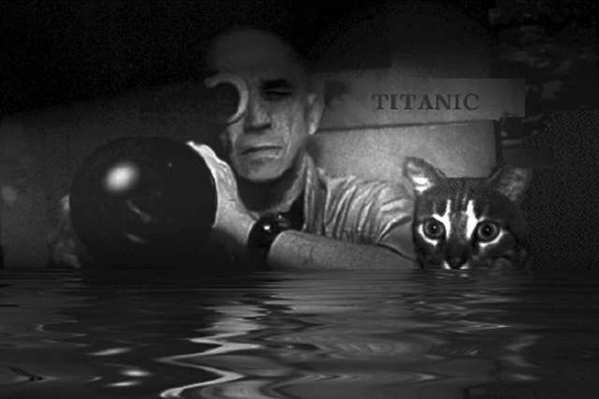
There is a quality in Marker’s work that resists the purely intellectual account of it, and that quality has something to do with cats. He loved cats with an enthusiasm that appeared in his films, his writings, and his online presence with a consistency that was clearly more than affectation — more than the charming eccentricity of a serious man allowing himself a lightness. The cats in Marker are the same thing as the owls in his collaborator Varda’s work: a reminder that the world contains presences that do not participate in human meaning-making, that look at us with an attention that is real and complete and entirely indifferent to our interpretations. The cat in Marker watches, and its watching is the model for the filmmaker’s watching: patient, precise, without agenda, fully present.
This quality of attention — the cat’s attention, attending without agenda — is what gives Marker’s films their strange combination of intellectual rigour and emotional openness. He thinks very hard, and the thinking is visible in the films, and the visibility of thought is part of what makes them demanding. But the thought is always in the service of feeling, always aimed at the things that matter most — loss, time, the preservation of what passes — and the feeling is always grounded in the specific, the concrete, the image that cannot be generalised without being lost. He is the most abstract of the great filmmakers and the most personal simultaneously, and the coexistence is not a paradox but a demonstration: that the deepest thinking about the things that matter most always ends up being personal, because the things that matter most are always the things we are losing.
Level Five and the digital turn
In the 1990s, as the digital revolution transformed both the making and the distribution of images, Marker was among the first serious filmmakers to understand what the new tools meant — not as a technological convenience but as a philosophical problem. Level Five, made in 1997, is structured around a video game about the Battle of Okinawa, and its central character — a woman trying to complete the game that her dead lover left unfinished — becomes a figure for a particular kind of contemporary grief: the grief of someone trying to enter a world that exists only as data, trying to reach a person through the archive they left behind.
The film is, among other things, a meditation on what happens to memory in the digital age — on whether the infinite reproducibility and retrievability of digital images changes the nature of what they preserve, whether perfect recall is the same thing as memory or something different and possibly worse. Marker’s answer, characteristically, is not resolved: the film holds the question open, turns it from different angles, refuses the easy comfort of either technological optimism or technological despair. What it insists on is the same thing his entire career insists on: that the image is not the thing, that memory is not the past, that the gap between what we record and what we lose is permanent and irreducible and must be acknowledged rather than filled.
What Marker invented
The essay film that Marker and Varda built together — or rather built independently, in conversation, each taking it somewhere the other did not — is now one of the dominant forms of serious documentary filmmaking, and its influence on the broader culture of the moving image is incalculable. Every documentary that thinks on screen rather than simply recording, every film that uses voiceover as a form of thought rather than a form of explanation, every work that trusts the viewer to hold complexity and irresolution and the productive gap between image and word — all of these are working in territory that Marker opened up.
But the influence that is hardest to quantify and most important is the influence on what serious filmmaking understands itself to be for. Marker’s career is a sustained argument that cinema can be a form of philosophy — not philosophy illustrated by images, not philosophy made accessible through narrative, but philosophy conducted in and through the specific properties of the moving image, which can do things with time and memory and the relationship between presence and absence that no other medium can do. This argument, made over sixty years with extraordinary consistency and extraordinary variety, changed what filmmakers after him believed was possible.
The filmmakers who have acknowledged the debt range across every kind of cinema: Alain Resnais, his closest collaborator in the early years; Agnès Varda, his lifelong friend and conversation partner; the generation of essay filmmakers — Adam Curtis in Britain, Harun Farocki in Germany, Johan van der Keuken in the Netherlands — who took the form in directions Marker himself did not take it; and the countless contemporary filmmakers who use the essay structure without knowing exactly where it came from, the way people use a language without knowing its etymology.
The archive and the fire
There is a recurring image in Marker’s work — appearing in La Jetée, in Sans Soleil, in Level Five, in the late multimedia pieces — of an archive threatened by fire. The image is not metaphorical, or not only metaphorical: it refers to actual events, actual losses, actual collections of images and records that have been destroyed by time or violence or neglect. But it also refers to the condition of all images, which are always burning — always in the process of being lost to time, to forgetting, to the simple fact that the world they recorded no longer exists and will never exist again.
Marker’s response to this condition is the whole of his work. He is, at the deepest level, a filmmaker of preservation — not preservation in the archival sense of storage and retrieval, but preservation in the sense of attending to what is passing before it is gone, of looking at the world with enough care and enough intelligence that the looking itself becomes a form of keeping. This is not a comfortable response to loss. It does not pretend that the archive can replace the world, or that memory can replace the dead, or that images can restore what time takes away. It insists, instead, on the value of the attempt — on the dignity of attending, even in the knowledge that attention is not enough.
This is the argument that connects Marker to Varda and to Ray and to everything this cluster has been building toward: that the camera aimed with full intelligence and full love at the world as it is — at the overlooked, at the specific, at the passing — performs an act that is simultaneously aesthetic and ethical, simultaneously personal and political, simultaneously modest and enormous in its ambitions. None of them saved what they filmed. All of them changed how we see what remains.
Watch La Jetée first. Watch it twice. Let the blink do what it does to you and then ask what it means that a single moment of movement in twenty-eight minutes of still photographs can produce that effect — ask what the movement adds that the stillness withholds, and what the stillness gives that the movement cannot. Then watch Sans Soleil, and let it take the time it needs, and follow the voice wherever it leads, and do not worry about arriving anywhere. The arrival is not the point. The going is the point. That is what Marker spent sixty years trying to tell us, in the only language that could say it.
Sources and further reading
Chris Marker, Immemory (1997) — a CD-ROM work that is itself an essay on memory and images, essential for understanding the full range of his practice across media.
Catherine Lupton, Chris Marker: Memories of the Future (2004) — the most thorough critical study in English, rigorous and attentive to the full range of his work.
Raymond Bellour and Christine van Assche, eds., Passages de l’image (1990) — a catalogue essay that places Marker within the broader context of the relationship between cinema and the visual arts.
Roland Barthes, Camera Lucida (1980) — not about Marker, but the essential companion text: the book that asks, in prose, the same questions that Marker asks in film about the nature of the photographic image and its relationship to death and time.
For first-time viewers, the suggested order: La Jetée (1962) first — twenty-eight minutes, completely essential. Then Sans Soleil (1983), the masterwork. Then A Grin Without a Cat (1977) for the political dimension. The Last Bolshevik (1993) for those who want to follow him into the most personal political territory he explored. Level Five (1997) last — the most difficult and the most contemporary in its concerns, and the one that rewards most richly when you already know what it feels like to be inside a Marker film.

