
Late Fame (2026): The Poet and His Public
Director: Kent Jones
Screenplay: Samy Burch, based on Arthur Schnitzler’s novella
Cast: Willem Dafoe, Greta Lee, Edmund Donovan
Running time: 97 minutes
Country: United States
Rating: ★★★★½ — 4.5/5
Willem Dafoe makes the experience of being flattered look wonderfully complicated. As Ed Saxberger, a New York postal worker whose youthful literary career has faded into obscurity, he receives admiration with the wary pleasure of someone being addressed in a language he once spoke fluently. He has learnt to live without an audience, yet the prospect of acquiring one can still disturb the arrangements he has made with himself. Kent Jones’s Late Fame gives that disturbance its full emotional and intellectual weight. Funny, perceptive and often exquisitely moving, this is a film about the authority we grant other people to interpret our lives, and the difficulty of surrendering that authority once they have told us something we want to hear.
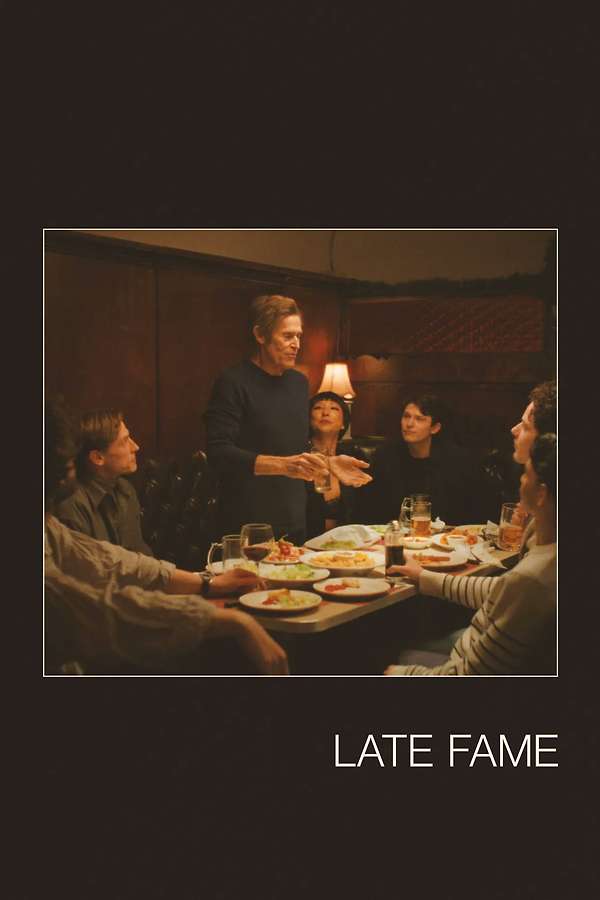
Ed published a poetry collection, Way Past Go, in the late 1970s. Decades later, an ardent young admirer, Meyers, played by Edmund Donovan, approaches him with the conviction that his work deserves rediscovery. Through Meyers, Ed enters the Enthusiasm Society, a gathering of aspiring writers whose devotion to literature includes considerable devotion to their own literary identities. They offer him an appreciative audience and a place within their ambitions. The actress Gloria, played with tremendous verve by Greta Lee, makes the invitation more enticing. Ed’s settled existence begins to accommodate an earlier version of himself, along with desires he had apparently ceased to entertain.
Samy Burch’s screenplay adapts Arthur Schnitzler’s novella, relocating its Viennese milieu to contemporary New York with an intelligence that extends well beyond updating the surroundings. The continuity between the two settings is itself revealing. The literary salon survives because it satisfies enduring social appetites: the wish to belong, the pleasure of shared enthusiasms, the promise of distinction and the reassurance of having one’s abilities recognised by the right people. Burch understands how easily these appetites mingle. Conversation can express a sincere love of art while also establishing a hierarchy, and admiration can become a means of securing a position within it. The film’s comedy grows from the participants’ limited awareness of their own motives.
The Society can usefully be read through Pierre Bourdieu’s account of the cultural field, in which artistic reputations develop through relationships among writers, critics, institutions and audiences. Meyers’s discovery gives him an opportunity to exercise cultural authority: he can identify a neglected writer and present himself as the person capable of correcting an injustice. Ed’s apparent obscurity becomes valuable to the group because it leaves his reputation available for their intervention. Their enthusiasm places them in a flattering relationship with literary history. Jones and Burch make this process entertainingly legible, while allowing for the uncomfortable possibility that sincere appreciation and personal ambition may be inseparable.
Dafoe is magnificent at conveying what such attention does to someone who has stopped expecting it. An actor so often associated with intensity brings remarkable delicacy to Ed’s susceptibility. His reserve makes the emergence of hope especially affecting; the performance allows us to appreciate both his intelligence and his willingness to cooperate with a flattering interpretation of himself. Ed can recognise the theatrical elements of the situation and still enjoy his part in it. Dafoe gives this contradiction a persuasive emotional life. The pleasure of his performance lies in watching a man renegotiate his sense of proportion, cautiously at first, as other people offer increasingly attractive terms.
The years Ed has spent working at the post office also give the film a valuable resistance to conventional accounts of artistic success. His employment, habits and established friendships constitute a substantial life, even if they sit awkwardly within the story his new admirers wish to tell. Their excitement encourages him to reassess those years through the lens of an interrupted vocation. That reassessment is moving because so many people retain an unfinished account of themselves: the work they might have pursued, the promise they might have fulfilled, the person they might have become. Late Fame takes those possibilities seriously while remaining attentive to the people and pleasures that have occupied the intervening time.
Greta Lee supplies a different, equally compelling form of self-invention. Gloria approaches life with theatrical assurance, drawing on a repertoire of glamour and emotional intensity that makes her a commanding presence. Lee gives her extravagance humour, intelligence and an underlying vulnerability. The performance is exhilarating because Gloria’s manner can accommodate several purposes at once: she can entertain, attract attention, conceal disappointment and assert a claim on the room. Her theatricality has the force of an achievement. She has fashioned a public personality through which her ambitions remain visible, even when the opportunities available to her are uncertain.
Gloria also makes the film’s gender politics harder to overlook. The Society readily assigns Ed the status of rediscovered genius, while her place within its orbit depends more ambiguously on charisma, allure and performance. This disparity invites a reading of the group as a miniature version of a familiar cultural arrangement, in which men receive intellectual authority and women undertake much of the work of sustaining its atmosphere. Lee’s presence complicates that arrangement. Gloria has aspirations of her own, and her cabaret rendition of Kurt Weill’s Surabaya Johnny gives those aspirations substance. Her ability to hold an audience makes the distinction between the group’s talk about art and the demands of actually performing it especially vivid.
The relationship between Ed and Gloria gives Late Fame much of its emotional richness. Their differences in age and manner create an absorbing uncertainty about what each recognises in the other. Ed is attracted to her vitality; she is drawn into the possibilities surrounding his renewed literary identity. There is affection here, alongside projection and the wish for a sympathetic witness. Jones gives these overlapping feelings room to develop. Dafoe’s inwardness and Lee’s expansive presence form a beautifully judged partnership, each performance making the other more revealing. Their connection suggests how intimacy can emerge through imperfect understanding, sustained by moments of attention whose value exceeds the explanations either person might give them.
Jones’s direction makes that attention cinematic. Working with cinematographer Wyatt Garfield, he gives conversations their interest through the movement between speakers, listeners and their surroundings. The rooms matter because belonging is negotiated within them: who receives attention, who feels at ease, who must establish a reason to remain. Ed’s literary acquaintances and his longstanding companions create different social environments, each with its own expectations. The film’s responsiveness to gesture and reaction allows those differences to register without turning every exchange into a declaration. Its considerable sophistication comes from the precision with which it observes people sharing space.
New York provides the wider setting for these negotiations. The city carries memories of artistic lives and communities that the younger characters know partly through their surviving reputations. Their enthusiasm therefore involves an imaginative relationship with a past they cannot recover. For Ed, that past is entangled with the ordinary experience of having lived through it. The distance between those perspectives gives the film a particularly affecting sense of time. A cultural scene that later acquires historical glamour was once made up of people finding work, meeting friends, forming attachments and trying to produce something. Jones preserves the human scale of that experience.
The treatment of poetry is similarly welcome. Ed’s invitation to write again exposes the distance between possessing an artistic identity and undertaking artistic work. Admiration can restore confidence, but it cannot supply the words. This gives the film a sharper understanding of creativity than many dramas about neglected talent, which treat public recognition as though it could complete the artist’s task. Here, the work retains its demands. The attention given to Ed’s poetry also leaves space for its personal origins, allowing language to reconnect with experience rather than serving solely as evidence in a debate about his reputation.
There are moments when the younger writers seem more fully realised as social types than as individual personalities. Their affectations make the satire immediately intelligible, although greater variation within the group might have given its collective enthusiasm more unpredictability. This is a modest limitation in a film whose central performances contain such an abundance of feeling. Jones’s humane curiosity sustains the comedy, and Burch’s screenplay gives vanity a recognisable place among the needs that bring people together. The film understands why its characters seek admiration, even when their methods expose them to embarrassment.
Late Fame is a beautifully accomplished film, distinguished by the quality of its performances and the seriousness with which it considers an apparently small episode in a man’s life. Its account of artistic recognition opens onto larger questions about ageing, friendship and the stories through which we make our years intelligible. Dafoe and Lee give those questions warmth, wit and an extraordinary emotional texture. Jones’s generosity allows the pleasures of attention to retain their force alongside its hazards, making a brief revival of hope feel worthy of sustained consideration. The result is an immensely rewarding work of cinema, alive to both the comedy of wanting to be admired and the dignity of wanting one’s life to have mattered.
Sources / Read More
- Film at Lincoln Center — Late Fame: synopsis, cast and adaptation
- The Black List — Kate Hagen’s interview with screenwriter Samy Burch
- RogerEbert.com — Isaac Feldberg’s interview with Kent Jones
- The Film Stage — Kent Jones on performance, cinematography and social spaces
- Sight and Sound — Jessica Kiang’s review
- New York Review Books — Arthur Schnitzler’s Late Fame
- Columbia University Press — Pierre Bourdieu’s The Field of Cultural Production
Discover more from My World of Interiors
Subscribe to get the latest posts sent to your email.

