

The Passenger is a weekly dispatch on travel — places, hotels, restaurants, the strange logistics of being elsewhere. It is written by Bergotte.
Chiang Mai in November, the ancient city of the Lanna kingdom, and the night the sky catches fire
Last week this column made the case for Bangkok — overwhelming, oceanic, inexhaustible. This week it makes the case for its opposite. Chiang Mai is everything Bangkok is not: human-scaled, mountain-ringed, quieter by several orders of magnitude, a city that invites the slow attention that the capital makes impossible. Where Bangkok is the future pressing itself against the present with tremendous force, Chiang Mai is a city still living comfortably inside its past — and in November, on a single extraordinary night, that past expresses itself in a way that no other event in Southeast Asia quite matches.
The city sits in a valley in northern Thailand, six hundred metres above sea level, surrounded by the forested mountains of the Doi Suthep range. It was founded in 1296 as the capital of the Lanna kingdom — Lanna meaning “a million rice fields” — and for the next two centuries functioned as one of the great centres of Theravada Buddhist culture in mainland Southeast Asia, producing a temple-building tradition, a literary heritage, and a cuisine that are distinctly its own and markedly different from the culture of the central plains and Bangkok. The old city, enclosed within its square moat and brick walls, still carries that heritage in its bones: more than three hundred temples within the municipal boundaries, the streets of the old quarter lined with teak shophouses and flowering trees, the pace unhurried in the specific way of places that have been worth visiting for seven centuries and know it.
November is the month to arrive. The cool season has settled: temperatures in the mid-twenties by day, occasionally cool enough at night to require a light layer, the mountain air clear and dry after the monsoon’s departure. The rice harvest is complete in the surrounding valleys. The hills are green. And on the night of the full moon — November 24th this year — the sky above the city does something that has to be seen to be understood.
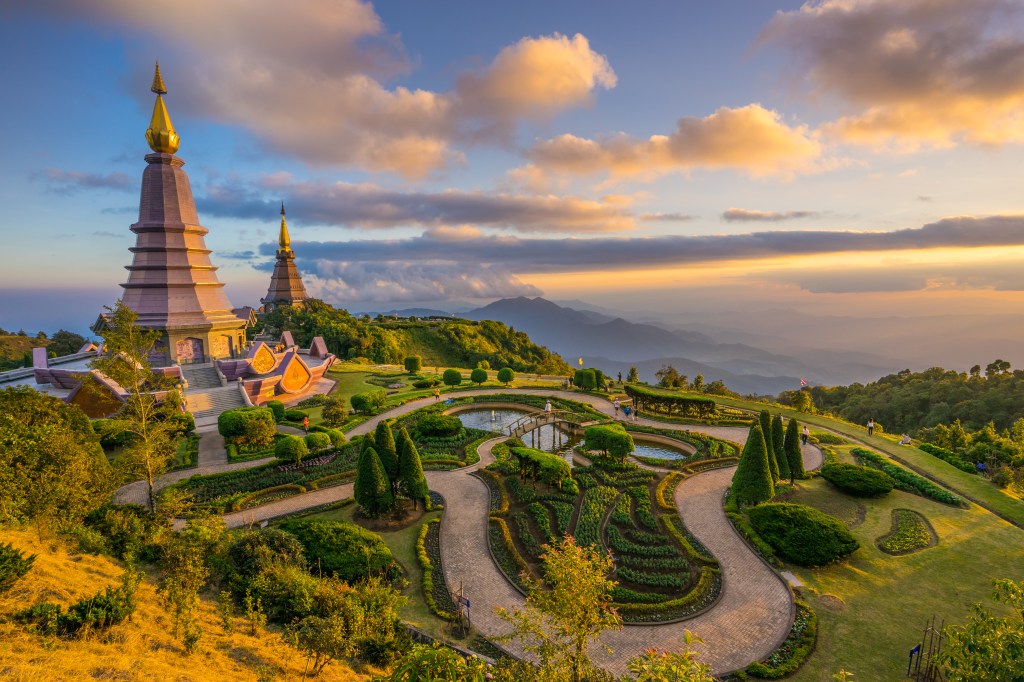
The old city and its temples
Chiang Mai’s old city is one of the better-preserved historic urban centres in Southeast Asia: a square kilometre enclosed by a moat and the remains of its original walls, navigable on foot, dense with temples that range from the nationally significant to the quietly local. The correct approach is not to treat it as a checklist but as a neighbourhood — to walk without agenda and allow the temples to appear as they do in the daily life of the city, matter-of-factly, between the coffee shops and the guesthouses and the family houses where monks’ saffron robes dry on lines in the inner courtyards.
That said, three demand attention.
Wat Phra Singh, in the western corner of the old city, is the most important temple in Chiang Mai — a complex of Lanna-style buildings around the Phra Singh Buddha image that is the city’s most venerated object. The assembly hall, the library, the chedis in their various states of ancient weathering: all of it constitutes the most coherent ensemble of Lanna religious architecture in the city, and in the early morning, when the monks are moving through their routines and the incense smoke is drifting across the courtyards, it has a quality of inhabited sacredness rather than performed heritage.
Wat Chedi Luang, a ten-minute walk to the east, is the site of the great ruined chedi — a 15th-century tower that was damaged by earthquake in 1545 and has been left in its partly-restored state, the upper sections still absent, the base rising enormously from the temple grounds in a way that communicates the ambition of the civilization that built it. On certain evenings, monks from the temple offer informal conversation sessions with visitors — the Monk Chat programme — which is one of the more genuinely unusual cultural exchanges available in the city, conducted without script or agenda on benches in the temple grounds.
Doi Suthep, the mountain temple fifteen kilometres above the city, is reached by a road that winds up through the forest and a 309-step naga staircase flanked by ceramic serpents. The temple itself — Wat Phra That Doi Suthep — sits at 1,073 metres, its golden chedi visible from most of the city below, and offers a view over the valley that makes Chiang Mai’s geography legible in a way that ground-level walking does not. Go in the early morning. The air is cool, the light is horizontal, and the city below is still waking up.
Where to stay: 137 Pillars House
http://www.137pillarshotels.com/en/chiangmai
The hotel occupies a property in the Wat Gate district, on the eastern bank of the Ping River — a quiet, leafy neighbourhood just outside the old city walls that has been Chiang Mai’s most atmospheric residential area for more than a century. At its heart is a teak house built in 1889 as the headquarters of the Borneo Company’s northern Thailand timber operations — one of the colonial enterprises that drove the great teak trade of the 19th century — and restored with meticulous attention to the original structure under guidance from Thailand’s historic preservation society.
The thirty suites are arranged through the teak house and its surrounding gardens, each different, combining antique furniture and archival photographs with contemporary comfort in the way that the best heritage hotels manage: the past is present without being a costume. The pool sits in the tropical garden. The bar is exactly the kind of place where a long afternoon happens without planning. There is a small on-site museum documenting the history of the Borneo Company and the teak industry that shaped the landscape of northern Thailand — worth an hour of anyone’s attention, particularly given that you are sleeping in what remains of it.
The hotel also organises visits to the Elephant Nature Park — the ethical elephant sanctuary north of the city that has become the model for responsible elephant tourism in Thailand, where rescued animals live in a natural environment and visitors observe rather than ride. Book this through the hotel; book it early.
137 Pillars House — 2 Soi 1, Nawatgate Road, Wat Gate, Chiang Mai 50000.
For the mid-range option inside the old city walls, Rachamankha is the alternative — a quiet compound of whitewashed buildings inspired by the 11th-century Chinese architecture that influenced Lanna design, within walking distance of Wat Phra Singh, with the particular atmosphere of a place that has been built around a courtyard and knows how to use it.
The food: a different Thailand
Northern Thai cuisine is not what most people mean when they say Thai food. It is older, earthier, less sweet, less dependent on coconut milk, more influenced by the cuisines of Burma and the Shan States and the Yunnan traders who brought their own traditions along the old caravan routes. It uses fermented ingredients — fermented soybean, preserved fish paste, pickled mustard greens — in ways that the central Thai kitchen rarely does. It is the food of a mountain culture rather than a river delta culture, and it rewards the visitor who arrives expecting something different from Bangkok.
The single most important dish in Chiang Mai is khao soi — a curry noodle soup of extraordinary depth and complexity: a rich, slightly sweet coconut curry broth built on a paste of dried chillies, shallots, garlic, turmeric, and ginger, served over soft egg noodles with crispy fried noodles on top, a piece of slow-cooked chicken or beef, and the essential condiments — pickled mustard greens, shallots, lime, and chilli oil — that each diner adjusts to their own calibration. It arrived in northern Thailand via the Yunnanese Muslim traders who travelled the old tea and caravan routes from southern China, and the best bowls carry that history in their flavour: something that is simultaneously Thai, Chinese, and Burmese and definitively none of these things.
The argument over who makes the best khao soi in Chiang Mai is conducted with the seriousness usually reserved for constitutional questions. Khao Soi Islam, near the mosque on the Charoenrat Road by the river, is the purist’s answer: a family-run Muslim-Thai restaurant following the Yunnanese original with a creaminess and a depth that the more tourist-facing versions rarely achieve.
For Huen Phen, in the old city on Ratchamankha Road, the claim is forty years of consistent excellence and a menu that extends far beyond khao soi into the broader northern Thai table: sai oua (the northern pork sausage, fragrant with lemongrass and kaffir lime), nam prik ong (the tomato and minced pork chilli dip eaten with raw vegetables and sticky rice), the slow-cooked curries that have none of the brightness of Bangkok cooking and all of its own particular gravity.
For the Sunday Walking Street on Wualai Road — which runs every Sunday evening and is the correct version of the night market form, local craft vendors and food stalls occupying the street from late afternoon until midnight — the khao soi, the grilled sausages, the mango sticky rice, and the various northern Thai dishes available from the stalls constitute both dinner and education. Go hungry. Go slowly. The street is long.
The craft villages
Chiang Mai is the craft capital of Thailand, a function of its position as the centre of the Lanna kingdom and the trade routes that brought Chinese, Burmese, and Shan artistic traditions into contact with Thai ones. The surrounding valley contains a constellation of specialist craft villages — each historically dedicated to a single craft — that are worth a half-day excursion for anyone interested in how things are made.
Borsang, ten kilometres east of the city, is the umbrella village: hundreds of paper and silk parasols made in workshops lining the main street, the hand-painting done in front of visitors, the craftsmanship genuine and unhurried. San Kamphaeng, further along the same road, produces silk and cotton textiles — the factories here are open to visitors and the weaving is extraordinary, the hand-operated looms producing cloth of a quality and a complexity that makes the output of mechanised production feel like a different material entirely.
The Chiang Mai Night Bazaar on Chang Klan Road is the commercial endpoint of all this craft production, and it should be visited once, with appropriate scepticism about provenance, rather than treated as the point. The craft villages are the point. The Night Bazaar is where the craft villages’ output meets a price negotiation.
Yi Peng: November 24th, 2026
On the night of the full moon of the twelfth Lanna lunar month — this year, November 24th — the Yi Peng festival transforms Chiang Mai into one of the most visually extraordinary places on earth. The name comes from the Lanna language: yi means two, peng means the full moon day of a lunar month — the second such occasion in the Lanna calendar, which begins in November rather than January. The festival is a Buddhist occasion, the sky lanterns — khom loi — released as offerings to the Buddha and as a symbolic gesture of releasing misfortune and making wishes for the coming year.
What happens in practice is this: thousands of paper lanterns, each one a cylinder of thin tissue paper around a small paraffin fuel cell, are lit simultaneously and released into the dark sky. Each lantern generates enough lift to rise slowly, silently, joining hundreds of others already ascending, until the sky above the city is full of moving lights that could be mistaken, at sufficient altitude, for a displaced constellation. They rise for several minutes, drifting on the mountain air, until the fuel is exhausted and they fall — dark now, spent — back to earth somewhere in the surrounding forest and fields.
The mass lantern releases require tickets and take place outside the city boundaries, at licensed venues north of the city — the airport restrictions that have governed lantern releases for safety reasons in recent years mean the main events happen at purpose-built sites like the CAD Khomloy festival ground. Tickets sell out months in advance and should be booked as early as possible through official channels. Within the old city itself, the festival is marked by the lighting of clay candles around the moat, the decoration of temples with hanging lanterns, and the floating of krathongs on the Ping River — the combination of sky lanterns and water lanterns simultaneously creating the specific double spectacle that is unique to Chiang Mai on this night.
Official tickets: http://www.yipenglanternfestival.in.th
A practical note of some importance: do not arrive in Chiang Mai the night of the festival expecting to find accommodation. Book hotel rooms alongside the lantern tickets, ideally three to four months ahead. The city is full. The good rooms go first.
Bangkok to Chiang Mai: the logical pairing
For the reader planning the November Thailand trip around Loy Krathong and Yi Peng: the festivals fall on the same night. Bangkok’s Loy Krathong on the Chao Phraya is extraordinary. Chiang Mai’s Yi Peng in the sky is extraordinary. You cannot do both in the same evening — but you can do both in the same trip. Fly Bangkok to Chiang Mai on the AirAsia or Bangkok Airways shuttle, which takes seventy minutes and operates multiple times daily. Spend three days in Bangkok for the city, the temples, the food, the river. Fly north for Chiang Mai, the old city, the craft villages, Doi Suthep. On November 24th, stand in a field north of the city and watch fifteen thousand lanterns rise into the dark sky in near-perfect silence and think, correctly, that you are somewhere unrepeatable.
Bangkok Airways: http://www.bangkokair.com
AirAsia Thailand: http://www.airasia.com
The essentials
When to go
November through February is Chiang Mai’s cool season — the best months. Temperatures mid-twenties by day, occasionally cool at night. Yi Peng falls on November 24, 2026. Book hotels and festival tickets months in advance.
Stay
137 Pillars House — 2 Soi 1, Nawatgate Road, Wat Gate, Chiang Mai 50000. Heritage teak house; riverside gardens; exceptional.
http://www.137pillarshotels.com/en/chiangmai
Rachamankha — 6 Rachamankha Road Soi 9, Phra Singh, Chiang Mai 50200. Boutique; old city; quiet courtyards.
http://www.rachamankha.com
Eat
Khao Soi Islam — Charoenrat Road (near the mosque), Wat Gate, Chiang Mai. The purist’s khao soi. No reservations; go for lunch.
Huen Phen — 112 Ratchamankha Road, Phra Singh, Chiang Mai. Northern Thai classics; forty years’ standing; book ahead for dinner.
http://www.huenphen.com
Sunday Walking Street — Wualai Road, Chiang Mai. Every Sunday evening from 4pm. Street food and craft; the correct night market.
See
Wat Phra Singh — Sanam Kila Road, Phra Singh, Chiang Mai. The most important temple in the city. Morning is best.
http://www.watphrasingh.net
Wat Chedi Luang — Phra Pokklao Road, Si Phum, Chiang Mai. The great ruined chedi; Monk Chat in the evenings.
Doi Suthep — 15km above the city. Take a songthaew from the old city; go before 8am.
Elephant Nature Park — 209/2 Sridom Chai Road, Mae Taeng, Chiang Mai. Ethical elephant sanctuary; book through your hotel or directly.
http://www.elephantnaturepark.org
Craft villages
Borsang (umbrellas) and San Kamphaeng (silk textiles) — east of the city on Route 1006. Best by hired songthaew or taxi; half-day excursion.
Yi Peng: November 24, 2026
Official CAD Khomloy festival tickets — book months ahead.
http://www.yipenglanternfestival.in.th
Bangkok to Chiang Mai
Bangkok Airways and AirAsia operate multiple daily flights; 70 minutes.
http://www.bangkokair.com | http://www.airasia.com
The Passenger publishes every Friday.
— Bergotte
Discover more from My World of Interiors
Subscribe to get the latest posts sent to your email.

