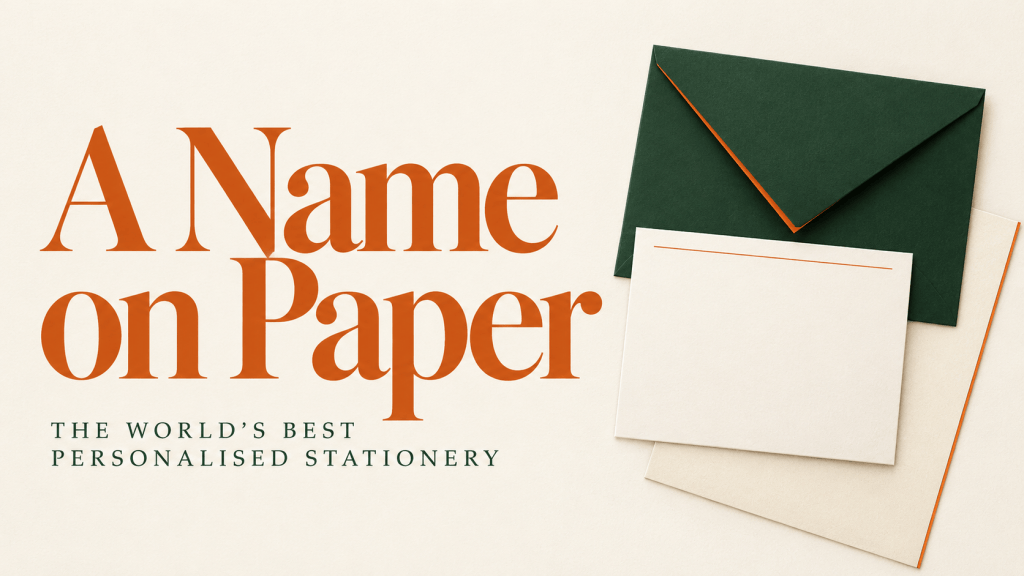
Correspondence cards, visiting cards and writing paper: what to buy, how to personalise it, and why handwritten letters deserve a return.
Thanking someone for dinner, returning a kindness or introducing a business should not require a fresh act of graphic design. A small collection of personalised stationery makes these gestures easier, giving everyday correspondence a recognisable form. The choices are deceptively consequential: the size of the card, the warmth of the paper, the shape of a letter and the space left for handwriting all influence how a message is received.
Stationery also occupies an interesting position between private life and public identity. A business card presents us to someone we have just met; a letter carries our voice into the home of someone we know. Both benefit from considered design, but their purposes differ. The best personalisation understands the occasion, allowing the printed name to introduce the person and the written message to do the rest.
A stationery collection that earns its place
The most useful first purchase is a flat correspondence card with matching envelopes. It accommodates a thank-you, a few lines of news, an invitation to lunch or a message accompanying a present. Choose a format large enough for your natural handwriting, with the name or monogram occupying a modest part of the surface. A name alone makes the card particularly versatile, carrying it comfortably between social and professional use.
Folded notecards provide more space and a little more privacy on opening. They suit a fuller thank-you, congratulations or a message of sympathy. Having “Thank You” printed on the front is entirely optional; a plain or personalised card can serve many occasions. For a small collection, versatility is useful: one well-chosen design should be able to thank a host, welcome a neighbour and acknowledge a thoughtful gift.
For longer correspondence, order writing paper with matching envelopes and blank continuation sheets. A5 or a stationer’s comparable smaller format makes a manageable page for a personal letter. A4 offers more room and is useful for professional correspondence. A personal heading might contain a name, an address or both; a business letterhead generally needs the organisation’s identity and relevant contact details. A restrained heading leaves the page available for its real purpose: writing.
The visiting card, also called a calling card, belongs to the social tradition of introducing oneself. Its modern usefulness lies in its simplicity: a name and, if wanted, one discreet means of contact. A business card has a more practical task, identifying the person, their work and how to reach them. Name, role, organisation, website and email are usually a sound starting point. Add a telephone number when it is useful to the recipient; the design does not need to reproduce an entire email signature.
Small gift enclosure cards complete the collection for anyone who regularly sends books, flowers or presents. These need room for a few handwritten words and a signature. Begin with the pieces you will use most: correspondence cards first, writing paper if you enjoy longer letters, and visiting or business cards when introductions are part of your life. Further additions can follow experience.
What to focus on when personalising
The name and the information
Start with the version of your name you actually use. A full name offers clarity and longevity; a first name feels more intimate; initials create a more graphic identity. Decide whether the stationery belongs to an individual, a couple, a household or a business before considering decoration. Shared stationery can carry two names without requiring either person to disappear into the other’s identity.
A monogram needs an explicit brief. Initials can appear in ordinary reading order, while some traditional designs place a larger surname initial in the centre. Give the printer the full name, specify the order and identify which initial, if any, should be emphasised. For a couple, agree the arrangement together. A handsome arrangement of letters should remain intelligible to its owners.
Consider which information is likely to remain useful throughout the life of the order. A name lasts; an address, job title or telephone number may change. A return address on the envelope flap can keep the writing surface clear. On business stationery, proofread the website and email especially carefully, and check any formal company details required for your circumstances before approving a large run.
Typography and space
A well-proportioned serif is a strong starting point for personal correspondence. Look for clear letterforms and good spacing, then judge the effect at the size in which it will actually be printed. Script can work beautifully for a monogram, but elaborate lettering becomes less useful when the reader must decipher an email address or a long name. For a business card, legibility deserves as much attention as character.
Limit the number of typefaces and give the design breathing room. A small printed name, generous margins and an uncluttered writing area often produce the most satisfying card. Print the proof at its actual dimensions and write a sample message on it. This immediately reveals whether the heading sits too low, the border crowds the handwriting or the contact details are too small.
Colour and decoration
White, soft white and ivory provide adaptable foundations. Dark blue, deep green, charcoal, burgundy or a clear orange can give the printed name a distinctive character without making the writing surface difficult to use. Colour can also appear in a narrow border, a painted edge or an envelope lining. Choose where it will have the greatest effect and let that decision organise the rest of the design.
A small illustration can be wonderfully personal: a dog, a favourite building, a boat or a carefully drawn symbol. Scale matters, as does the relationship between the motif and the words. The illustration should leave enough space for correspondence and feel appropriate to the occasions for which the card is intended. A separate, plain design remains useful for more solemn messages.
Paper that suits the hand
For everyday correspondence cards, an uncoated stock around 300–400gsm is a useful place to begin. Heavier cards offer greater substance and can accommodate certain finishes, but also increase the bulk of an order. For writing paper, roughly 100–140gsm is a practical starting range. These are buying suggestions: ask to handle samples, because surface, flexibility and writing comfort matter alongside weight.
Smooth paper allows the pen to move readily; laid paper has a subtly lined texture; cotton paper can offer an appealing softness. Test the sample with the pen and ink you normally use, particularly if you write with a fountain pen. Check for feathering, drying time and ink showing through the sheet. If you intend to put letterhead through an office printer, confirm compatibility with both the stock and the pre-printed finish.
Envelopes deserve the same attention. Check their fit, opacity, colour and ease of sealing, and establish whether they are included in the quotation. A lining adds another opportunity for colour, but an attractive unlined envelope is perfectly sufficient. For unusually thick or oversized stationery, check postage before committing to a format.
Understanding the printing
Engraving, often described as die-stamping in British stationery, produces fine, raised lettering from an engraved plate or die. It is particularly appealing for a small name, a precise monogram or formal letterhead. Letterpress prints from a raised surface and can leave an inked impression in the paper. The depth of that impression should suit the design; delicate lettering deserves a delicate treatment.
Thermography creates a raised effect using powder and heat and can offer a less expensive route to tactile lettering. Flat printing, including digital and lithographic methods, offers a smooth presentation and is useful for straightforward designs or illustrations. Blind embossing creates a raised mark without coloured ink, while foil stamping introduces a metallic or coloured foil. Ask to see examples of the exact process being quoted, especially when a description says only “printed” or “personalised”.
Where to buy: thirteen outstanding stationers
The following selection brings together traditional engravers, contemporary printing workshops and convenient online services. The recommendations reflect their current offerings and an editorial preference for well-considered paper, typography and personalisation. Some specialise in complete suites; others are particularly appealing for a first set of cards or a distinctive approach to letter-writing.
1. Smythson, London
Smythson is an excellent starting point for a coordinated collection of correspondence cards, writing paper and business cards. Its online service offers established layouts, paper colours and lettering options, while bespoke appointments allow a more individual commission. The smaller Kings correspondence card is a useful everyday format; the larger Imperial offers additional writing space. Consider a simple name on soft white or pale blue paper, then carry the same lettering and ink through the rest of the order. Choose Smythson for a formal collection with an accessible ordering structure.
2. Mount Street Printers, London
Mount Street Printers offers correspondence cards, writing paper, letterheads and custom envelopes, with traditional processes including engraving and letterpress. It is particularly appealing when colour and finishing form an important part of the brief. A strong serif in orange or green, a carefully chosen border and ample white space would make a confident commission here. Request its sample pack and discuss the print method alongside the design. Choose Mount Street for bespoke social stationery or a business identity that benefits from careful attention to material and detail.
3. The Wren Press, London
The Wren Press offers both bespoke consultations and an online route to engraved correspondence cards, business cards and writing paper. Its personal stationery can incorporate names, motifs and coloured borders, allowing formality to coexist with individual taste. The online collection is useful for someone who wants a traditional engraved finish within a defined layout; a consultation suits a more particular idea. Choose Wren for an engraved suite in which the name, paper and print colour carry most of the design.
4. Gee Brothers, London
Gee Brothers is a strong choice for a working collection of social stationery: correspondence cards, writing paper, continuation sheets and matching envelopes. Its range includes straightforward name layouts and monogram options, and a sample pack helps make the paper choice tangible. Begin with an everyday card and add writing paper in a related format, keeping the lettering and colour consistent. Choose Gee Brothers for a traditional collection assembled around practical use, with further bespoke options available by enquiry.
5. Dempsey & Carroll, New York
Dempsey & Carroll is especially compelling for engraved correspondence on cotton paper. Its bespoke services extend to letter sheets, folded notes, calling cards, business cards and gift enclosures, with finishing options including painted borders and lined envelopes. This breadth makes it a useful choice for someone who wants a coherent collection across several formats. Start with a restrained engraved name or monogram and compare paper weights in person or through samples. Choose it for a substantial commission in the American tradition of engraved social stationery.
6. Crane, United States
Crane offers personalised social and business stationery on cotton paper, including flat cards, folded notes and calling or business cards. Its collections include several printing methods, so identify the process attached to the particular design you choose. A clearly drawn name in dark ink on white or ecru is an adaptable starting point. Choose Crane for a broad American stationery collection with established formats and options spanning personal and professional correspondence.
7. Cheree Berry Paper & Design, United States
Cheree Berry is particularly appealing for colour, imaginative typography and a sense of humour. Its personalised collection includes classic, modern and whimsical designs, with selected options for letterpress, painted edges and envelope linings. There is plenty to choose from for someone whose taste runs beyond a formal monogram. Look for a design with a generous writing area and select the upgrades that genuinely improve it. Choose Cheree Berry for stationery with graphic personality and a cheerful, considered use of colour.
www.chereeberrypaperdesign.com
8. Benneton Graveur, Paris
Benneton Graveur offers bespoke correspondence cards, business cards and letterheads, with options including engraving, personalised motifs and hand-gouached borders. It is an especially attractive choice for a commission in which small decisions about lettering, format and finishing matter. Discuss a simple name on smooth or laid paper, accompanied by a carefully chosen border and coordinated envelopes. Its correspondence-card enquiry form specifies a minimum of 100 cards, making quantity part of the initial conversation. Choose Benneton for meticulous French social stationery commissioned directly with the house.
9. Pineider, Florence
Pineider’s paper offering includes personalised letterhead, envelopes and correspondence cards, alongside ready-made writing-paper collections. It is particularly worth considering for someone who intends to write letters as well as short notes. Discuss a coordinated personal paper order with the house, establishing the available formats, print options and quantity. Choose Pineider for Italian stationery with an emphasis on the writing surface and the pleasure of using it; clarify the bespoke service separately when browsing its standard boxed papers.
10. Le Typographe, Brussels
Le Typographe combines traditional letterpress production with a distinctly contemporary approach to paper and colour. Its Brussels workshop produces bespoke work for private customers and businesses, including business cards, correspondence cards and letterheads. It also offers personalisation across its stationery range. The appeal lies in clear typography, tactile printing and well-judged colour combinations. Choose it for a spare, modern design, and discuss quantities for your exact product: the maker’s published minimums vary across services.
11. Haibara, Tokyo
Haibara offers a different starting point for the letter-writer, with Japanese and Western-style letter papers chosen for particular writing tools and layouts. Its own letter-paper guide states that the papers can be personalised with a name. Treat this as an enquiry-led purchase: discuss the script, position of the name, quantity and delivery arrangements with the shop. Choose Haibara for a collection centred on handwritten letters and the character of the sheet itself. Ask for advice about the paper best suited to your pen.
12. Papier, United Kingdom
Papier is a convenient choice for a first personalised set, offering an online editor and a broad range of notecard designs. Simple borders and typographic layouts sit alongside more decorative options, while its branded cards can incorporate a name or logo. The Classic Border branded set offers a 324gsm stock and includes plain white envelopes, with other options available. Choose Papier for a manageable initial order or a gift, keeping the personalisation simple and paying attention to the writing space shown in the preview.
13. Minted, United States
Minted offers personalised designs by independent artists, with standard, foil-pressed and letterpress options across its collections. It is particularly useful for comparing different visual approaches through an online service. Its simple Letterpress Name design is an appealing place to begin for someone interested in tactile printing without a fully bespoke commission. Choose Minted for design variety and a straightforward route to personalised cards, checking the paper and printing method attached to each design before comparing prices.
Spending wisely and commissioning well
A useful price comparison begins with the same specification: card dimensions, quantity, paper weight, print method, envelopes and finishing. Published starting prices illustrate how wide the field is. At the time of writing, Smythson lists 50 Kings correspondence cards personalised with a name from £216; Papier’s Classic Border branded set starts at £21 for ten; and Minted advertises standard personalised cards from $50 for 25. These are different products and processes, with delivery and any relevant charges still to consider.
For a bespoke order, request an itemised quotation that explains design work, plates or dies, paper, printing, envelopes and finishing. Establish what is retained for future reorders and what those reorders would cost. A larger quantity may reduce the unit price, but the right order is one you will use while its details remain current. Ask when production begins, how long it will take after proof approval, and which changes remain possible at each stage.
Before approving the proof, check every letter, accent, initial, contact detail and line break. Confirm the finished dimensions and look at the layout at actual size. Spend first on a paper you enjoy writing on, readable typography and well-executed printing. A capable local printer using a good uncoated stock can also produce excellent everyday stationery from a simple design. The pleasure of using it should govern the purchase.
Thank-you notes and the etiquette of attention
Written thanks acknowledge both a kindness and its arrival. This matters especially when a gift has been sent through the post: the giver should know it reached you. Anglo-American etiquette guides commonly recommend handwritten notes for substantial hospitality, meaningful gifts and significant favours. Expectations vary between families and cultures, so the relationship and occasion deserve consideration. A message should make the recipient feel appreciated, with its form serving that purpose.
For a dinner party or a stay in someone’s home, write while the occasion is fresh, ideally within a day or two. Mention something particular: the care taken over the meal, a memorable conversation or the welcome that made the visit enjoyable. A gift brought on arrival and a note written afterwards perform different gestures, and can sit happily together. For an ordinary coffee or an informal invitation arranged by message, a warm text or email will often be entirely appropriate.
Wedding gifts deserve individual written acknowledgements, even when the giver was thanked in person. The Emily Post Institute recommends sending the note within three months of receiving the gift; prompt replies make the task easier and reassure the sender. Couples should share the work. Thank the person for the specific present and say something truthful about its use or meaning. For money, acknowledging the generosity and explaining a planned use gives the note substance; mentioning the amount is optional. A printed photograph or general message can accompany these words, but each giver should receive a personal acknowledgement.
A good thank-you note can be brief. Address the person, name the kindness, add a specific observation and close warmly. “Dear Anna, thank you for such a lovely evening on Saturday. I especially enjoyed our conversation about your travels, and the care you took over dinner made it feel like a real occasion. It was a pleasure to see you both. With love, …” is enough. The detail makes the thanks belong to that evening and those people.
Professional thanks require similar judgement. After an interview or a meeting with a quick decision timetable, send a prompt email so that gratitude arrives while it is useful; a handwritten note can follow where appropriate. For a personal dinner hosted by a colleague, social stationery is a natural choice. Keep the message centred on the invitation or kindness, and use the name and form of address the recipient prefers.
Illness and bereavement require particular generosity from everyone involved. Gifts and personal messages can be acknowledged when the recipient has the capacity, with help from a friend or relative if needed. Someone sending condolences should leave the bereaved person free of pressure to reply. Etiquette is most valuable when it makes care easier to express, and its application should remain attentive to the circumstances of the person receiving it.
Let’s bring back handwritten letters
The handwritten letter deserves a place beyond ceremonial thanks. It allows us to tell someone what has happened, what we have been reading, what we noticed on a walk and what a conversation made us think about. Its particular pleasure lies in the continuity of a voice over a page. News, reflection and affection can occupy the same piece of paper, addressed to someone whose attention we have imagined as we write.
Private letters also make a record of ordinary life. Their value accumulates through details that can seem unremarkable at the time: an account of a journey, a remembered meal, the way a relative described their day. Handwriting, crossings-out and a date give these words a physical relationship to the person who sent them. Years later, the sheet may carry meanings that neither writer nor reader anticipated at its arrival.
Bringing the habit back can begin modestly. Choose one person who would enjoy receiving a letter and write a page. Give it a date, tell them one piece of news, describe something that held your attention and ask about their life. An ordinary afternoon supplies enough material. The letter needs only to be legible and engaged with its reader; distinctive handwriting is part of its character, and a natural voice gives it warmth.
Keep writing paper, envelopes, a comfortable pen and stamps together where you are likely to sit. Ten or fifteen minutes once a month can establish a rhythm, and a short note is a useful beginning when a longer letter feels difficult. Send it once it is written. The practical act of addressing and posting the envelope deserves a place in the habit, because a finished letter acquires its social life through delivery.
A correspondence can also accommodate different capacities and preferences. One person may enjoy handwriting while another finds typing easier; replies may be long, short or occasional. Discuss the pleasure of exchanging letters without imposing a timetable. That freedom makes room for the form to return as an enjoyable part of a relationship.
Personalised stationery becomes worthwhile through these uses. A card thanks someone while the evening is still vivid; a visiting card helps two people remain in touch; a sheet of writing paper carries a page of news into a friend’s home. Choosing it carefully gives those gestures a pleasing form. Keeping it close at hand helps turn the intention to write into something another person can open, read and keep.
Sources / Read More
- Smythson: personalised stationery, formats and paper specifications — www.smythson.com.
- Mount Street Printers: personal stationery and print processes — www.mountstreetprinters.com.
- The Wren Press: engraved and bespoke personal stationery — www.wrenpress.com.
- Gee Brothers: personal stationery and samples — www.geebrothers.co.uk.
- Dempsey & Carroll: bespoke services and printing explanations — www.dempseyandcarroll.com.
- Crane: personalised social and business stationery — www.crane.com.
- Cheree Berry Paper & Design: personalised stationery — www.chereeberrypaperdesign.com.
- Benneton Graveur: bespoke stationery and correspondence cards — www.bennetongraveur.com.
- Pineider: personalised paper and correspondence — www.pineider.com.
- Le Typographe: bespoke printing and personalisation — www.typographe.be.
- Haibara: letter-paper guide and name personalisation — www.haibara.co.jp.
- Papier: notecards and Classic Border specifications — www.papier.com.
- Minted: personalised stationery and letterpress designs — www.minted.com.
- Emily Post Institute: thank-you notes, wedding thank-yous, professional thanks and personal letters — www.emilypost.com.
Shopping information checked in October 2026.
Personalised_Stationery_Article_and_Shopping_Guide.md

