
Eva Marie Saint belonged to that rare category of actor whose place in cinema history could have been secured by two performances alone. As Edie Doyle in Elia Kazan’s On the Waterfront in 1954, she brought moral clarity and emotional delicacy to one of the defining films of post-war American cinema. Five years later, as Eve Kendall in Alfred Hitchcock’s North by Northwest, she appeared almost transformed: immaculate, enigmatic, sexually assured and entirely at ease opposite Cary Grant. Between those two women lies much of what made Saint such a remarkable performer. She could suggest vulnerability without weakness, glamour without vacancy and goodness without ever becoming dull.
Saint died on 6 October 2026 at her home in Los Angeles, aged 102. Her career had lasted more than seven decades, extending from the pioneering age of live television and the Actors Studio through classical Hollywood, prestige television and into twenty-first-century cinema. At her death, she was one of the last living links to a generation in which Kazan, Hitchcock, Brando, Grant, Elizabeth Taylor, Montgomery Clift and Paul Newman were working at the height of their powers.
Born Eva Marie Saint in Newark, New Jersey, on 4 July 1924, she initially imagined a considerably less theatrical future. At Bowling Green State University in Ohio she intended to become a teacher, following her mother’s profession, but acting gradually displaced that plan. After graduation she went to New York, where the beginnings of her career were unglamorous: radio, commercials, small television appearances and the relentless auditioning that characterised the lives of young actors during the extraordinary expansion of American television after the war.
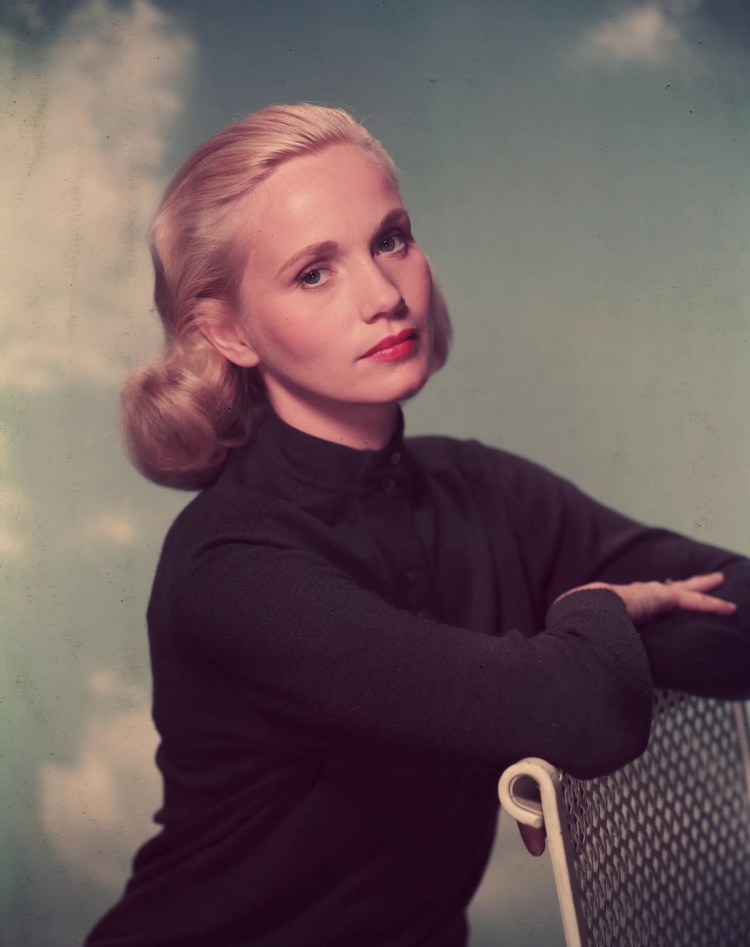
Her development coincided with a revolution in American acting. Saint was accepted into the Actors Studio and studied under Lee Strasberg, becoming part of a generation encouraged to replace theatrical display with psychological observation. She was naturally shy, something Strasberg encouraged her to use rather than disguise. The resulting quality remained visible throughout her career. Saint rarely appeared to announce an emotion to the audience. It seemed instead to arrive in the face, the voice or a moment of hesitation, almost before the character herself had understood it.
She established herself in television and on Broadway before Elia Kazan cast her opposite Marlon Brando in On the Waterfront. It was an extraordinary film debut. Edie Doyle, the convent-educated sister of a murdered dockworker, could easily have been reduced to a symbol of innocence in a world governed by violence and corruption. Saint made her something more complicated. Her gentleness becomes a kind of resistance; the film’s moral seriousness depends in considerable part upon our believing that Terry Malloy might still become the person Edie sees in him.
Acting opposite Brando at the moment when his naturalistic technique was transforming screen performance, Saint never disappears beside him. Their scenes possess an unusual intimacy because neither actor seems determined to dominate the other. The famous glove sequence, in which Brando absent-mindedly slips his hand into Edie’s dropped glove, contains precisely the kind of almost accidental physical detail on which the new American acting depended. Saint’s watchfulness is as important as Brando’s improvisatory ease.
She won the Academy Award for Best Supporting Actress for the role. She was heavily pregnant when she accepted it; her son Darrell was born two days later. Hollywood immediately offered her the machinery of stardom, but Saint declined the conventional trajectory. She resisted long-term studio contracts, turned down prominent roles and periodically withdrew from filmmaking altogether. It was not a failure of ambition so much as a different understanding of what a successful life might contain.
Her choices consequently produced a career more selective than prolific. She appeared with Montgomery Clift and Elizabeth Taylor in Raintree County and gave one of her strongest dramatic performances in Fred Zinnemann’s A Hatful of Rain, a sombre study of addiction and family life. Then came Hitchcock.
Saint’s casting as Eve Kendall in North by Northwest initially appeared counterintuitive. Audiences knew her from serious, emotionally exposed performances; Hitchcock saw the possibility of something sleek and dangerous. He transformed her visual presentation, rejecting the wardrobe prepared by MGM and taking her to Bergdorf Goodman to select clothes himself. His direction concentrated less on psychological excavation than on control: the voice lowered, the gestures reduced, the eyes directed steadily towards Cary Grant.
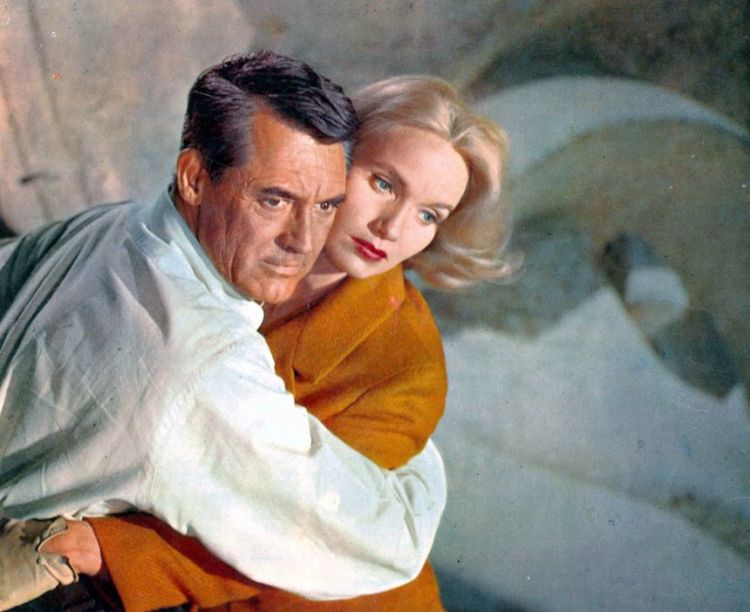
The result was one of Hitchcock’s great female performances. Eve Kendall first appears on a train as a fantasy of mid-century sophistication, cool enough to disconcert even Grant’s Roger Thornhill. Yet Saint prevents the character from becoming merely another immaculate Hitchcock blonde. Desire, deception, fear and genuine emotional attachment move beneath the polished surface. Her stillness becomes expressive. One of the reasons the seduction scenes remain so unusually erotic is that almost nothing needs to be exaggerated.
Saint later described the contrast between Kazan and Hitchcock with amusement. Kazan wanted access to a character’s emotional interior; Hitchcock was intensely interested in what the camera could see. Saint was sufficiently intelligent as an actor to understand that neither approach was inherently superior. She adapted to both, and the distance between Edie Doyle and Eve Kendall became perhaps the strongest demonstration of her range.
The 1960s brought major productions and major collaborators. She starred opposite Paul Newman in Otto Preminger’s Exodus, appeared with Warren Beatty in John Frankenheimer’s All Fall Down, worked again with Elizabeth Taylor in Vincente Minnelli’s The Sandpiper, and joined James Garner in the wartime thriller 36 Hours. In John Frankenheimer’s Grand Prix, she entered the enormous technical machinery of one of the decade’s most ambitious racing films; in Norman Jewison’s The Russians Are Coming, the Russians Are Coming, she proved equally comfortable with comedy.
Yet her relationship with Hollywood remained deliberately loose. Saint never seemed especially interested in maintaining the mythology of the movie star. When film roles became less interesting, she returned to television, the medium in which she had learned her profession. There she found the sort of mature character work Hollywood increasingly failed to offer women. She won an Emmy for the 1990 miniseries People Like Us and appeared in productions ranging from Moonlighting to numerous television films and dramas.
Later generations encountered her differently. She played Tom Hanks’s mother in Nothing in Common, Superman’s adoptive mother Martha Kent in Superman Returns, and continued appearing on screen well into old age. One of her final feature films was Akiva Goldsman’s Winter’s Tale in 2014. She remained connected to acting into her nineties, rather than becoming merely a ceremonial survivor of classical Hollywood.
That longevity inevitably became part of her public image, but it should not obscure the strangeness and modernity of her best work. Saint was frequently described in the language traditionally applied to actresses of her generation — graceful, elegant, luminous — and all were true. But they are insufficient. Her performances were also intelligent. She understood silence, ambiguity and the importance of withholding something from an audience. Even in her most apparently innocent characters there is consciousness behind the face.
Her private life also resisted one of Hollywood’s familiar narratives. She married director Jeffrey Hayden in 1951 and remained married to him until his death in 2016, after 65 years together. They had two children, Darrell and Laurette. Saint repeatedly spoke of decisions about work and family not as sacrifices imposed upon her but as choices she had made deliberately. In an industry organised around the assumption that visibility must constantly be converted into greater visibility, her refusal to pursue every opportunity now seems unusually self-possessed.
There is something fitting about the fact that her two most enduring films preserve apparently opposite versions of her. In On the Waterfront, Saint stands amid tenements, docks and winter light, her face open to the suffering around her. In North by Northwest, five years later, she moves through trains, hotels and modernist interiors in immaculate dresses, appearing to possess secrets that neither Cary Grant nor the audience can entirely penetrate. One performance belongs to the great flowering of American Method acting; the other to Hitchcock’s supreme artificial universe. Saint is completely convincing in both.
That is ultimately why Eva Marie Saint survives beyond the category of Hollywood legend. She did not merely inhabit an era of exceptional cinema; she understood different languages of performance within it. Beneath the blonde hair, the composure and the extraordinary photogenic beauty was an actor of precision, discipline and emotional intelligence. At 102, she leaves behind not an enormous filmography, but something rarer: a body of work in which the finest performances have lost remarkably little of their power.
Sources / Read More
Associated Press, “Eva Marie Saint, star of ‘North by Northwest’ and ‘On the Waterfront,’ dies at 102.”
The Guardian, “Eva Marie Saint, star of North by Northwest and On the Waterfront, dies aged 102.”
Turner Classic Movies, “Eva Marie Saint: Live from the TCM Classic Film Festival.”
Turner Classic Movies, “Star of the Month: Eva Marie Saint.”
Turner Classic Movies, “North by Northwest – The Essentials.”

