He wrote nothing. He claimed to know nothing. He taught by pretending not to teach, questioned by pretending not to have answers, and led the most examined life in the history of Western philosophy — and then, when Athens offered him the choice between his life and his vocation, he chose the vocation. He was seventy years old, and he drank the hemlock without trembling, and the conversation continued until the poison reached his heart.
By Bergotte
The first difficulty with Socrates is that he does not exist — not, at least, in the way that the other philosophers in this series exist. Kierkegaard left journals and pseudonymous works and polemical pamphlets. Nietzsche left books, letters, and private notebooks. Camus left novels and essays and the unfinished manuscript in the bag at the side of the road. Socrates left nothing. Not a sentence, not a note, not a record in his own hand of a single thought he had. He was the most important philosopher in the Western tradition, and he wrote nothing down, and everything we know about him we know through others — primarily through Plato, who was his student and his most devoted interpreter and who was also, by the standards of biographical accuracy, approximately as reliable as a loving son writing his father’s obituary.
The Platonic Socrates — the figure who appears in the dialogues, arguing about justice and beauty and piety and the soul with the young men of Athens, always claiming ignorance, always finding in the other’s confident assertions the hidden contradiction that unravels them — is probably not identical with the historical Socrates. Xenophon’s Socrates, who appears in the Memorabilia and the Symposium, is more conventional, more practically minded, less philosophically dazzling. Aristophanes’ Socrates in The Clouds, written when the real Socrates was alive and in the audience, is a comic figure running a Thinkery and teaching young men how to make the worse argument defeat the better. These three portraits do not quite coincide, and the figure they all claim to be representing cannot be reconstructed with confidence from any of them.
This is, when you think about it, philosophically appropriate. The philosopher who valued the spoken word over the written, who believed that genuine philosophical understanding could only be produced in the living encounter between two consciousnesses — in the conversation, the argument, the moment of genuine contact between one mind and another — left no text, as if to say that the thing he valued most was precisely the thing that cannot be preserved. The examination of life cannot be texted. It can only be lived. And so Socrates is the philosopher we cannot quite recover, the presence we approach through the accounts of those who were changed by it, the voice we hear only in the words of his interpreters.
What those accounts agree on — across all the divergences of Plato and Xenophon and Aristophanes and the other sources — is sufficient to produce a figure of extraordinary coherence and extraordinary distinctiveness. He was ugly in a way that the sources are unanimous about and that seems to have been central to how he presented himself: short, broad, with a flat nose and protruding eyes that he compared himself to a satyr, the half-animal creatures of Greek myth. He went barefoot regardless of the season. He wore the same rough cloak always. He drank, at symposia, quantities that left his companions under the table while he remained, by all accounts, completely clear. He had a wife — Xanthippe, who has been transmitted to posterity as a shrew on the basis of evidence that consists entirely of stories told by people who were not married to him — and children whom he apparently neglected in favour of the philosophical conversations that consumed his days.
And he talked. He talked constantly, to everyone — to the politicians and the generals and the craftsmen and the poets, to the young men who gathered around him, to strangers in the agora, to anyone who would engage with the questions that he considered the only questions worth asking. He charged no fee. He founded no school. He claimed to have no doctrine. He was, in his own description, a gadfly — the insect that stings the great horse of Athens, keeping it awake and moving when it would prefer to drowse in the comfort of its own unexamined certainties.
The Knowledge of Not-Knowing
The oracle at Delphi — the most authoritative religious institution in Greece, the voice of Apollo, the source of the divine instruction that organised political decisions and military campaigns throughout the Greek world — declared that no one was wiser than Socrates. Socrates, hearing this, was baffled. He knew, with a certainty he was prepared to defend against any challenger, that he knew nothing worth knowing. How could the oracle call him wisest?
The investigation he undertook in response to this puzzle is the founding act of Western philosophy. He went, systematically, to the people who were reputed to know things — the politicians, the poets, the craftsmen — and he questioned them. And what he found, in each case, was that the reputation for knowledge was not supported by the substance. The politicians who were reputed to know about justice could not, under questioning, give an account of what justice was that survived scrutiny. The poets who were reputed to understand beauty and virtue could not explain the principles behind the beautiful and virtuous things they made. The craftsmen knew their craft, genuinely and usefully, but tended to assume that the knowledge of their craft extended to knowledge of other things — of virtue, of politics, of the good life — and this assumption was not supported.
The conclusion Socrates drew from this investigation was the only conclusion available: he was wiser than these people not because he knew more but because he did not assume he knew what he did not know. His wisdom was the wisdom of acknowledged ignorance — the specific cognitive achievement of the person who knows the limits of her knowledge, who does not mistake the absence of contradiction for the presence of truth, who remains genuinely open to the possibility that what she thinks she knows is not what is actually the case.
This is the beginning of philosophy and it remains, two and a half thousand years later, the most difficult achievement philosophy requires. The assumption of knowledge — the confident belief in one’s own understanding, the comfortable certainty that the concepts one operates with actually carve the world at its joints — is the most natural thing in the world and the greatest obstacle to genuine understanding. Socrates spent his life dismantling this assumption, in himself and in others, not because ignorance was the goal but because the honest confrontation with ignorance was the only path toward the genuine understanding that the assumption of knowledge blocked.
The method he used — the elenchus, the cross-examination — was not designed to humiliate. Though it often did humiliate, because the revelation that one’s confident assertions contain hidden contradictions is not a comfortable experience, and the people whose contradictions Socrates revealed were not always able to distinguish the embarrassment from the insight. What the elenchus was designed to do was to clear the ground — to remove the false certainties that blocked genuine inquiry, to produce in the interlocutor the specific discomfort of not-knowing that was the necessary precondition for the genuine pursuit of knowledge.
He called this discomfort aporia — the state of being at a loss, of having reached an impasse, of finding that the road one thought one was on does not in fact lead where one thought it led. The Socratic dialogues are full of aporia — they typically end not with a conclusion but with the recognition that the question has not been answered, that the answer one thought one had was inadequate, that the inquiry must continue. This has frustrated readers for two and a half thousand years, who want the dialogues to arrive at answers and find instead that they arrive at better questions. The frustration is the point. The better question is the achievement.
The Gadfly and the City
Athens in the fifth century BCE was the most intellectually vital city in the ancient world — the city of Pericles and Thucydides and Sophocles and Euripides and Phidias, the city that had invented democracy and built the Parthenon and defeated the Persians at Marathon and Salamis and had then, in the years of the Peloponnesian War, watched its empire and its self-confidence erode in a series of military and political catastrophes that culminated in its defeat by Sparta in 404 BCE.
Socrates was born in 470 or 469 BCE, the son of a sculptor and a midwife — he later described his own philosophical method as a form of midwifery, the drawing out of what the interlocutor already knew but had not yet brought to birth — and he lived in Athens his entire life, leaving it only for military service. He was a soldier of genuine courage, by the accounts of those who served with him; Alcibiades, the brilliant and catastrophic Athenian general who was one of Socrates’ closest associates, described in Plato’s Symposium how Socrates had saved his life in battle and stood motionless in thought for a full day and night in the snow while the other soldiers watched him in amazement.
He loved Athens. He loved it with the specific, embodied, critical love of the person who is so thoroughly formed by a place that leaving it would be a form of self-amputation. He knew its streets and its conversations and its political culture with the intimacy of the gadfly that has spent its life on the horse — knowing the horse’s habits and weaknesses and capacities, stinging it not to destroy it but to keep it from the torpor that would be its genuine death.
The metaphor of the gadfly — which is his own, from the Apology — is the most precise description of what Socrates understood himself to be doing in Athens. Athens was a great horse, powerful and well-bred, but prone to the specific torpor of the powerful: the assumption that what it was was what it should be, that the arrangements it had produced were adequate to the questions they were supposed to answer, that the unexamined life of the collective was a life worth living. Socrates was the sting that prevented the torpor — the persistent, infuriating, inescapable presence of the question that the comfortable life preferred not to be asked.
Why did he stay? This is the question that the Crito — the dialogue set in his prison cell on the eve of his execution, where Crito arrives with money and a plan for his escape and Socrates refuses to go — addresses with a directness and a philosophical seriousness that makes it one of the most important documents in the history of political philosophy.
He stayed because Athens had given him everything — the language he thought in, the conversations that constituted his philosophical life, the laws that had protected his birth and his childhood and his marriage. To escape would be to act against the laws that had sustained him. It would be to say, by his action, that the laws applied when they were convenient and could be set aside when they were not — which was precisely the kind of inconsistency that his entire philosophical career had been devoted to exposing in others. He could not, without self-contradiction, do in practice what he had spent his life arguing was indefensible in principle.
There is also, in the Crito, something that is harder to name but more important: the sense that Socrates had already, in some deep way, accepted what was happening — that the trial and the sentence were the culmination of something rather than an interruption of it, that the examined life had always been leading here, toward the moment when the examination would cost everything.
The Apology: The Defence That Was Not Designed to Win
In 399 BCE, Socrates was tried before a jury of five hundred Athenian citizens on charges of impiety — failing to acknowledge the gods the city acknowledged and introducing new divine beings — and of corrupting the youth of Athens. He was found guilty by a relatively small margin. During the penalty phase, he was invited to propose his own punishment. He initially suggested that the appropriate response to his services to Athens would be to house and feed him at public expense in the Prytaneum — the highest honour Athens gave to its benefactors. When this was received poorly, he proposed a fine of thirty minae, an amount so modest relative to the crime he had been convicted of that it amounted to an argument rather than a concession. The jury sentenced him to death by a larger margin than they had convicted him.
The Apology — Plato’s account of Socrates’ defence speech — is, if Plato can be trusted, the most extraordinary courtroom performance in history. It is a defence that does not seek acquittal. It is a defence that is addressed not to the jury but to the truth — that is concerned not with what will produce the outcome the defendant wants but with what is actually the case, regardless of the outcome that the truth produces.
Socrates defends his life by describing what his life has been. He explains the oracle, the investigation, the gadfly metaphor. He argues that what he has been doing is not corrupting the youth but benefiting Athens — providing the philosophical examination that prevents the torpor, the stinging that keeps the horse alive. He argues that the charge of impiety is incoherent — that a man who has spent his life in philosophical inquiry, following the argument wherever it leads, cannot be genuinely accused of impiety, because the inquiry is itself a form of service to the divine.
He does not beg. He does not weep. He does not bring his wife and children before the jury to move them to pity, as was conventional in Athenian courtroom practice. He explicitly refuses to do these things, not because he is indifferent to his own fate but because doing them would be a form of dishonesty — would be an appeal to the emotions rather than to the argument, a concession that the argument alone was insufficient to carry the case. If the argument alone is insufficient, he seems to say, then let the case be lost. He is not in the business of winning at the cost of truth.
“Perhaps you think,” he says to the jury, “that I am brash in saying this. But I tell you, there will never be another like me.” This is not vanity. It is the literal truth, stated with a directness that the occasion demands. The gadfly, once removed, does not automatically reappear. The city that kills the question does not immediately generate another questioner. The speech is Socrates’ most elaborate philosophical act — the demonstration, by the performance of the defence itself, of the principle the defence is arguing for: that the examined life is worth living even when living it costs you your life.
The Phaedo: The Last Day
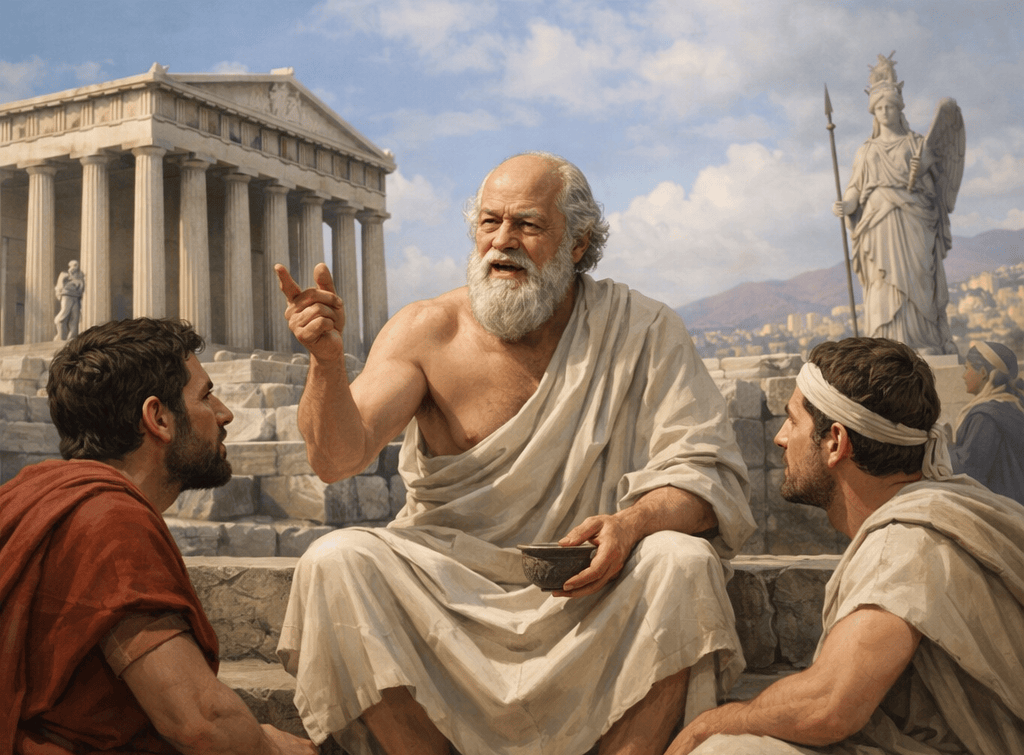
The Phaedo is the dialogue that describes Socrates’ last day — the hours between his final conversation with his friends and the moment when the jailer brings the cup of hemlock. It is framed as a conversation about the immortality of the soul, conducted with the specific intellectual energy of a man who is about to die and for whom the question of what happens to the soul at death is not an academic question but the most urgently personal one imaginable.
The arguments Socrates offers for the soul’s immortality are not, by the standards of subsequent philosophy, conclusive. Plato knew they were not conclusive — he has Socrates’ interlocutors raise objections that are not fully answered, and the mood of the dialogue is not one of settled certainty but of genuine inquiry conducted under the pressure of the approaching end. What matters about the Phaedo is not the arguments but the quality of the person making them — the specific character of the consciousness that is doing philosophy right up to the moment the philosophy ends.
He sends away his wife and children early in the day, because they are weeping and the weeping is not useful to what he wants to do with his last hours. He bathes, so that the women will not have to wash his body after death. He continues to argue — about the soul, about the good, about what philosophy is for — with the same concentrated attention he has brought to every conversation of his life. When the hemlock is brought, he asks the jailer whether he can pour a libation to the gods from the cup, and the jailer says there is only enough for one dose. Socrates accepts this with equanimity.
He drinks the hemlock. He walks about, as instructed, until his legs grow heavy, and then he lies down. The poison rises through his body with a slow, systematic progress that the Phaedo describes with a clinical precision that is itself a form of philosophical argument — here is what dying looks like, here is the body’s submission to the physical world’s authority, here is the specific sensory record of the ending. When the coldness reaches his stomach he uncovers his face, which he had covered, and says his last words: “Crito, we owe a cock to Asclepius. Don’t forget to pay the debt.”
The cock to Asclepius was the offering made to the god of healing when a patient recovered from illness. The reading that has attracted most philosophical attention — that Socrates considered death a recovery from the illness of embodied life, and was asking Crito to make the appropriate offering — may be too elaborate for a dying man’s last words. But the simplest reading is sufficient: in the moment of his death, Socrates is concerned with a social obligation, with a debt owed to a god, with the maintenance of the small pieties that constitute the texture of the civic life he is leaving. He is, to the last, a member of the community that killed him.
The Daimon: The Inner Voice
Among the strangest and most discussed features of Socrates’ self-presentation — in the Apology and throughout the dialogues — is his account of the daimon: the inner voice, the divine sign, that has accompanied him since childhood and that speaks, always in the negative, to prevent him from doing things he should not do.
The daimon is not a god in the conventional sense. It is not a figure who appears with instructions and demands. It is a voice — Socrates is careful about the word — that produces a specific internal experience of prohibition, a check on a proposed course of action that has no rational content but that Socrates treats as authoritative. He follows the daimon’s check without knowing why the check is appropriate. He trusts the voice.
The daimon is philosophically puzzling because it sits in apparent tension with everything else Socrates stands for — with the insistence on reason, on argument, on following the argument wherever it leads, on the inadequacy of authority and tradition and convention as substitutes for genuine understanding. The daimon is not a rational process. It does not give reasons. It is, by Socrates’ own account, something given to him rather than something he achieves.
And yet the tension may be less real than it appears. The examined life, in Socrates’ account, is not the life of pure reason — is not the life of the person who has reduced every decision to a logical procedure and follows the procedure with mechanical consistency. It is the life of the person who maintains a specific quality of attention to the question of how she is living — who remains genuinely open to the signals, rational and non-rational, that the examined life produces. The daimon is one such signal: the specific experience of the self in contact with something it cannot fully articulate but cannot dismiss. Socrates trusts it for the same reason he trusts the argument — because it is, in the vocabulary available to him, a form of evidence.
The daimon also functions, in the Apology, as the ground of his refusal to stop philosophising even under pain of death. When the jury offers him, hypothetically, the option of acquittal on the condition that he ceases his philosophical activity, he declines: he will obey the god rather than the jury, the daimon rather than the social authority, the inner voice rather than the outer pressure. This is not mere stubbornness. It is the expression of the deepest commitment of his examined life: that the examination cannot be conditional, cannot be suspended when it becomes costly, without ceasing to be the examination at all.
The Cave We Live In: Socrates and the Question of Reality
Plato puts in Socrates’ mouth, in the Republic, the most famous image in the history of philosophy: the allegory of the cave. Prisoners are chained in a cave, facing a wall on which shadows are projected by objects passing before a fire behind them. The prisoners have never seen anything other than the shadows, and they take the shadows for reality — they name them, they compete in the ability to predict their sequence, they take expertise in shadow-watching for the highest form of human wisdom.
One prisoner is freed and turned toward the fire. The light is painful. He wants to turn back to the shadows, which he can see clearly and which he understands. He is forced further, up and out of the cave, into the sunlight. The adjustment is agonising. Eventually he can look at the things of the world directly, and finally at the sun itself — the source of all light, the cause of all visibility, the Form of the Good.
He returns to the cave. He cannot see the shadows anymore — his eyes are adjusted to the sunlight and the cave’s darkness blinds him. The prisoners take his blindness for evidence of damage — see, they say, the journey upward has ruined his sight; we had better not go up. And if anyone tries to lead them up, toward the light, they will kill him.
The allegory’s relevance to Socrates’ situation is explicit and is intended to be explicit. The philosopher who returns to the cave is Socrates. The prisoners who kill him are Athens. The shadows are the comfortable certainties — the political slogans, the religious conventions, the unexamined beliefs — that constitute ordinary life and that the examined life threatens. The sun is the Form of the Good, the ultimate object of philosophical inquiry, the thing that genuine knowledge is always seeking even when it does not know that is what it seeks.
The image is so familiar that it has lost some of its strangeness, but the strangeness is real and should be recovered. Plato is saying — Socrates is saying, in the account Plato gives of him — that the ordinary human life, the life of the person who has not been forced up and out of the cave, is a life spent watching shadows and mistaking them for reality. Not occasionally, not in specific moments of confusion or delusion, but constitutively: the ordinary human condition is the cave, and the shadows are what we know as the world, and the genuine reality is something most people never see and that the person who has seen it cannot adequately communicate to those who have not.
This is a claim about epistemology — about what we know and how we know it. It is also a claim about politics — about who should rule and on what basis. And it is a claim about the examined life — about what the examination is for and what it costs and why it is worth the cost. The philosopher who comes back to the cave is not doing so because she prefers the cave. She is doing so because the people in the cave are the people, and the people need the light, and the light can only be brought by someone who has been blinded by it and then adjusted to it and then returned.
This is Socrates — the man who has been to the light, or closer to it than most, and who has come back to Athens to sting the horse.
Who We Are According to Socrates
Strip away the Platonic elaboration — the Forms, the immortal soul, the theory of recollection — and what Socrates himself seems to have believed, by the evidence of the dialogues that are considered earliest and most historically reliable, is something both simpler and more demanding than the full Platonic system.
We are beings who do not know what we are. We carry around confident beliefs about justice, beauty, courage, piety, the good — the concepts that organise our moral and social lives — without having examined those beliefs with the rigour that their importance demands. The beliefs feel solid. Under questioning, they dissolve into contradiction. The dissolution is not the end of the inquiry — it is the beginning of it, the necessary first step, the clearing of the ground on which genuine understanding might eventually be built.
We are beings whose most important possession is the soul — not the immortal Platonic soul of the later dialogues, necessarily, but the soul in the more basic sense: the seat of reason, of moral understanding, of the examined life. The care of the soul — attending to the quality of one’s own understanding, the honesty of one’s own reasoning, the consistency of one’s own principles — is the most important activity a human being can engage in. More important than the care of the body. More important than the accumulation of wealth or honour or political power. These external goods are not nothing, but they are nothing compared to the internal one.
We are beings for whom the unexamined life is not worth living. Not because examined life is more comfortable or more successful or more socially rewarded — it is rarely any of these things, and in Socrates’ case it was eventually fatal. But because the failure to examine is a failure to be fully human — a failure to exercise the specifically human capacity for rational self-reflection that distinguishes the person from the stone, the examined consciousness from the prisoner watching shadows.
And we are beings who, in being questioned, are being helped — even when the questioning is uncomfortable, even when the aporia produced by the questioning is genuinely distressing, even when the person doing the questioning is infuriating and ugly and barefoot and utterly unreasonable. The gadfly stings. The stinging is a form of care. The care is the most important thing one person can offer another.
He knew this when he drank the hemlock. He knew it when Crito wept at his feet and he sent him away gently. He knew it when the jailer, who liked him and was sorry for what was happening, asked him to blame him as little as possible. He knew it when the cold reached his waist and then his chest and the conversation, which had not stopped, finally stopped.
The unexamined life is not worth living. The examined life sometimes costs exactly that.
The essential texts for Socrates are Plato’s Apology, Crito, Phaedo, and Symposium, all available in the translations by G.M.A. Grube and C.D.C. Reeve in the Hackett Plato: Complete Works, edited by John Cooper, which is the standard scholarly edition. For the problem of recovering the historical Socrates, Gregory Vlastos’s Socrates: Ironist and Moral Philosopher (Cambridge University Press) is the most rigorous account. C.C.W. Taylor’s Socrates in the Oxford Past Masters series is the most accessible introduction. Xenophon’s Memorabilia and Symposium are available in the Loeb Classical Library. For the historical and political context, I.F. Stone’s The Trial of Socrates (Little, Brown) is provocative and useful, though its sympathies lie firmly with Athens rather than Socrates.

Leave a Reply