

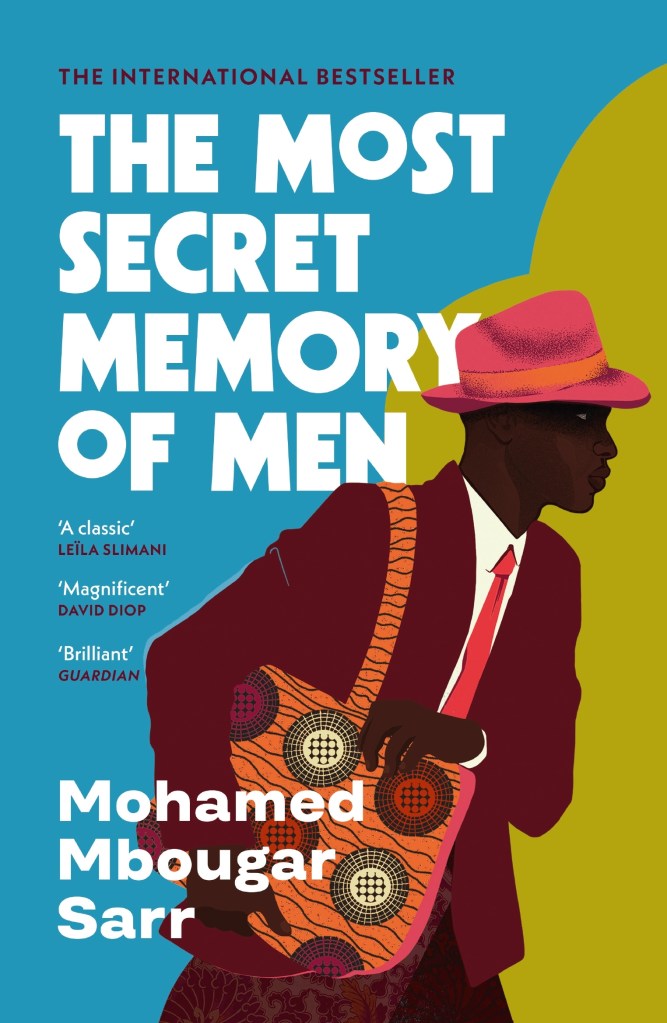
Author: Mohamed Mbougar Sarr
Translated from the French by Lara Vergnaud
Publisher: Other Press
First published: 2021
English-language edition: 2023
Pages: 496
Genre: Literary Fiction / Postcolonial Fiction
Original title: La plus secrète mémoire des hommes
Awards: Prix Goncourt 2021
The Writer, the Myth and the Literary Machine
There are novels about writers, and there are novels that interrogate the entire machinery by which a writer is created, celebrated, interpreted and, if circumstances demand it, destroyed. Mohamed Mbougar Sarr’s The Most Secret Memory of Men belongs emphatically to the latter category. It is at once a literary mystery, a postcolonial novel, a satire of cultural institutions and an extended meditation on the purpose of literature itself. Yet what makes it remarkable is not simply the number of intellectual questions it contains, but Sarr’s refusal to resolve them into anything as reassuring as a thesis.
Originally published in French as La plus secrète mémoire des hommes in 2021, the novel won that year’s Prix Goncourt, making the Senegalese Sarr the first writer from sub-Saharan Africa to receive France’s most prestigious literary prize. There is a particular historical symmetry in this distinction, because Sarr’s novel is deeply concerned with the uneasy relationship between African writers and the French literary establishment: with who is admitted into the canon, on what terms, and how rapidly admiration can turn into condescension or exclusion.
Its narrator, Diégane Latyr Faye, is a young Senegalese novelist living in Paris. He becomes fascinated by an almost mythical book, The Labyrinth of Inhumanity, published in 1938 by an elusive African writer named T. C. Elimane. The novel had initially caused a sensation in French literary circles. Elimane was extravagantly praised, exoticised and transformed into a literary phenomenon. Then came allegations of plagiarism. His reputation collapsed, the book effectively disappeared, and Elimane himself vanished from literary history.
Diégane becomes obsessed with finding out what happened to him.
What initially resembles a literary detective story gradually expands across decades and continents, incorporating letters, diaries, conversations, criticism, testimony, rumour and legend. Senegal, France and Argentina become points within an increasingly complicated cartography of memory. Colonialism, the Second World War and the Holocaust stand behind individual histories, while the apparently simple question — what happened to Elimane? — becomes less answerable the more Diégane discovers.
The structure is deliberately labyrinthine. Every recovered story seems to contain another story; every witness complicates the testimony of the previous one; every attempt to secure Elimane’s identity makes him more elusive. The missing writer becomes less a person to be discovered than a space into which other people have projected their desires, resentments and theories.
The historical figure haunting the novel is Yambo Ouologuem, the Malian author whose extraordinary 1968 novel Le devoir de violence (Bound to Violence) won the Prix Renaudot before accusations of plagiarism devastated his European literary career. Ouologuem eventually withdrew from the French literary world and returned to Mali. Sarr does not merely fictionalise this history. He uses it to ask a much larger and more uncomfortable question: who is permitted to borrow from literary tradition, and who is accused of stealing from it?
At the centre of The Most Secret Memory of Men lies the problem of originality.
It is more dangerous than it first appears. Literature has always been constructed from other literature. Allusion, imitation, quotation, parody, translation, adaptation and appropriation constitute much of literary history. Writers converse with the dead as readily as with the living. No serious account of literature could maintain that artistic creation occurs in isolation.
Yet the boundary between influence and theft has never been policed equally.
For the African writer entering the European literary marketplace, Sarr suggests, originality can become an impossible demand. Write recognisably about Africa and risk becoming an ethnographic specimen, valued for providing supposedly authentic access to a culture. Write within European literary traditions and risk being treated as derivative. Achieve international success and one may suddenly be required to represent a continent. Reject that representative function and one may be accused of insufficient political or cultural engagement.
Sarr’s young African writers in Paris inhabit precisely this contradiction. Their books can scarcely be permitted simply to exist as novels. Critics search them for Africa, identity, colonial history, migration and testimony. The African writer is interpreted before he is read.
Even praise can therefore contain a form of diminishment. A writer celebrated principally as the representative of a race, country or continent is still being denied the freedom routinely granted to writers considered culturally universal.
This is why Elimane’s fate matters beyond the question of whether he plagiarised. He becomes the surface upon which competing European ideas about Africa, genius, authenticity and legitimacy are projected. The literary establishment first turns him into a phenomenon and then turns him into a scandal. In both cases, the actual writer disappears behind the interpretation.
Sarr is exceptionally perceptive about this strange violence of cultural admiration. Canonisation appears to be the opposite of erasure, but the novel demonstrates how easily the two can resemble one another. To canonise a writer is also to construct him: to decide what his significance consists of, which aspects of his identity matter and which contradictions can conveniently be ignored. Elimane is ultimately destroyed by criticism, but he has already been partially erased by praise.
The fact that Sarr himself won the Prix Goncourt for a novel interrogating the mechanisms through which French literary prestige is distributed gives the book an almost Borgesian irony. But The Most Secret Memory of Men is far too intelligent to reduce this contradiction to hypocrisy. Sarr is himself deeply engaged with French and European literature. His argument is not that African writers should retreat towards some uncontaminated cultural authenticity. Indeed, the fantasy of cultural purity is precisely one of the ideas the novel dismantles.
What interests Sarr instead is artistic freedom.
Can an African writer simply be a writer?
Can he draw upon Borges, Bolaño, French modernism, African oral traditions, erotic literature, history, mythology and philosophy without being required to justify the cultural provenance of every influence? Can literary influence travel in every direction rather than perpetually being imagined as something transmitted from a European centre towards a postcolonial periphery?
The form of The Most Secret Memory of Men provides its own answer. Sarr takes what he needs.
The literary investigation inevitably recalls Roberto Bolaño, particularly The Savage Detectives, while the disappearing author, mythical manuscript and unstable literary archive evoke Borges. There are echoes of the great tradition of novels about lost writers, invented texts and unreliable scholarship. Yet this intertextuality is not decorative. It forms part of the argument. Sarr writes as though world literature belongs equally to him.
And of course it does.
This may be the novel’s most quietly radical proposition. Sarr refuses the assumption that European writers inherit the whole history of literature while African writers inherit principally Africa. His novel moves through literary traditions with complete intellectual entitlement.
Its polyphonic structure reinforces the point. No final authoritative voice can explain Elimane. His identity survives only through fragments belonging to other people. The archive is unreliable; memory is subjective; testimony is compromised by love, resentment, desire, self-interest and time. History, like literature, is assembled from texts whose authority must continually be questioned.
This makes the novel considerably more interesting than a straightforward act of historical rehabilitation. Sarr could easily have transformed Elimane into a fictional vindication of Ouologuem: the wronged African genius persecuted by a racist European establishment. It would have been emotionally satisfying and intellectually much less interesting.
Instead, he preserves ambiguity.
Elimane is neither simply martyr nor fraud, innocent victim nor romantic genius. The more intensely Diégane searches for the truth, the clearer it becomes that recovering a human being from literary history may ultimately be impossible. Biography cannot entirely explain a book, just as a book cannot entirely reveal its author.
There is also something wonderfully comic in Diégane’s seriousness. Sarr understands the vanity of writers remarkably well: their rivalries, insecurities, erotic entanglements, jealousies and magnificent ability to discuss literature as though civilisation will collapse before breakfast unless somebody determines the future of the novel. The literary world is populated by people who simultaneously believe literature is everything and suspect that nobody is reading them.
This humour is important because it prevents the novel’s intellectual ambitions from hardening into solemnity. Sarr believes profoundly in literature, but he does not necessarily believe writers’ own accounts of their importance.
At times the very abundance that makes The Most Secret Memory of Men exhilarating also threatens to overwhelm it. Sarr wants to discuss literature, colonialism, racism, exile, sexuality, artistic ambition, historical memory, criticism, literary prizes, plagiarism, Europe, Africa and the relationship between writing and life. The narrative proliferates accordingly. Some passages acquire greater conceptual weight than dramatic urgency, and readers expecting the clean momentum suggested by the central mystery may find the novel deliberately resistant.
But its excess is ultimately part of its aesthetic argument.
A tidier novel would betray its subject. Elimane cannot be reduced to a case study; Africa cannot be reduced to an identity; history cannot be reduced to an archive; and literature cannot be reduced to information. The digressions and embedded narratives enact a world in which meaning accumulates rather than resolves.
The deepest question of The Most Secret Memory of Men, however, is neither colonial nor institutional. It is existential.
What can literature actually do?
Sarr is suspicious of easy answers. Books do not prevent violence. They do not abolish colonialism, racism, war or death. Writers themselves can be vain, cowardly, dishonest and ridiculous. Literary institutions can reproduce precisely the hierarchies that literature supposedly teaches us to question. Great books can disappear. Mediocre books can become celebrated. Reputation is unstable, posterity arbitrary.
And still people write.
This contradiction gives Sarr’s novel its emotional force. Literature is presented neither as salvation nor ornament, but as a way of remaining intellectually present in the world. To read is to enter into relationships with consciousnesses that precede us; to write is to risk becoming part of the memory of people one will never meet.
Elimane disappears physically, but his book continues to generate desire, interpretation and argument decades later. His absence becomes strangely productive. Diégane’s search may never produce the definitive answer he wants, but the act of searching creates another literary history.
The title is therefore crucial. The most secret memory of men is not necessarily the information preserved by official history. It may be what remains underneath it: traces, voices, unfinished conversations, forgotten books and lives that refuse to disappear completely. Literature cannot defeat mortality, but it can complicate oblivion.
This is ultimately what makes Sarr’s novel so powerful. Beneath its literary games and postcolonial arguments lies an extraordinarily serious belief in reading. Not the sentimental belief that books automatically make us better people, nor the contemporary demand that every novel provide representation, instruction or moral usefulness, but something considerably more difficult: that literature deserves a territory in which uncertainty, contradiction, beauty and even uselessness remain possible.
The Most Secret Memory of Men is therefore both a critique of literary culture and an unapologetic declaration of faith in literature itself. Sarr dismantles the institutions that manufacture reputations while defending the mysterious activity upon which those institutions depend. Writers may be misunderstood, appropriated, racialised, celebrated for the wrong reasons or forgotten entirely. Books may fall out of print. Their authors may disappear.
And yet, sometimes, somebody finds one.
That moment — one reader encountering one book and becoming unable to leave it alone — is where Sarr locates literature’s most enduring power.
Discover more from My World of Interiors
Subscribe to get the latest posts sent to your email.

