
The Passenger is a weekly dispatch on travel — places, hotels, restaurants, the strange logistics of being elsewhere. It is written by Bergotte.
Bangkok in November, and why the most complex city in Southeast Asia deserves more than a night before the ferry
Bangkok defeats the traveller who arrives with a plan. It is too large — one of the great megalopolises of the world, twelve million people spreading across the flat central plain of the Chao Phraya delta — and too contradictory, and too much itself to be navigated by itinerary. The temples and the sky trains and the street food carts and the Michelin-starred restaurants and the klongs threading through old neighbourhoods and the rooftop bars and the ancient palace complex and the contemporary art spaces and the night markets: none of it arranges itself conveniently into a sequence. Bangkok simply operates, at full intensity, on every register simultaneously, and the visitor’s only option is to choose a point of entry and go in.
Most visitors get this wrong by choosing the wrong entry point — the tourist circuit of the Grand Palace and Khao San Road and a rooftop bar, which is fine as far as it goes and goes almost nowhere. The city they experience is a performance of Bangkok for visitors rather than Bangkok itself. The correct approach is to choose a neighbourhood, find a base, and proceed outward with curiosity rather than a checklist. To treat Bangkok, in other words, the way you would treat Paris or Athens or Vienna — as a serious city that requires time and attention and will reward them in proportion.
November is the month in which this becomes easiest. The rainy season has ended. The humidity has finally, mercifully, retreated from the particular oppressiveness of October into something that merely requires a light shirt rather than a will to survive. The temperatures settle into the low thirties in the day and the low twenties at night — warm, equable, the kind of weather that makes walking a pleasure rather than a test. And at the end of the month, on the full moon night of the 24th and 25th of November 2026, the city performs one of the most beautiful things it does all year.
Loy Krathong: the festival of floating lights
Loy Krathong falls on the full moon of the twelfth month in the Thai lunar calendar and has been celebrated for over eight hundred years, originating in the ancient kingdom of Sukhothai as a ritual offering to Mae Khongkha, the goddess of water — a gesture of gratitude for the year’s rains and an act of letting go of accumulated grief and wrongdoing, floated away downstream on small, intricately made vessels of banana leaves and marigolds and candles.
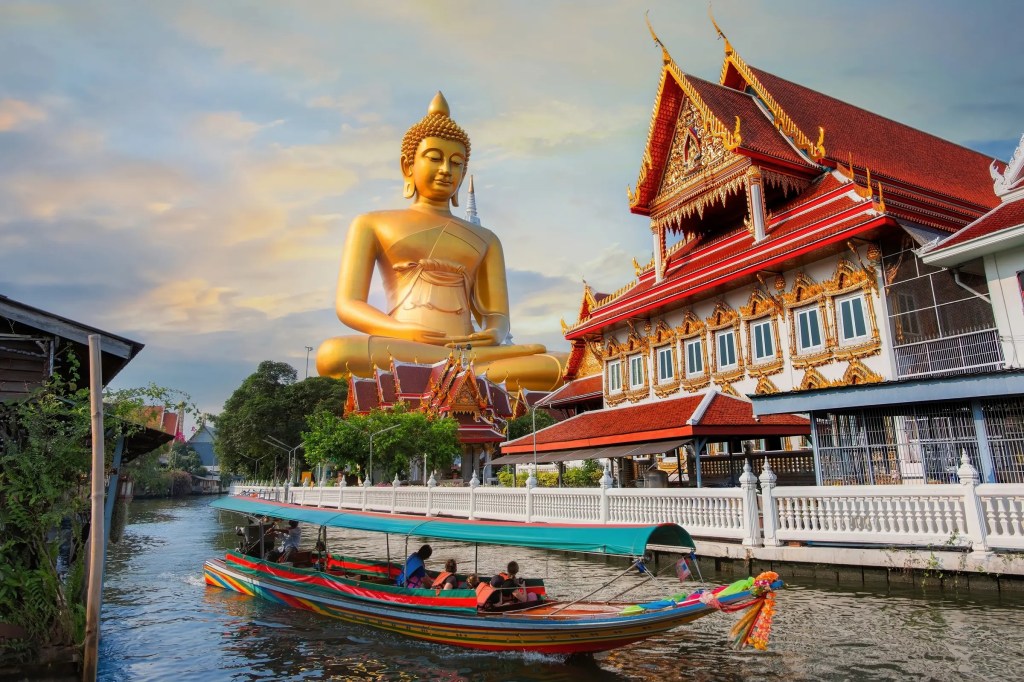
In Bangkok in 2026 it falls on the night of 24 to 25 November, and it transforms the Chao Phraya and the city’s canals into something that no photograph has ever adequately conveyed. A photograph shows light on water. What Loy Krathong actually produces is the specific quality of many small flames floating in darkness, each one the centre of someone else’s private act of release, the river carrying all of it downstream while the city watches from the banks. The Mandarin Oriental hotel on the east bank has been watching this particular stretch of river since 1876 and does not look tired of it. Neither will you.
The correct way to experience Loy Krathong in Bangkok is not to watch it from a rooftop bar, which provides spectacle without participation, but to go to the river — to Lumpini Park, to the banks of the Chao Phraya near the Tha Tien pier, to any canal that runs through a residential neighbourhood — and to buy a krathong from one of the vendors who appear on every street corner in the weeks before the festival, fold your wishes into it, light the candle, and let it go. The ritual is available to anyone willing to do it sincerely rather than performatively, and sincerity is not difficult when the river is full of ten thousand other candles and the night is warm and the city is, for once, doing something ancient.
Charoenkrung: the oldest street in Bangkok
Charoenkrung Road is the correct neighbourhood for the visitor who wants Bangkok without the tourist infrastructure. Built in 1861 at the request of Western merchants who needed a road rather than a canal to conduct their business, it runs along the east bank of the Chao Phraya through what is now one of the most interesting quartiers in the city: a district of colonial shophouses, Chinese shrines, old trading houses, embassies from an earlier era of Bangkok’s commercial life, and — in the last decade — a growing concentration of galleries, independent restaurants, design studios, and the kind of places that open because someone thought something should exist there.
The Charoenkrung creative district, centred on the stretch between Charoenkrung Soi 28 and Soi 36, contains the TCDC — Thailand Creative and Design Centre — in a converted post office building that is itself worth seeing: a vast, light-filled industrial conversion housing design exhibitions, a research library with one of the best design collections in Southeast Asia, co-working spaces, and a programme of events that treats design as a civic matter rather than a luxury product.
Around it: galleries, the River City Bangkok complex with its mix of art dealers and auction houses, the occasional restaurant that has decided this is the right neighbourhood before the neighbourhood is entirely discovered. Walk Charoenkrung on a November morning when the river light is doing what river light does in Thailand at that hour — golden, slightly hazy, specific to this latitude and this time of year — and the city reveals something it doesn’t show to everyone.
Where to stay: Capella Bangkok
http://www.capellahotels.com/bangkok
The hotel sits on the east bank of the Chao Phraya, on Charoenkrung Road, nine floors of riverfront accommodation that opened during the pandemic and emerged from it as one of the finest hotels in Southeast Asia. The design is by the New York firm Rockwell Group: Thai materials — silk, teak, hand-woven textiles — processed through a contemporary idiom that is neither pastiche nor generic luxury, but something that actually feels connected to where it is. The 101 rooms and suites all face the river. Every room has a balcony from which the Chao Phraya is directly in front of you at whatever hour you need it to be.
The hotel operates through what it calls Culturists — staff members whose role is not concierge in the conventional sense but genuine local expertise, people who know where to eat and what to see and why it matters and who will tell you so in a way that reflects actual knowledge rather than partnership arrangements with the obvious places. In a city as large and complex as Bangkok, this is not a luxury amenity but a structural necessity for the first-time visitor.
The restaurant, Côte by Mauro Colagreco, is overseen by the Argentine-Italian chef who holds three Michelin stars at Mirazur in Menton. In Bangkok it serves a French Mediterranean cuisine grounded in Thai produce — local seafood, river fish, herbs from the hotel’s own garden — at a table where the Chao Phraya is performing its dusk transition outside the window. For Loy Krathong night, book the riverfront table months in advance. You will not regret the planning.
Capella Bangkok — 300/2 Charoenkrung Road, Yannawa, Sathorn, Bangkok 10120.
For the mid-range visitor who wants the Charoenkrung neighbourhood without the Capella price point, the Warehouse Bangkok and several well-designed smaller properties along the Soi network offer the same access to the creative district at a fraction of the cost. The neighbourhood, not the hotel, is the point.
The temples: a serious approach
Bangkok has over four hundred Buddhist temples, and the correct response to this fact is not to attempt coverage but to choose three and give each of them the time they deserve.
Wat Phra Kaew — the Temple of the Emerald Buddha, within the Grand Palace complex — is the non-negotiable. The Emerald Buddha is not emerald and not particularly large: a 66-centimetre figure of jadite seated in meditation, housed in a golden throne room that is itself extraordinary, surrounded by murals that cover every surface of the courtyard walls with scenes from the Ramakien, the Thai version of the Ramayana. The density of gold and craft and accumulated devotion in this single compound is unlike anything else in Southeast Asia. Go early — the complex opens at 8.30am — and accept that it will be busy regardless. The busyness is part of the experience: this is a working royal temple, not a museum.
http://www.royalgrandpalace.th
Wat Pho, immediately south of the Grand Palace, is the correct antidote to the formal intensity of Wat Phra Kaew. It is one of the oldest and largest temple complexes in Bangkok, housing the Reclining Buddha — a 46-metre gilded figure of such scale that the building around it barely contains it — and the oldest centre for traditional Thai massage in the country, where trained practitioners work in a colonnaded hall on the temple grounds. A massage at Wat Pho after the morning temples is not an indulgence but a logical conclusion to several hours of concentrated walking.
Wat Arun — the Temple of Dawn — is best seen from the opposite bank of the river at dusk, when its prangs catch the last light of the day in a way that justifies its name more precisely than the dawn does. Cross on the ferry from the Tha Tien pier, three minutes, five baht. Walk the compound. Climb the central prang if the restoration has concluded. Return by ferry. The whole thing takes two hours and costs almost nothing and is one of the more beautiful experiences available in Thailand.
The museums
The Bangkok Art and Culture Centre — BACC — at the corner of Rama I Road and Phayathai Road, connected to the National Stadium BTS station, is the city’s primary contemporary art museum: a nine-floor drum of a building housing galleries, artist studios, independent shops, and a programme of exhibitions that takes Thai and international contemporary art seriously. In November 2026 the programme continues its investigation of Thai creative identity through rotating group and solo shows that have made the BACC one of the more consistently interesting art institutions in Southeast Asia. Admission is free. The bookshop is excellent.
The National Museum Bangkok, on Na Phra That Road adjacent to the Grand Palace, is one of the largest museums in Southeast Asia and one of the most undervisited, which makes it the correct choice for the visitor who has already done the palace circuit and wants to understand what they have been looking at. The collection spans Thai history from prehistoric artefacts through the Sukhothai and Ayutthaya kingdoms to the Rattanakosin period — the Bangkok era — with particular strength in Buddhist art, royal regalia, and the decorative arts that form the visual foundation of everything the temples are doing. Free guided tours in English run on Wednesdays and Thursdays.
http://www.virtualmuseum.finearts.go.th/bangkoknationalmuseum
The Jim Thompson House, on Rama I Road, is the kind of museum that travel writing either overwrites or dismisses, and deserves neither. Jim Thompson was the American businessman who revived the Thai silk industry after World War II and disappeared in the Malaysian jungle in 1967 without explanation — a disappearance that has never been solved and that hangs over the house with an appropriately unresolved quality. The house itself is a compound of six Thai silk-merchant houses reassembled around a canal-side garden, filled with Thompson’s collection of Asian art and antiques, and preserved in the specific amber of a life interrupted rather than concluded. The adjacent Jim Thompson Art Center runs a contemporary programme of exhibitions and events that uses the cultural gravity of Thompson’s story as a launch point for more current investigations of Thai craft and design.
http://www.jimthompsonhouse.com
Where to eat
Bangkok is one of the great food cities of the world — not one of the great food cities of Asia, but of the world — and November is the month when the full range of this proposition becomes available. The outdoor tables that are impossible in the rains and brutal in the dry-season heat are simply pleasant. The evening temperatures make a street dinner in Chinatown into an occasion rather than an endurance test.
The beginning and end of Bangkok food is the street, and the street’s best expression in November is Yaowarat — Bangkok’s Chinatown, along Yaowarat Road — which operates its full theatrical food programme from about 6.30pm onwards: seafood grilled over charcoal, oyster omelettes in smoking woks, roast duck hanging in lit windows, Chinese-Thai hybrids that taste specifically of this neighbourhood and nowhere else on earth. Walk the length of Yaowarat Road and eat at intervals. Do not plan. Order what looks correct.
For the elevated version of Thai cooking — the proposition that Thai cuisine operates at the highest level of culinary complexity and that most of what the world knows about it is a simplified translation — the restaurant is Nahm at the COMO Metropolitan Hotel, under chef Pim Techamuanvivit. Royal Thai cuisine, rigorously researched, made from ingredients sourced with the specificity that the tradition demands: the galangal and kaffir lime and shrimp paste and dried fish that produce flavours of a depth and balance that the tourist-facing Thai restaurant never achieves. The green curry here is the argument for Thai food as a serious culinary tradition rather than a convenient Asian option.
http://www.comohotels.com/metropolitanbangkok/dining/nahm
For something more neighbourhood-inflected — the chef-driven bistro that Bangkok has been producing with increasing sophistication — Wana Yook by chef Chalee Kader is the 2026 address. Kader has made a name building on traditional khao kaeng — rice and curry, the foundation of everyday Thai eating — and at Wana Yook he applies the intelligence of a serious chef to dishes that most restaurants treat as background, using heritage rice varieties from the Thai northeast and heirloom ingredients to produce food that is simultaneously deeply familiar and genuinely new. The tom yum here will recalibrate your understanding of a dish you thought you knew.
For the most important meal: breakfast, at a pavement table somewhere near the river, with a bowl of jok — rice porridge — and strong Thai coffee and the morning boat traffic on the Chao Phraya and the day not yet decided. No specific address. Find it by walking toward the river in the early morning and following the smell of charcoal and broth. This is how Bangkok begins and it is, on reflection, one of the better ways a day can begin anywhere.
The essentials
Stay
Capella Bangkok — 300/2 Charoenkrung Road, Yannawa, Sathorn, Bangkok 10120. Riverfront; design; Michelin-starred dining.
http://www.capellahotels.com/bangkok
Eat
Nahm — COMO Metropolitan Hotel, 27 South Sathorn Road, Bangkok 10120. Royal Thai cuisine; book ahead.
http://www.comohotels.com/metropolitanbangkok/dining/nahm
Wana Yook — Phrom Phong area, Bangkok. Chef Chalee Kader; contemporary Thai; khao kaeng elevated.
Search: Wana Yook Bangkok for current reservations.
Yaowarat (Chinatown) — Yaowarat Road, Bangkok. From 6.30pm; no reservations; follow the smoke.
See
Wat Phra Kaew / Grand Palace — Na Phra Lan Road, Phra Nakhon. Opens 8.30am; go early.
http://www.royalgrandpalace.th
Wat Pho — 2 Sanam Chai Road, Phra Nakhon. Reclining Buddha; traditional massage. Opens 8am.
http://www.watpho.com
Wat Arun — 158 Wang Doem Road, Bangkok Yai. Cross by ferry from Tha Tien pier; go at dusk.
http://www.watarun.net
Bangkok Art and Culture Centre (BACC) — 939 Rama I Road, Pathumwan. Free admission; contemporary art.
http://www.bacc.or.th
National Museum Bangkok — 4 Na Phra That Road, Phra Nakhon. Free guided tours Wed–Thu in English.
http://www.virtualmuseum.finearts.go.th/bangkoknationalmuseum
Jim Thompson House — 6 Soi Kasemsan 2, Rama I Road, Pathumwan.
http://www.jimthompsonhouse.com
TCDC — Thailand Creative and Design Centre, Charoenkrung Road, Bang Rak.
http://www.tcdc.or.th
November event
Loy Krathong — 24 to 25 November 2026. The Chao Phraya River and Lumpini Park are the best Bangkok locations. Buy a krathong from street vendors; participate rather than observe. If travelling to Chiang Mai for the coinciding Yi Peng sky lantern festival, book flights and accommodation months in advance — it sells out entirely.
Getting around
The BTS Skytrain and MRT metro are excellent for the main corridors. For the river and riverside neighbourhoods, the Chao Phraya Express Boat is both cheap and the correct way to move. Grab (the Southeast Asian equivalent of Uber) covers everywhere else. Bangkok is large — factor transit time into every plan.
Practical note
November temperatures: 28–33°C by day, 22–25°C at night. Dress modestly for temple visits — shoulders and knees covered; sarongs available at the Grand Palace entrance. The temples are Buddhist places of worship and active use, not historical sites. Conduct yourself accordingly.
The Passenger publishes every Friday.
— Bergotte
Discover more from My World of Interiors
Subscribe to get the latest posts sent to your email.

