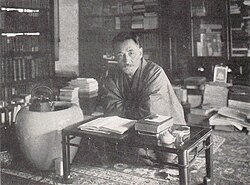
Natsume Soseki wrote at the hinge point of Japanese history — the Meiji era, when Japan was dismantling a feudal world and replacing it, with extraordinary speed and deliberate violence, with a Western one — and the hinge is felt in every page he wrote. His novels are about the cost of that replacement: what happens to the self when the values that gave it shape are suddenly declared obsolete, when the social forms through which identity was expressed are swept away and new ones, imported from a foreign civilisation, are imposed in their place. But Soseki is not simply a novelist of historical transition. He is a novelist of the permanent human problem that the Meiji transition made newly visible: the problem of the self that cannot find its place in the world, that is too intelligent to accept the available arrangements and too formed by its own culture to abandon them, that retreats into solitude and finds solitude not peaceful but catastrophic. He is the novelist of loneliness as a philosophical condition — not the loneliness that can be cured by company, but the loneliness that is the ground of modern consciousness itself.
Between Two Worlds
Natsume Kinnosuke — who took the pen name Soseki, meaning something like dwelling in an eccentric place, from a Chinese classical phrase — was born in Tokyo in 1867, two years before the Meiji Restoration that would transform Japan from a feudal society closed to the outside world into a modern nation state aggressively absorbing Western technology, Western institutions, and Western culture. He was the last child of an elderly couple who found his arrival unwelcome and sent him to live with foster parents, an experience of early abandonment whose psychological weight he carried into adulthood and whose traces are visible throughout his fiction.
He was educated in the classical Chinese tradition and then, under the Meiji imperative to Westernise, in English literature — eventually studying in London on a government scholarship from 1900 to 1902, two years that he described as the most miserable of his life. He was lonely, poor, possibly mentally ill, unable to make the social connections that the scholarship was meant to facilitate, increasingly convinced that the project of understanding Western civilisation from the outside was not merely difficult but fundamentally incoherent — that you could study the literature and learn the language and still be unable to inhabit the consciousness that produced them, because consciousness is not a text that can be translated but a form of life that must be lived from within.
He came home changed and alienated in both directions: unable to return to the Japan he had left, unable fully to enter the Japan that had replaced it, unable to inhabit the Western world whose literature he had mastered without being able to belong to. He taught English at Tokyo Imperial University, suffered a serious nervous breakdown in 1903, began writing fiction in 1905 at the suggestion of a friend as a form of therapy, and produced in the following decade the body of work — I Am a Cat, Botchan, Kokoro, Sanshiro, And Then, The Gate, Grass on the Wayside, Light and Darkness — that established him as the central figure of modern Japanese literature. He died of a stomach ulcer in 1916, aged forty-nine, in the middle of dictating the final chapter of Light and Darkness, which remains unfinished. His last words, reportedly, were that he wanted to die in the midst of his work. He did.
I Am a Cat and the Comedy of Observation
I Am a Cat, published serially between 1905 and 1906 and Soseki’s first novel, announces its method in its title: the narrator is a cat, unnamed, belonging to a middle-school English teacher named Kushami, and the comedy of the book derives from the cat’s application of a cool, disinterested, non-human intelligence to the behaviour of the humans around it. The cat observes without participating, judges without investment, and finds the pretensions and anxieties of the Meiji professional class — the teachers and businessmen and their wives navigating the collision of Japanese tradition and Western modernity — both fascinating and faintly absurd.
The satirical target is the newly educated Japanese bourgeoisie: men who have absorbed enough Western culture to be dissatisfied with traditional life and not enough to find satisfaction in the Western alternative, who discuss philosophy and literature with the earnestness of people who have been told these things matter without being quite sure why, who are engaged in the continuous performance of a cultural identity they are not certain they possess. The cat watches them with the clarity that only radical outsideness provides — not the outsideness of a foreigner, which carries its own investments, but the outsideness of a creature for whom human social arrangements are simply not available as a framework for self-organisation.
This is Soseki’s method in miniature: the deployment of a perspective so removed from the normal that the normal becomes visible as a construction rather than as nature. What the cat sees — what the novel shows through the cat’s eyes — is a society in the process of losing itself, of surrendering the forms through which its members had previously understood who they were, without yet having found new forms adequate to replace them. The comedy is real and the anxiety beneath it is real, and the combination — the laugh that is also a diagnosis — is the tonal signature of everything Soseki wrote.
Kokoro and the Heart of Things
Kokoro, published in 1914 and the novel by which Soseki is most widely known outside Japan, is the work in which his vision of the human condition achieves its fullest and most devastating expression. The title means heart or mind or spirit — the inner life, the place where what matters actually happens — and the novel is about the impossibility of fully knowing another person’s heart, the gap between the self that is presented to the world and the self that exists in the dark, and the way that guilt — specifically, the guilt of a betrayal that was not witnessed and that the law will never address — can constitute a self-imposed life sentence more absolute than any external punishment.
The novel is in three parts. In the first two, a young student forms an intense attachment to an older man he calls Sensei — teacher, but also the honorific that signals respect and distance simultaneously — a man of evident intelligence and evident unhappiness who lives in quiet, deliberate withdrawal from the world, refusing the professional positions his education has prepared him for, refusing friendship, refusing the full intimacy that his wife clearly wants and that he clearly cannot give. The student is drawn to Sensei with the particular intensity of a young person who senses, in an older person’s sadness, the presence of a knowledge he has not yet earned.
The third part is Sensei’s letter, sent to the student on the day of Sensei’s suicide, read by the student on the train as his own father is dying — the two deaths overlapping, the personal and the generational simultaneous. The letter reveals the secret that has organised Sensei’s life: that in his youth he betrayed his best friend, K, by marrying the woman K loved without warning him, without giving him the chance to declare himself first. K killed himself. Sensei has lived for decades in the knowledge of what he did and what it caused, unable to confess, unable to be forgiven, unable to forgive himself, choosing finally the same death he chose for K as the only available form of restitution.
The guilt in Kokoro is not the guilt of a monster. It is the guilt of an ordinary person who acted from ordinary human motives — desire, self-interest, the failure of courage at a specific moment — and who found that ordinary guilt, unconfessed and unabsolved, could hollow out a life entirely. Soseki is not making a theological argument about sin and redemption. He is making a psychological argument about the self: that the unacknowledged act does not disappear but goes underground, where it continues its work with a patience and a thoroughness that the conscious self cannot interrupt. Sensei is a man consumed from inside by something he cannot name to anyone who is present. The letter is the naming, too late, to someone who cannot be present to receive it.
The novel’s famous last image — the student on the train, the letter in his hands, his father dying somewhere behind him and Sensei dying ahead — is the most complete image of the modern condition that Soseki produced: the person suspended between two deaths, two losses, two worlds, unable to stop either, able only to read and understand and arrive, finally, at the full weight of what has been carried.
The Meiji Wound
Soseki returned, throughout his career, to a diagnosis of the Meiji era that he articulated most directly in a lecture delivered in 1914, the same year as Kokoro: that Japan’s modernisation had been driven by external pressure rather than internal development, that the country had been forced to compress into forty years a transformation that Western Europe had taken centuries to undergo, and that the cost of this compression was a specific kind of modern Japanese suffering — the suffering of a person whose inner life had no adequate cultural framework to inhabit, who was educated in Western individualism and Buddhist interdependence simultaneously, and who could find no ground stable enough to stand on.
He called this condition jiko hon’i — self-centeredness, or individuality in the Western sense — and he regarded it as both necessary and dangerous: necessary because the alternative was the submission of the self to collective authority that Japan’s pre-Meiji culture had required, dangerous because individualism without the cultural roots that had developed it in the West produced not freedom but isolation, not self-realisation but self-destruction.
This is the condition of virtually every protagonist in his fiction. Sensei in Kokoro. Daisuke in And Then, who has chosen a life of elegant, deliberate uselessness — refusing work, refusing social utility, living on his father’s money and his own intelligence — and who discovers that the deliberate refusal of engagement is itself a form of engagement, that you cannot stand outside the world and observe it without the observation costing something. Sosuke in The Gate, who has committed a similar betrayal to Sensei’s and who seeks forgiveness through a brief, unsuccessful attempt at Zen practice, unable to enter the gate of enlightenment, unable to return to the world he has left, standing permanently at the threshold. Sanshiro, the innocent young student from the country arriving in Tokyo, overwhelmed and charmed and gradually disillusioned, the city offering everything and delivering something more complicated than anything it offered.
These are not characters with problems that the plot will solve. They are characters in conditions that the novel illuminates without resolving, because the conditions are not pathologies but structures — permanent features of the modern self in a world that has changed faster than the self can adapt.
The Style of Interiority
Soseki’s prose style — in the original Japanese, and as well as translation can carry it — is notable for its directness and its precision, both of which were partly learned from English literature and both of which sat, in the context of Meiji Japanese prose, as deliberate formal choices against the prevailing styles. He wrote with a clarity about psychological states that Japanese prose had not previously attempted in quite his way: not the elliptical, suggestive approach of the classical tradition, in which feeling is registered through image and season rather than stated, but a more direct engagement with the mechanics of consciousness, the specific sequence of thought and response and self-examination through which his characters moved.
This directness is one of the things that makes him feel modern in a way that distinguishes him from Murasaki Shikibu — not more advanced, but differently situated, writing at the moment when the psychological novel as a form was becoming conscious of itself as such. He had read James and Meredith and Hardy and understood what the European psychological novel was doing, and he brought that understanding back to Japan and applied it to Japanese material with the specific modifications that Japanese material required: the communal obligations that the Western novel could treat as external constraints but that in the Japanese novel are internal as well, the guilt that is not simply personal but represents the self’s failure to fulfil its obligations to others, the loneliness that is not simply the absence of connection but the presence of too many incompatible demands for connection simultaneously.
The most technically interesting of the novels is Light and Darkness, the unfinished final work, which represents Soseki’s most sustained attempt at the kind of multiple-consciousness narration that James had pioneered — moving between the perspectives of a husband and wife in a deteriorating marriage, giving each their full interiority, refusing to adjudicate between them. It is the novel that most explicitly engages with the Western tradition and transforms it most completely into something Japanese, and the fact that it breaks off mid-sentence — Soseki dying at his desk — gives it a quality of permanent incompletion that is itself, in a way he could not have intended, entirely appropriate.
Then and Now
There is a quality in Soseki’s fiction that his Japanese readers have always recognised and that Western readers sometimes miss on first encounter: the sense that he is writing not just about the Meiji transition but about a permanent feature of human experience that the Meiji transition made temporarily visible. The self caught between two worlds is not only a Meiji self. It is the modern self, the self that exists in every era of rapid change, the self that has been formed by values that the world no longer supports and that must find a way to live in the world as it is rather than as it was.
Every generation, in every culture, faces some version of this: the values of the parents no longer adequate to the world the children inherit, the forms of life that gave meaning becoming forms of life that constrain, the identity that was a home becoming a prison. Soseki’s diagnosis is local and it is universal simultaneously, which is why he is still read — not as a historical curiosity, a novelist of the Meiji transition, but as a writer who understood something permanent about the cost of being a self in a world that will not hold still.
Kokoro ends with a death and a letter and a young man on a train, and the train is still moving, and the letter is still being read, and the question the letter asks — how do we live with what we have done, with what we have failed to do, with the gap between the self we presented to the world and the self we know ourselves to be — is still the question. It was the question in the Heian court. It is the question now. Soseki simply found, in the specific crisis of his time and his place, the clearest possible way to ask it.
Sources and Further Reading
Soseki, Natsume. Kokoro. Translated by Edwin McClellan. Regnery, 1957.
Soseki, Natsume. I Am a Cat. Translated by Aiko Ito and Graeme Wilson. Tuttle, 2002.
Soseki, Natsume. Botchan. Translated by Alan Turney. Kodansha International, 1972.
Soseki, Natsume. And Then. Translated by Norma Moore Field. Louisiana State University Press, 1978.
Soseki, Natsume. The Gate. Translated by William Sibley. University of Michigan Press, 1972.
Soseki, Natsume. Sanshiro. Translated by Jay Rubin. University of Washington Press, 1977.
Soseki, Natsume. Light and Darkness. Translated by V. H. Viglielmo. University of Hawaii Press, 1971.
Soseki, Natsume. Grass on the Wayside. Translated by Edwin McClellan. University of Chicago Press, 1969.
Komori, Yoichi. Soseki wo Yomu. Iwanami Shoten, 1990.
Karatani, Kojin. Origins of Modern Japanese Literature. Translated by Brett de Bary. Duke University Press, 1993.
Keene, Donald. Dawn to the West: Japanese Literature of the Modern Era. Henry Holt, 1984.
Turney, Alan. “Soseki’s Development as a Novelist.” In Natsume Soseki. Edited by Harold Gould Henderson. Columbia University Press, 1969.
McClellan, Edwin. Two Japanese Novelists: Soseki and Toson. University of Chicago Press, 1969.
Rubin, Jay. Injurious to Public Morals: Writers and the Meiji State. University of Washington Press, 1984.

