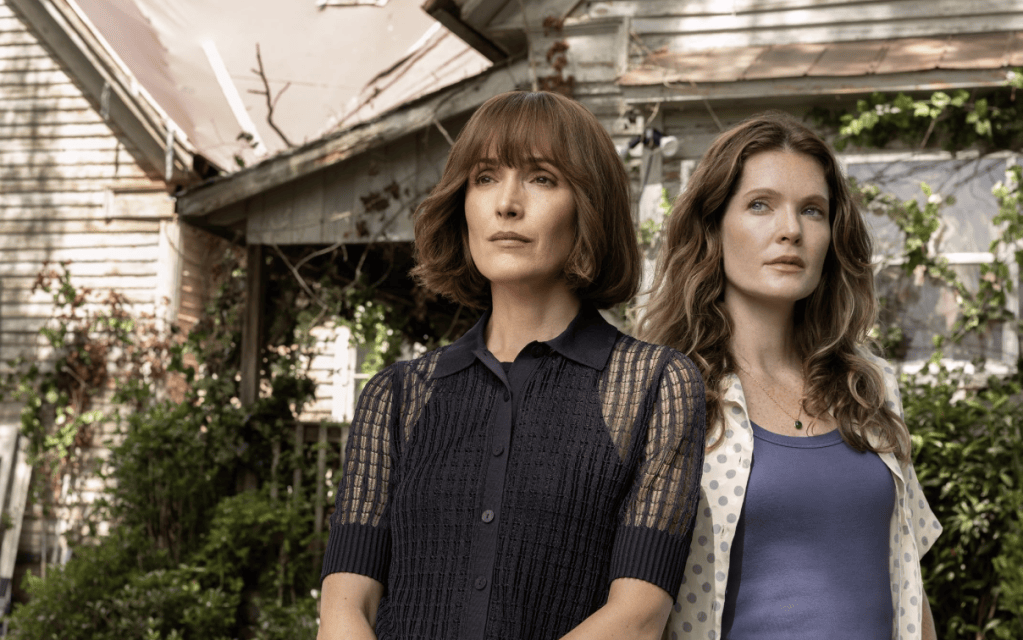
Rose Byrne, Meghann Fahy and Brendan Gleeson lead an outstanding ensemble in Karin Slaughter’s deeply affecting television drama about family, violence and the consequences of what people choose to believe.
In the opening episode of The Good Daughter, defence attorney Charlotte Quinn finds herself at the scene of a shooting at her old high school. When the police seize a teenage suspect, her instinct is to record what they are doing. It is a revealing moment. Charlotte knows how quickly a community can decide who is guilty, and how difficult it can be to challenge that judgement afterwards.
The Good Daughter, the new six-part adaptation of Karin Slaughter’s 2017 novel, is an exceptionally accomplished drama. Written for television by Slaughter herself and directed throughout by Steph Green, it combines the suspense of a crime thriller with an unusually perceptive understanding of human behaviour. Its greatest achievement is the care with which it approaches people whose lives have been shaped by violence, grief and decisions they can neither entirely explain nor undo.
Twenty years earlier, Charlotte and her older sister Samantha survived a brutal attack on their family home in the fictional Georgia town of Pikeville. Their mother, Harriet, was murdered, and both girls were left with wounds that would shape their adult lives. When another act of violence strikes the town, the sisters are brought together after years of estrangement.
Rose Byrne plays Samantha, who escaped Pikeville for a successful career as a patent lawyer in New York. Her younger sister, Charlotte, played by Meghann Fahy, remained behind and followed their father into criminal defence work.
The relationship between these women provides the emotional centre of the series. Byrne is remarkable as Samantha, whose formidable intelligence and tightly controlled manner conceal an accumulation of anger and pain. Her performance is precise, occasionally abrasive and deeply affecting. Samantha has constructed a life around independence and professional accomplishment, yet the physical consequences of the attack remain part of her everyday existence. Byrne’s attention to the way Samantha moves, manages her disability and controls her reactions makes the character’s determination entirely convincing.
Fahy is equally impressive as Charlotte, whose outward warmth, humour and impulsiveness disguise wounds of her own. She has stayed close to their father, shouldering responsibilities her sister left behind, while struggling with the uneasy knowledge that remaining in Pikeville has come at a personal cost.
What makes their relationship so convincing is the absence of easy emotional resolutions. Each woman has legitimate grievances and has hurt the other. Their differing responses to the same catastrophe have produced entirely different lives, and the writing understands how love and resentment can coexist within the closest families. The sisters can be funny, cruel, protective and exasperating, sometimes within the same conversation.
Slaughter is particularly perceptive about how trauma can alter a person’s behaviour without necessarily making that behaviour understandable to others. Samantha’s need for control and Charlotte’s impulsiveness offer contrasting responses to what they endured. Neither sister can fully appreciate the other’s experience, despite having survived the same event. Their estrangement feels painfully credible because neither is entirely wrong.
Brendan Gleeson gives a magnificent performance as Rusty Quinn, their father. His dishevelled appearance, drinking, literary quotations and irreverent humour might easily have made him a familiar Southern eccentric. Gleeson gives him considerably greater depth. Rusty is principled and capable of extraordinary tenderness, yet his professional convictions and personal failings have exacted a terrible price from those closest to him.
There is something especially affecting about Gleeson’s ability to communicate affection through a character who is frequently exasperating. Rusty can be difficult, irresponsible and stubbornly self-righteous, but his love for his daughters is never in doubt. The performance allows these qualities to exist together without offering excuses for his mistakes.
Olivia Williams is superb as Harriet, known as Gamma, the girls’ intellectually formidable mother. Her presence in the flashbacks establishes the family’s earlier life, giving the loss of her character a weight that extends beyond the initial tragedy. Audrey Grace Marshall and Drew Cheek, playing the younger Samantha and Charlotte, are beautifully cast, making the transitions between past and present particularly effective.
The supporting performances are just as carefully judged. Harper Steele brings understated assurance to Lenore, Rusty’s indispensable assistant, while Michael Dorman gives emotional substance to Ben, Charlotte’s estranged husband. Shayna Benardo is especially affecting as Kelly Wilson, the vulnerable teenager at the centre of the new criminal investigation. The care given to these smaller roles is one of the production’s considerable strengths.
Pikeville itself is essential to the story. Rusty’s willingness to represent defendants whom the town has already condemned has made him deeply unpopular, and his family has suffered as a result. The relationship between the Quinns and their neighbours is complicated by longstanding resentments, prejudices and the uncomfortable proximity of professional and personal loyalties.
The investigation into the school shooting exposes how easily these attitudes influence the administration of justice. Kelly’s vulnerability makes her particularly susceptible to the assumptions of those around her. Charlotte’s determination to scrutinise the police response and Samantha’s involvement in Kelly’s defence reveal a community in which established reputations can carry more weight than evidence.
Slaughter’s writing is sharpest when examining the compromises people make to preserve their position within such a community. Respectability offers protection, while poverty and social difference invite suspicion. People who regard themselves as fundamentally decent can participate in considerable cruelty without recognising their own responsibility. The corruption here is as much a matter of ordinary behaviour as institutional failure.
Green’s direction gives the actors room to inhabit their characters, while the shifting chronology gradually alters our understanding of events. Scenes from the past acquire new significance as previously withheld details emerge. The structure is carefully controlled, allowing the audience to reconsider what it believes about the characters without losing the emotional continuity of their experiences.
Filmed in Georgia, the series draws considerable atmosphere from its landscape. Cinematographer Zoë White and production designer Michael Bricker establish a visual world rooted in the region’s dense woods and domestic interiors. The wooded surroundings are especially significant in the flashbacks, where the landscape becomes inseparable from the sisters’ recollections of the attack. The attention to place adds conviction to the drama without overwhelming it.
Perhaps most impressive is the affection the series retains for its deeply imperfect characters. There is genuine humour amid the suffering, tenderness in unexpected places, and a recognition that people can behave terribly while remaining capable of love. Slaughter allows her characters to contradict themselves, to make mistakes and occasionally to behave with considerable selfishness. Their suffering is taken seriously without becoming an excuse for everything they do.
The six episodes are suspenseful, frequently harrowing and remarkably absorbing. Yet some of their most memorable moments occur when the pace slows and the family is left to contend with its own history. The conversations between Samantha and Charlotte, often interrupted by irritation or an old grievance, carry as much dramatic weight as the revelations surrounding the crimes.
There is a striking consistency of purpose throughout the production. The performances, the dialogue, the direction and the gradual disclosure of information have been assembled with evident care. Even the humour feels entirely natural to these characters, whose ability to laugh at one another has survived circumstances that might reasonably have destroyed their relationship.
For all its violence and disturbing revelations, The Good Daughter is ultimately sustained by the complicated affection between the Quinns. Samantha and Charlotte know precisely how to hurt one another, and the smallest exchanges can reveal years of resentment. Watching them attempt to find their way through that history is often more compelling than the mystery itself.
It is a beautifully crafted series, distinguished by its extraordinary ensemble and by writing that understands how difficult, contradictory and unexpectedly funny people can be, even when they have suffered terribly.
The Good Daughter premiered on 12 November 2026 on Peacock in the United States and on Sky and NOW in the United Kingdom and Ireland.

