
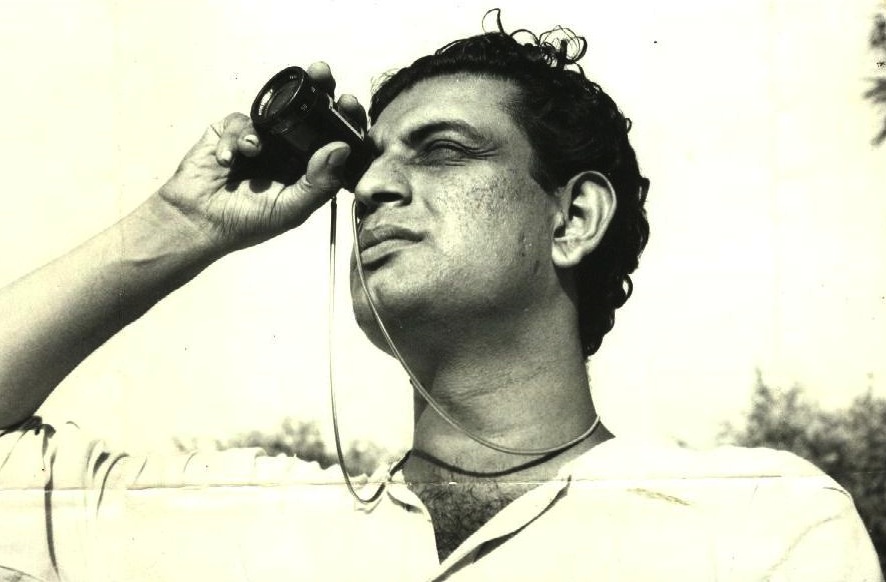
By Bergotte
Satyajit Ray made his first film in 1955 with borrowed equipment, a cast of non-professional actors, and enough money for perhaps half the shooting he needed, and what he produced was one of the most complete and devastating works of art that cinema has ever seen. Pather Panchali — Song of the Little Road — is the first part of what became the Apu Trilogy, the work that announced Indian cinema to the world and announced Ray as one of the great filmmakers of any country or era, and it achieves its effect through means so simple and so unassuming that the achievement is almost invisible until it has already undone you. Ray’s cinema is a cinema of the ordinary rendered extraordinary by the quality of its attention, a cinema that looks at the lives of people the world has decided do not matter — the rural poor, the urban struggling, women trapped by circumstance, children discovering a world that is simultaneously beautiful and cruel — and finds in those lives a fullness and a dignity that more spectacular subjects rarely possess.
Satyajit Ray was born in Calcutta in 1921 into a distinguished Bengali family with deep roots in literature, music, and the visual arts — his grandfather was a writer and philosopher, his father a poet and illustrator — and the cultural inheritance shaped everything he made. He came to filmmaking through graphic design and illustration, working for a British advertising agency in Calcutta while developing the visual sensibility that would define his cinema. The encounter that changed everything came in 1950, when he travelled to London for work and spent his evenings watching films, including a screening of Vittorio De Sica’s Bicycle Thieves that he later described as the decisive experience of his cinematic education. What De Sica had done for Italian working-class life — taken the camera into the streets, worked with non-professional actors, found the epic in the ordinary — Ray understood immediately as something that could be done for Bengal. He returned to Calcutta and began shooting Pather Panchali.
He is the filmmaker who established that Indian cinema was capable of being world cinema in the fullest sense — not a regional curiosity or an exotic object for Western festival audiences, but a body of work that addressed universal human experience with the formal sophistication and the emotional depth that the greatest cinema anywhere achieves. This was not a modest achievement. Indian popular cinema in the 1950s was a commercial entertainment industry of enormous scale and energy, and it had almost no tradition of the kind of serious, realist filmmaking that Ray was attempting. He built that tradition largely alone, working outside the commercial system, financing his films through the West Bengal government and cultural institutions and his own earnings as a filmmaker, and he sustained it across nearly four decades and thirty-six films.
The road and what it leads to
Pather Panchali takes its title from a classic Bengali novel by Bibhutibhusan Bandyopadhyay, and it follows a poor Brahmin family in a village in rural Bengal across a period of hardship and loss — the father away seeking work, the mother holding the household together with a tenacity that costs her everything, and the two children, Apu and his older sister Durga, discovering the world with an openness and a wonder that the film never sentimentalises and never abandons.
What Ray does with this material is the thing that requires the longest attention to understand and the shortest time to feel. He films it as though he were a witness rather than a director — as though the camera had been placed at the right distance and angle and simply left to record what happened. There are no dramatic confrontations built to a crescendo, no score that tells you when to feel sad, no editing that hurries you past the moments of ordinary duration that most films eliminate because they are afraid of boring you. There is instead a quality of time that is unlike almost anything else in cinema: time that passes at the speed of actual experience, that accumulates detail and weather and the small physical textures of a specific life until the accumulation becomes something overwhelming without your quite understanding how it has done so.
The sequence in which Durga falls ill in the rain — and the sequence that follows it, in which Apu’s father returns from his months away, and his wife begins to tell him what has happened during his absence, and the camera watches her face as the words arrive at the thing she cannot yet say — is one of the most devastating passages in world cinema. It achieves its effect without a single conventional dramatic gesture, without the musical cues or the close-ups or the editing rhythms that Hollywood had established as the grammar of emotional climax. It is simply two people in a room, one beginning to understand what the other has not yet been able to tell him, and the camera watching with the patience and the love of someone who knows that this moment is complete in itself and requires nothing added to it.
The world discovered
Aparajito, the second part of the trilogy, and The World of Apu, the third, follow Apu from childhood to university to marriage and fatherhood, and together the three films constitute a portrait of a life across time that has no real equivalent in cinema. They are not a bildungsroman in any conventional sense — they do not trace the development of a personality toward a fixed destination, do not shape Apu’s experience into the arc of growth and achievement that the genre normally provides. They trace instead the way life actually accumulates: through encounters that matter without being dramatically significant, through losses that change everything without being understood as they happen, through the gradual, unannounced acquisition of selfhood that is the real subject of any honest portrait of a human being across time.
Soumitra Chatterjee, who plays the adult Apu in The World of Apu and would go on to become the definitive actor of Ray’s cinema — appearing in fourteen of his films across three decades — brings to the role a quality of presence that is difficult to describe because it is the opposite of what acting normally looks like. He is simply there, in the room, fully himself, and the camera watches him with the same quality of attention that Ray brings to everything: patient, precise, unwilling to editorialise. The great scenes of The World of Apu — the marriage, the birth, the years of withdrawal after his wife’s death, the final reconciliation with his young son — are great not because of what is done in them but because of what is allowed to be there, unhurried and unmanaged, in the space that Ray’s patience creates.
The women Ray saw
It is one of the persistent injustices of how Ray’s work is discussed that the conversation tends to centre on Apu — on the trilogy, on the young man’s journey, on the hero’s development — at the expense of the women who populate his cinema with a complexity and a vividness that is, if anything, rarer and more extraordinary than his achievement with the trilogy.
Charulata, made in 1964 and the film that Ray himself considered his most perfect, is a portrait of an intelligent woman in nineteenth-century Bengal trapped in a comfortable, affectionate, and spiritually suffocating marriage to a man who does not see her. The arrival of her husband’s cousin — charming, literary, alive in ways her husband is not — sets in motion a drama of suppressed longing and thwarted selfhood that Ray films with a formal precision and a psychological depth that is among the finest things he ever achieved. Madhabi Mukherjee’s performance as Charulata is the equal of anything in European art cinema — a portrait of a woman whose interior life is richer, more dangerous, and more demanding than the world she inhabits has room for, rendered through the most delicate and exact observation of behaviour and gesture and the specific quality of a face when it believes it is unobserved.
The English title The Lonely Wife is almost insultingly reductive. Charulata is not lonely in any simple sense. She is alive in a world that has decided she need not be, and Ray’s camera — in its patience, in its refusal to reduce her to the object of the plot that surrounds her, in its insistence on following her attention wherever it leads — performs the act of recognition that her husband cannot. This is what Ray does for women throughout his cinema, across Mahanagar and Devi and Teen Kanya and the late films: he looks at them with the fullness of attention that their world routinely denies them, and the looking is itself a form of justice.
Bengal as a world
Ray’s Bengal is as completely and lovingly rendered as any landscape in world cinema, and it is worth dwelling on what this means and why it matters. The rural Bengal of the Apu Trilogy — the ponds and paddy fields and banyan trees and monsoon rains that seem to breathe through the screen — is not backdrop. It is character, as fully inhabited and as emotionally specific as any human figure in the films. Ray’s time as a graphic designer gave him an unusually precise visual imagination, and his cinematographers — Subrata Mitra above all, who worked with him on the trilogy and on Charulata — developed with him a style of natural-light photography that was simultaneously documentary and lyrical, as committed to the truth of a specific light at a specific time of day as it was to the composition of the frame.
The city of Calcutta, which becomes the primary setting of Ray’s later work, is rendered with equal precision and equal love — a love that is clear-eyed about what the city costs the people who live in it. Mahanagar, made in 1963, follows a middle-class housewife who takes a job as a saleswoman when the family’s finances require it, and the film’s portrait of Calcutta — its offices and its trams and its domestic interiors — is as attentive and as specific as anything in the rural films. The city in Ray is never the city of spectacle or alienation that it becomes in European modernist cinema. It is the city as a place where specific people live specific lives, and the specificity is always the point.
The music and the image
Ray composed the scores for his own films from 1961 onward, and the decision was not merely practical but aesthetic — a recognition that the relationship between music and image in his films was too intimate and too precise to be trusted to anyone else. His scores are among the most distinctive in world cinema: they draw on the classical Indian traditions of Hindustani and Carnatic music while absorbing influences from Western classical composition, and the resulting sound is entirely his own — neither conventionally Indian nor conventionally Western, but something that serves the specific emotional register of each film with an exactness that is itself a form of argument.
The use of music in Ray’s films is worth attending to because it illuminates his entire aesthetic. He uses it sparingly, which means that when it arrives it carries weight. He uses it precisely, which means that the relationship between what is heard and what is seen is always meaningful rather than merely atmospheric. And he uses it with a restraint that is itself a form of respect for the audience — a refusal to pre-empt feeling, to tell you what to feel before you have had the chance to feel it yourself. This restraint is the musical equivalent of his camera style, and it comes from the same conviction: that the material, attended to with enough patience and enough love, will generate its own meaning without being pushed.
What Ray made possible
The influence of Ray on Indian cinema is so vast and so complex that it cannot be traced in any simple lineage. He did not found a school or spawn a movement in the way that the French New Wave produced identifiable successors. What he did was more fundamental: he established that Indian cinema could be serious, personal, formally sophisticated, and engaged with the texture of actual Indian life, and this establishment — this demonstration that the thing was possible — changed what filmmakers after him understood they were allowed to attempt.
Outside India, the influence is felt wherever filmmakers have tried to make cinema that is simultaneously rooted in a specific culture and legible to audiences with no knowledge of that culture — wherever the local and the universal have been understood not as opposites but as the same thing seen from different distances. The great tradition of world cinema that emerged in the second half of the twentieth century — from Senegal and Iran and Taiwan and South Korea and everywhere else that cinema found ways to be itself — owes something to Ray’s demonstration that a film about a poor family in rural Bengal could be a film about everyone.
He was not, it should be said, universally celebrated in his own country during his lifetime. The Bengali intelligentsia embraced him. The commercial film industry largely ignored him. There were critics, particularly from the Hindi film establishment, who argued that his films were made for Western festival audiences and did not represent the real India. This charge misunderstands both what Ray was doing and what the real India is, and it has not survived the test of time. What has survived is the films, which continue to be watched and loved and argued over by audiences in India and everywhere else, and which continue to do what the greatest cinema always does: make the particular so specific, and hold it with such complete attention, that it becomes available to anyone willing to look.
The attention that transforms
Ray died in 1992, working almost until the end — he received his honorary Academy Award in his hospital room in Calcutta, too ill to travel to Los Angeles, and gave a speech in which he described cinema as his life and his love with a simplicity that was entirely characteristic. He had made thirty-six films across nearly four decades, working in conditions that would have defeated most filmmakers, and not one of them is careless. Even the minor works have the quality of attention that distinguishes his cinema — the sense that every frame has been considered, that every performance has been attended to with complete patience, that the world being shown deserves more time and more love than most filmmakers are willing to give it.
This is what connects him to Varda and to Marker and to the tradition of filmmaking this cluster has assembled: not a shared style or a shared subject but a shared conviction that the camera’s job is to attend, and that attending — really attending, with patience and precision and love — is both an aesthetic act and an ethical one. Varda attends to the overlooked. Marker attends to memory and time and the gap between image and meaning. Ray attends to the specific gravity of specific lives in a specific place, and finds in that specificity something that reaches everywhere.
Watch Pather Panchali. Watch the children run through the fields of kash flowers, their faces turned up to the first glimpse of a train — the modern world arriving in rural Bengal as a thunderous, magnificent apparition that they have never seen and cannot name. Watch what Ray does with that moment: how he holds it, how the music rises and then falls away, how the children’s faces contain everything — wonder and terror and the future bearing down on the present without pity or announcement. Then ask yourself whether you have seen anything more true about what it is to be a child in the world, discovering that the world is larger and more dangerous and more beautiful than you had imagined. The answer, almost certainly, is no. And that is enough.
Sources and further reading
Satyajit Ray, Our Films, Their Films (1976) — his collected writings on cinema, essential for understanding both his own practice and his place in the broader tradition of world film.
Andrew Robinson, Satyajit Ray: The Inner Eye (1989) — the most thorough critical biography in English, authoritative and deeply attentive to the films themselves.
Darius Cooper, The Cinema of Satyajit Ray: Between Tradition and Modernity (2000) — the most rigorous academic study, particularly valuable on the relationship between Ray’s films and Bengali cultural tradition.
Chidananda Das Gupta, The Cinema of Satyajit Ray (1980) — a study by one of the founders of the Calcutta Film Society, written by someone who knew Ray personally and understood his world from the inside.
For first-time viewers, the suggested order: Pather Panchali (1955) first, without preparation, and let it find you. Then Aparajito (1956) and The World of Apu (1959) to complete the trilogy. Then Charulata (1964), the most formally perfect of his films. Mahanagar (1963) and The Music Room (1958) for those who want to understand the full range of what he could do.
Discover more from My World of Interiors
Subscribe to get the latest posts sent to your email.

