
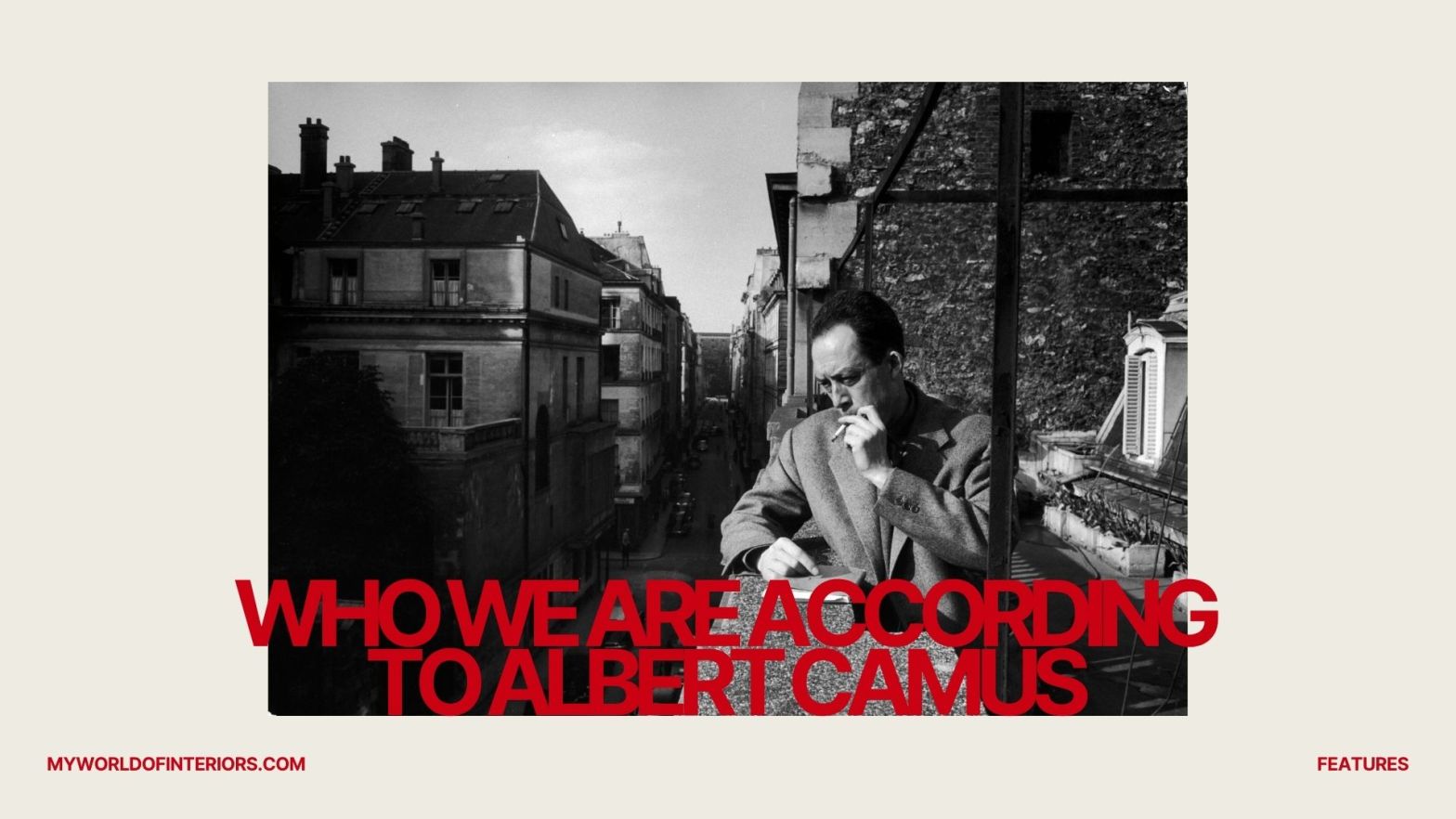
He is the last philosopher in this series and the one who answers the question the series has been building toward. Not the question of what the self is, or how it is made, or what it is condemned to. The question that Sartre’s radical freedom leaves ringing in the air: given all of this — the groundlessness, the silence of the world, the absence of any guarantee — is it worth it? Is life worth living? Camus says yes. He says it without metaphysical support, without political programme, without God and without the project that substitutes for God. He says it with his face turned toward the sun.
By Bergotte
On the fourth of January 1960, Albert Camus was killed in a car accident on the Route Nationale 5 near Villeblevin in Burgundy. He was forty-six years old. In his coat pocket was an unused train ticket — he had planned to travel to Paris by train but had accepted at the last moment a lift from his publisher Michel Gallimard, whose car went off the road at high speed. In his bag were the pages of an unfinished autobiographical novel, The First Man, which he had been working on for several years and which was published posthumously in 1994 from the manuscript found at the scene.
He had won the Nobel Prize for Literature three years earlier, in 1957, at forty-four — the second youngest writer ever to receive it. The Nobel speech he delivered in Stockholm is one of the most honest and most moving documents in the literature of what art is for: “I cannot live without my art,” he said. “But I have never placed it above everything. If, on the other hand, I need it, it is because it cannot be separated from my fellow men, and it allows me to live, just as they are, on the true level of the only life I know.”
The absurdity of the death — the unused train ticket, the last-minute change of plan, the road, the tree, the forty-six years — is not lost on anyone who has read him carefully. Camus spent his philosophical life arguing that the universe is indifferent to human aspiration, that no meaning is built into the structure of things, that the confrontation between the human being’s need for clarity and the world’s silence is the fundamental condition of conscious existence. He called this condition the Absurd. He died in it, without warning, in the specific arbitrary way that the Absurd produces — not tragically, not meaningfully, not in the manner of a life that curves toward its own symbolic conclusion, but simply, suddenly, in a ditch beside a French road on a winter afternoon.
He would not have been surprised. He would, perhaps, have seen it clearly and continued to say yes.
The Absurd: The Confrontation at the Heart of Things
Camus was not, and refused the label of, an existentialist. He had absorbed the existentialist tradition — had read Kierkegaard and Husserl and Heidegger and Sartre with the attention of a serious philosopher — and had arrived at a position that shared certain features of existentialism while rejecting what he considered its most fundamental evasion. The rejection was precise and consequential, and it is the key to everything that makes Camus different from every other philosopher in this series.
The existentialists — in the specific sense that Camus had in mind, which includes Kierkegaard and Sartre but also Jaspers and Husserl — had, in his account, correctly identified the absurd condition: the confrontation between the human being’s need for clarity, for meaning, for a world that answers to the questions she addresses to it, and the world’s complete silence, its radical indifference to her needs. They had faced the abyss. And then — and this is the move that Camus calls philosophical suicide — they had leapt. Kierkegaard had leapt into faith, finding in the divine the meaning the world refused to provide. Sartre had leapt into the project, finding in the sustained commitment to a set of possibilities the functional equivalent of the meaning that God used to provide. In each case, the honest confrontation with the absurd had been followed by the provision of a solution — by the generation of a meaning that the absurd condition had just demonstrated was not available.
Camus wanted to stay in the confrontation. Not because he enjoyed suffering, not because he thought despair was authentic and hope was cowardly, but because he thought the honest thing — the thing that genuine philosophical courage required — was to face the absurd without resolving it, to refuse both the leap of faith and the leap into the project, to live within the confrontation and find, from within it, the basis for a life that was genuinely affirmable.
This is what he means by revolt — not political revolt, initially, not the organised resistance to an unjust order, but the philosophical revolt of the consciousness that faces the absurd and refuses to be destroyed by it, that says no to despair and no to the false comfort of the leap, that maintains the tension of the confrontation without releasing it in either direction. The absurd cannot be resolved. It can be lived.
The Myth of Sisyphus, published in 1942, opens with the most direct statement of the philosophical stakes available in the literature: “There is but one truly serious philosophical problem, and that is suicide.” The question of whether life is worth living, he argues, is the first question — the question that must be answered, or at least genuinely asked, before any other philosophical question can be approached with the seriousness it deserves. Every other question — about knowledge, about ethics, about politics, about the nature of the self — presupposes that the life in which the question is being asked is a life worth living. Camus refuses to presuppose what the others have taken for granted.
The Stranger: The First Portrait
Before the philosophy, the fiction — because in Camus’s case, uniquely in this series, the fiction preceded the philosophical argument and remains, for many readers, its most powerful expression.
The Stranger — L’Étranger — was published in 1942, the same year as The Myth of Sisyphus, and it is the first and most complete portrait of a person living in the absurd without the benefit of philosophical reflection about it. Meursault, the novel’s narrator, is not a philosopher. He is a clerk in Algiers who attends his mother’s funeral without weeping, takes a new lover the day after the burial, shoots an Arab on a beach for reasons he cannot adequately explain, and is tried and condemned not primarily for the shooting but for the indifference to his mother’s death — for the failure to perform the emotional rituals that the social world requires and that he cannot produce because they would be false.
The novel is one of the strangest and most immediately arresting openings in European literature: “Mother died today. Or maybe yesterday, I don’t know.” The famous flatness of the prose — the short sentences, the paratactic accumulation of observed details, the absence of causal explanation, the refusal of the emotional colour that narrative fiction conventionally supplies — is the formal enactment of the condition being described. Meursault lives in the immediate, the sensory, the present moment. He notices the heat of the sun and the smell of the sea and the specific quality of light on the water. He does not interpret, does not narrativise, does not organise his experience into the meaningful arcs that consciousness habitually imposes on the flow of events. He is radically present — more present than most people are capable of being — and the presentness is both his most admirable quality and the quality that makes him, in the eyes of the society that judges him, a monster.
He is not a monster. He is a man who cannot lie — who cannot produce the emotions that the situation demands when those emotions are not what he actually feels, who cannot tell the court what it wants to hear because what it wants to hear is not true, who faces his own death sentence with the same quality of attention he has brought to everything else: clear, physical, without the consolations of false hope or false meaning. The chaplain who visits him in his cell wants him to feel something — regret, hope, the fear of damnation, the anticipation of God’s mercy — and Meursault refuses. Not defiantly, not nihilistically, but simply: he does not feel those things, and he will not pretend to feel them, and the refusal is, in the terms of Camus’s philosophy, the most authentic act in the novel.
The scene in which Meursault finally loses his controlled flatness — in which the chaplain’s persistence breaks through the surface and produces a genuine, overwhelming outburst of feeling — is one of the most cathartic passages in French fiction: he grabs the priest by the collar and shouts at him, tells him he is certain of nothing, not of his own death, not of the chaplain’s God, not of anything — but certain of what he is, certain of this life and this moment, and no other certainty is needed. He is at peace. He is ready to live again. He opens himself to the gentle indifference of the world.
The gentle indifference of the world. This is Camus’s image of the absurd condition — not the hostile universe of the Gothic tradition, not the indifferent universe of Victorian naturalism, but something stranger and more bearable: a world that is simply there, that does not answer, that offers no meaning but also no active cruelty, that is genuinely indifferent in the way that the sun and the sea and the warmth of the physical world are indifferent — present, available, real, and silent.
Three Responses to the Absurd: What Is Not Available
The Myth of Sisyphus considers three responses to the absurd and dismisses two of them before arriving at the third — the only one that Camus thinks is genuinely available to the honest consciousness.
The first response is physical suicide: the decision that the confrontation between human need and the world’s silence is genuinely intolerable, that life under these conditions is not worth living, that the most rational response to the absurd is to end the consciousness that experiences it. Camus takes this seriously as a philosophical position — it is not a response he dismisses with contempt. But it is, in his account, a response that evades the problem rather than facing it. It resolves the confrontation by eliminating one of its terms — the human consciousness that experiences the absurd — without engaging with the confrontation itself. It is the wrong answer to the right question.
The second response is philosophical suicide — the leap. This is Camus’s term for the move that the existentialists made: the move from the honest confrontation with the absurd to the generation of a meaning that the confrontation had just demonstrated was not available. The leap into faith, the leap into the project, the leap into the historical dialectic that will eventually resolve the contradictions of the present: all of these are, in Camus’s account, forms of dishonesty — forms of intellectual courage that break at the last moment, that face the abyss and then, unable to sustain the facing, generate a meaning to fill it. They are more sophisticated than physical suicide, and their sophistication makes them more dangerous, because they present themselves as honest responses to the absurd when they are in fact evasions of it.
The third response is revolt: the decision to face the absurd honestly and to live within the confrontation without resolving it, to refuse both the despair of suicide and the false comfort of the leap, to maintain the tension of the consciousness that knows its own condition and refuses to be diminished by the knowing. This is what Camus means by the absurd man — not a particular psychological type, but the consciousness that has faced the confrontation fully and continues, with full awareness of the conditions, to live.
Sisyphus: The Image That Changes Everything
The image with which Camus closes The Myth of Sisyphus is the one that justifies the entire essay and that has become, for readers across decades and cultures, the most memorable and the most personally resonant image in modern philosophy.
Sisyphus is condemned by the gods to push a boulder up a hill for eternity. Each time the boulder reaches the summit, it rolls back down. Sisyphus descends to the plain and begins again. His punishment is the most purely futile imaginable: maximum effort, no result, endless repetition, the boulder always rolling back, the hill always to be climbed again. It is the image of the human condition made mythological — the condition of the consciousness that knows its own effort is not building toward anything final, that the boulder of meaning will always roll back down, that the hill must always be climbed again without the assurance that the summit means anything.
And then Camus says: one must imagine Sisyphus happy.
The sentence is not a consolation. It is a philosophical claim, and the claim requires everything that has preceded it to make it legitimate rather than simply cheerful. Sisyphus is happy — or we must imagine him happy, which is Camus’s way of insisting that the happiness is available rather than guaranteed, that it must be claimed rather than simply experienced — because his rock is his thing. The descent, the moment between the summit and the plain, is Sisyphus’s moment of clarity: he knows his fate, he sees it whole, and in the seeing he surpasses it. The absurd is not resolved. The boulder will roll back. The hill will always be there. And none of this prevents the consciousness that faces it clearly from finding, in the facing, a form of life that is genuinely affirmable.
“I leave Sisyphus at the foot of the mountain! One always finds one’s burden again. But Sisyphus teaches the higher fidelity that negates the gods and raises rocks. He too considers things to be good. The universe henceforth without a master seems to him neither sterile nor futile. Each atom of that stone, each mineral flake of that night-filled mountain, in itself forms a world. The struggle itself toward the heights is enough to fill a man’s heart.”
The struggle itself is enough. Not the summit — the struggle. Not the completion — the continuing. Not the answer — the asking. The series has been moving toward this, and the arrival feels both earned and surprising: the most demanding philosophical journey of the century — through Kierkegaard’s leap, Beauvoir’s resistance, Nietzsche’s creation, Spinoza’s dissolution, Heidegger’s thrownness, Sartre’s condemnation — ends here, in this image, with a man pushing a rock and finding it sufficient.
The Plague: From the Individual to the Collective
The Plague — La Peste — published in 1947, is the novel in which Camus moves from the individual confrontation with the absurd to the collective one, from the metaphysical question of whether life is worth living to the ethical question of how to live with others in the face of conditions that make both hope and despair available and that make neither honest.
The plague that arrives in Oran in the novel’s opening pages is both literal — a bubonic plague, described with clinical precision, killing people with the arbitrary brutality of the physical world at its most indifferent — and allegorical. The occupation of France is the most immediate allegorical referent, but the plague is also simply what happens to human communities, again and again, in forms that change and in a structure that does not: the sudden arrival of catastrophic suffering, the inadequacy of the existing frameworks, the question of how to continue being human in conditions that seem designed to make humanity impossible.
The novel’s central figure is Dr. Bernard Rieux, who treats plague patients from the first cases to the last, who watches people he has tried to save die, who separates from his wife to contain the contagion and receives the news of her death — she has been ill in a sanatorium outside the city — by telegram, who continues working after the telegram as he continued working before it, not because he is certain of success but because the work is what there is to do.
Rieux is not heroic in the conventional sense. He does not believe in God, does not believe in history’s arc toward justice, does not believe that his work is building toward a guaranteed outcome. He treats patients because patients are suffering and he is a doctor and what a doctor does is treat patients. The work is its own justification. Not its results — which are uncertain and frequently inadequate. The work itself, the showing up, the treating, the maintaining of the human relationship between the person who suffers and the person who tries to relieve suffering. This is solidarity, and solidarity is what Camus thinks the absurd condition makes available — not the grand historical project, not the political programme that will eventually redeem the present suffering with future justice, but the simple, difficult, non-guaranteed act of being present to the suffering of another.
The character who provides the sharpest philosophical contrast is Tarrou — a man who has spent his life fleeing from what he considers his own complicity in state-sanctioned death, who wants to be “a saint without God,” who articulates the ethical position of the novel most explicitly and who dies of the plague before the epidemic ends. Tarrou’s aspiration — sainthood without God, goodness without transcendence, solidarity without guarantee — is the aspiration that The Plague embodies and that Camus thinks is the most honest ethical position available in the absurd condition.
The plague ends. Not because anyone has triumphed over it. It simply ends, as plagues do, in its own time, by its own logic, without reference to the human drama it has been the occasion for. Rieux stands at the end of the novel and watches the people of Oran celebrate their liberation, and he knows — because he is a doctor, because he has read the records, because he knows what the physical world is — that the bacillus of plague never dies, never disappears, that it waits in furniture and bedclothes, that it may rouse its rats again for the harm and education of men. The struggle is not over. The boulder will roll back. One must imagine Rieux returning to work.
The Quarrel With Sartre: The Philosophical Break
In 1951, Camus published The Rebel — L’Homme révolté — a sustained philosophical argument against the political violence that had been conducted in the name of historical necessity and that had produced, across the twentieth century, a catastrophic toll of suffering in the service of ideological goals that the suffering was supposed to redeem. The argument was aimed at Stalinism but also at the broader tendency — present in Sartre’s Marxism and in the revolutionary political thought of the French left — to justify present violence with reference to a future historical state that the violence was building toward.
Camus’s argument was precise and, he believed, consistent with his absurdist philosophy: to kill people now for the sake of a historical goal was to commit philosophical suicide — to give the absurd a meaning it did not have, to pretend that the boulder would eventually stay at the top of the hill if enough people were pushed down it first. The revolutionary who accepts political violence in the service of the historical dialectic has made a leap — has allowed a future meaning to justify present horror — and the leap is, in Camus’s account, as dishonest as the leap into faith.
Sartre and his circle responded to The Rebel with a review — written primarily by Francis Jeanson — that was more dismissive than critical, more politically motivated than philosophically engaged. The quarrel that followed destroyed the friendship between the two men and divided the French intellectual left for years. Sartre’s position was that Camus’s refusal of political violence was itself a political position — a defence of the status quo disguised as philosophical principle, a comfortable humanism that could afford its purity only because it was not actually engaged with the conditions of the colonised and the oppressed. Camus’s position was that Sartre’s willingness to accept political violence in the service of historical necessity was a form of the bad faith that Sartre himself had diagnosed — a flight from the absurd into the comfort of the ideological guarantee.
Both men had a point. Sartre was right that Camus’s refusal of political violence was more comfortable from the position of a French intellectual than from the position of an Algerian peasant under colonial rule. Camus was right that Sartre’s acceptance of political violence in the service of historical necessity was a philosophical leap that his own framework should have prevented. The quarrel did not have a winner, and the friendship did not survive it, and the French intellectual left arranged itself on one side or the other and remained arranged for a generation.
Algeria: The Wound That Would Not Speak
Camus was born in Mondovi, Algeria, in 1913, the son of a French agricultural worker who died in the First World War when Camus was less than a year old and a partially deaf Spanish Algerian mother who could barely read and who cleaned houses to support the family in the working-class Belcourt district of Algiers. He grew up in poverty — real poverty, the poverty of a childhood without books or heat or privacy — and the specific quality of that childhood: the light, the warmth, the physical world of the Algerian coast, the community of the poor who share what they have — is present in everything he wrote, as the foundation on which the philosophy is built rather than the material the philosophy transcends.
He loved Algeria with the specific, inarticulate, embodied love of the person who was formed by a place before he was capable of reflecting on it. And he could not, finally, bring himself to support Algerian independence — could not bring himself to the position that the logic of his own philosophy of solidarity and revolt should have led him to, because the position required him to choose, in his imagination, between the Arab majority and the French Algerian community that had produced him and that included his mother and his friends and the specific texture of the life he had loved before he had the vocabulary to love it.
The famous statement — made at a press conference in Stockholm after the Nobel Prize, in response to a challenge from an Algerian student — has been variously quoted and misquoted. What he said, in rough translation, was: “I have always condemned terror. I must also condemn a terrorism which is carried out blindly, for example in the streets of Algiers, and which one day could strike my mother or my family. I believe in justice, but I will defend my mother before justice.” The statement has been used to condemn him as a colonialist and to defend him as a man who placed human loyalty above political abstraction. It is, honestly read, both: an expression of genuine feeling and a genuine political failure, a statement of the limits of his own solidarity and a refusal to face those limits as limits rather than as virtues.
He was not a colonialist in the sense of believing in the right of France to rule Algeria. He had written about the poverty of the Arab population of Algeria with genuine indignation and genuine care. But he could not — or would not — take the final step of supporting independence, and the failure is a genuine failure, one that his own philosophy of revolt and solidarity should have made impossible. The mother and justice are not, in the final analysis, incompatible. The mother is a member of a community whose continued presence in Algeria depended on arrangements that were unjust to the majority. To defend the mother before justice was to defend the arrangements before justice. Camus knew this, at some level, and could not say it. The knowledge is in the statement’s famous awkwardness.
He died before the independence of Algeria in 1962. The incomplete manuscript in his bag — The First Man — was, by all accounts, an attempt to return to the origin, to the poverty and the light and the mother and the specific quality of the Algerian childhood that was the ground of everything. It is, in its unfinished form, one of the most moving documents in French literature: the philosopher of the absurd reaching back, at the end, to the first things, the things before the philosophy, the things that had made the philosophy necessary and possible and insufficient in equal measure.
What the Series Has Been Building Toward
Stand back now and look at what the series has produced — the seven philosophers, the seven accounts of who we are, the seven positions on the question that the series has been asking from the beginning.
Kierkegaard said: the self is a task, and the task requires genuine decision, made in absolute solitude, in relation to the absolute. Without the decision, the self is in despair — comfortable, perhaps, but not genuinely itself.
Beauvoir said: the task is always situated, and the situation is always shaped by power, and the power has been organised, historically and systematically, to make the task of genuine self-making unavailable to half of humanity. The first requirement is to see this clearly. The second is to refuse it.
Nietzsche said: the values that organise the task are not given but made, and the making has been done in bad faith — in the service of the weak’s resentment of the strong, disguised as the voice of God. The death of God leaves the task of value-creation inescapable and guaranteeless. The criterion is the eternal recurrence: would you live it again?
Spinoza said: the task is real but the self that performs it is not the primary unit. The self is a wave in the ocean of the one substance — real, specific, irreplaceable, and not separate from the medium in which it exists and which it is. The highest human achievement is the intellectual love of the whole: the understanding of one’s own being as a mode of the being of everything.
Heidegger said: the self is always already thrown into a world it did not choose, always already moving toward the death that is always its own, always already lost in the comfortable inauthenticity of das Man, always capable — if the call of conscience is heard and answered — of achieving the owned existence that faces its own condition without evasion.
Sartre said: there is nothing beneath the choosing. Existence precedes essence. The self is nothing but what it makes of itself through its choices, in its situation, with no essence to fall back on and no excuse to hide behind. We are condemned to be free, and the condemnation is total and the freedom is absolute and the responsibility that follows is without limit.
And Camus says: yes. To all of it. Yes to the task and the situation and the void and the ocean and the thrownness and the condemnation. And given all of it — given the groundlessness and the silence and the boulder that always rolls back — life is worth living. Not because it leads somewhere. Not because it will eventually be redeemed by justice or absorbed into the whole or given meaning by the project. But because the struggle itself is enough to fill a heart. Because the sun on the water is real. Because the presence of another person in their suffering is the most important fact available to the consciousness that faces the absurd honestly. Because solidarity — the simple, non-guaranteed, mortality-acknowledging act of being present to each other in the conditions we find ourselves in — is what the human being has, and it is sufficient, and it is worth defending with everything we have.
Who We Are According to Camus
We are the beings who ask questions that the universe does not answer — who need meaning in a world that produces none, who need justice in a world that contains vast quantities of its opposite, who need permanence in a world in which everything is temporary including ourselves.
We are the beings who face this confrontation — who can face it honestly, who can refuse both the despair of suicide and the dishonesty of the philosophical leap, who can maintain the tension of the absurd without releasing it in either direction — and who find, from within the facing, the basis for a life that is genuinely affirmable.
We are Sisyphus, and the boulder is our thing, and the hill is real, and we know it will roll back, and we go down to the plain to retrieve it, and we push again, and the struggle is enough, and the struggle is ours, and one must imagine us happy.
We are Dr. Rieux, treating patients not because the plague will end or because the treatment is guaranteed but because suffering is present and we are present and the human response to the suffering of another is to be present to it — to refuse the comfortable distance of the observer, to show up with what we have, to maintain the solidarity that is not guaranteed and not underwritten and not building toward a historical resolution, but that is the most genuinely human thing available to us in the conditions we are in.
We are Meursault at the end of his cell, opening himself to the gentle indifference of the world — not because the indifference is comfortable but because it is honest, because the world is what it is and we are what we are, and the acceptance of the fact of both, without the false comfort of the imposed meaning, is the beginning of the only genuine freedom available to us.
We are the consciousness that the series has been following across seven philosophers and seven accounts — the consciousness that must choose, and resist, and create, and dissolve, and own, and project, and revolt. The consciousness that does all of this without guarantee, without God, without the assurance that any of it is heading anywhere in particular. The consciousness that does it anyway.
The boulder is heavy. The hill is real. The sun is warm on the face of the man at the foot of the mountain. He reaches for the rock. He begins to push.
One must imagine him happy.
A Note on the Series
Seven philosophers. Seven answers to the question of who we are. The answers do not resolve into a single position, and the series has not been trying to produce one. What it has been trying to do is map the terrain — to show, through the sustained encounter with the most serious thinking available on the question, what the question actually contains, how deep it goes, how many real answers it has produced and how each of those answers illuminates dimensions of the question that the others miss.
The series is not finished. Philosophy is not finished. The question of who we are is, as Kierkegaard would have said, a task — not a problem with a solution but a condition to be inhabited, a question to be lived rather than answered. The seven philosophers in this series are the most important stations on the path of that living that the Western tradition has produced in the modern period. There are others — Wittgenstein, on language and the limits of what can be said; Merleau-Ponty, on the body as the primary site of experience; Simone Weil, on attention and affliction and the specific quality of gravity and grace; Hannah Arendt, on action and plurality and the political life. The series could continue.
But it ends here, with Camus, because Camus is the philosopher who looks at the full weight of what the series has accumulated — the demands and the groundlessness and the condemnation and the silence — and says yes. And the yes is not naive. It is not the yes of someone who has not faced the worst. It is the yes of someone who has faced it all, who has read Kierkegaard and Nietzsche and Heidegger and Sartre and found in them the most honest accounts of the human condition available, and who has then turned his face toward the Algerian sun and said: even so. Even so, the struggle is enough. Even so, the rock is ours.
Even so.
The essential Camus texts are The Stranger (1942), translated by Matthew Ward (Vintage); The Myth of Sisyphus (1942), translated by Justin O’Brien (Vintage); The Plague (1947), translated by Stuart Gilbert (Vintage) or the newer Robin Buss translation (Penguin); and The Rebel (1951), translated by Anthony Bower (Vintage). The First Man (1994), translated by David Hapgood (Vintage), is the unfinished autobiographical novel. For biography, Olivier Todd’s Albert Camus: A Life is published by Knopf and remains the most comprehensive. Ronald Aronson’s Camus and Sartre: The Story of a Friendship and the Quarrel That Ended It is published by University of Chicago Press. For the Algeria question, Edward Said’s essay on Camus in Culture and Imperialism (Vintage) is the most challenging critical account.
Discover more from My World of Interiors
Subscribe to get the latest posts sent to your email.

