
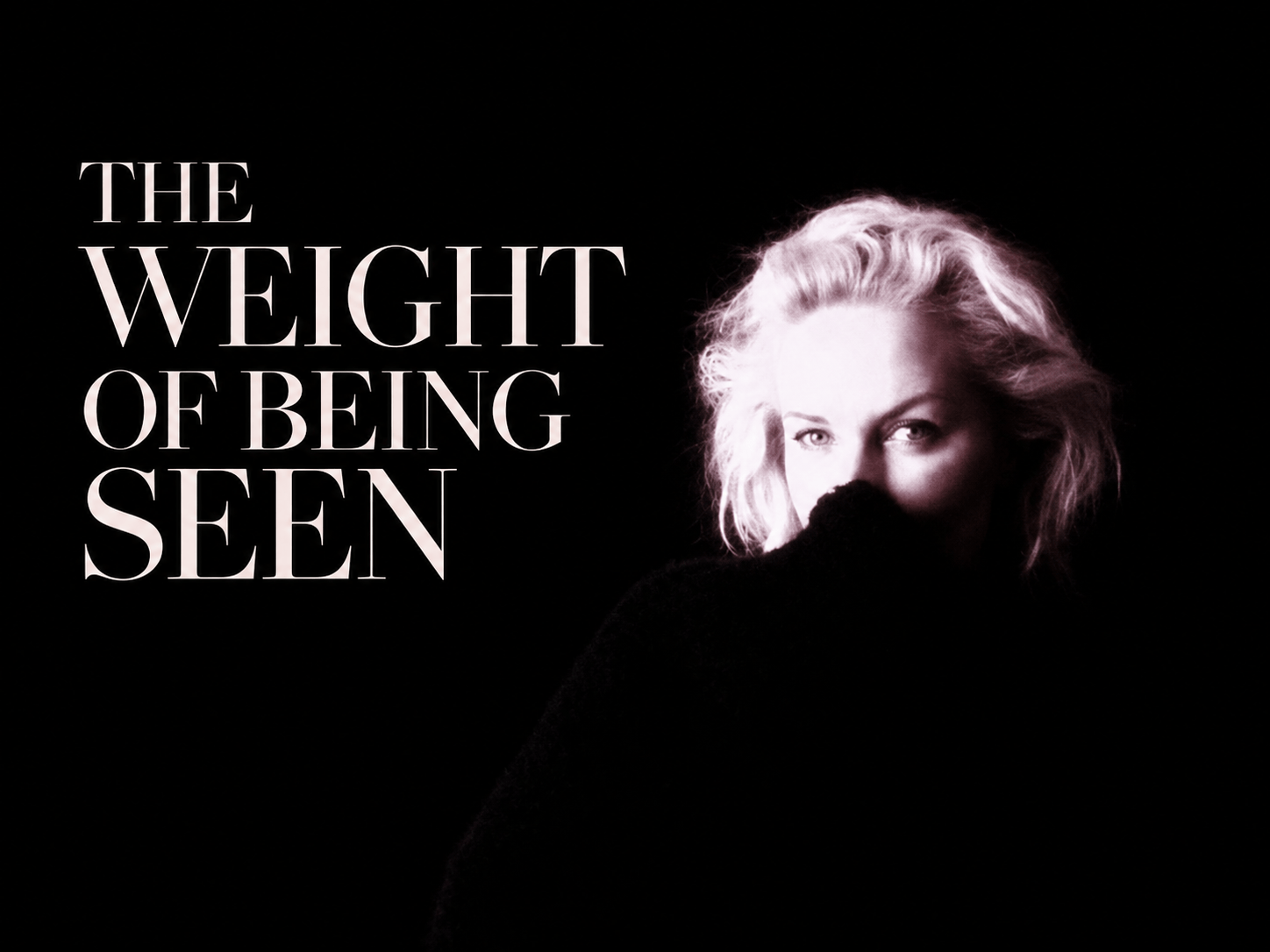
I have never much minded what people think of me. I don’t read a room for approval, and being ignored has never cost me (much) sleep. Which is what makes the last fifteen years interesting to me in a way that has almost nothing to do with vanity: I ran an accidental experiment on how a body determines what a person is assumed to be, without changing anything else about who I was — and the results kept arriving whether I wanted them or not.
At fifty-one, I have lived in three versions of the same body. For most of my life I was slim, without ever having to manage it. Then, in my late thirties, that changed. Slowly, then quickly: I’d gain weight, lose some of it, and come back heavier each time, until I was carrying forty kilos more than my old normal — my teens-and-twenties normal, mind you. Two years ago I started taking Wegovy. Within a year I had lost roughly thirty-five kilos; within a year and a half, the rest of it.
None of this is a weight-loss story. I don’t want to write one of those. What I have instead is closer to a case study, in which I happened to be both the subject and the only available scientist.
The spirit inside my body did not change when the shell grew heavier. Neither did my education, my manners, my politics, my humour, my competence or my capacity for friendship. Only the reception changed. Heavier, I became less visible and, oddly, more legible — people seemed to think they knew something about me simply by looking. Thinner again, I’ve watched the whole mechanism run in reverse.
It has rearranged what I thought I understood about women and thinness. I grew up knowing women were supposed to be thin. What I hadn’t clocked — because I had always been thin myself — was the penalty for failing to stay that way.
I am a Generation X woman, which matters here. My generation inherited the victories of second-wave feminism alongside an extraordinarily punitive culture of female appearance. We were told that women could enter universities, professions, boardrooms and public life on terms unimaginable to our grandmothers, while simultaneously absorbing the message that the successful female body should occupy remarkably little physical space. We passed through aerobics, calorie counting, low-fat everything, women’s magazines promising new bodies by summer, the spectacular bodies of the supermodel era, Kate Moss and heroin chic, and eventually the peculiar fanaticism of the size-zero years.
The contradiction was almost too ordinary to notice. Women were encouraged to become larger socially while remaining smaller physically.
It would be historically simplistic to argue that whenever women acquire power society immediately orders them to become thinner. Beauty ideals are not that tidy, and fatness has not been equally stigmatised in every place or period. But feminist thinkers have long identified something more subtle. As women acquired greater formal freedom, regulation did not necessarily disappear; much of it migrated inward. The modern woman became responsible for supervising herself.
Michel Foucault’s account of disciplinary power is useful here precisely because discipline works most efficiently when the guard no longer has to stand outside the cell. We learn to watch ourselves. Sandra Lee Bartky later applied that insight directly to femininity: the female body becomes an ongoing disciplinary project, subjected to regimes of size, posture, movement, grooming and presentation. Susan Bordo took the argument further in Unbearable Weight, showing how anxieties about appetite, self-control and femininity become written onto the body itself. The slender body does not signify beauty alone. Within modern Western culture it has repeatedly been made to signify competence, restraint, class, health, desirability and moral self-command.
That last association became much clearer to me when I gained weight.
Fatness remains one of the physical conditions from which people feel strangely entitled to infer character. The body is visible; therefore the presumed failure must also be visible. Appetite becomes greed, size becomes indiscipline, and difficulty losing weight becomes evidence that one has not tried hard enough. A thin person who declines dessert may be disciplined. A fat person who eats dessert confirms the case against her. The moral judgement arrives long before anyone knows how she eats, how she exercises, what medication she takes, how she sleeps or what her physiology is doing.
My own experience had taught me to believe in willpower because, for many years, my body had cooperated with it. When that changed, I initially assumed that I had changed too.
The physiology of weight regulation makes that morality tale increasingly difficult to sustain. Human bodies are not passive containers into which a mathematically sufficient calorie deficit can simply be imposed indefinitely. Following substantial weight loss, appetite often increases while energy expenditure can fall beyond what would be expected simply from inhabiting a smaller body. Hormones involved in hunger and satiety change as well. In one much-cited study, alterations in several appetite-regulating hormones and reported hunger remained detectable a year after diet-induced weight loss. The weight-reduced body, in other words, can actively resist remaining weight-reduced.
This does not mean that biology makes weight inevitable, nor that behaviour is irrelevant. It means that behaviour takes place inside biology. The distinction matters.
I spent years losing weight and regaining it, frequently ending up heavier than when I had begun. The conventional interpretation is that I had repeatedly succeeded and then repeatedly failed. A physiological interpretation is less morally satisfying but considerably more plausible: each attempt took place within a system evolved, among other things, to defend stored energy. Hunger is not an ethical defect. Metabolic adaptation is not laziness.
At roughly the same time, I was moving through perimenopause. I would not claim that menopause caused me to gain forty kilos; the evidence does not support anything so crude. Ageing and menopause are themselves difficult to disentangle. What is well established is that the menopausal transition is frequently associated with changes in body composition, particularly a redistribution of fat toward the abdomen and increased visceral adiposity, alongside changes in muscle, sleep and metabolic health.
In plain terms, I was trying to control my weight exactly when my physiology stopped behaving as it had for the first four decades of my life.
Eventually I stopped treating the struggle as a referendum on my character.
I live in Denmark, in what might reasonably be called Novo Nordisk-country, which is probably why my doctor prescribed Wegovy. I never reached the maximum dose. I increased it slowly, lost weight slowly and experienced nothing resembling the feverish transformation narratives that now surround GLP-1 drugs. I am now on a low maintenance dose. I do not want to become extremely thin, and I have no interest in endlessly pursuing a smaller number. I want something much less dramatic: an ordinary, healthy body weight that I can realistically maintain.
This is where contemporary arguments about GLP-1 drugs become philosophically peculiar. We have spent decades telling larger people that their bodies are evidence of insufficient self-control. Now that medicine has produced an effective intervention, some of those same people are accused of avoiding the very moral struggle through which thinness was supposedly meant to be earned. Fatness is treated as failure; medical weight loss as cheating.
Apparently the body is not merely required to become smaller. It must suffer correctly on the way there.
That position becomes increasingly difficult to defend medically. Obesity is now widely approached as a chronic, relapsing condition rather than a temporary lapse in behaviour, and studies following people after semaglutide withdrawal have found substantial weight regain. None of this settles how long any particular person should stay on treatment, or resolves every question about long-term use. But it does make the moral credit some people award themselves for stopping medication difficult to justify. We do not normally congratulate people for discontinuing an effective treatment simply to prove that they can manage without it.
My own experience of the medication has been relatively uneventful. I have had some nausea and constipation. I also lost perhaps a third of my previously extremely thick hair. Hair shedding during substantial weight loss can have several causes, including nutritional change and telogen effluvium, so I cannot honestly assign that effect solely to semaglutide. In my case, even this rather dramatic-sounding loss has been manageable because I began with more hair than I knew what to do with.
More interesting to me have been changes that I cannot prove were caused by the drug at all.
My experience of my neurodivergence became quieter. My Ménière’s symptoms and gut problems improved. I felt less inflamed. My mood became steadier, my hormones seemed less volatile, my energy improved and I became less irritable and more resourceful. Three months after starting treatment I began writing a novel. I finished it before I had been taking Wegovy for a year. I also started working more seriously on this site.
I am careful about this because anecdote is not pharmacology. Semaglutide should not be rebranded as a treatment for creativity, neurodivergence or every inflammatory complaint that happens to improve while somebody is taking it. I cannot demonstrate causation. I can only say that these things changed at roughly the same time.
Yet there may be another explanation that requires no miraculous pharmacology at all. A remarkable amount of mental space is occupied by the management of an unruly body.
Women know this particularly well. Consider the aggregate cognitive labour represented by food, dieting, clothes, mirrors, weighing, exercise, photographs, ageing, skin, hair, breasts, stomachs, thighs and the continuous assessment of whether one’s body is acceptable. This labour is rarely counted because it produces nothing except conformity. A woman can spend an astonishing portion of her intellectual life thinking about how much of herself there ought to be.
When some of that noise receded, I had more attention for other things — eating mindfully, taking the right supplements, looking after myself, mentally and physically.
That’s probably why losing weight has mattered less for the smaller clothes than for what it exposed: how much meaning both I and other people had attached to the body that used to fill them.
Heavier, I picked up data I hadn’t asked for. I went to job interviews and didn’t get the job, repeatedly, in a way that hadn’t been true of my working life before. I can’t prove any single employer’s decision came down to my body — that’s a bad inference from a small sample. But the research on weight bias in hiring isn’t ambiguous: larger people face measurable disadvantages in hiring, pay and workplace treatment, and the penalty lands hardest on women.
Shops told a similar story, particularly the high-end ones. Service cooled. Sometimes it didn’t show up at all. Strangers extended fewer small courtesies. I got used to moving through public space without much acknowledgment.
Then I lost weight, and the acknowledgment came back.
I’m not interested in whether that sounds vain. I’m interested in what it implies. I already knew, abstractly, that attractiveness pays dividends. What surprised me was realising I’d been cashing them in for thirty years without ever registering it as income — because privilege generally just feels like the room behaving normally.
I’d grown used to being helped, greeted, listened to and treated as though I obviously belonged in certain rooms. I’d read all of that as simply how people behave. Gaining weight showed me how much of it had been conditional.
Losing it again showed me the meter was still running.
I also have to locate that experience within other forms of privilege. I am a white European woman with a university degree. Weight gain did not remove the racial and class related advantages I carry, nor did it suddenly make my experience equivalent to that of women whose bodies are judged through different histories of race and class. Sabrina Strings’s work on the racial history of fat stigma is an important corrective to any universal story about the female body: Western ideas about slenderness, civilisation, self-control and racial hierarchy developed in conversation with one another. There has never been one neutral standard applied equally to all women.
What changed for me was one specific kind of privilege: being read as conventionally attractive and thin.
Even that came with conditions. Pretty privilege is a double-edged form of power: it gives women social value by making them valuable as objects of attention. The young attractive woman may be welcomed into the room, but part of the welcome can depend upon her willingness to remain visually pleasing inside it. She acquires visibility while also being watched. Age, fatness, illness or any other departure from the accepted category can reveal how provisional the membership always was.
This is why I resist both the traditional diet narrative and its simplest body-positive opposite.
I do not believe that becoming thinner made me a better person. I also prefer being thinner. Those two statements are not contradictory.
There is a strange pressure within some discussions of female embodiment to turn every personal decision into a political declaration. If a woman wants to lose weight, the desire must demonstrate internalised misogyny; if she refuses to lose weight, her body becomes a manifesto of resistance. Both positions can inadvertently reproduce the problem they are attempting to solve by making the female body permanently symbolic.
Sometimes I simply want my body to function comfortably.
I believe people in larger bodies deserve exactly the same respect, opportunity and ordinary public kindness as anyone else. I also know that I did not want to remain that much heavier. I felt physically better after losing the weight. I prefer the body I inhabit now. I intend, if it remains medically appropriate, to use a maintenance dose rather than deliberately regain weight in order to demonstrate ideological purity.
The moral question is not whether I ought to have wanted to lose weight. It is why my larger body was treated as permission to value me less.
This summer, the story of my body acquired a final, almost comic complication. I had a breast reduction. Approximately a kilo was removed from each breast. After half a century in a culture that has instructed women to be simultaneously thin and voluptuous, I chose to remove part of the characteristic most insistently coded as feminine desirability.
The decision did not feel like repudiation. It felt like relief. It was physically painful to carry the front-facing weight around, and I was done with it.
At fifty-one, the problem of the female body is beginning to look different to me. Youth asks, often without admitting it, whether the body is desirable enough. Middle age introduces another question: what sort of body do I actually want to inhabit for the next thirty years?
That question interests me far more.
I do not want to spend the remainder of my life becoming progressively smaller. I do not want to win thinness. I do not particularly want my body to stand for anything. I want to be strong, mobile and healthy. I want clothes to fit without becoming a referendum on my character. I want enough energy to write, travel, work, think and live. I would like the extraordinary amount of female attention historically devoted to bodily surveillance to be redirected toward almost anything else. I do not care for the male gaze at all anymore. Menopause relieved me of that.
The irony is that it took losing weight for me fully to understand the cruelty of our obsession with weight.
When I was larger, the culture had an explanation for me: I had failed to control myself. When I used contemporary medicine to alter that body, another part of the culture produced a second accusation: I had taken the easy way out. Women are offered remarkably few uncomplicated relationships with their own flesh. Too large and we have let ourselves go; very thin and we may be vain or disordered. Lose weight through deprivation and the struggle acquires moral dignity; lose it medically and we have cheated. Age without intervention and we have surrendered; intervene too visibly and we are accused of refusing to age gracefully.
What changes is the charge; what remains constant is the jurisdiction — the female body is expected to remain permanently available for public judgement.
Perhaps that is what my brief passage across the weight divide has taught me. The heavier version of me was not less disciplined, less intelligent or less worthy than the woman writing this now. Nor do I have to pretend that I wish to return to her body in order to defend her dignity. I can be grateful for modern medicine, prefer my present weight, acknowledge the genuine health improvements I have experienced and intend to maintain them, while refusing the fiction that bodily size is a reliable measure of moral worth.
If there is any liberation available at fifty-one, it lies not in finally constructing the correct female body but in withdrawing some of the meaning we have been taught to attach to it. The body still matters. Health matters. Comfort matters. Desire matters. But none of these requires us to convert flesh into character.
I am the same person I was forty kilos ago.
The most disturbing discovery is that the world was not always prepared to treat me that way.
Sources / Read More
Michel Foucault, Discipline and Punish: The Birth of the Prison.
Sandra Lee Bartky, Femininity and Domination: Studies in the Phenomenology of Oppression.
Susan Bordo, Unbearable Weight: Feminism, Western Culture, and the Body.
Naomi Wolf, The Beauty Myth.
Sabrina Strings, Fearing the Black Body: The Racial Origins of Fat Phobia.
Priya Sumithran et al., “Long-Term Persistence of Hormonal Adaptations to Weight Loss,” The New England Journal of Medicine.
National Institute of Diabetes and Digestive and Kidney Diseases, “The Physiology of the Weight-Reduced State.”
“Weight, Shape, and Body Composition Changes at Menopause,” review of menopause-related changes in adiposity and body composition.
John P. H. Wilding et al., “Weight Regain and Cardiometabolic Effects After Withdrawal of Semaglutide: The STEP 1 Trial Extension.”
Katrin E. Giel et al., “Weight Bias in Work Settings – a Qualitative Review.”
World Health Organization, Guideline on the Use of GLP-1 Therapies for the Treatment of Obesity in Adults.
Discover more from My World of Interiors
Subscribe to get the latest posts sent to your email.

