On the shores of Lake Whakatipu, London-based architecture studio Nebbia has completed an extraordinary public sculpture designed to endure for a millennium. Part monument, part meeting place, Interlude challenges the increasingly short lifespan of contemporary design.
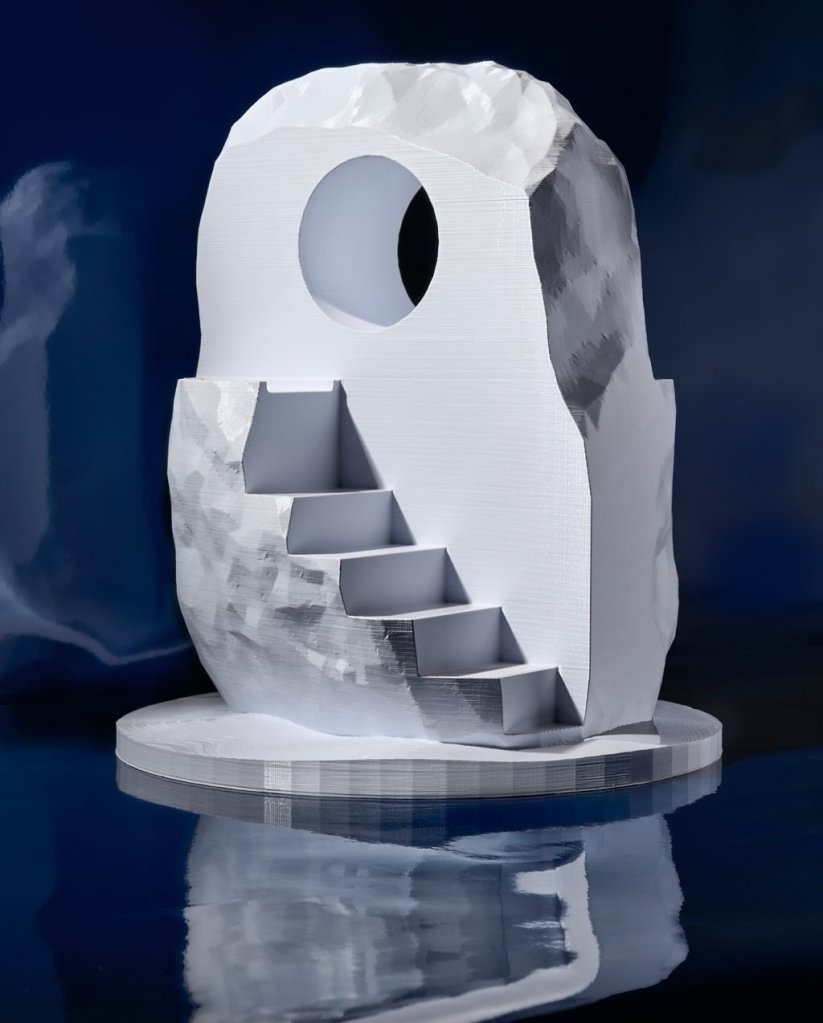
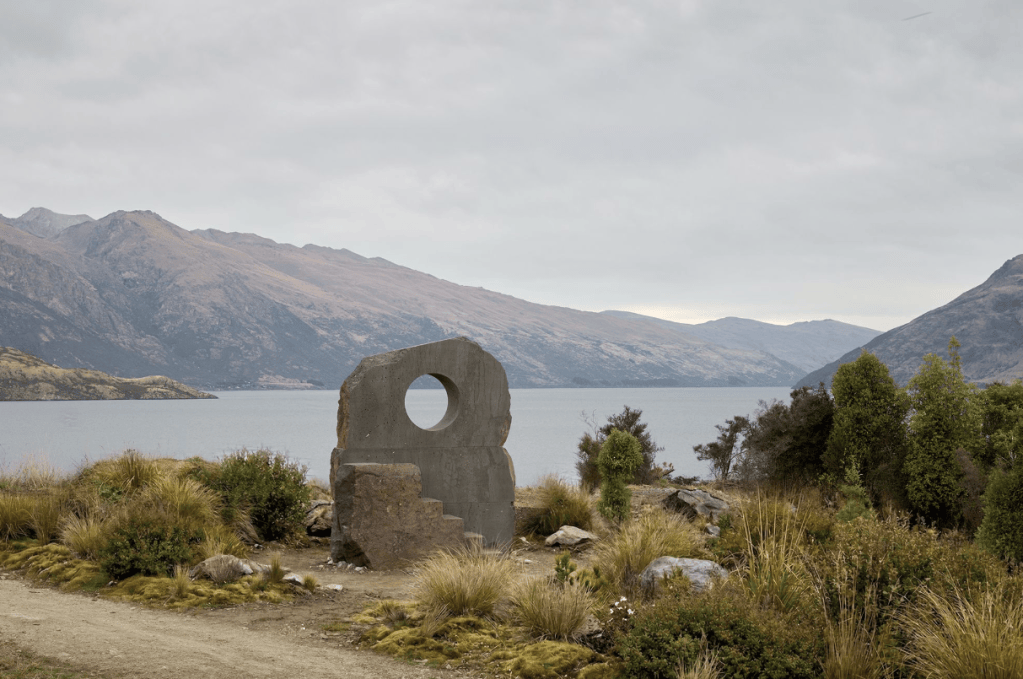
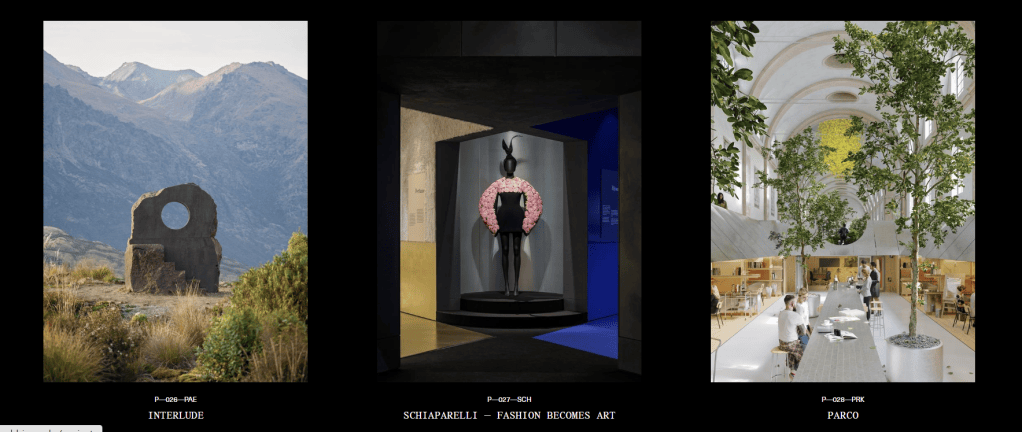
In April 2026, an unusual structure appeared above Lake Whakatipu, near Queenstown on New Zealand’s South Island. At first glance it resembles an ancient stone monument: enormous blocks of dark basalt, a circular opening cut through their upper section, and steps ascending towards the sky. Its silhouette suggests something archaeological, although its precisely worked surfaces reveal a distinctly contemporary sensibility.
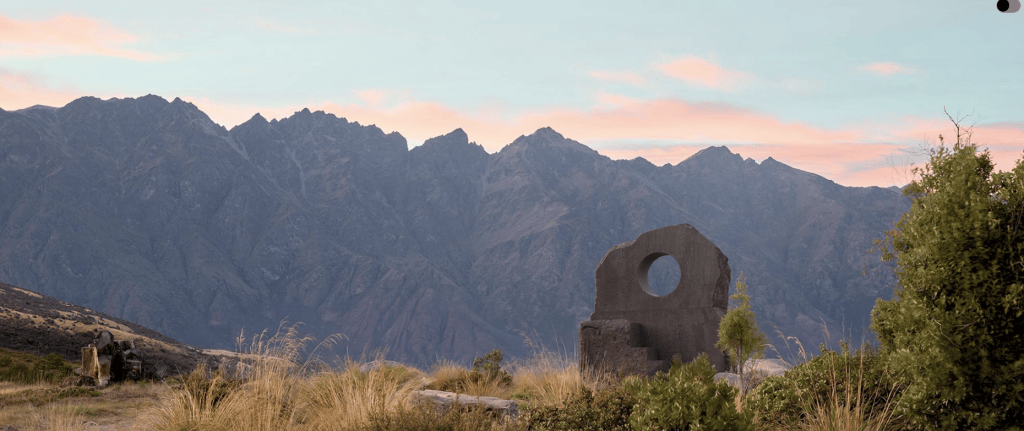
Called Interlude, the installation is the work of London-based architecture and design practice Nebbia, founded by Madhav Kidao and Brando Posocco. It occupies a cliff-edge position in Jardine Park on the Kelvin Peninsula, overlooking the lake and the dramatic mountains of The Remarkables.
The sculpture was unveiled on 28 April 2026. Its purpose is unusually modest for something so monumental: it is designed for two people to sit and talk.
Yet the commission came with an almost unimaginable condition. The structure should endure for a thousand years.
Designing Beyond Our Own Lifetimes
Interlude belongs to Paererewā, an ambitious New Zealand initiative proposing 1,000 public places of reflection, each conceived to last a millennium.
The programme was developed through the involvement of Japanese entrepreneur Hideaki Fukutake and the New Zealand organisation STILL, bringing together art, philanthropy and a distinctly long-term approach to public space.
Its premise is simple but radical. Rather than commissioning objects primarily to be admired, Paererewā seeks to create places that encourage people to stop, rest and engage with their surroundings.
The name itself refers to a threshold or place of exchange, drawing together Māori concepts of movement, time and place.
A thousand years is a particularly provocative design brief. Contemporary architecture is increasingly measured against immediate economic returns, short construction programmes and constantly changing expectations. Even substantial public buildings are frequently altered or replaced within a few generations.
Nebbia’s response was to reconsider what permanence actually means.
The architects recognised that no structure could be guaranteed to remain unchanged across ten centuries, particularly in a region shaped by seismic activity and dramatic geological forces. Instead, they approached longevity as a process of gradual transformation.
Materials would weather, surfaces would become worn, and the surrounding landscape might change beyond recognition. The work needed to accommodate those possibilities rather than deny them.
Five Stones and the Art of Making
The sculpture consists of five substantial pieces of South Island bluestone, a dense basalt quarried near Timaru.
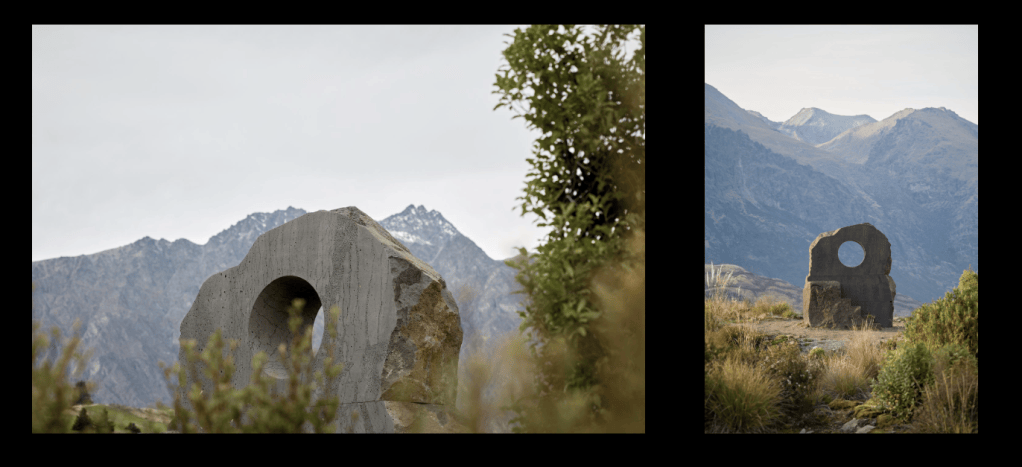
Together they form an approximately 35-tonne structure containing two opposing seats, ascending steps and a circular opening that frames the mountain landscape.
The arrangement derives from the traditional tête-à-tête, a seating form designed to bring two people into conversation. Nebbia has transformed this intimate furniture typology into something approaching monumental architecture.
The material is central to its meaning.
Basalt possesses a geological history extending millions of years, placing human activity within a timescale considerably greater than that of individual lives or even civilisations.
The particular stone used for Interlude originated in volcanic activity associated with Mount Horrible, near Timaru, more than two million years ago.
Its fabrication also illustrates the intersection of traditional craftsmanship and advanced technology.
As documented in Paererewā’s account of the construction, finding suitable stones proved unexpectedly difficult. Most quarried rock in New Zealand is broken down for construction and infrastructure, whereas this project required enormous, largely intact blocks.
The design team used photogrammetry to create digital three-dimensional models of the selected stones. These informed how the separate pieces could be assembled and where cuts were required.
At Parkside Quarries in Ōamaru, computer-controlled equipment was used to cut the steps and other demanding geometries. Local stonemasons carried out further shaping, retaining the contrasting textures of natural rock, fractured edges and worked surfaces.
More than one hundred hours of cutting were required for the stairs alone.
The structure’s apparent simplicity conceals substantial engineering, including internal steel connections and reinforced foundations designed with the local seismic conditions in mind.
What emerges is a carefully considered collaboration between geological material, digital precision and the judgement of experienced craftspeople.
Nebbia: Architecture Between the Ancient and the Future
Nebbia was established in London in 2018 by two architects who had previously worked together at Heatherwick Studio.
Their practice operates across architecture, sculpture, installations and experimental design, with particular attention to material processes and the relationship between objects and human experience.
This approach is evident in earlier projects such as Between Forests and Skies, the striking aluminium pavilion created for the Victoria and Albert Museum in London in 2021.
That installation used thin sheets of aluminium to construct a seemingly delicate architectural environment above water. Its reflective surfaces dissolved the boundaries between built structure, landscape and sky.
The material was subsequently recycled, with part of it transformed into Bardo, Madhav Kidao’s contribution to the British Pavilion at the 2023 Venice Architecture Biennale.
The relationship between destruction and regeneration, permanence and impermanence, has therefore been present in the studio’s work for some time.
Their monumental Babylon installation at Coachella in 2024 explored another aspect of these interests. Its stacked geometric volumes created an imposing structure containing an immersive interior, demonstrating the studio’s fascination with architectural forms that appear simultaneously ancient and futuristic.
At Queenstown, however, the material ambition is stripped back considerably. There is no elaborate visual technology, theatrical lighting or complex internal environment.
Just stone, a landscape and the presence of other people.
A Monument That Requires Participation
One of the most interesting aspects of Interlude is its rejection of the conventional relationship between monument and spectator.
Public sculpture has historically tended to commemorate individuals, represent collective ideals or assert cultural and political authority. Its significance is generally understood through its appearance and symbolism.
Nebbia’s installation instead depends upon use.
The two seats face one another, establishing the possibility of conversation. The circular aperture frames the person opposite against the landscape, transforming an encounter between individuals into the central visual experience of the work.
The structure is not simply something to be observed from a distance. Its architectural meaning develops through occupation.
The project also carries a more personal history.
Supported by the British Council New Zealand and the Pacific and the Edgar family, the installation serves partly as a memorial to the New Zealand philanthropist Sir Eion Edgar.
His familiar greeting, “Another day in paradise”, is commemorated on a bronze plaque beside the sculpture.
It is an unusually sympathetic approach to remembrance. Rather than erecting a figurative monument celebrating an individual, the family helped create a public place in which other lives could continue to unfold.
The design was developed through engagement with local community groups, organisations and iwi, reflecting the significance of the landscape beyond its visual qualities.
Its location matters. Lake Whakatipu is not an empty scenic backdrop but a place with an extensive Māori history and continuing cultural associations.
The challenge for such projects is to create meaningful contemporary interventions without reducing an existing landscape to a picturesque setting for imported architectural ideas.
The Value of Endurance
There is something quietly challenging about Interlude appearing in 2026, when so much cultural production is designed around immediate visibility, rapid consumption and eventual replacement.
Its ambition rests upon an entirely different understanding of value.
The sculpture’s future cannot be predicted. Its surfaces will change, its steps may become hollowed by generations of visitors, and its meaning will undoubtedly evolve as the communities around it change.
The architects have allowed for precisely that uncertainty.
Its significance may ultimately depend less upon the preservation of its original form than upon its continued usefulness as a place where people choose to spend time together.
A thousand years from now, the names of the architects and commissioners may no longer be familiar. The conversations that take place there today will certainly have disappeared from living memory.
But the two seats may still face one another, offering the same simple invitation to whoever arrives next.