
Encounters · No. 8
Snake Skin, Warm Blanket
Sophia Luna Portra makes sculptures from muslin and coffee, sings gothic folk songs about transformation, and thinks about clothes the way a philosopher thinks about the self. She is at the beginning of something.
By Bergotte
A note on this essay: the preceding pieces in this series have been written about figures whose careers are complete or nearly so — artists for whom the retrospective view is available, the biography settled, the influence measurable. This one is different. Sophia Luna Portra is a Danish artist in her thirties, recently graduated from the Royal Danish Academy of Fine Arts, with a body of work still actively forming. The essay that follows is therefore something different in kind: a portrait of a practice in motion, written from the outside of a career that has not yet arrived at its full shape. The thinness of the public record is, in this case, part of the subject.
There is a sculpture made of muslin and coffee called Costume, completed in 2021, that is approximately the height of a standing person. It is not a garment in the conventional sense — you could not wear it, or not easily — but it has the presence of something worn, something inhabited, something that has been close to a body for a long time and carries the record of that proximity in its fabric. The coffee staining gives it the quality of age, of something excavated rather than made. It stands, in photographs from the Charlottenborg Spring Exhibition where it was shown, with a kind of bodily authority — the authority of a thing that knows what it is for, even if what it is for is not immediately legible.
Sophia Luna Portra made it, and she has said, in the compressed and precise language she uses to describe her work, that a costume is one way to travel through time and space: an intimate structure suggesting a direction, an ideal, a dream. She has said that clothes are both surface and substance. She has said they are snake’s skin, warm blankets, intimate architecture — rooms to enter, characters to become. These are not metaphors in the decorative sense. They are propositions, held with the seriousness of someone who has decided that clothing is one of the most philosophically dense objects in human culture, and who intends to spend her working life making that density visible.
A costume is one way to travel through time and space: an intimate structure suggesting a direction, an ideal, a dream. Clothes are both surface and substance.
The Tradition She Enters
To take clothes seriously as art — as the primary material and subject of a sculptural and conceptual practice — is to enter a tradition that is richer and stranger than the fashion world’s version of it tends to suggest. There is Miyake’s philosophical proposition about the body and freedom. There is the Flemish painter’s obsessive attention to the fall of a sleeve, the weight of velvet, the way fabric holds light differently depending on whether it is moving or still. There is the whole history of the still life, in which clothing and textile appear as markers of social position, of time passing, of the vanity of surfaces and the persistence of things. There is Meret Oppenheim’s fur-lined teacup, which is also, in its way, a garment — something designed to be close to the body, made strange. There is the Japanese tradition of the boro textile, the cloth repaired so many times that the repairs become the cloth, that the history of mending becomes the surface.
Portra knows this tradition, or seems to — the references in her work and statements are literary and mythological and art-historical in roughly equal measure, and they sit alongside each other with the ease of someone who has read widely and absorbed rather than catalogued. What she is doing with this inheritance is not synthesis in the academic sense. It is something more like metabolisation: she takes the material in, and what comes out is her own.
Lamia
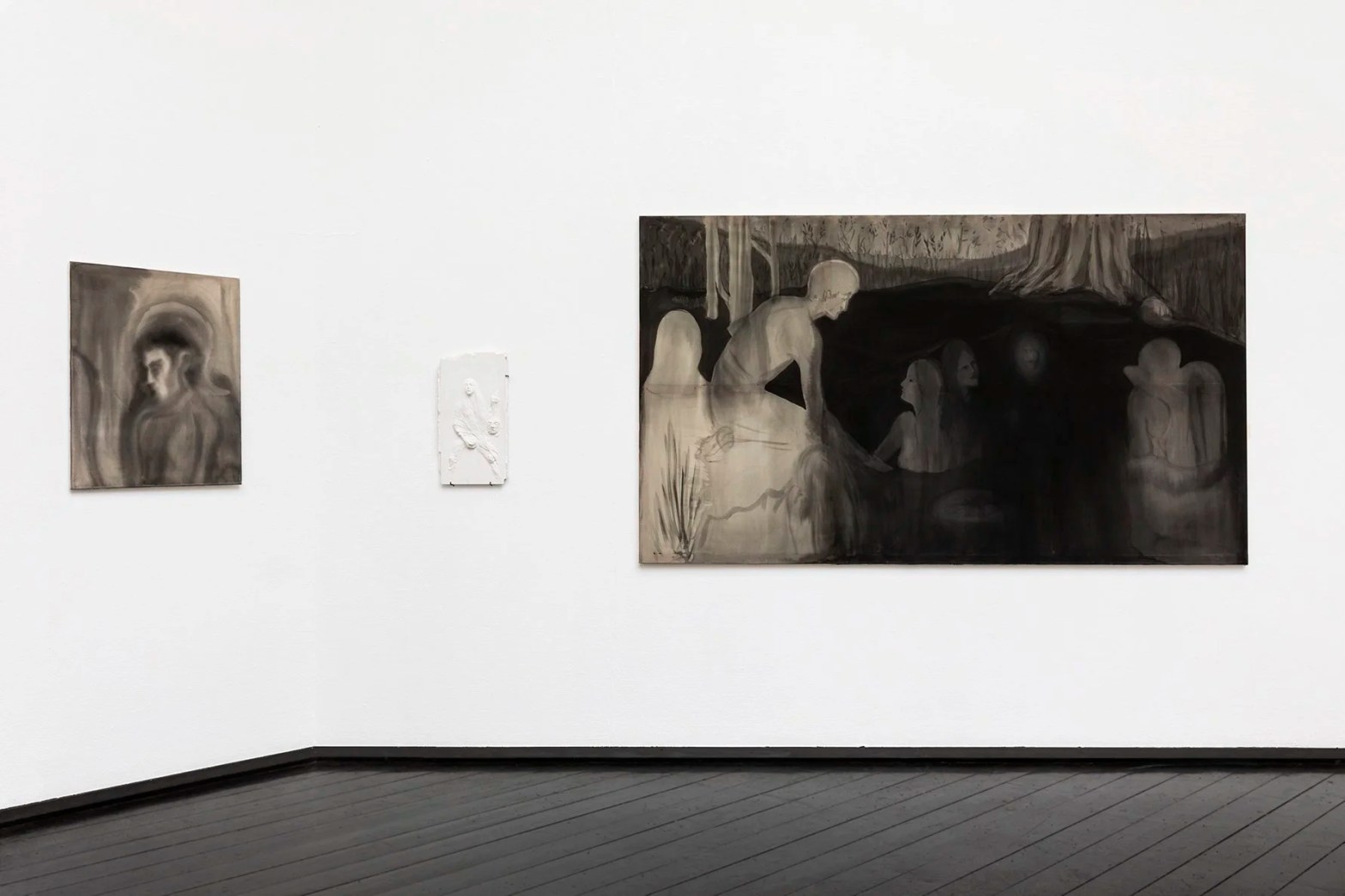
The second work shown at the 2022 Charlottenborg Spring Exhibition was Keats’ Lamia — a sculpture in stout and ink, 182 centimetres tall, taking its name and subject from the 1819 poem by John Keats. Lamia is one of the stranger figures in classical mythology: a woman transformed by the gods into a serpent, who later regains a partial human form and falls in love with a young man named Lycius, only to be exposed at their wedding feast by the philosopher Apollonius, who sees through her beauty to the snake beneath. In Keats’s telling, the revelation destroys her — she vanishes at the moment of being seen truly — and Lycius dies of the shock.
It is a myth about the violence of being accurately perceived. About what happens when the transformation is undone in public. About the particular cruelty of a certain kind of seeing — the seeing that strips rather than holds, that names in order to diminish. Portra’s description of the work is characteristically compressed: the sculpture, she says, caresses the poem. It reaches through time and myth to stand there once again, revealed as snake at your very wedding feast. Time and myth misremembered, the feeling the same.
A myth about the violence of being accurately perceived. About what happens when the transformation is undone in public. About the particular cruelty of a certain kind of seeing.
The choice of Lamia as a subject tells you something important about where Portra’s interests lie. She is not drawn to mythology as decoration, as the source of beautiful stories that can be retold with contemporary materials. She is drawn to it as a technology — as a repository of emotional and psychological structures that persist because they describe something true about human experience, something that has not changed despite the centuries of costume change that separate us from the Greeks and the Romantics. The snake beneath the skin. The transformation that can be undone. The wedding feast that becomes a revelation. These are not ancient concerns. They are this morning’s concerns, wearing older clothes.
Bona Fide
Portra’s practice does not stop at the gallery wall. She is also the vocalist and co-creator of Bona Fide, a musical project made with guitarist Emil Palme that operates — the description is theirs — at the intersection of music and contemporary art. Bona Fide is gothic folk: minimalist, romantic, built from Portra’s voice and Palme’s guitar and a sensibility that holds hands, in their own phrase, with country and goth and doom americana. The songs are about love, loss, and magic. The world they construct is consistent — a worldbuilding project, each song an entry into the same romantic universe — and that world has the quality of Portra’s visual work: ancient and intimate simultaneously, myth wearing everyday clothes.
The project has been shown in galleries and taught as part of the curriculum at the Royal College of Art in London, which is one measure of its seriousness. Another measure is harder to quantify: the quality of a practice that moves fluidly between media — sculpture, textile, voice, guitar — without feeling diluted by that fluidity, without the sense that the artist is spreading themselves thin. The opposite is the case. The different forms illuminate each other. The sculptures are, in some sense, silent songs. The songs are, in some sense, wearable objects. The myth runs through all of it like a thread.
That Certain Light
There is a phrase Portra uses in her artist’s statement that has stayed with me since I first read it. She lists the materials and influences and preoccupations of her practice — history, theory, spectacle, mother’s hands and the revenge dress, the tricks of scenographers — and then she adds: that certain light. Always that certain light.
She does not explain what the light is. She does not need to. Every artist who has ever worked seriously with visual material knows what she means: the quality of illumination that makes an object or a body or a surface suddenly, briefly, more itself than it usually is. The light that the Flemish masters chased in the fall of velvet. The light that Carl Larsson spent forty years trying to catch in the rooms of Sundborn. The light that Goldin saw in the bars at two in the morning and reached for with her camera. It is not a specific light — not a time of day or an angle of sun or a quality of atmosphere. It is a condition of seeing, available only to people who have trained themselves to notice it, and then only intermittently, and always briefly.
That Portra names it as a persistent concern — always that certain light — suggests that she has already found her subject, even if the body of work that will fully realise it is still being made. She is at the beginning of something. The work is already precise enough, strange enough, serious enough, to make that beginning feel like an event worth paying attention to. The Lamia stands at the wedding feast. The costume waits to be entered. The light falls at an angle you cannot quite locate, and the surface it touches is more itself than it was a moment ago.
This is where the series leaves her: not concluded but in motion, which is the only honest place to leave a practice that is still becoming what it is going to be. The canonical artists in the preceding pages had the advantage of completeness — the whole arc visible, the influence measurable, the mistakes absorbed into a larger story of achievement. Portra has instead the more vertiginous condition of the open future, which is both more difficult and, in its way, more interesting. She has already made things worth looking at. She is about to make more of them. What those things will be is not yet known, which is not a problem. It is the whole point.
Works referenced: Costume (2021, muslin and coffee, Charlottenborg Spring Exhibition); Keats’ Lamia (2022, stout and ink, Charlottenborg Spring Exhibition); Solastalgia group exhibition, SOL, Nexø (2023). Bona Fide: YIELD (debut album); DAWN (symphonic work). John Keats, “Lamia” (1819). This essay is part of an ongoing series, Encounters, on artists whose practice cannot be easily categorised.
Discover more from My World of Interiors
Subscribe to get the latest posts sent to your email.

